Week 9 - FVM Literature Review
Finite Volume Method(FVM) :
It is a method for representing and evaluating partial differential equations in the form of algebraic equations. In the finite volume method, volume integrals in a partial differential equation that contain a divergence term are converted to surface integrals, using the divergence theorem.
Where as,
Finite Difference method (FDM):
It is an approximate method for solving partial differential equations. It is used to solve the problems like linear and non-linear, time independent and dependent problems. This method can be applied to problems with different boundary shapes, different kinds of boundary conditions, and for a region containing a number of different materials.
Difference between FDM and FVM :
| Finite Difference method | Finite Volume method |
|
The PDE is written in a form which can be solved for a given point in the domain (nodes). The computational domain is usually divided into hexahedral cells (the grid) The discretization results in a system of equation of the variable at nodal points |
The PDE is written in a form which can be solved for a given finite volume (or cell). The computational domain is discretized into finite volumes and then for every volume The resulting system of equations usually involves fluxes of the conserved variable |
Let us consider one dimensional linear heat conduction equation to understand interpolation schemes and flux limiters
`d/dx(k (dT)/dx) + S =0`
Where,
S is the source term that denotes the heat generation part of the system.
k is the thermal conductivity.
T denotes the temperature.
Need for interpolation schemes in FVM:
Interpolation schemes are used to transform cell-centre quantities to face centres. The operation is used in many of the finite volume calculations, e.g. for the calculation of gradient, divergence, and Laplacian terms.
Interpolation is a type of estimation, a method of constructing new data points within the range of a discrete set of known data points.
In order to discrretize the equation consider the a control volume C as shown in the figure below and the heat flux through that volume depends on the heat inflow (left boundary) and the heat outflow (right boundary),
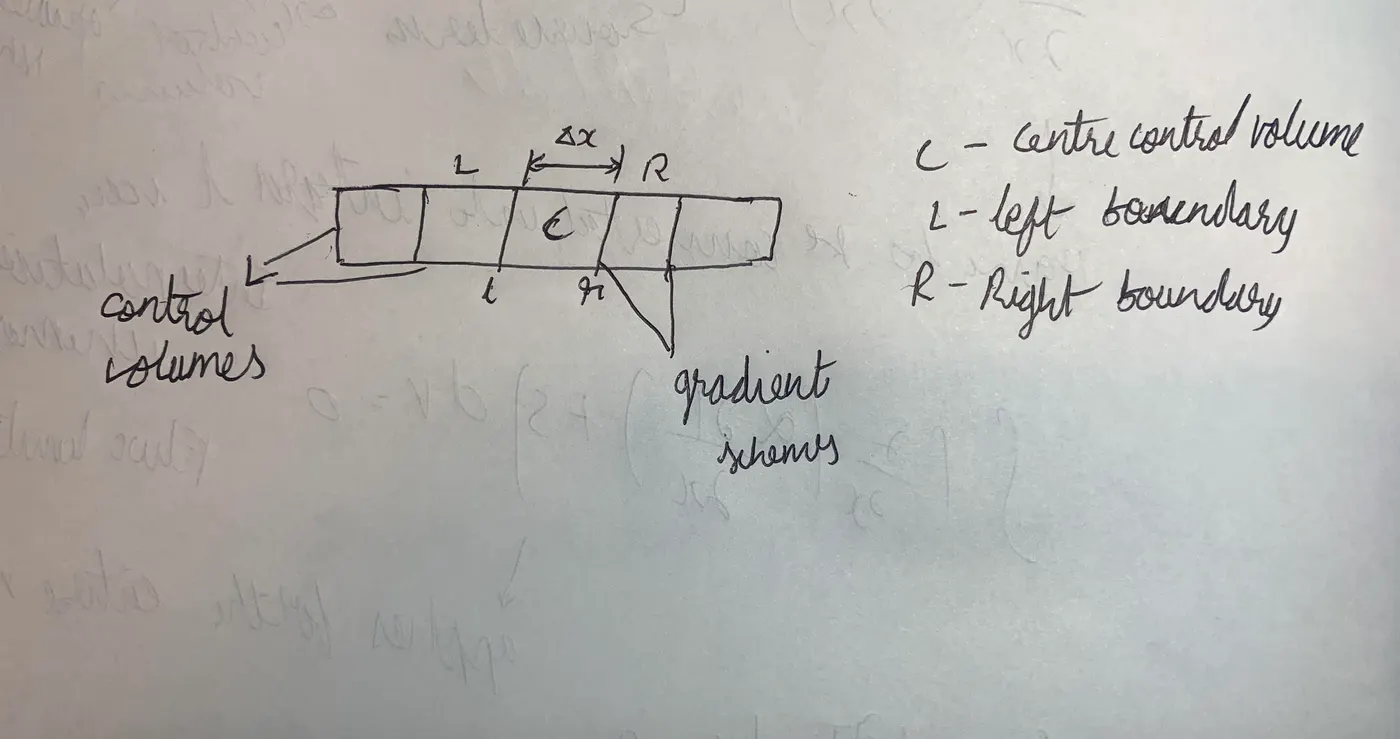
Integrating the control volume from left to right we get the equation written in its discretized form,
`(Kl (Tl - Tc)/(del x)) - (Kr (Tc - Tr)/(del x)) + overlineS dv = 0``
where `alpha` is the function of temperature
In order to find values of dT/dx in between the boundaries, the discretized form of equation is interpolated as,
`(Kl Al (Tl - Tc)/(del x)) - (Kr Ar (Tc - Tr)/(del x)) + Su + ScTc = 0`
The above equation can be said it is linearized or liner interpolation scheme is applied to the discretized form to obtain the value of dT/dx
Need for flux limiters in FVM:
Flux limiters are used in high resolution schemes – numerical schemes used to solve problems in fluid dynamics.The main idea behind the construction of flux limiter schemes is to limit the spatial derivatives to realistic values.
The image below shows how the flux limiters work for diffrent forms:
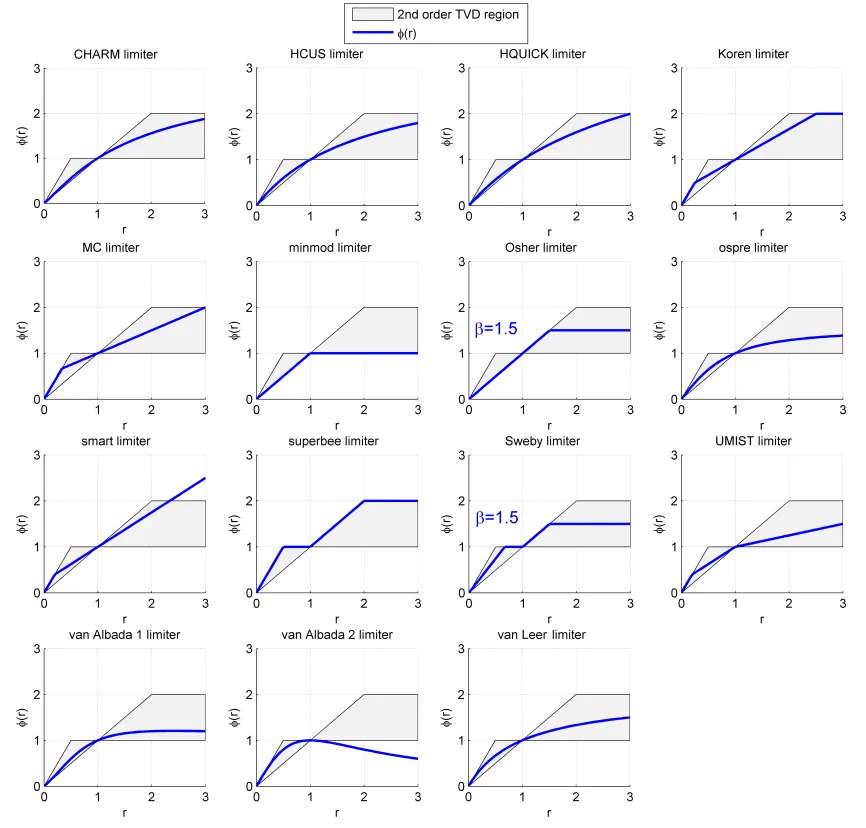
It can be observed that after applying flux limiters the solution becomes much smoother as in close to realistic physical form.