Week 9 - FVM Literature Review
FVM Literature Review
- OBJECTIVE:
What is Finite Volume Method(FVM), what are the major differences between FDM & FVM. Also, the need for interpolation schemes and flux limiters in FVM ?
- Finite Volume Method :-
- The finite volume method (FVM) is a method for representing and evaluating partial differential equation in the form of algebraic equations. Similar to the finite difference method (FDM) or finite element method (FEM) values are calculated at discrete places on a meshed geometry.
- One important features of finite volume schemes is their conservation properties. Since they are based on applying conservation principles over each small control volume, global conservation is also ensured.
- "Finite Volume" refers to the small volume surrounding each point on a mesh means the grid points where variables are stored are typically defined as being at the center of each control volume.
- The methods starts by dividing the flow domain into a small control volumes.
- In the finite volume method, volume integrals in a partial differential equation that contains a divergence terms are converted to the surface integrals, using the divergence theorem. These terms are then evaluated as fluxes at the surfaces of each finite volume. Because the flux entering a given volume is identical to that leaving the adjacent volume, these methods are conservative.
- The advantage of the finite volume method is that it is easily formulated to allow for unstructured meshes, and this method is used in many computational fluid dynamics package.
- Difference between FDM & FVM :-
- A finite differnce method (FDM) discretization is based upon the differential form of the PDE to be solved . Each derivative is replied with an approximate difference formula that can generally derived from a Taylor Series expansion. The computational domain is usually divided into hexahedral cells (grid) and the solution will be obtained at each nodal point.
- A finite volume method (FVM) discretization is based upon an integral form of PDE to be solved (e.g. conservation of mass, momentum, or energy). The PDE is written in a form that can be solved for a given finite volume of cells. The computational domain is discretized into the finite volume and then for every volume the governing equations are solved. The resultingsystem of the equation usually involves fluxes of the conserved variables, and thus the calculation of fluxes is very important in FVM.
- The basic advantage of this method over FDM is it does not require the use of structured grids, and the effort to convert the given mesh into a structured numerical grid internally is completly avoided.
- Interpolation schemes in Finite Volume Method :-
- Interpolation is a process to estimate the values at the unknown points by using the points with known value and sample points on either side of the known points. In FVM interpolation schemes are used to find values of volume integration required at the points other than nodes.
- The different interpolation schemes are :-
- Upwind interpolation scheme (UDS)
- Linear interpolation scheme
- Quadratic Upwind Interpolation Scheme
- Hybrid Interpolation Scheme
- Total variation Diminishing Scheme
- Essentially non-oscillatory interpolation scheme
- Upwind Interpolation Scheme :-
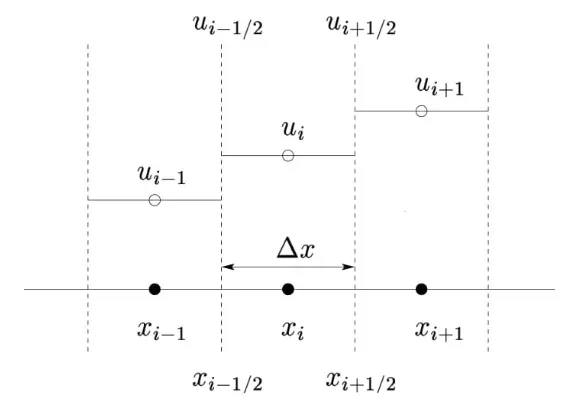
The upwind interpolation scheme (UDS) for approximately the value f at the east face of a control volume is given by :
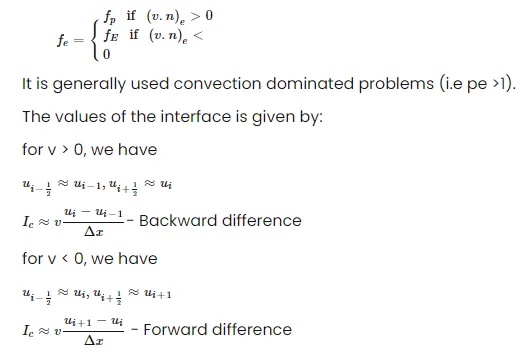
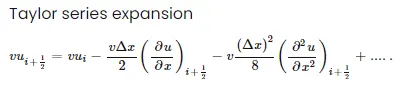
a first order accurate flux approximation, the leading truncation error resembles a difference flux
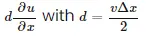 being numerical diffusion coefficient.
- Linear Interpolation :-
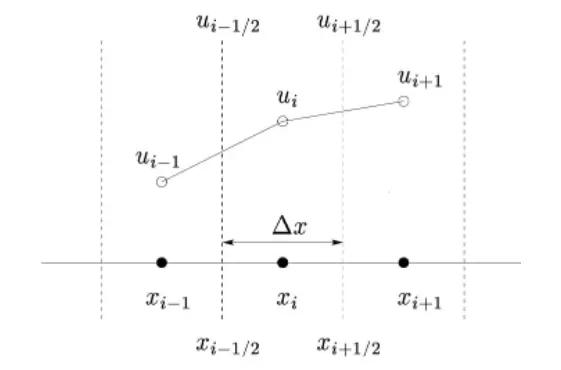
To approximate the values of variables at CV full center by linear interpolation of the values at two nearest computational nodes. This is equivalent to the use of the central difference scheme of first order derivative, and hence it is known as central difference scheme. This also leads to very simple approximation of evaluation of gradients required for evaluation of diffusive fluxes. This relation is given as follows :-
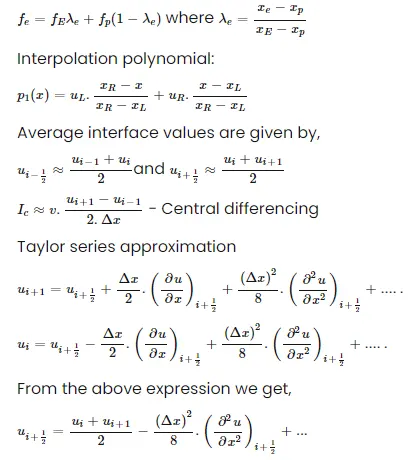
The approximation is second order accurate . It is the simplest and most widely used interpolation for evaluation of greater required for evaluation of diffussive fluxes.
- Quadratic Unwind Interpolation Scheme (QUICK) :-
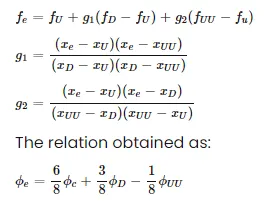
This approximates the values of variable at CV face center by quadratic interpolation of the values at three nearest computational nodes (one downstream node D and two upstreams nodes, U). It is third order accurate for both uniform and non-uniform grids.
- Hybrid Interpolation Scheme :-
It is the blend of CDS and UDS scheme, based on the Peclet number.

- Total Variation Diminishing Scheme :-
- Flux Limiter :-
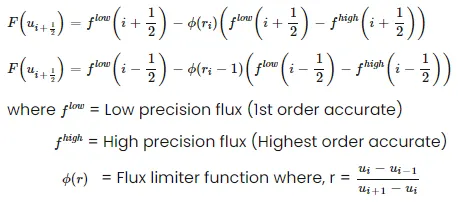
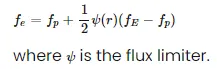
For convective fluid flow, it is observed that the low order schemes are usually stable but quite dissipative in nature around the points of discontinuity or shocks while the higher order schemes are unstable in nature and show oscillations in the vicinity of discontinuity or shocks. Highly accurate and oscillation free schemes are known as Highly Resolution Scheme.
Flux Limiters functions are used to fine tune the higher order and lower order scheme in such a way that the resulting scheme gives a higher order accuracy in the vicinity of shocks and discontinuties. For such a scheme TVD is employed.