Week 9 - FVM Literature Review
Finite Volume Method:
- The finite volume method is a method for representing and evaluating partial differential equations in the form of algebraic equations. In the finite volume method, volume integrals in a partial differential equation that contain a divergence term are converted to surface integrals, using the divergence theorem.
Finite Difference Method:
- The finite-difference method is the most direct approach to discretizing partial differential equations into a system of linear equation, that can be solved by matrix algebra equations.
Major Difference between FVM and FDM:
| Finite Volume Method | Finite Difference Method |
|
|
The Importance of Interpolation Schemes in FVM
Interpolation Schemes used in Finite Volume Method:
- Upwind Interpolation Scheme(UDS).
- Linear Interpolation Scheme(LDS).
- Total Variation Diminishing Scheme(TVDS).
- Quadratic Upwind Interpolation Scheme(QUICK).
- Hybrid Interpolation Scheme(HDS).
- Essentially Non-Oscillatory interpolation Scheme (EDS).
- Interpolation Scheme:
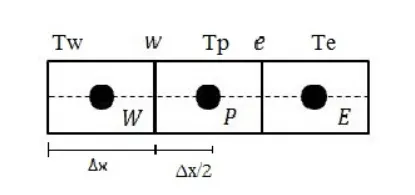
The upwind interpolation UDS for approximating the value of a variable f at the east face of a control volume is given by
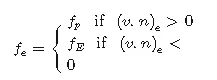
The Upwind differencing Interpolation Scheme which is used for first order accuracy of the FVM, the upwind differencing scheme takes in account the flow direction when determining the value at a cell face.The convected value of `phi`at cell face.
So we have take 1D linear heat conduction equation.
Its an example of considering heat flow from right face to left face in block so it can be descritise of the block by using some interpolation method.
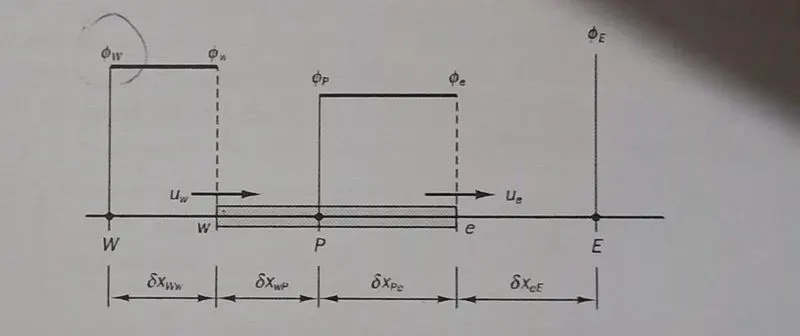
considering as a governing equation
`del/(delx)(alpha.(delT)/(delx))+S=0`----------(A)
Where S is the source term.
we have considering as a small amount of volume to descrities the block in 1D condition show in above.
to integrate the 1D governing equation by using volume
`int(del/(delx).(alpha.(delT)/(delx))+S).dv=0`---------(B)
equation B is the integral form of governing equation.
lets,
`intdel/(delx)(alpha.(delT)/(delx)).dv+intS.dv=0`
so dv is the small amount volume lets consider as a its area (A.dx)
`int_w^edel/(delx).(alpha.(delT)/(delx).Adx)+intS.dv=0`
lets we use the west and east face as a limiter for the flow of volume integration
`[alphaA(delT)/(delx)]_w^e+barSdv=0`
`alpha_eA.(delT)/(delx_e)-alpha_wA.(delT)/(delx_w)+barSdv=0`
`alphaA[(T_e-T_p)/(Deltax)]-alphaA[(T_p-T_w)/(Deltax)]+barSdv=0`---------------(C)
so 1D equation of 'C' shows the heat flux enter in block to heat flux out from block so what amout of energy are absorb by the block which are the addition of source term is equal to zero.
That means the amount of heat conserved in a volume to remove the heat and plus source term is equal to zero.
so we have use to find out the governing equation by descritisation of interpolation griding schemes we most use interpolation scheme is
- Quadratic Upwind Interpolation Scheme(QUICK).
It is a Quadratic upstream interpolation for convective kinetics (QUICK) scheme of leonard (1979)uses a three-point upstream-weighted quadratic interpolation for cell face values.
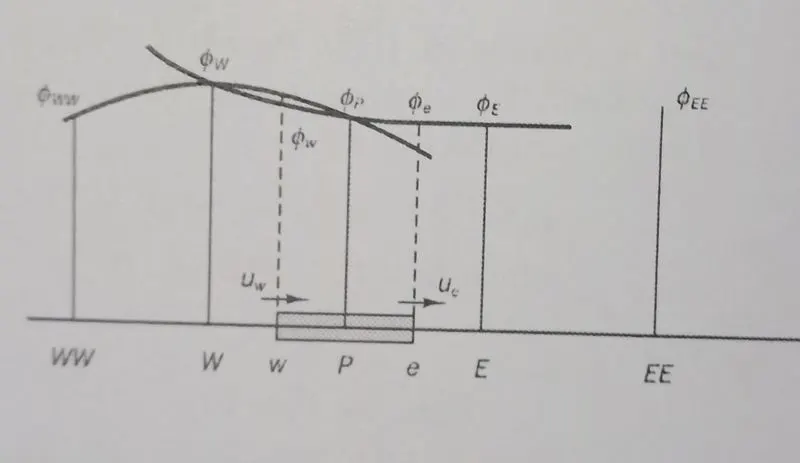
It can be shown that for a uniform grid the value of `phi`at the cell face between two bracketing nodes `i and i-1`and upstream node `i-2`is given by the following formula.
`phi_(face)= 6/8.phi_(i-1)+3/8.phi_i-1/8.phi_(i-2)-----A`
when `u_w>0,`the bracketing nodes for the west face w are W and P , the upsteame node is WW shown in fig
`phi_w=6/8phi_W+3/8phi_P-1/8phi_(WW)-------B`
when `u_e>0`, the bracketing nodes for the east face e &P and E, the upstreame node is W, So
`phi_e=6/8phi_p+3/8phi_E-1/8phi_W-------c`
The diffusion terms may be avaluated by using the gradient of the approximating parabola. It is interesting to note that on a uniform grid. It is same as the central differencing for diffusion, the slope of the chord between two points on a parabola is equal to the slope of tangent to the parabola at its midpoint. so one dimensional convection diffusion equation written in the form of,
`[F_e(6/8phi_p+3/8phi_E-1/8phi_W)-F_w(6/8phi_W+3/8phi_p-1/8phi_(WW))]=D_e(phi_E-phi_p)-D_w(phi_p-phi_W)`
for rearranging the equation and write in standard form of discritised equation is
`a_pphi_p=a_Wphi_W+a_Ephi_E+a_(WW)phi_(WW)`
The QUICK scheme for one-dimensional convection–diffusion problem is
`a_Pphi_P = a_Wphi_W + a_Ephi_E + a_(WW) phi_(WW)+ a_(E E)phi_( E E)`----(D)
with central coefficient is
`a_P = a_W + a_E + a_(WW) + a_(E E) + (F_e − F_w)`-----------(E)`
`his is the QUICK interpolation schemes used in descritisation of the FVM&nbsi`
Conclusion:
1) The Interpolation method used for the descritisation in FVM which give the finest result for analysis of system.
2)Any critical system can be descritise by using the Interpolation method.