Week 9 - FVM Literature Review
1. What is finite volume method --
FVM is computational discritization method and it is used inCFD and it is based on control volume formulation of analytical fluid dynamics. in FVM we divide the domain into number of control volume where intrested or calculated variables are in the centre of control volume and then integrate the differential form of governing equation over each control volume in a domain because if we consider control volumne valid in one variable so it will be valid entire domain. FVM satisfy conversation results or quantities like mass, momentum, energy.
2. Difference between FVM & FDM--
- FVM is similar to FDM but the FVM integrate differential differential equation over the control volume and discretizing domain. FVM accuracy is based on order of polynomial used.
- in FVM the grid is linear and aligned so that all grid point in straight line and the properties are consider to concentrated at single point
- the properties are valid over an elemental area and properties are assumed at area centre point.
- FVM computes solution at each control volume wheres FDM computes solution at each point.
- FVM converse the result better than FDM.
3. steps to solve FVM--
find out integer for of governing equation
apply gauss divergence theorem
used suitable method for calculating flux term
4.interpolation scheme--
- it is used to transform cell centre quantities of face centre
- example-the calculation of gradient,divergence and laplacian term
5. Types of interpolation scheme--
upwind interpolation scheme(USD)
consider the following one-dimensional linear advection equation
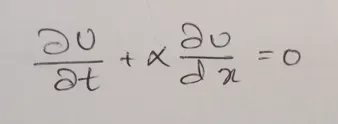
which describes a wave propagating along the x-axis with alpha velocity. consider a typical gird point in the domain. in a ond-dimensional domain , there are only two direction associated with point i- left (towards negative infinity) and right (towards positive infinity). if alpha is positive, the travelling wave solution of the equation above propagates towards the left, the left side is called downwind side and right side is the upwind side. if the finite difference scheme for the spatial deritive contains more points in the upwind side, the scheme is called an upwind scheme
linar interpolation scheme (CDS)--
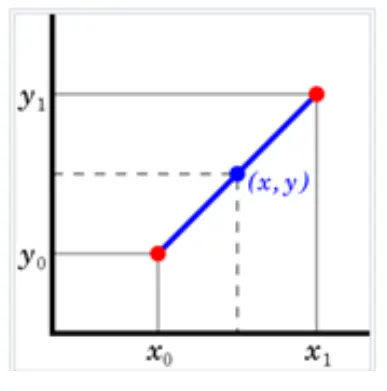
linear interpolation is a simple technique used to estimate unknown values that lie between known values. the consepts of linar interpolation relies on the assumption that rate of changes betwween the known values is constant and the calculate this value from simple slope formula.
Quadratic upwind interpolation scheme--
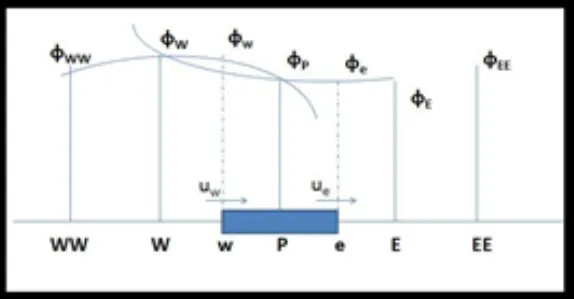
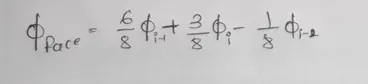
for the one-dimensional domain shown in the figure the `phi`value at a control volume face is approximated using three-point quadratic function passing through the two bracketing or surrounding nodes and one other node on upstream side. in the figure , in order to calculate the value of the properties at the face , we should have three nodes i.e two bracketing or surroundig nodes and one upstream node.
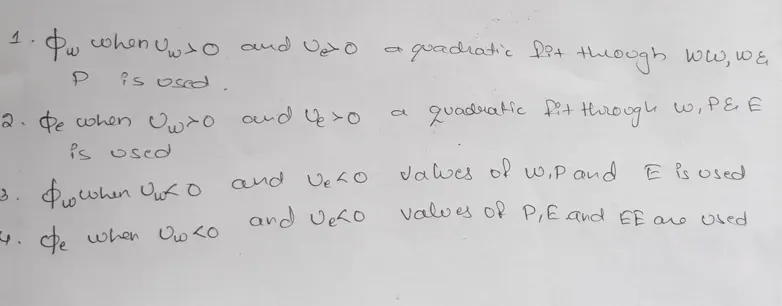
let the two bracketing nodes ne i and i-1 and upstream node i-2 then for a uniform grid the value of`varphi`at the cell face between the three nodes is given by:
hybrid interpolation scheme--
it is combination odCDS(linear interpolation ) and UDS(upwind interpolation)
6. Gradient scheme:
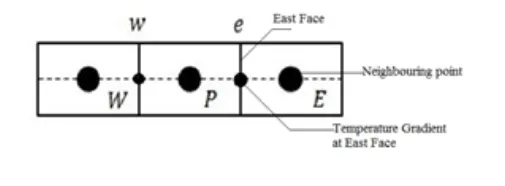
in a gradient scheme finding the temperature at east face we get information from neighbouring point E
7. Flux limiter in FVM--
they are used high resolution scheme such as MUSCL scheme to avoid the surpous osciallation that would otherwise occur with high order spatial discretization scheme due to shok discontinuities or sharp changes in the solution domain. Flux limiter also refered as slope limiter
8.example-linear heat conduction equation--
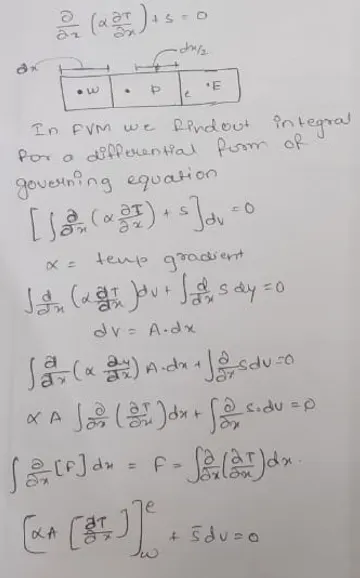
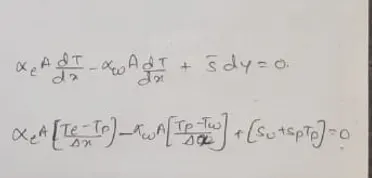
from the above equation we can say that , finding the temperature at east face e we get information from neighbouring point E called as gradient scheme and if we can find values at unknown location we need or require interpolation scheme.