Week 9 - FVM Literature Review
OBJECTIVE :TO HAVE A OVER VIEW OF FINITE VOLUME METHODS ,INTERPOLATION SCHEMES USED FOR ESTIMATION OF PROPERTIES AT CONTORL VOLUME FACES AND FLUX LIMITER
PART 1
FINITE DIFFERENCE METHOD
- Define mesh or nodal points in computational domain
- Develop the unknown funtions as a taylor series expansion around the values at mesh point
- Governing differential equations are repalced by the finite diffrence approximation accordinghly for diferent derivatives.
- In finite difference method each of these three steps are defined in more general formulation there are two ways of expressing 1 explicit method 2. implicit method
LIMITATIONS
- For complex geometeries finite difference method becomes tedious
- in general governing equations are repalced by taylor series expansion f(x+h)=f(x)+h f'(x)+(h^2/2) f''(x) if h -> 0 then approximation is accurate but if h -> finite number then the error is significant.if h is small number we tend to neglect higher order terms but in case if multipalyer f'' is finite then the product of f'' and h becomes significant(provided h is finite number) .example if f(x)=e^x ,f''=e^x
- finite difference method does not have any inbuilt conservativeness,boundedness and transprotiveness
PART 2
FINITE VOLUME METHOD
In finite volume method, we divide the domain into number of control volumes,we will mostly use integral form of the governing equation, and this is applied to each control volume.
- finite volume method is sutable for complex geometries
- integral form of the governing equations is used
- conservation equation for any generic variable phi is given as

- surface and volume integrals are approximated using appropriate formulae
- integral form of the governing equations is applied to each control volume also to solution domain as a whole
- if one sums all equations surface integral cancels out at all inner control volumes and so global conservation equation are recovered.hence finite volume method ensures conservation laws are satisfied
- accuracy is improve by choosing appropriate quadrature formulae.
FINITE VOLUME FORMULATION 1D HEAT CONDUCTION EQUATION
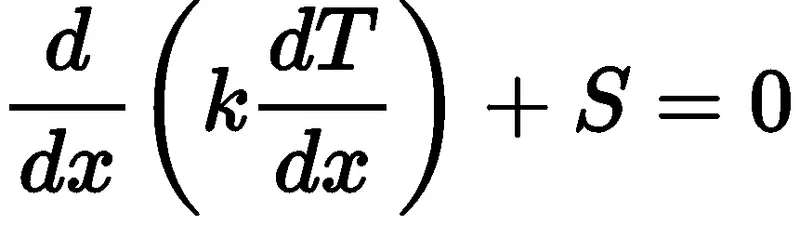
1D heat diffusion equation
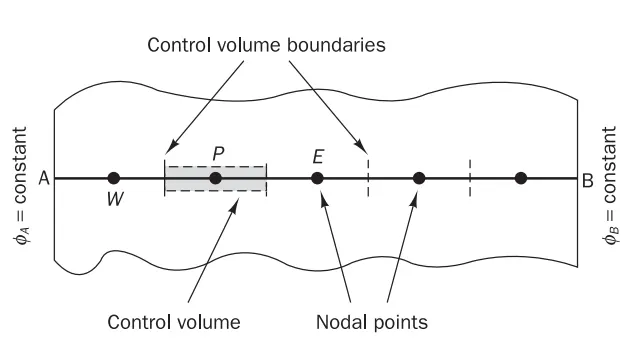
GRID GENERATION
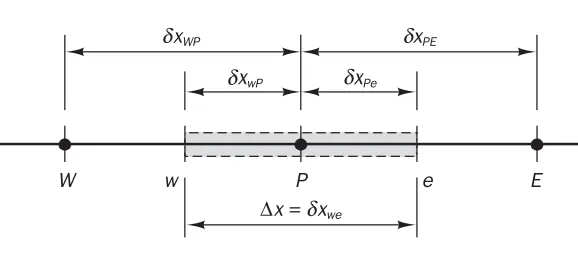
Intergration






TYPES OF INTERPOLATION SCHEMES
1. CENTRAL APPROXIMATION SCHEME
In general the flow properties of one node is approximated by using neighbouring node flow properties,so in central differencing scheme is unable to identify the direction of flow becaues it takes information form both left side node and right side node.
For heat diffusion from W to P the central differencing scheme assumes equal influencing from either side

centeral differencing is 2nd order accurate but does not reflect convection
2. PURE UPWIND SCHEME
The value of phi at the faces are determined by the nature of the convective velocity . if flow is form left to right then it takes the information from w node .but if the flow is form right to left it takes the information of flow properties from node E
in this case ϕw=ϕp,ϕe=ϕp
upwind is 1 st order accurate but reflects the convection of the flow
3. HYBRID SCHEME
One can switch between the central differenicing scheme and pure upwind scheme based on some weightage
combingh both central differenicing scheme and pure upwind scheme both method we can calculate heat flux at a given face of control volume by giving equal weightage. to do so we define non dimentional number called peclet number
peclet number = convective flux / diffusive flux
pe is evaluvated for each cell face then apply conditions for evaluvations
if pe < 2 centeral differencing scheme is used
if pe >2 then pure upwind scheme is used
4. POWER LAW SCHEME
In this method in the entire flow domain based on the situation we can switch beteween hybrid central differencing or upwind schemes and pure upwind scheme
in this scheme diffusion is set to zero if pe exceeds 10 for this condition only upwind scheme is used
5. QUADRATIC UPWIND SCHEME
In this scheme we use information of flow properties form 3 points that is it take information of properties from w and ww for the evaluvation of properties at p. qudratic curve is a fit through three node it uses three nodes one on each side and one extra node in the direction of the flow
it is upwind-biased or upwind weighted scheme and transprotive properties is ensured
it is 3rd order accurate scheme
numerical or false diffusion is very small
it has greater accuracy than central differencing scheme,upwind scheme,Hybrid sscheme
FLUX LIMITERS
Flux limiters are used in high resolution scemes ,often flux limiters are also referred as slop limiters because they both have the same mathamatical form and both have the effect of limiting the solution gradient near shocks of discotinuities. in general the term flux limiter is used when the kimiter acts on system fluxes and slop limiter is used when the limiter acts on the system states like temperature ,pressure and velocity
the main purpose of flux limiter are to set strict upper and lower bound for estimation of flow properties at the faces of control volumes
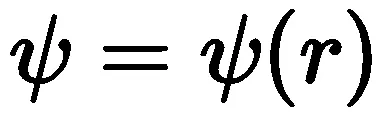
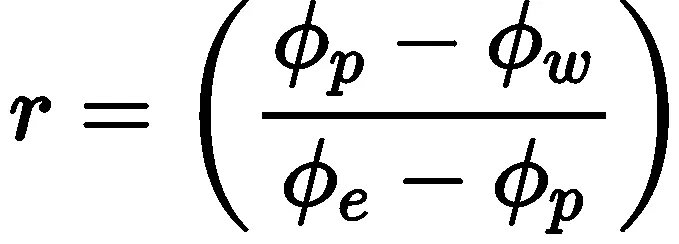

for the UPWIND scheme ψ(r)=0
for the central differencing scheme ψ(r)=1
for the linear upwind scheme ψ(r)=r
for quick scheme ψ(r)=(3+r)/4
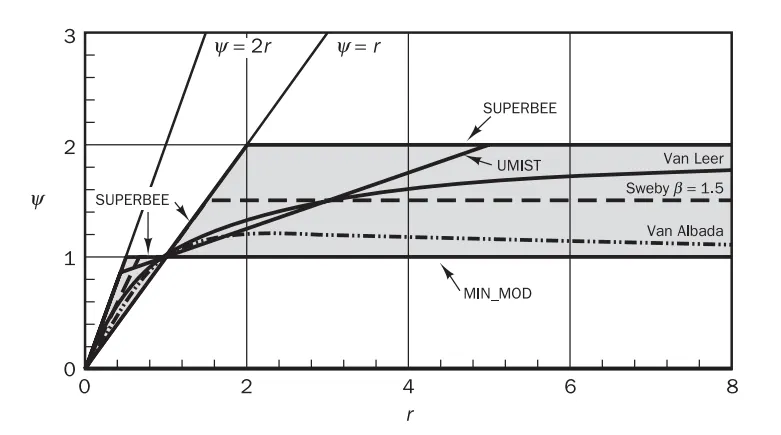
all the limiter functions stay inside the TVD region an dpass through the point(1,1) on the r-ψ diagram so they all represent secound order accurate discretisation schemes van leer and van albadas limiters are smooth functions whereas all the others are piecewise linera expressinons