Week 9 Challenge
EMS (Energy Management System)
The goal of energy management is to optimize the performance and to reduce the fuel consumption. In EV which operates with Fuel cell, Battery and Ultracapacitor, during running the EMS monitors the power demand by the vehicle in real time and has to properly share the power between each energy source
- to support varying power demands
- to make energy source to operate near rated condition
- to maximize the fuel efficiency of fuel cell
- to protect them from overdischarging and overcharging
- to maintain the SoC of Battery and UC.
- to maintain healthy charging and discharging for battery and UC.
The EMS uses several algorithms like rule based, optimisation base, etc. Each one of it have advantages and complexity.
An EMS is build in this project using priority based algorithm, that is the discharging priority is given first to the energy supplying device having lowest discharge capability (ie, kW/s). In this the priority is first for FC(Fuel cell) the Battery and last UC (Ultracapacitor).
The algorithm for priority based EMS is given below
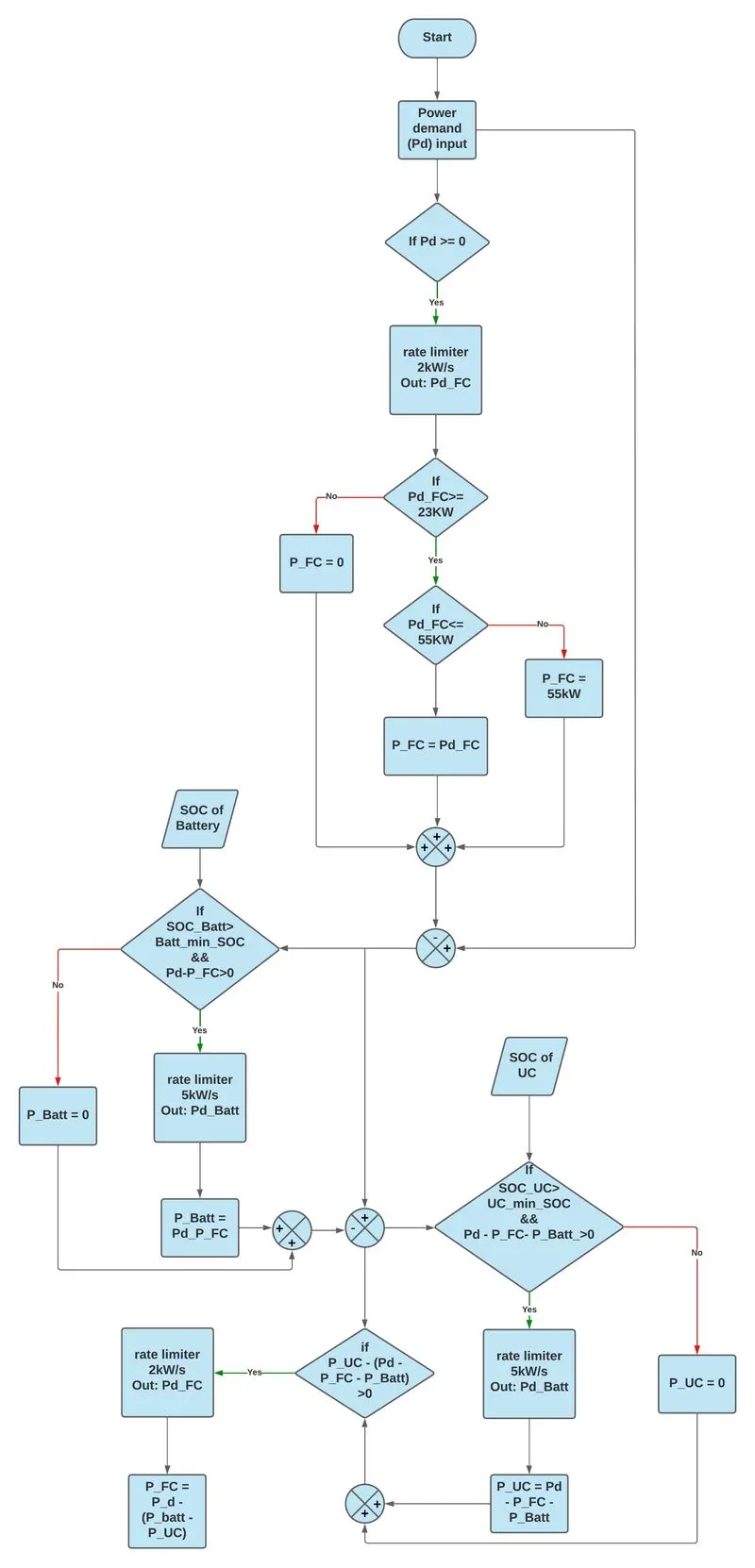
The above algorithm is modelled using Simulink as shown below
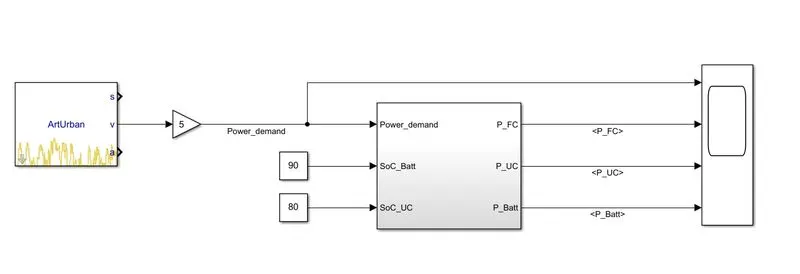
the algorithm in simulink

SIMULATION AND RESULT:
The initial SoC of Battery and UC are 90% and 80% respectively.
Other datas are collected from the init file attached with this project.
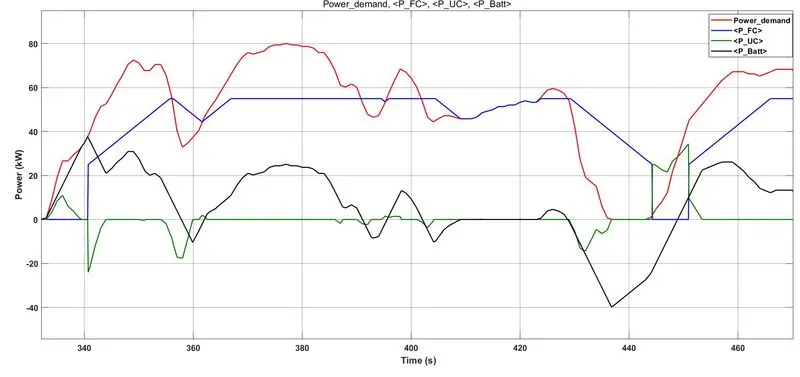
The result for a given power demand is as shown below
OBSERVATION:
- A part of scope is analysed for the result.
- The initial power demand rate is high, during this the UC and Battery response to it as it is below 25kW, the battery disspiate power at max rate of 5kW/s, the rest is supported by the UC at high rate because UC has highest power density.
- When the power demand crosses 25kW, the FC starts to support the power demand. As the FC starts to support the UC gets charged because demand power is less than supply power. But during this the battery is also supporting the power demand as the rate of power demand is greater than FC (2kW/s).
- At 365s, the power demand increase above 55kW, now the power is supported by FC (max 55kW)+Battery and UC (when there is rise in power demand).
- At 430s, the power demand is lesser than FC power supply (FC can't be suddenly turns to zero) during this extra power is used to charge the battery.
- The power demand is supported efficiently by this three power supply devices without any lag, And this EMS helps in it with helathy operating conditions for all devices.
CONCLUSION:
An EMS (Energy Management System) for an HEV is modelled and working of the MES is analysed. The EMS works as per requirement and the power demand is met at all point when all three devices are active. The EMS also helped in maintaining the discharge and charge limit under helathy condition.