Week-3 Challenge: ADVISOR Tool
1. EV_defaults_in
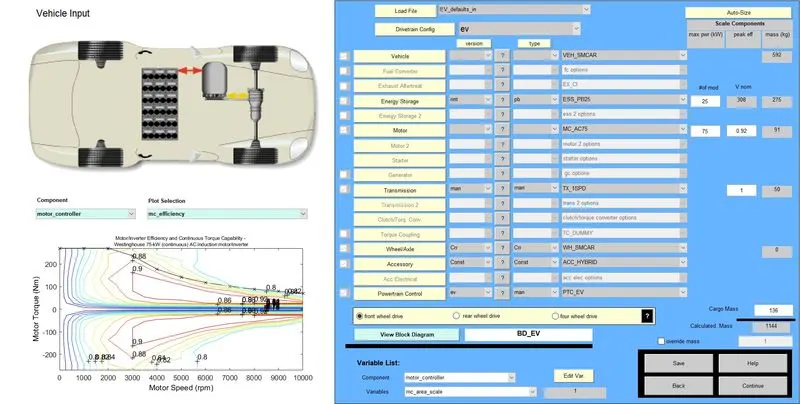
The following system "EV_defaults_in" is considered, in default condition the cargo wieght is 136kg.
In next step we consider drive cycle for the vehicle, the drive cycle is taken for the study is "CYC_FTP"
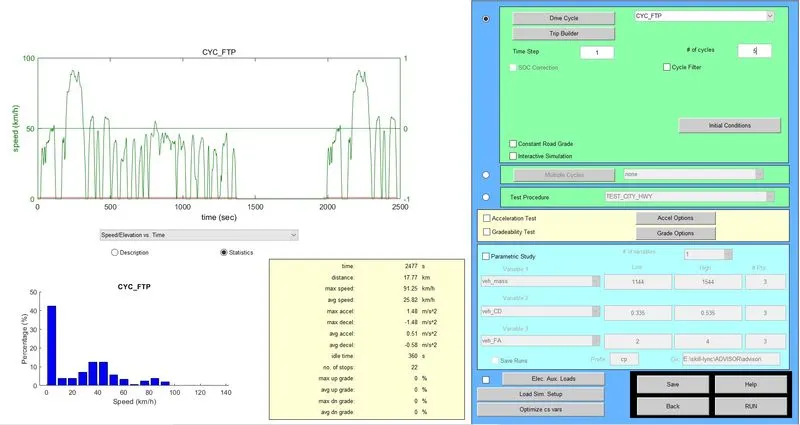
As the vehicle completly travelled the cycle 1 without completly draining the battery, so the no. of cycle is increased to 5, for checking the range of the EV. By changing the mass of the vehicle studies are made
CASE 1: Default condition Cargo weight = 136kg
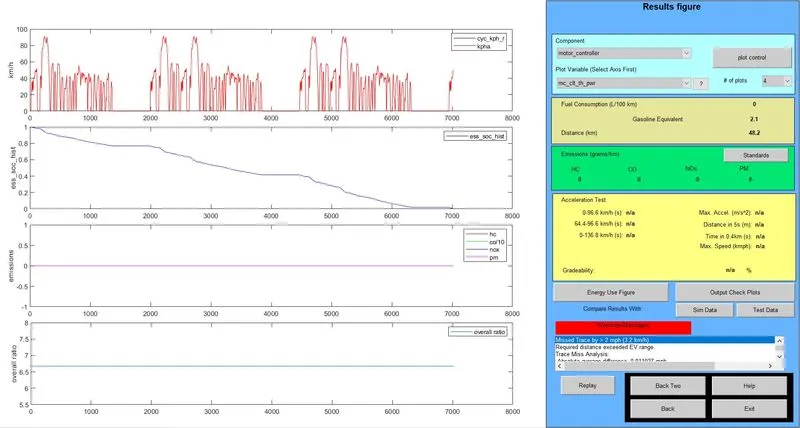
In the above result the EV has travelled for 48.2km with cyc_ftp drive cycle (EV now in 4th cycle). This is for EV having the cargo weight of 136kg.
CASE 2: Increased cargo weight = 500kg
Considering the cargo weight has increased to 500kg, now when we calculate the range of EV for the cyc-ftp cycle, we get,
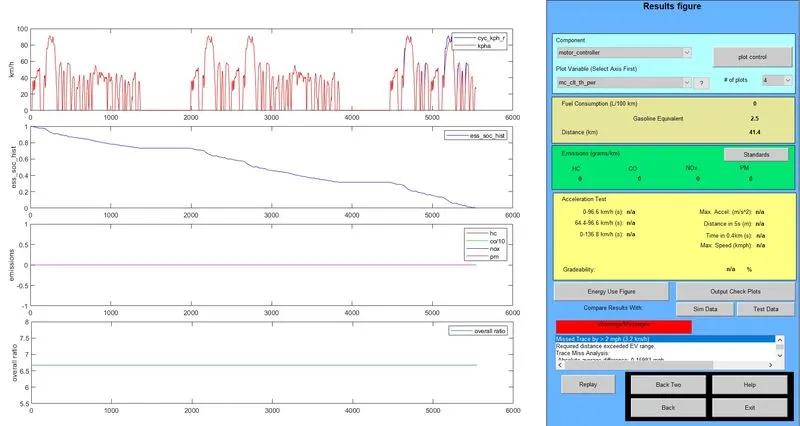
From the result we can see the EV does not completed the 3rd cycle and has travelled only 41.4km, the range of the EV has decreased by 6.8km with an increase of 364kg in cargo weight.
OBSERVATION
| EV with cargo weight | Drive Cycle | Present cycle | Distance covered by EV |
| 136 | CYC_FTP | 4th | 48.2 |
| 500 | CYC_FTP | 3rd | 41.4 |
CONCLUSION
- The EV with cargo weight of 500kg cannot cover 45km distance, while the EV with cargo weight of 136kg has succesfully covered 45km.
- With increase in mass the EV needs to supply more instantaneous power.
- The rolling resistance, acceleration and hill climb power required will be more as these force is proportional to the mass of the vehicle.
- So battery needs to support increased instantaneous power demanded by the EV, so the range of the vehicle is decreased.
2. EV_defaults_in
Considering the above system "EV_defaults_in" and the drive cycle "cyc_ftp", shown in the fig
The system is used to study the effect of increasing battery capacity for the EV and the range of the vehicle.
CASE 1: EV with 25 modules of battery
The study is made with default condition and with a cargo weight of 500kg. The result with battery consisting of 25 modules is
From the above given condition the EV has travelled only for 41.4km
CASE 2: EV with 30 modules of battery
In this case, the battery capacity is increased by increasing the no. of modules. The result of distance travelled is given as
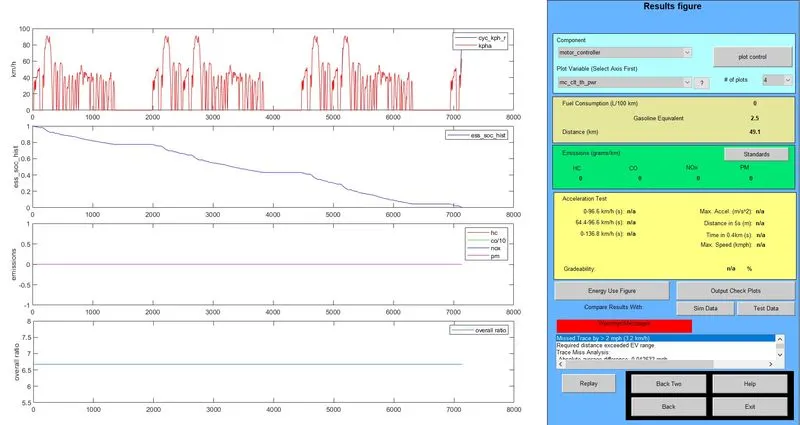
The EV with increased battery capacity has travelled a distance of 49.1km.
OBSERVATION
| CASE | No. of Lead acid battery modules | Nominal voltage (V) | Drive Cycle | Present cycle | Distance Covered (km) |
| Case 1 | 25 | 308 | cyc_ftp | 3rd | 41.4 |
| Case 2 | 30 | 370 | cyc_ftp | 4th | 49.1 |
CONCLUSION
- With increase in battery capacity by increasing the modules the EV has travelled more by 7.7km
- The battery is now able to supply more power to EV with increase in battery modules.
- So total range of the vehicle is increased.
- But the battery needs to support little more instantaneous power because the increased no.of modules increase total mass of the EV.
3. Prius HEV
We have taken Toyota Prius for gradeabilty test. The system and the default parameter is taken as
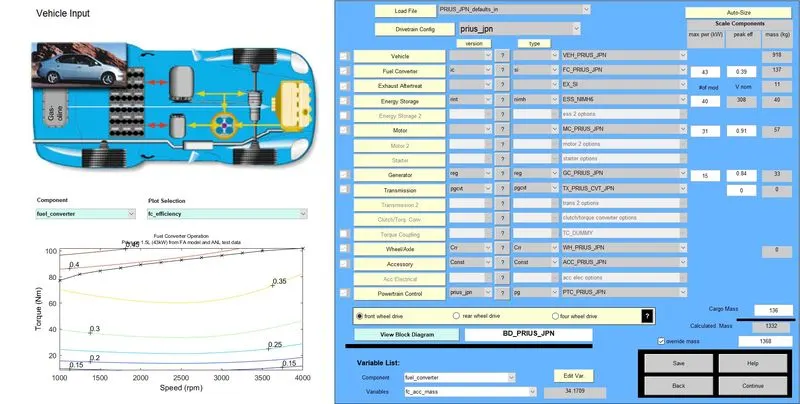
In next step we need to opt "gradeabilty test", in that a window opens up
In the window select "All system enabled" and change the mph from 0 to 180, so the max grade with that speed can be get
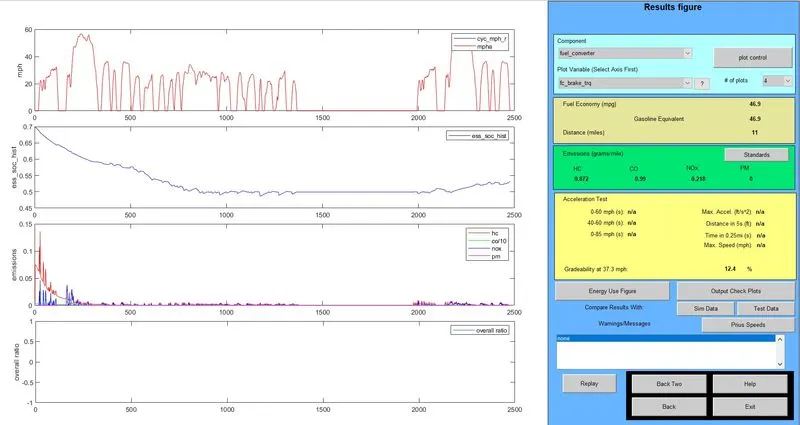
In this result for 60kmph max grade it can climb is 12.4%. So by considering from 0 to 180 kmph, the max grade that can climb is given as below
| Speed (kmph) | Speed (mph) |
Max grade (%) |
| 0 | 0 | - |
| 10 | 6.21 | 32.7 |
| 20 | 12.42 | 27.5 |
| 40 | 24.85 | 16.6 |
| 60 | 37.28 | 12.4 |
| 80 | 49.71 | 9.8 |
| 100 | 62.1 | 7.8 |
| 120 | 74.56 | 5.4 |
| 140 | 87 | 3.3 |
| 160 | 99.42 | 1.3 |
| 170 | 105.63 | 0 |
CONCLUSION
- By increasing the speed the max grade that can climb by the vehicle is decreased.
- After 162kmph the grade is 0, beacuse 162kmph is the max speed of the vehicle. and max speed of vehicle only can be achieved in zero grade without influence of external force like gravitational force.