Week 9 - Attachment Feature Creation - Challenge 2
CREATE DOG HOUSE FOR DOOR TRIM LOWER
AIM:
Create the Dog House for the Door Trim considering the design rules and the thickness of the part to be 2.5 mm.
Objective:
- The main aim of this challenge is to create a solid body of 'Door Trim Lower' with the help of the closed surface method by using the 'Generative shape design' workbench in CATIA V5.
- Performing the 'Draft Analysis' on the solid part body of the Door trim.
CLASS-A SURFACE:
the class-A surface is used in the automotive design industry.it the describes the final production surface data for the aesthetic parts of the car.
CLASS-B SURFACE:
The Class B finish is a quality finish with only minimal imperfections.
CLASS-C SURFACE:
The interior surfaces not readily visible, surfaces that will be covered by another part when assembled, or surfaces which the Customer feels do not need to meet a high cosmetic finish.
DRAFTING ANALYSIS:
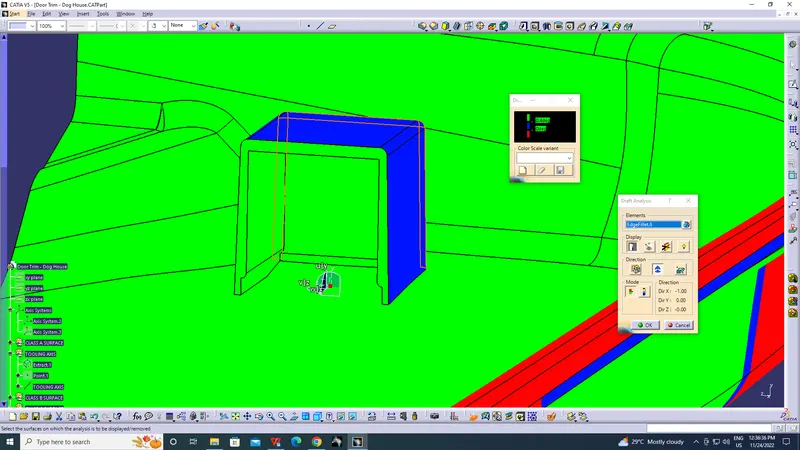
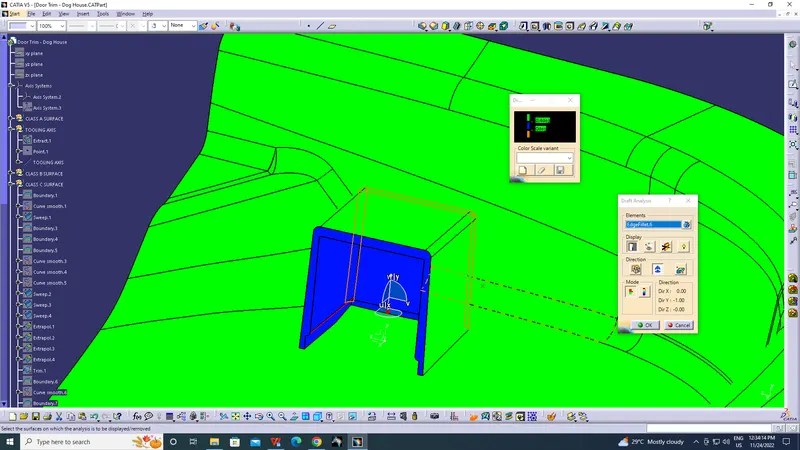
- Draft analysis is performed on the components where the ejection of materials happens after the material is made inside the tools.
- In the case of automotive sheet design manufacturing, the blank sheet after turning into automotive panels like Hood, Fender, Roof, Side Doors, Back Doors,bumpers need to be removed from Panel Dies.
- If a considerable amount of draft angle is not provided, the removal of components from the tool will be difficult.
- It’s the same in the case of mold(plastic component) after getting filled inside the core and cavity, it needs to get ejected easily with the help of ejectors.
Creating tooling axis:
- The ejection from the mold after manufacturing the interior trim must have the nominal 3-degree draft angle.
- hence the tooling directions created by considering the above factor and bisecting method is used.
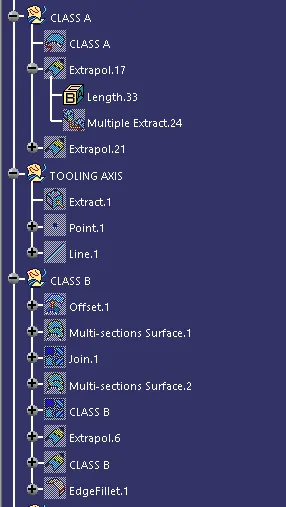
- The base surface of the class-A was extracted to create a reference point on the surface using the point, create a line in the z-direction and an axis system was inserted to the point
- Tooling direction is the main consideration for plastic part and mould parts because it defines the movement of the mould part and the possibility of the plastic part coming out from the mould part (Core and Cavity).
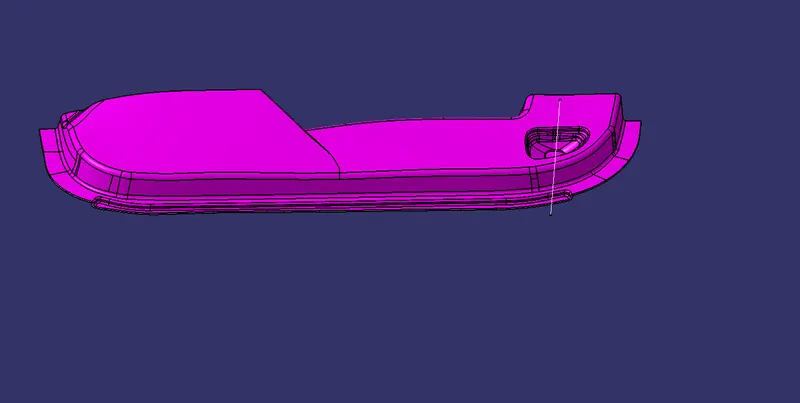
CLASS A SURFACE:
- In automotive design application Class A surfaces are created on all visible exterior surfaces (ex; body panels, bumper, grill, lights etc.) and all visible surfaces of see-touch in interior (ex: Dashboard, seats, door pads etc.)
- class A surface should be given and we dont make any dimension changes.
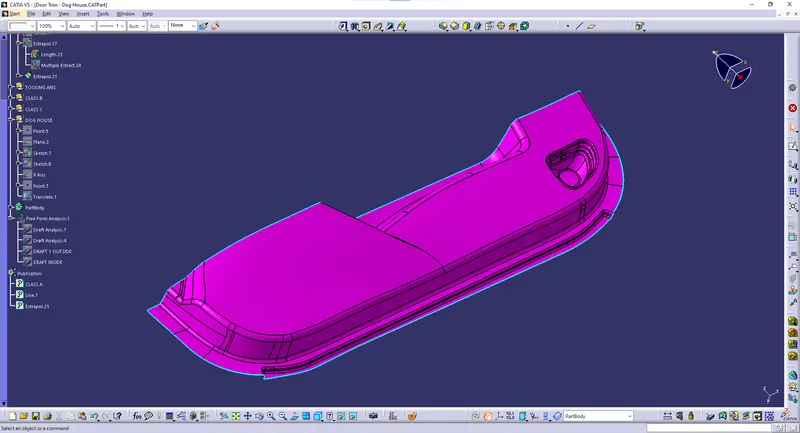
CLASS A DRAFT ANNLYSIS:
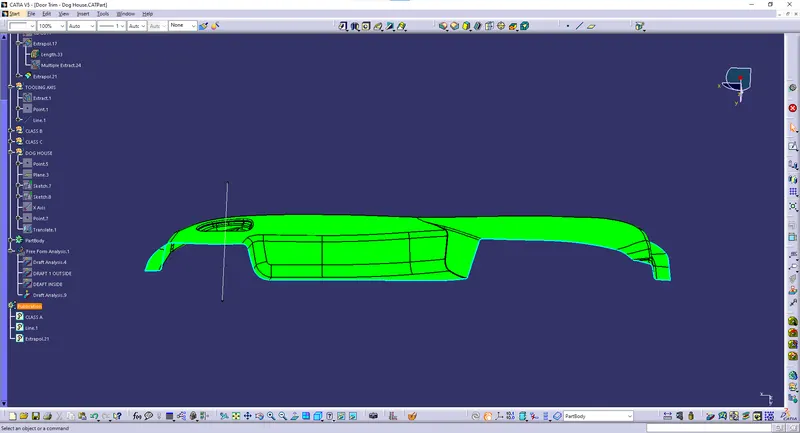
CLASS B SURFACE:
- Class B surface is to be creating the engineering features and offsetting the surface of class A. Firstly we will extract surfaces by using the extract command and from the class A surface. And if there are any patches we have to make it a smooth surface and finally get the complete boundary.
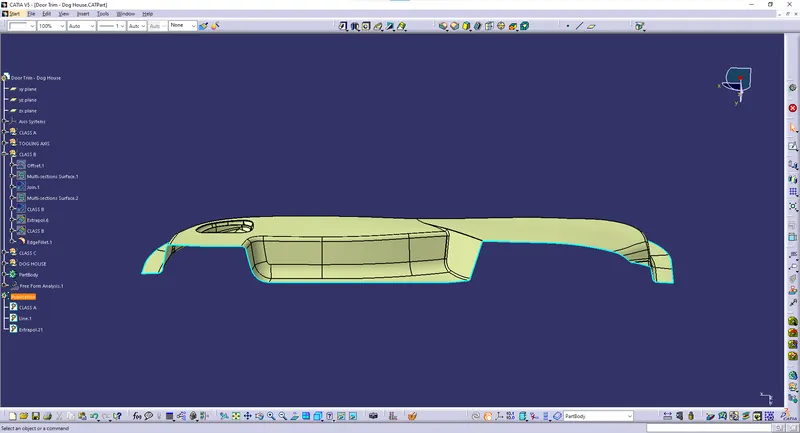
CLASS C SURFACE:
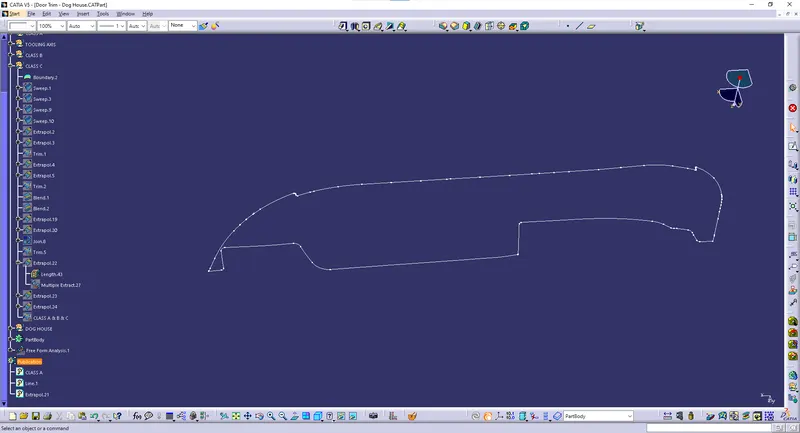
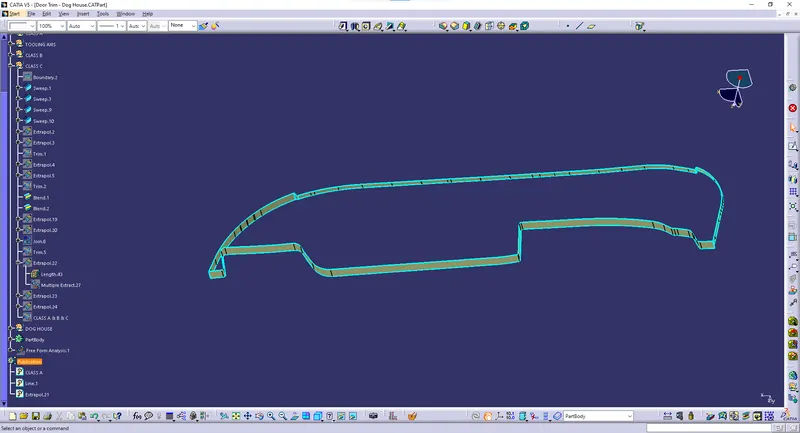
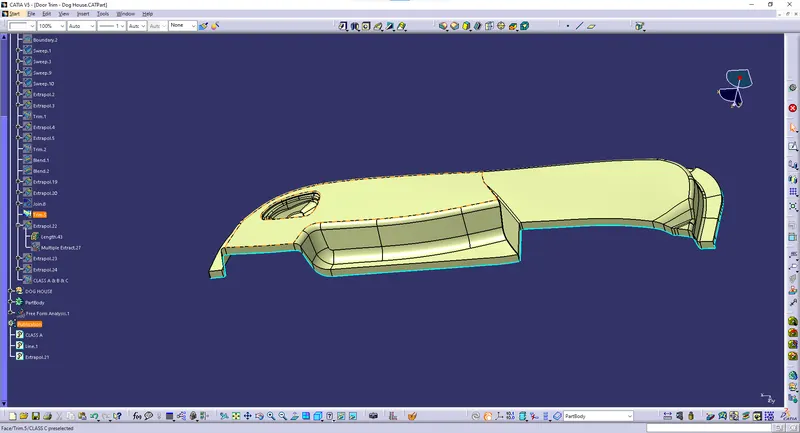
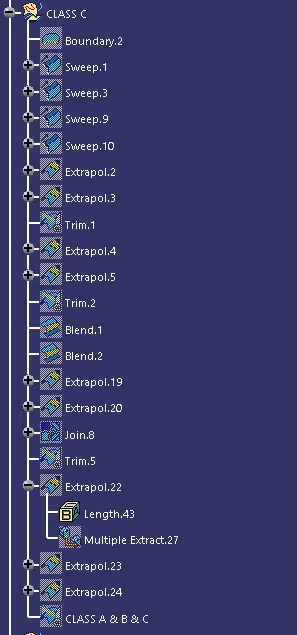
- Class C surface is connected the Class A and Class B, For the class C surface, we need to create the entire boundary of the component by using the boundary command.
- And also creating the best way for the tooling direction to manufacturing easily in an effective way.
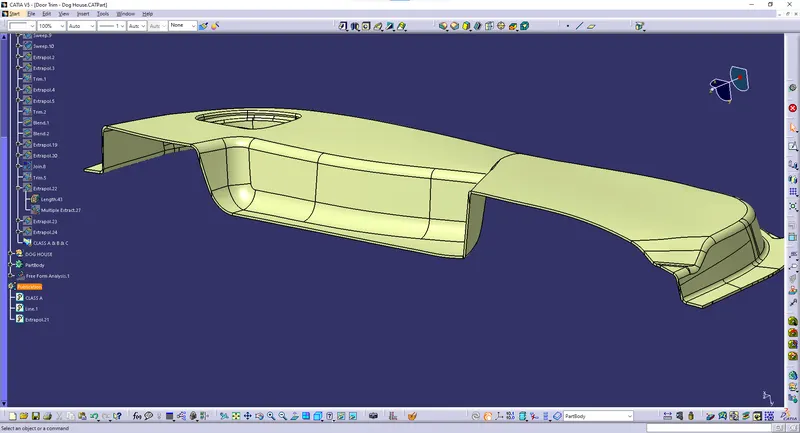
- By using the sweep command we can combine them and trim the surfaces so we can get the completed closed surface body and draft angle given as min 3 degrees.
- Before trimming the most important things join them all.
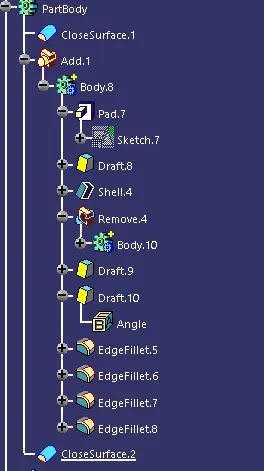
- After the body has to be closed by using the closed surface in part modeling.
CLASS C BOUNDARY:
CLASS C SWEEP:
CLASS A & C:
CLASS A & B & C:
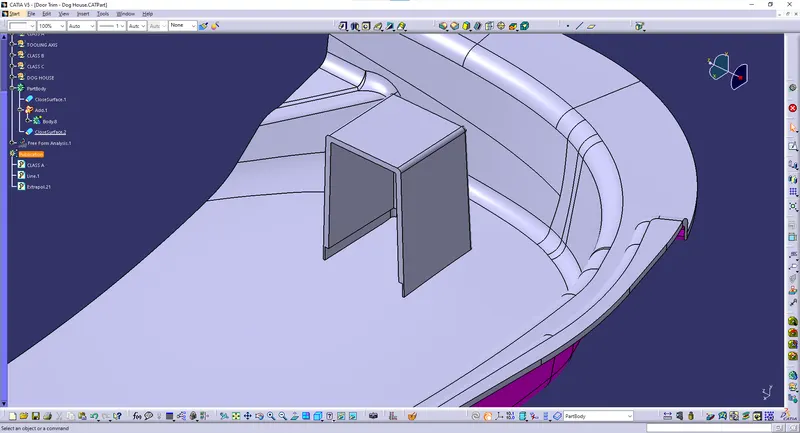
CREATION OF DOG HOUSE:
- Dog house is an engineering feature used in plastic trim design.
- Dog houses are used as supporting feature. Sometimes other engineering features like snaps; locators etc. are mounded on them to increase their strength. Dog houses are subjected to draft analysis to prevent breakage of the component during ejection from mould cavity.
- Dog house and other engineering components are built on B-surface.
- Wall thickness guide range is 0.75 mm to 3 mm
DRAFT ANGLE:
Tooling must be cleared for easy ejection of the component, from the core cavity. In order to clear tooling certain value of draft is given to the component. Minimum of 2-3deg is provides on all plastic components.
DRAFT ANALYSIS OF DOG HOUSE:
FINAL DRAFT ANALYSIS:
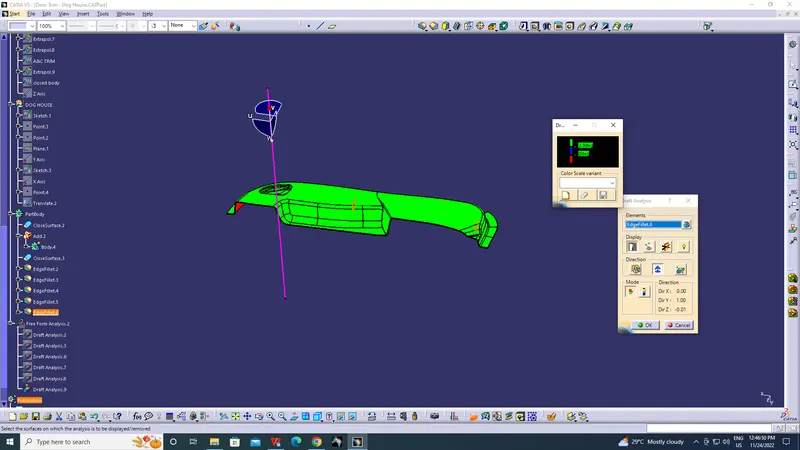
SOLID BODY:
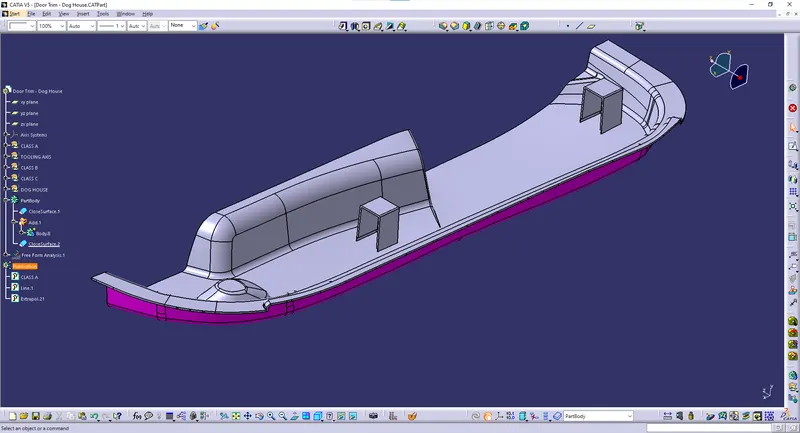
TREE STRUCTURE:
CONCLUSION:
Creation of the Dog House for the Door Trimand thickness of the part to be 2.5 mm is completed.