Week 9 - Attachment Feature Creation - Challenge 2
Aim-
Create a Dog House for the Door Trim considering the design rules mentioned in the video.
"C" is where the doghouse contacts the backside of the surface
- Doghouse wall thickness at the intersection of the part wall ( C ) should be 40% or less than the main wall stock ( T ).
- The height of ( B ) should be between 3.0 – 6.0 mm
INTRODUCTION:
CLASS-A SURFACE:
A surface made by the designer is given as an input to the plastic modeler to work on. It is an aesthetic surface and the outermost surface.
CLASS-B SURFACE:
The surface below a certain thickness from the class-A surface is a class-B surface. This is the surface that contains engineering aspects of a model.
CLASS C SURFACE:
The surface that joins class-A and class-B surfaces is a class-C surface.
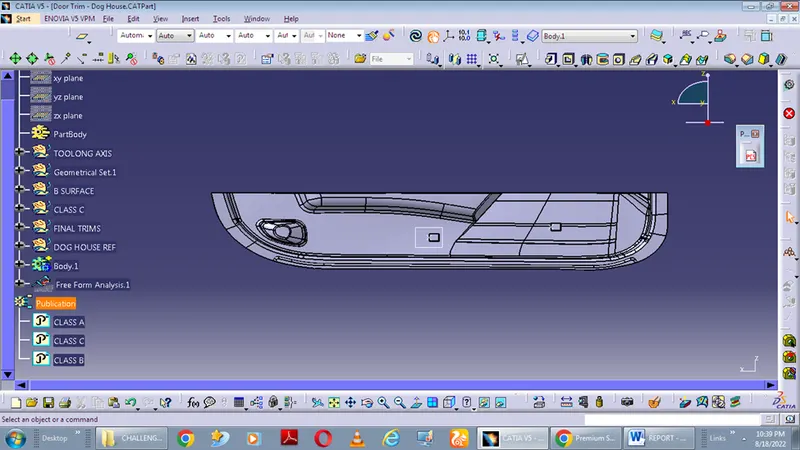
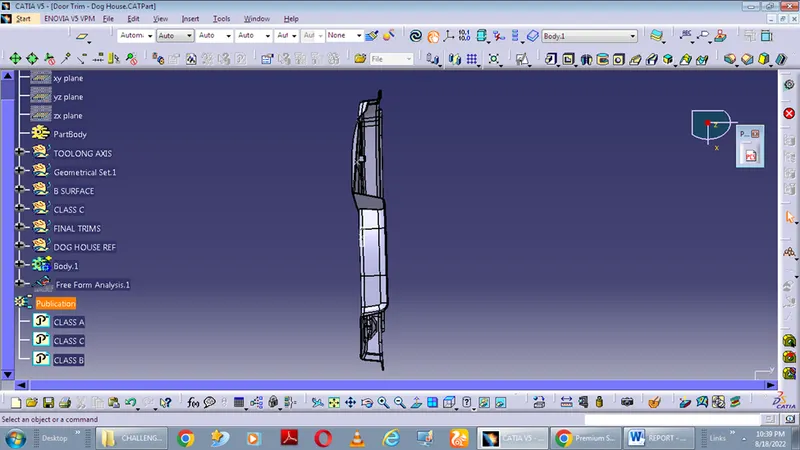
TOOLING AXIS-
- It is defined as the direction in which the mold/core and cavity open. Selection of the direction of the tooling axis depends on the ease at which components can be easily ejected.
- By analyzing the component the most easily electable direction is somewhere close to the Z direction,(might be inclined to it) so we have made a sketch on the YZ plane of the Axis System) to create a bisecting line considering the 2 faces which might be difficult to be tooled.
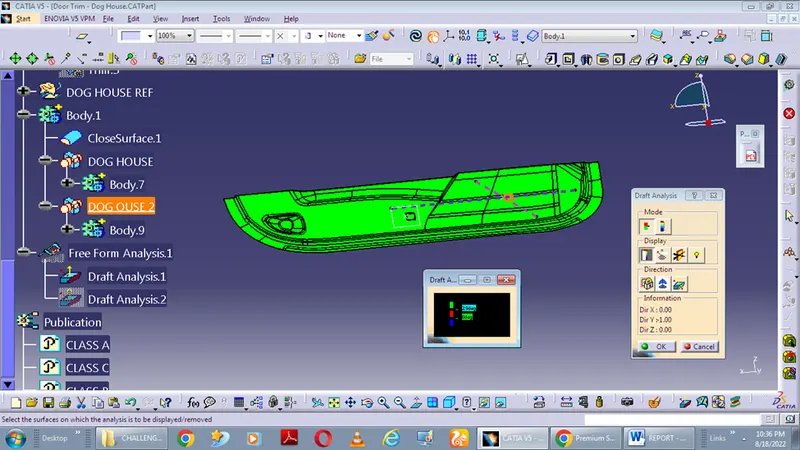
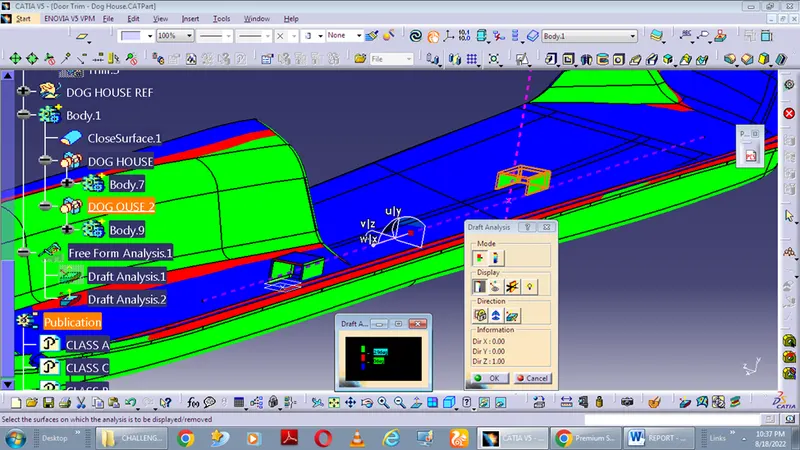
Draft Analysis
Draft analysis is a method used in design to check whether the component created in CAD is manufactured based on the draft condition applied. The main reason behind the draft analysis is the part manufactured should be easily removed from the mold. It also gives an idea of the draft angle from the tooling direction. Here we are giving a tooling direction in order to eject the component easily from the tool. The ideal draft angle given to automotive industries for plastic components is 3 degrees.