Week 8 - Universal Joint
OBJECTIVE
To perform transient structural analysis on a double universal joint with spring for the following three different cases of materials,
- Case-1: Structural steel
- Case-2: Stainless steel
- Case-3: Titanium alloy
To find out Total Deformation and Equivalent (v-m) Stress for all the cases and compare the results.
1. THEORY
1.1 Universal Joint:
A universal joint also known as universal coupling, U joint, Cardan joint, Hardy-Spicer joint, or Hooke’s joint is a joint or coupling used to connect rotating shafts that are coplanar, but not coinciding. A universal joint is a positive, mechanical connection used to transmit motion, power or both. Each universal joint assembly consists of three major components: two yokes and a cross trunnion. An automotive flange yoke has a machined flat face which may be affixed through a bolted connection to the rear differential of a vehicle. The cross trunnion is used to deliver rotation from one yoke to another using four needle pin bearings.
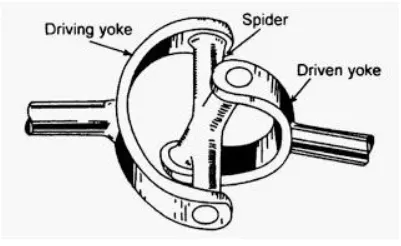
Fig. Universal Joint
The main application of the Universal or Hooke’s joint is found in the transmission from the gearbox to the differential or back axle of the automobiles. It is also used for the transmission of power to different spindles of multiple drilling machines. It is also used as a knee joint in milling machines.
Universal joints differ in view of their material composition, type of hub and the applications for which they are designed. Steel is the most widely recognized material utilized, either in stainless form or alloyed with different metals to handle more noteworthy torque and temperature.
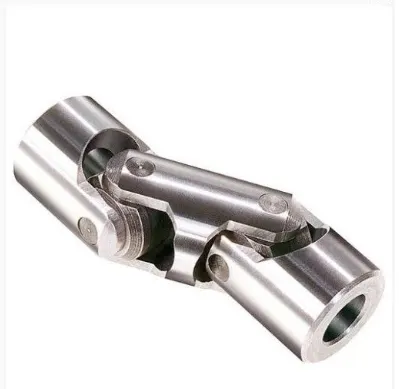
Fig. Double Universal Joint
2. STEPS FOR PERFORMING ANALYSIS:
1. Open ANSYS workbench.
2. Select the static structural module.
3. Select the proper Engineering data card.
4. Import geometry.
5. Open Mechanical model.
6. Give proper connections (contacts and joints).
7. Generate mesh.
8. Set Analysis Setting as given.
9. Insert output request
10. Analyze Result.
3. ANALYSIS SETUP:
3.1 Geometry:
The given 3D model of double universal joint with spring assembly is imported into SpaceClaim. It consists of a driver yoke, two cross trunnion, an intermediate link and a driven yoke with spring.
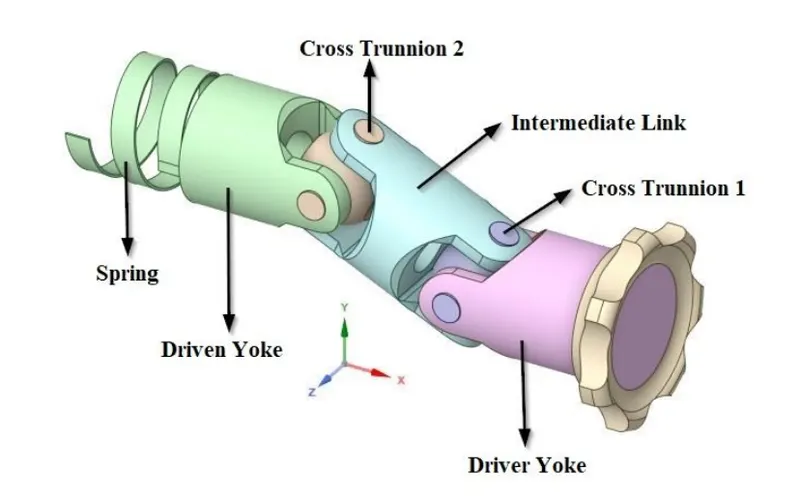
3.2 Meshed Model:
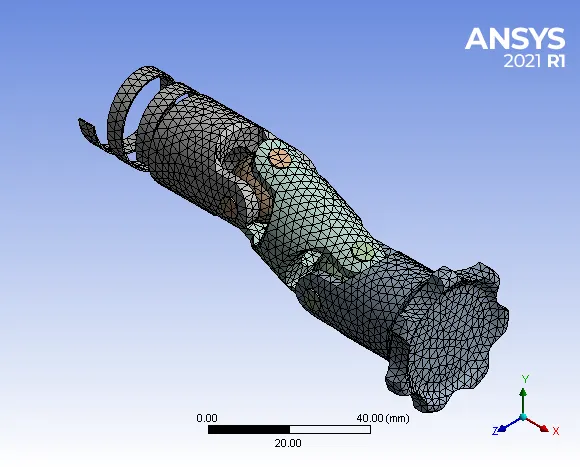
- Details:
- Element Size = 2.5 mm
- Global Sizing = 4 mm
- No of Nodes = 34812
- No of Elements = 20304
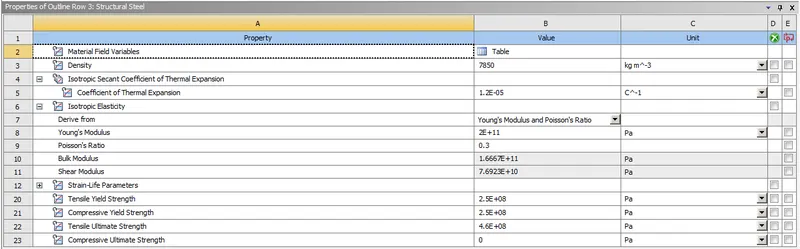
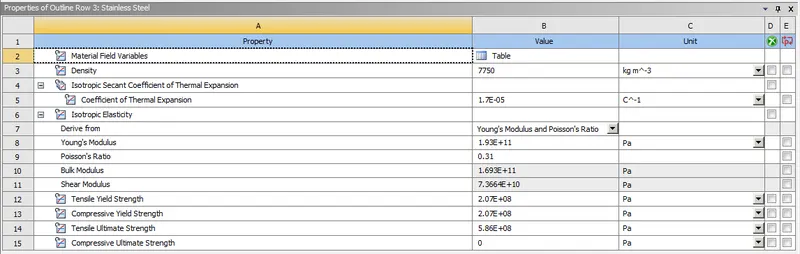
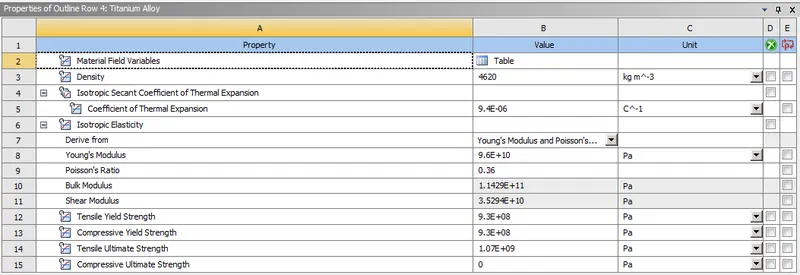
3.3 Material Properties:
For Case 1: Structural steel.
For Case 2: Stainless Steel.
For Case 3: Titanium alloy.
3.4 PROCEDURE:
(3.4.1) Import model in ANSYS Workbench.
(3.4.2) Assign material properties.
(3.4.3) Open the mechanical module, where we going to perform analysis.
(3.4.4) Meshed the model with desired element size.
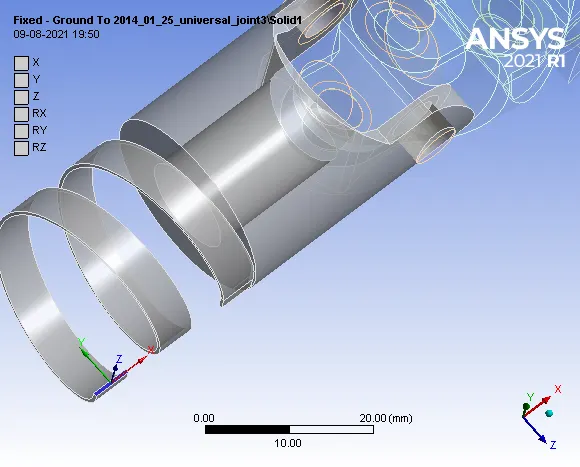
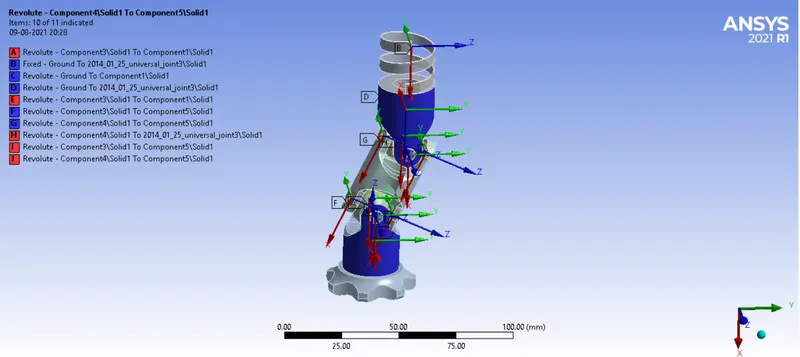
(3.4.5) Now after meshing, From Project Tree, select "Connections" and create "Joints"
1. Fixed Joint: Fixed Support applied to the free end of spring.
- Connection Type = Body-Ground
2. Revolute Joint: Revolute joint specified on the driver yoke.
- Connection Type = Body-Ground
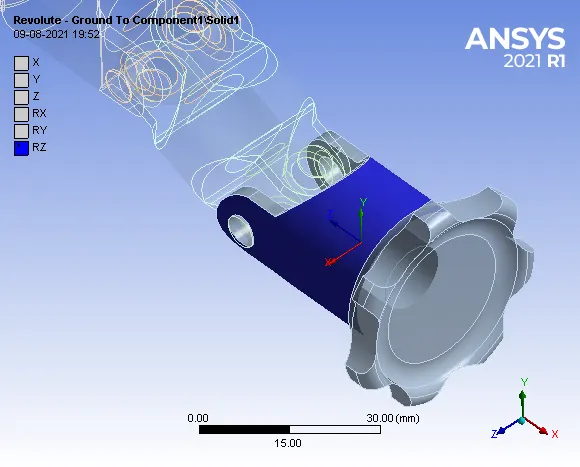
3. Revolute Joint: Revolute joint specified on the driven yoke.
- Connection Type = Body-Ground.
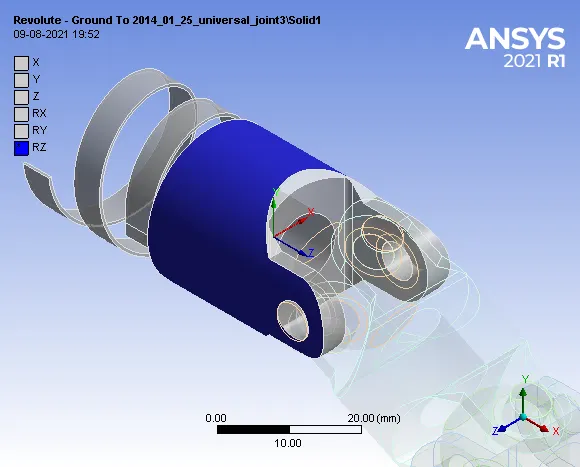
4. Revolute joint: Revolute joints specified between driver yoke, trunnion_1, intermediate link and trunnion_2.
- Connection Type = Body-Body
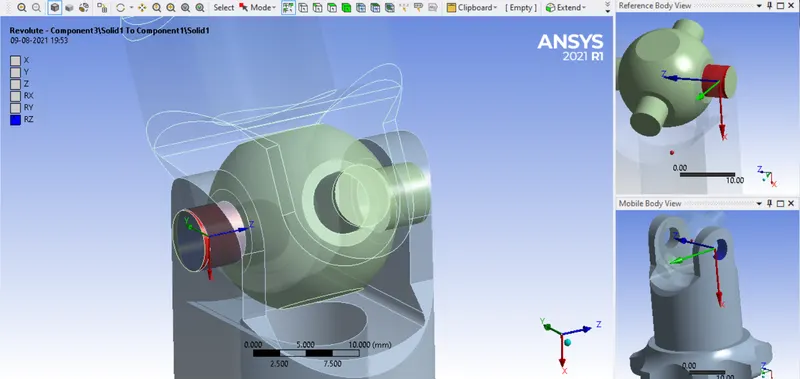
- Do as shown in the image for all 8 joints. First between driver yoke and trunnion_1, second between intermediate link and trunnion_2, Third between intermediate link and trunnion_1.
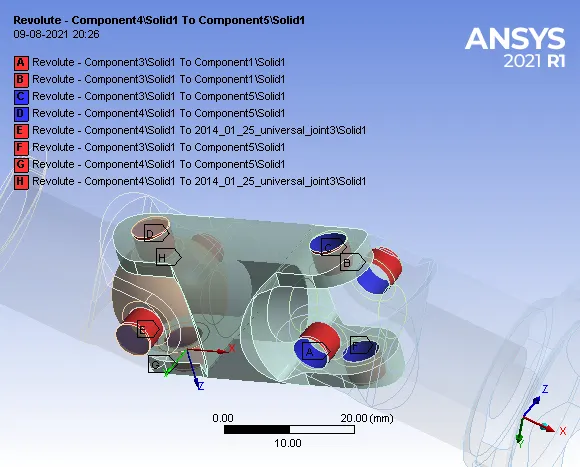
- After Creating all Body-Body Revolute joints, It looks like as shown in the image.
-
Joint details of double universal joint with spring.
(3.4.6) Analysis Setting:
Now let's define the Analysis Setting.
- Here we are going to look at stress, Total Deformation developed in the Universal Joint.
- In the Analysis setting.
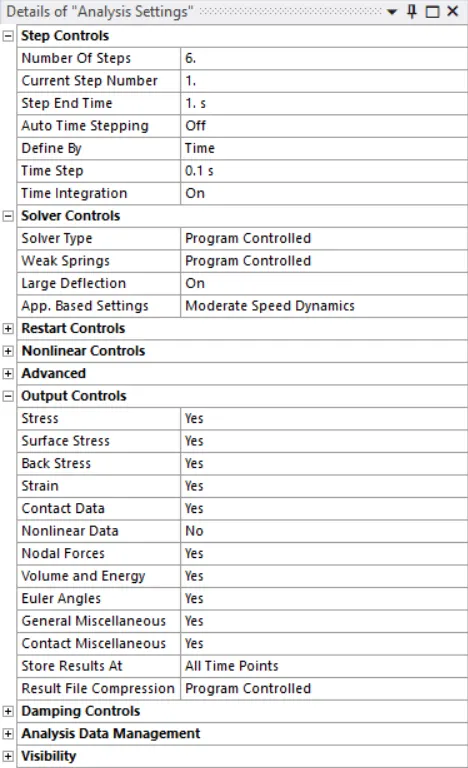
- In the analysis settings, the number of steps considered is 6. which is defined by ‘time’. For all steps, auto time stepping is set to ‘Off’, the time step is considered as 0.1s. In the solver controls, solver type is chosen as ‘Program controlled’, weak springs are set to ‘Program controlled’ and large deflection is set to ‘On’. Under the output controls, all the required results are set to ‘Yes’.
(3.4.7) BOUNDARY CONDITIONS:
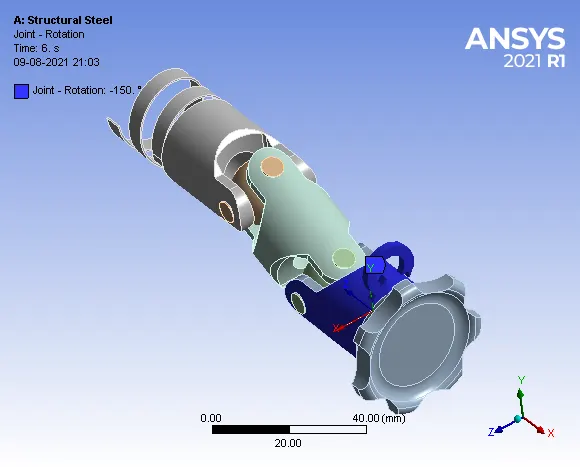
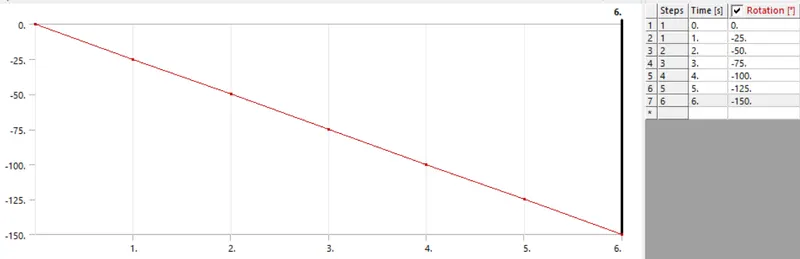
1. Joint Load- The joint load is applied to the driver yoke to rotate it in a clockwise direction from 00 to 1500, with an increment of 250 in each step.
(3.4.7) SOLUTION:
After giving proper Boundary conditions, create a solution for the output result.
- Equivalent stress and Total deformation for all three cases.
4. RESULT AND DISCUSSIONS:
(A). CASE 1: Structural Steel
1. Equivalent Stress:
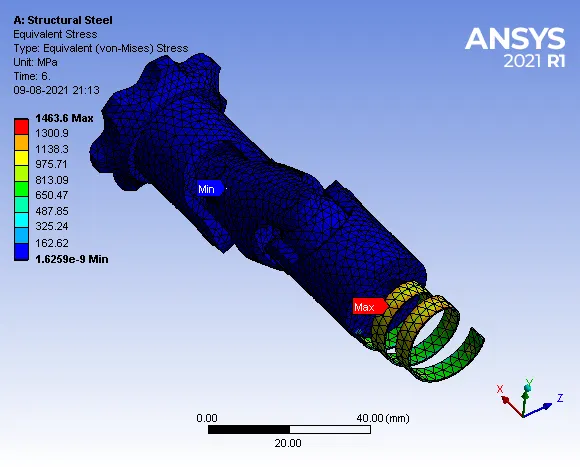
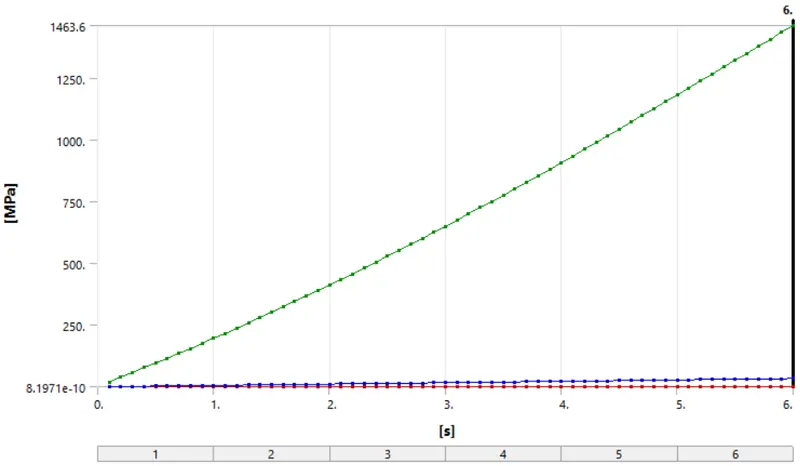
Maximum Stress = 1463.6 MPa
- Stress Contours:
2. Total Deformation:
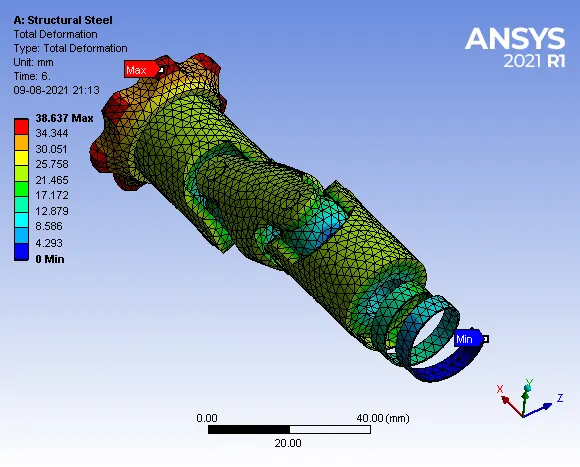
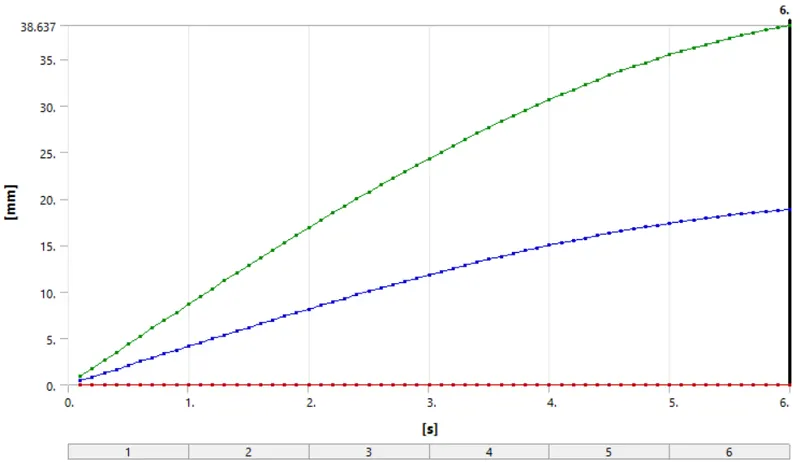
Maximum Deformation = 38.637 mm
- Deformation Contours:
(B) CASE 2: Stainless Steel.
1. Equivalent Stress:
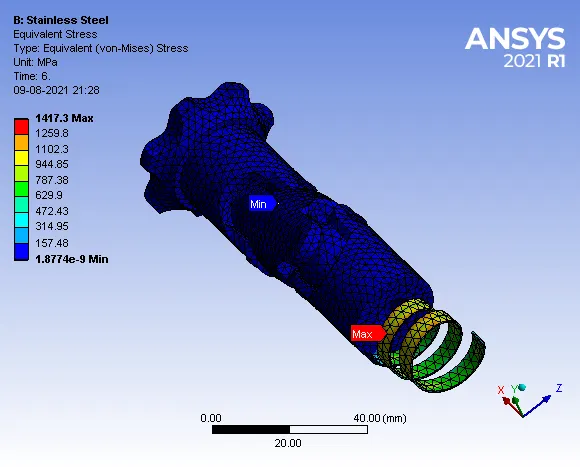
Maximum Stress = 1417.3 MPa
- Stress Contours:
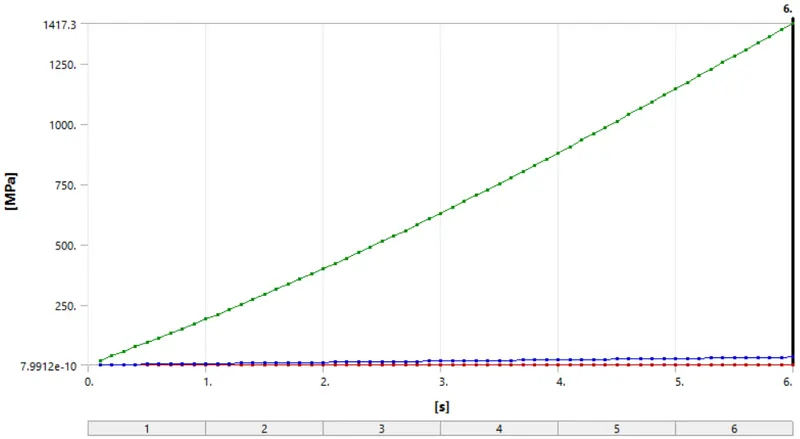
2. Total Deformation:
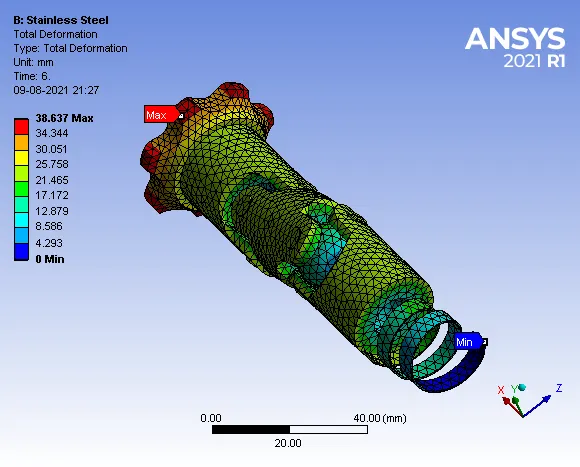
Maximum Deformation = 38.637 mm
- Deformation Contours:
(C) CASE 3: Titanium Alloy.
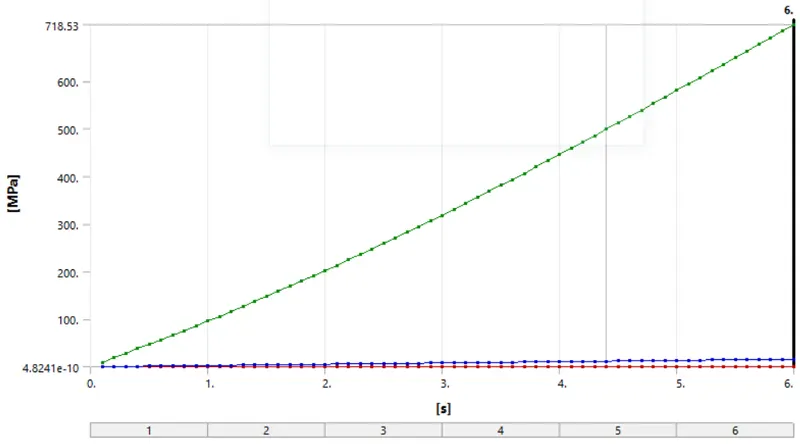
1. Equivalent Stress:
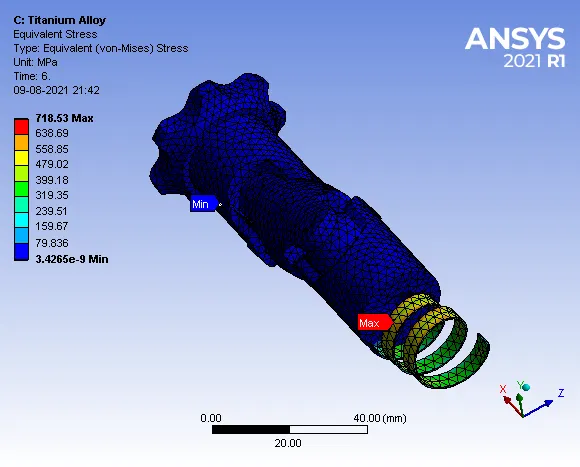
Maximum Stress = 718.53 MPa
- Stress Contours:
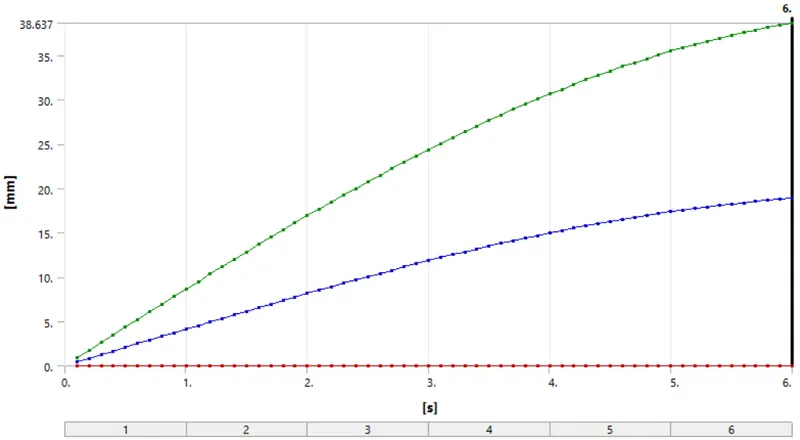
2. Total deformation:
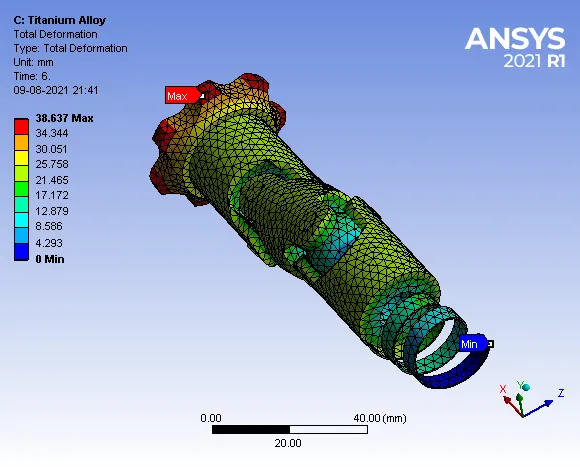
Maximum Deformation = 38.637 mm
Deformation Contours:
5. Comparison of Results:
| CASES |
Maximum v-m Stress (MPa) |
Maximum Total Deformation (mm) |
| CASE 1: Structural Steel | 1463.6 | 38.637 |
| CASE 2: Stainless Steel | 1417.3 | 38.637 |
| CASE 3: Titanium Alloy | 718.53 | 38.637 |
From the table, it is observed that the value of maximum total deformation is the same for all the cases.
The maximum v-m stress was developed in the spring for case-1 i.e., 1463.6 MPa, whereas, for case-3 is only 718.53 MPa, because of the value of young’s modulus, Poisson’s ratio and compressive yield strength are more in the case of Titanium alloy compared to other two given materials.
6. CONCLUSION:
- The transient structural analysis on a double universal joint with spring was carried out successfully for the following three different cases of materials,
- Case-1: Structural steel
- Case-2: Stainless steel
- Case-3: Titanium alloy
- The maximum value of total deformation is the same for all the cases i.e., 38.637 mm.
- The maximum v-m stress was developed in the spring for case-1 i.e., 1463.6 MPa, whereas, for case-3 is only 718.53 MPa, because of the value of young’s modulus, Poisson’s ratio and compressive yield strength are more in the case of Titanium alloy compared to other two given materials.