Week 8 - Universal Joint
AIM: - To perform a transient Structure analysis for Double universal joint with a spring model using Ansys workbench.
OBJECTIVE:
To perform a transient analysis For Double universal joint model with following setup CASES
- CASE:1 To Use Structural Steel for Material of spring also.
- CASE:2 To use Stainless steel for Material of spring only.
- CASE:3 To use Titanium alloy for Material of spring only.
THEORY:
Double universal joint
- A double universal joint with a spring is a type of joint mechanism that consists of two universal joints connected by a spring. The purpose of the spring is to absorb shocks and vibrations that may occur in the system, and to compensate for any misalignment between the two universal joints.
- The universal joint, also known as a U-joint, is a mechanical component that allows for the transmission of torque and rotation between two shafts that are not in a straight line. It consists of a cross-shaped element with bearings at each end, which allow for rotational movement between the two shafts. Double universal joints are used when the two shafts are at an angle to each other and require more flexibility in their movement.
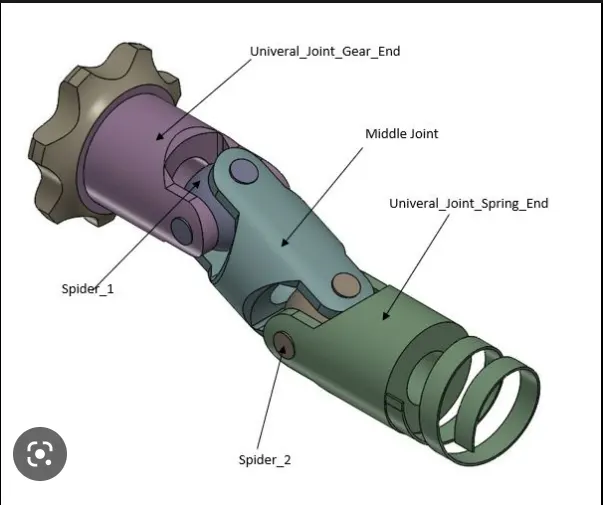
- The addition of a spring to the double universal joint provides several benefits. Firstly, it reduces the amount of wear and tear on the joint by absorbing the shocks and vibrations that occur during operation. This helps to extend the lifespan of the joint and prevent damage to other components in the system.
- Secondly, the spring helps to compensate for any misalignment between the two universal joints. Misalignment can occur due to manufacturing tolerances, wear and tear, or other factors, and can cause excessive stress on the joint and lead to premature failure. The spring allows for a certain degree of movement between the two joints, which helps to reduce the stress and increase the overall durability of the joint.
- Overall, a double universal joint with a spring is a reliable and efficient mechanism for transmitting torque and rotation between two shafts that are not in a straight line. It is commonly used in a variety of industrial and automotive applications, where it is required to operate under challenging conditions and withstand high levels of stress and vibration.
Transient Analysis:-
transient analysis in ANSYS Workbench is a powerful tool for simulating the behaviour of a system over time. It is widely used in engineering applications to investigate the response of a system to time-varying inputs. ANSYS Workbench provides a range of analysis tools to perform transient analysis, including explicit and implicit solvers. The transient analysis workflow in ANSYS Workbench involves defining the geometry, material properties, boundary conditions, transient analysis settings, running the simulation, and analysing the results.
ANALYSIS SETUP:
Here we will start our work Transient structural Analysis for Double universal joint with a spring in three different cases as per the material difference for the shaft or spring joint are given as below:
- CASE: 1 {Structural Steel}
- CASE: 2 {Stainless Steel}
- CASE: 3 {Titanium Alloy}
- Given Geometry
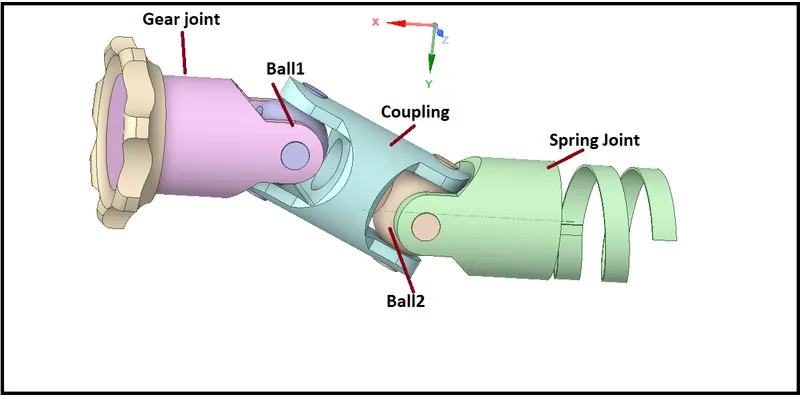
One shaft is named as Gear joint, which is attached to the Gear. Another Shaft is named as spring joint, which is attached to the spring.
Here we have two ball structure as a cross piece for transmission of the motion. Also, for transmission of the motion from one joint to another, we have a coupling containing the two balls as a cross piece.
- Mesh:
Details:
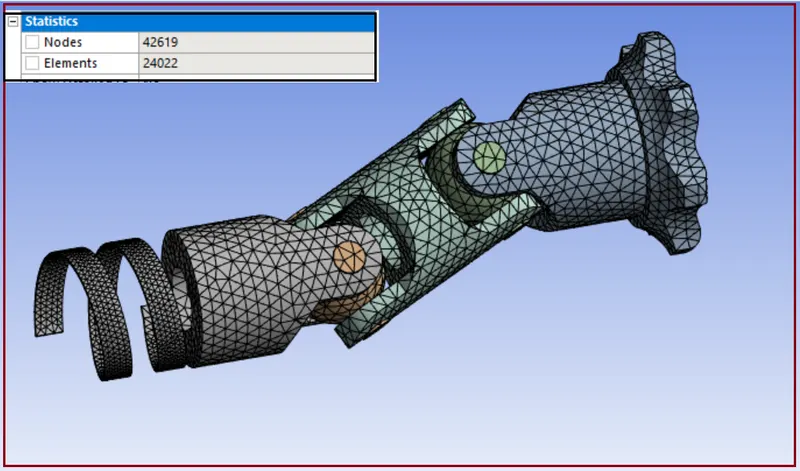
- Global Element Size: 2.5 mm.
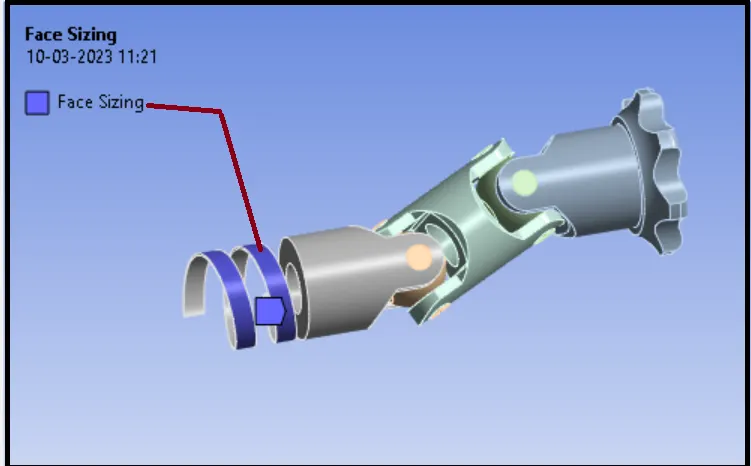
- Face Sizing: Spring =1 mm.
- Use Adaptive Sizing: No.
- Quality: Smoothing= Medium.
Materials For Spring Joint
CASE:1{Structural Steel}:
- Density: 7850 Kg/m3
- Young’s Modulus: 2 E+05 MPa
- Poisson’s Ratio: 0.3
- Tensile Yield Strength: 250 MPa
- Compressive Yield Strength: 250 MPa
- Tensile Ultimate Strength: 460 MPa
CASE:2 {Stainless Steel}
- Density: 7750 Kg/m3
- Young’s Modulus: 1.93E+05 MPa
- Poisson’s Ratio: 0.31
- Tensile Yield Strength: 207 MPa
- Compressive Yield Strength: 207 MPa
- Tensile Ultimate Strength: 586 MPa
CASE :3 {Titanium Alloy}
- Density: 4620 Kg/m3
- Young’s Modulus: 96000 MPa
- Poisson’s Ratio: 0.36
- Tensile Yield Strength: 930 MPa
- Compressive Yield Strength: 930 MPa
- Tensile Ultimate Strength: 1070 MPa
Initial steps
- Import model in Transient Structural in Geometry section.
- Then go to Mechanical model section.
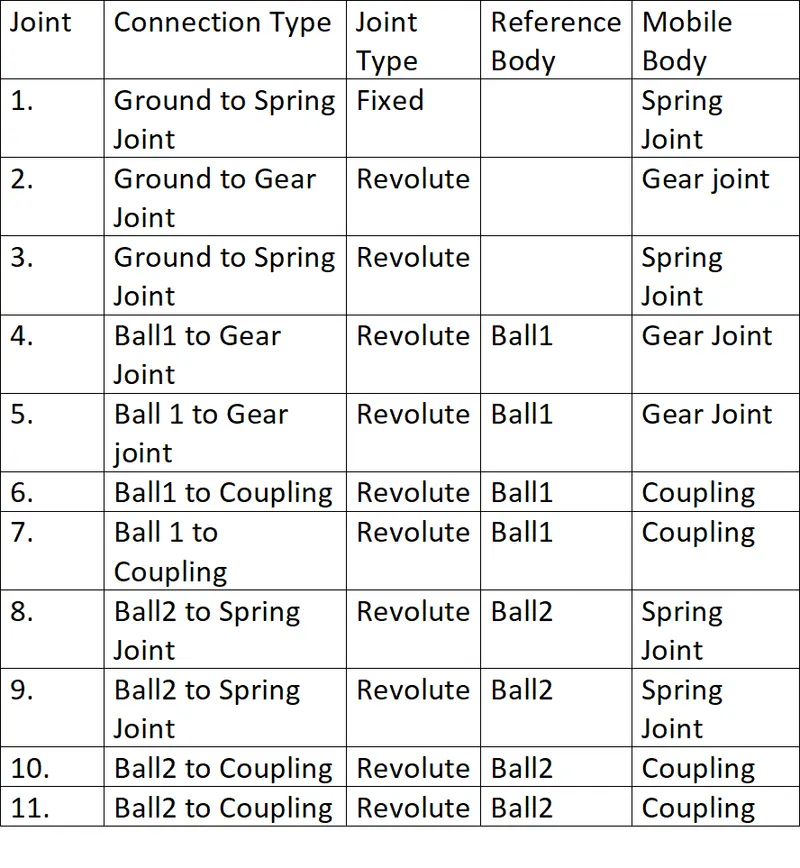
- Rename the Parts of the setup as Spring Joint, Gear Joint, Ball1, Ball2 and Coupling.
- Connections:
Joints
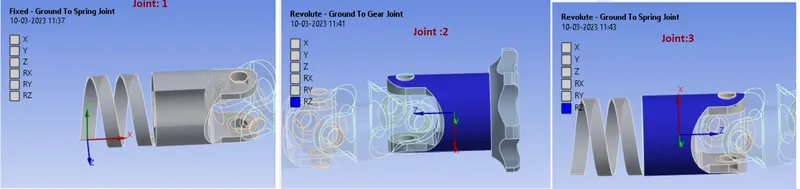
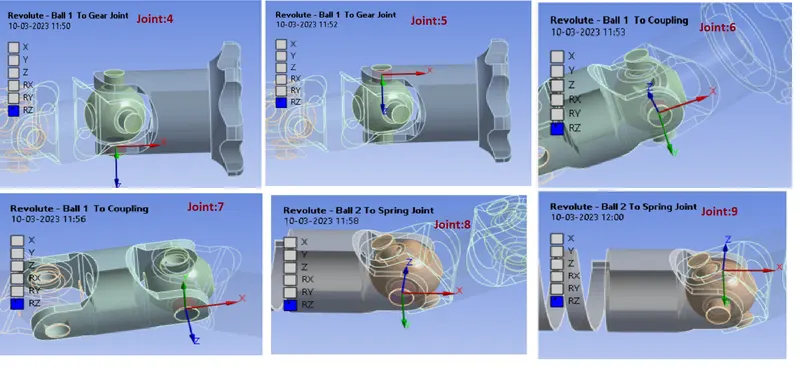
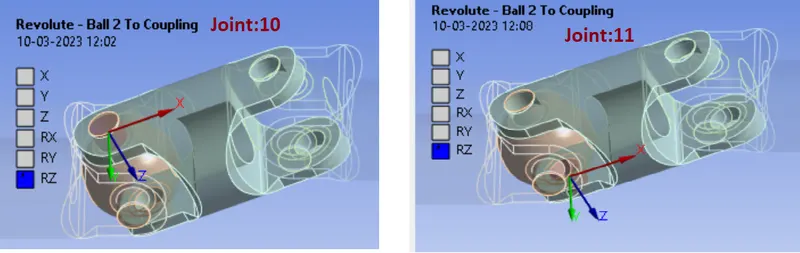
Joint detail
Boundary Conditions settings:
Our next step is creating Boundary Conditions:
Analysis Settings:
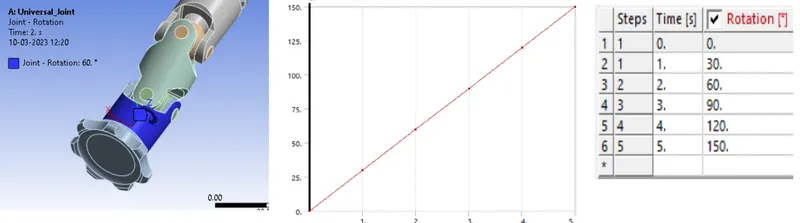
- No. of Steps: 5
- Solver Type: Program Controlled
- Weak Springs: Program Controlled
- Large Deflection: ON
- Auto Time Stepping: OFF
- Defined By: Time
- Time Step: 1 s
- Time Integration: ON
- Output Controls: Stress, Strain, Contact Data, Nodal Forces, Volume & Energy, Euler Angles, Contact Miscellaneous General Miscellaneous put Yes.
Joint Rotation:
Apply Joint rotation - Ground to Gear Joint in order to transfer the rotary motion of the Gear Joint to another universal joint and from there to the Spring Joint shaft and at last to the spring attached to the Spring Joint.
SOLUTION
After giving proper boundary conditions, create desired solutions for output results.
- Equivalent Stress
- Total deformation
- Stress
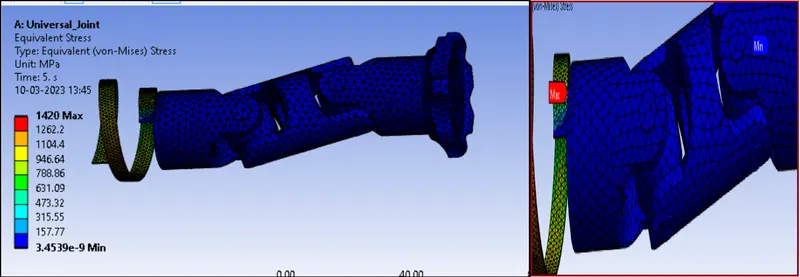
CASE: 1 {Structural Steel}
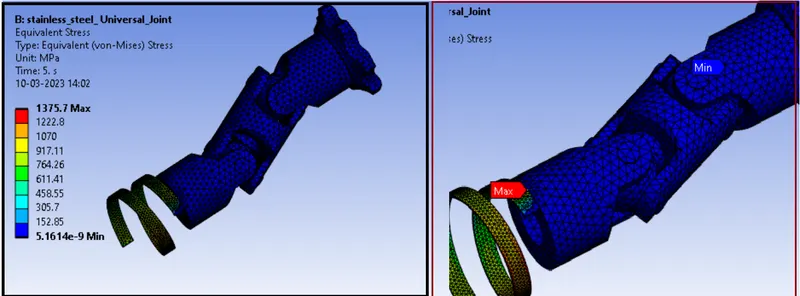
CASE: 2 {Stainless Steel}
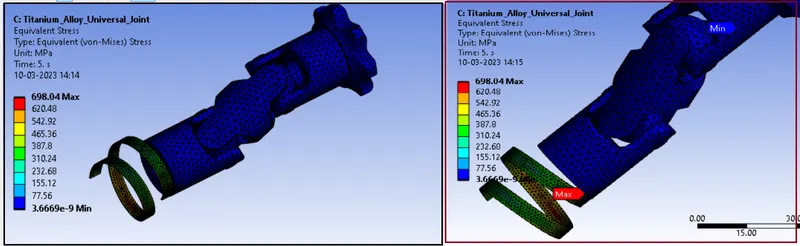
CASE: 3 {Titanium Alloy}
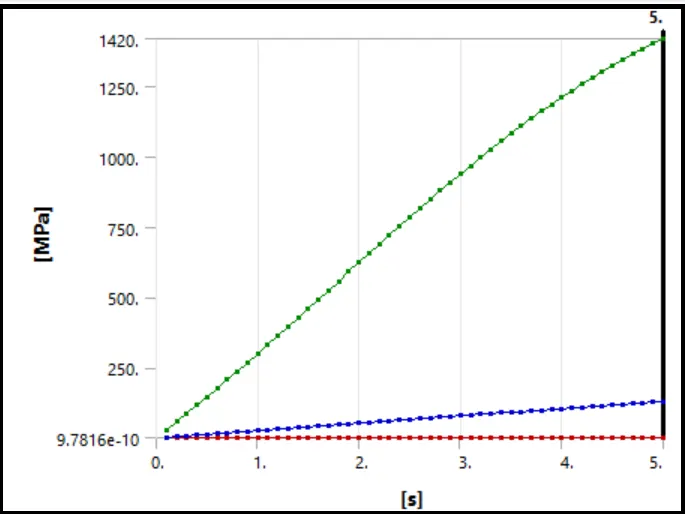
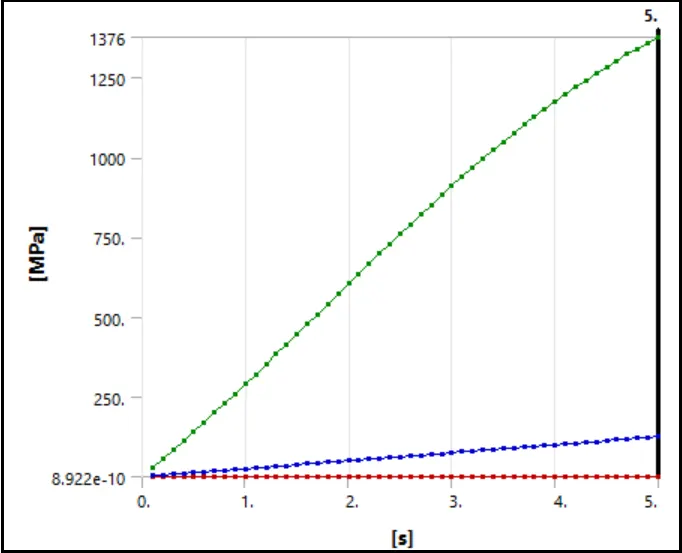
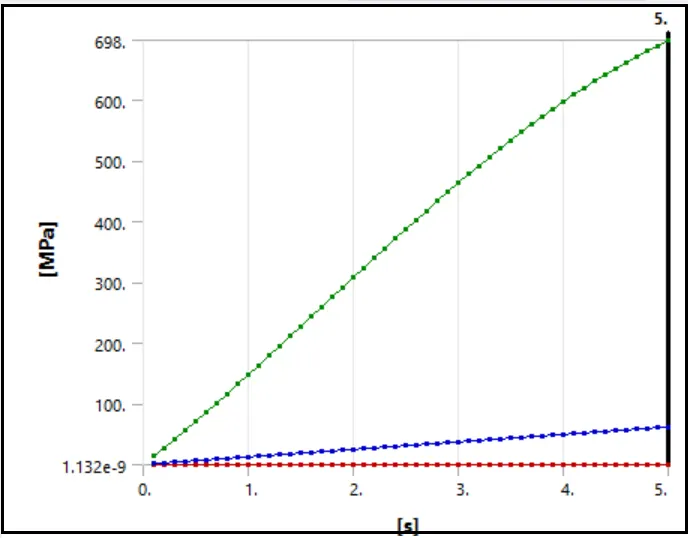
- Stress plots
CASE: 1 {Structural Steel}
CASE: 2 {Stainless Steel}
CASE: 3 {Titanium Alloy}
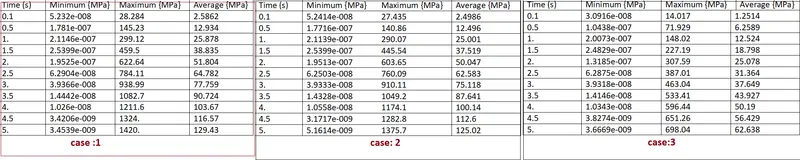
- Stress detailed data
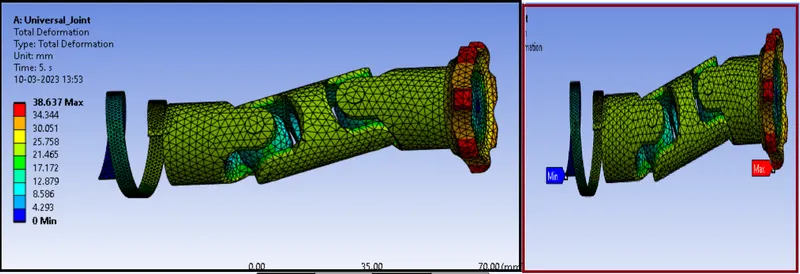
- Total Deformation
CASE: 1 {Structural Steel}
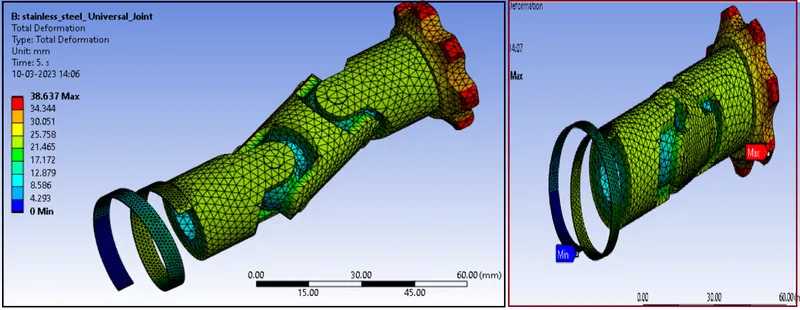
CASE: 2 {Stainless Steel}
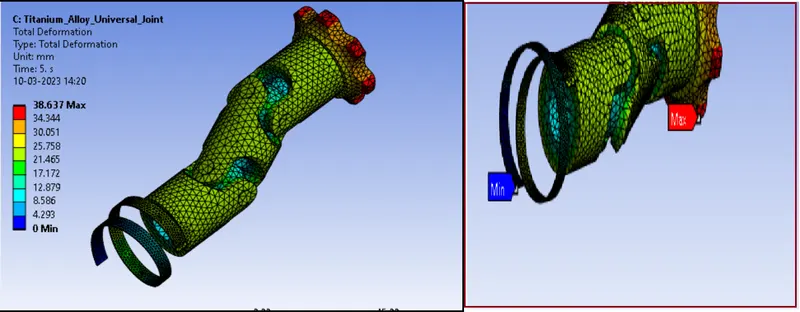
CASE: 3 {Titanium Alloy}
Comments:
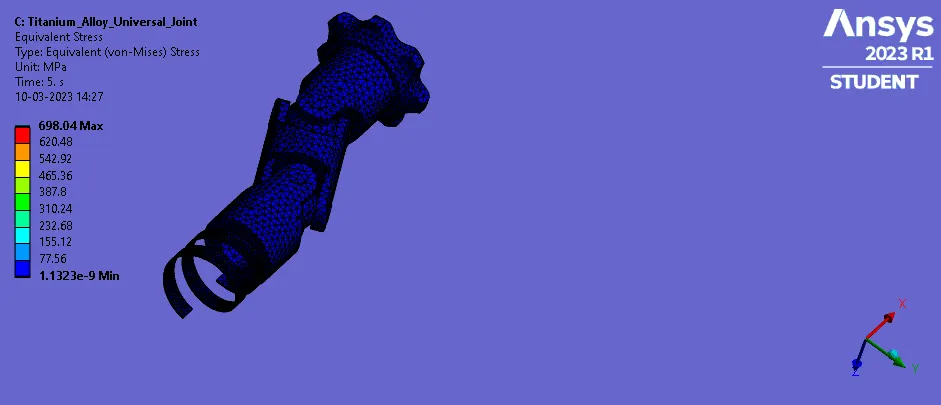
- Here we can observe that the stress is increasing with the degree of rotation from 90 to 150.
- Minimum stress is at 1s or from 0 to 90 degree and maximum stress is generating at 150 degree or at 5s.
- From the setup we know that with the rotation of the joint, the spring is getting twisted.
- So, we can say that with increase in rotation of the joint, the tension in the spring and hence the value of the stress is increasing accordingly.
- Total Deformation Plots
CASE: 1 {Structural Steel}
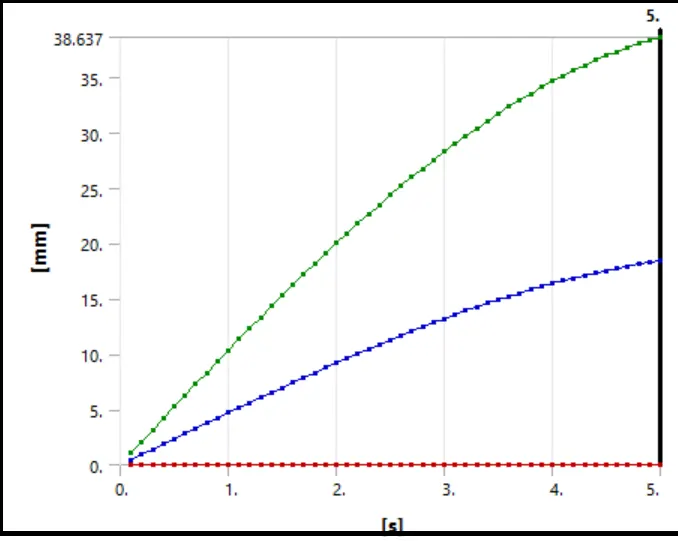
CASE: 2 {Stainless Steel}
CASE: 3 {Titanium Alloy}
- Total deformation detailed data
Comments
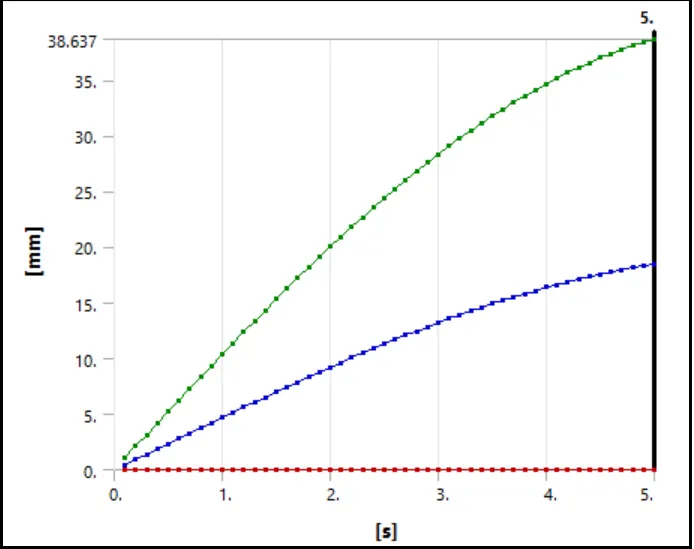
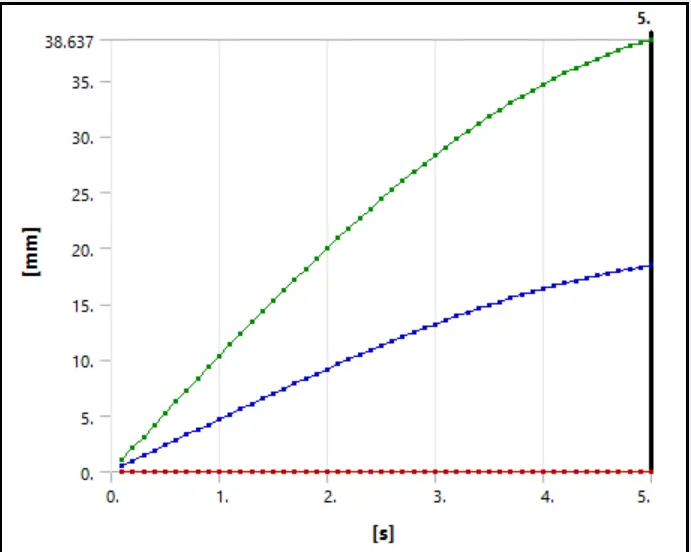
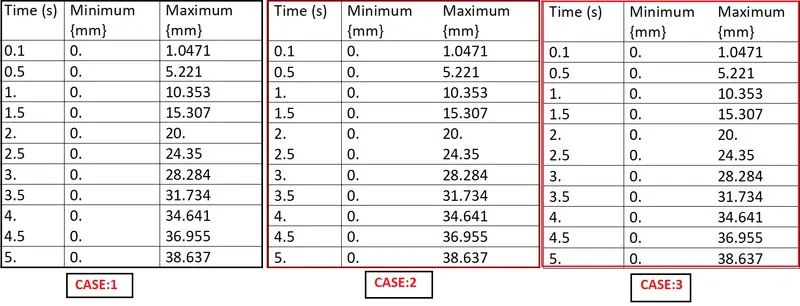
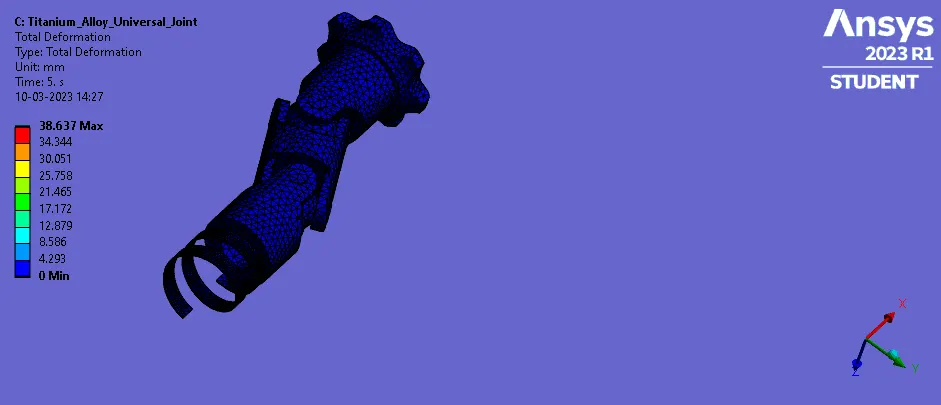
- Here we observe the deformation is increases as the degree of rotation increases in gradual manner.
- At the end of 150 degrees rotation, we got 38.637 mm deformation. And this value is same for all the cases.
Result summary
CONCLUSION:
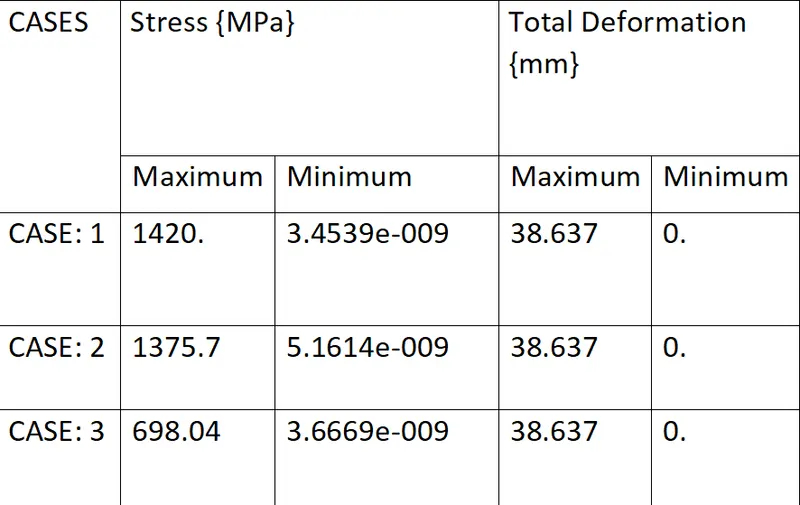
- Here in CASE: 1 and CASE: 2, maximum stress is exceeding the value of the yield Strength, so there is plastic deformation, but in CASE: 3, maximum stress is well below the yield strength.
- From the table we can observe that the Structural Steel gives higher stress than Stainless steel and Titanium Alloy has the lowest stress.
- We also know that Titanium Alloy has the density nearly half of the Structural Steel, so it is light weight compared to Structural Steel and Stainless Steel, and so it is more flexible.
- Also, the Tensile Yield Strength and Tensile Ultimate Strength of the Titanium Alloy are highest among the all material. So, it has more elastic region and can regain the original shape easily and also can withstand to higher loads.
- Also, the Ultimate strength of the Titanium Alloy is very high, so the structure is safe compared to other materials.
- Thus, the alloy of the Titanium material can give good results for Universal Joint and it the best suited material.
- we can conclude that the Titanium Alloy is very safe and effective material, which can give high performance and the mechanism of the Double Universal Joint, will be safe and can work longer.
---------------------------------------------------------------------------------------------------------------------------------------------------------------------------------------------------
ANNIMATION
CASE:3
STRESS
Total deformation
**********************************************************************************************************************************************************************************************************************************************************************END
Thanks & regards,
Devesh kashyap