Week 8 - Simulation of a backward facing step in OpenFOAM
Objective:
This task aims to simulate the flow through a backward-facing step geometry using OpenFOAM. The simulation will be done with and without a grading factor, and the velocity field will be compared.
Procedure:
To simulate the backward-facing step in OpenFOAM, the following steps were carried out:
- The actual tutorial folder was copied into a desired directory using cp -r command ( the corresponding tutorial folder was in tutorials/incompressibleFluid/pitzDailySteady/
- Then the block mesh was created using the blockMeshDirect file containing the details of the meshing and boundary conditions.
Geometric Details:
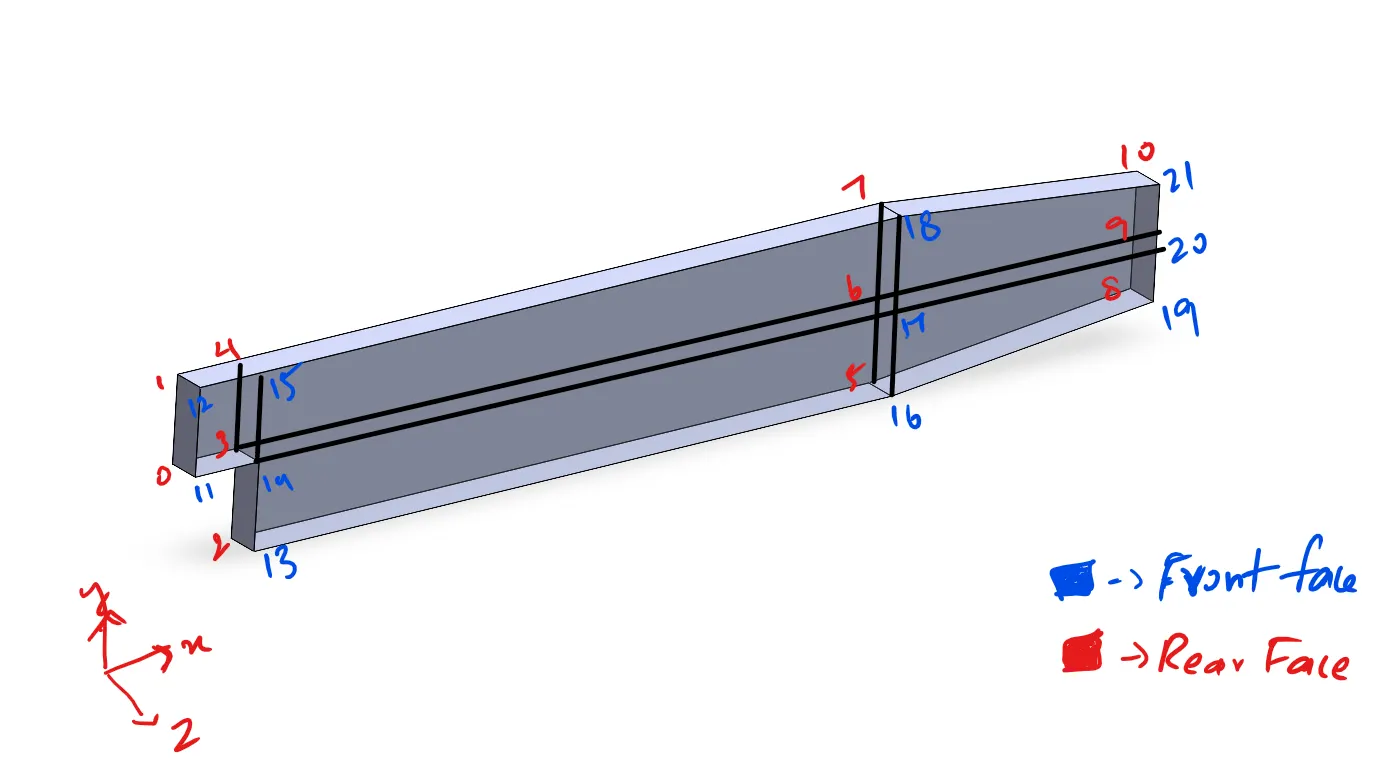
The 3D geomtry of backward facing step is created in solidworks and shown below:
Simulation carried out without grading factor:
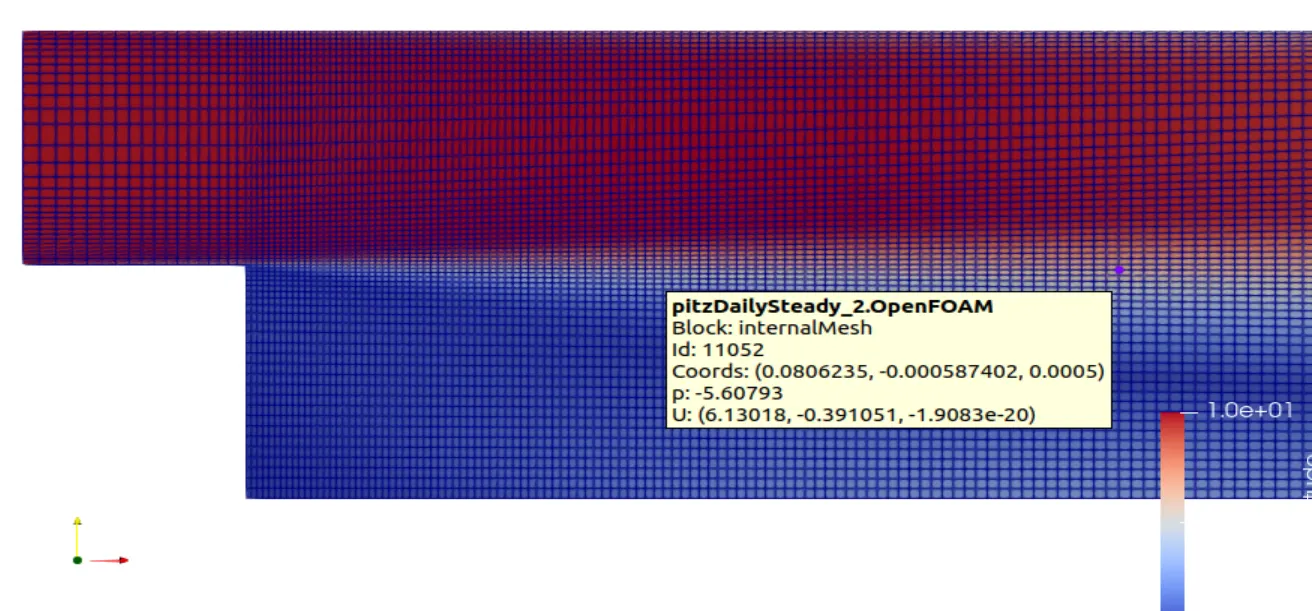
Case 1 was simulated without any grading factor i.e with a Grading factor of 1
The Grading Factor (GF) is changed to 1.0 in the simple grading method throughout the mesh in all axes.
`GF = delta_{end cell} / delta_{firstcell}`
The mesh created with GF=1 is shown below:
Simulation carried out with 0.2 grading factor:
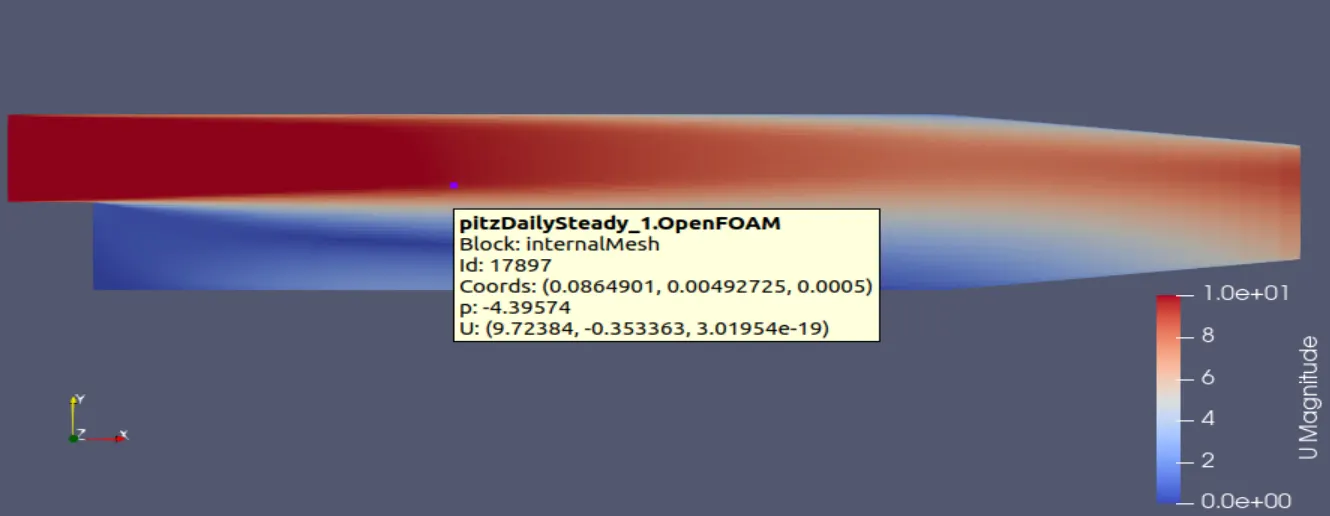
Case 2 was simulated with a grading factor of 0.2 around the step wall to improve the cell quality to get a better solution.
The mesh created with finer near wall is shown below:
Conclusion:
It is observed that the mesh created with a grading factor over the step gives the better solution as the velocity field near the step wall is captured well as the area of interest.
Outputs obtained from both the cases are given below:
The Velocity field in x-direction measured for both the cases in paraview at Xdistance=0.08m are given below:
- With GF as 1.0, U0.08m= 6.1 m/s
- With GF as 0.2, U0.08m= 9.5 m/s
Grading factor can be made using three way:
- simpleGrading
- edgeGrading
- by creating multi-meshing grid (which split mesh along paarticular direction with available cells)
It is observed that the Grading Factor (GF) is importance to capture the flow over the area of interest and resolve the solution in a better way especially in a wall where we expect flow seperation and boundary layer capture.