Week 8 - Simulating Cyclone separator with Discrete Phase Modelling
Aim:- To perform analysis on a cyclone separator and calculate the separation efficiency and pressure drop.
Objective:-
- To write a few words about any four empirical models used to calculate the cyclone separator efficiency.
- To perform an analysis on a given cyclone separator model by varying the particle diameter from 1 μm to 5 μm and calculate the separation efficiency in each case. Discuss the results. [Use both the velocity's as 3m/sec.]
- To perform an analysis on a given cyclone separator model by varying the particle velocity from 1 m/sec to 5 m/sec and calculate the separation efficiency and pressure drop in each case. Discuss the results. [Use particle diameter size as 5 μm for all cases & keep flow velocity same as particle velocity].
- Case 1:
- Velocity = `3m/s`
- Size of particles = 1,2,3,4,5`mum`
- Case 2:
- Size of particle =`5` `mum`
- Velocity = 1,2,3,4,5 `m/s`
Theory:
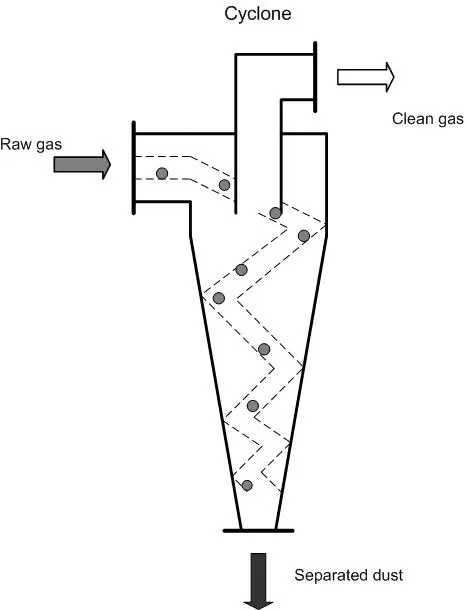
- A cyclone is a centrifugal separator in which particles, due to their mass, are pushed to the outer edges as a result of centrifugal force. Incoming air is automatically forced to adopt a fast-revolving spiral movement - the so-called “double vortex”. The cyclone consists of a vertical cylinder with a conical bottom. Cyclone separators have no moving parts. The cylindrical part is closed at the top by a cover, through which the liquid overflow pipe, known as the vortex finder, extends some distance into the cyclone body.
Cyclone separators work much like a centrifuge, but with a continuous feed of dirty air. In a cyclone separator, dirty flue gas is fed into a chamber. The inside of the chamber creates a spiral vortex, similar to a tornado. The lighter components of this gas have less inertia, so it is easier for them to be influenced by the vortex and travel up it. Contrarily, larger components of particulate matter have more inertia and are not as easily influenced by the vortex. - The maximum efficiency of cyclone separator
High efficiency single cyclones are designed to achieve higher control of smaller particles than conventional cyclones. According to Cooper (1994), high efficiency single cyclones can remove 5 µm particles at up to 90 percent efficiency, with higher efficiencies achievable for larger particles.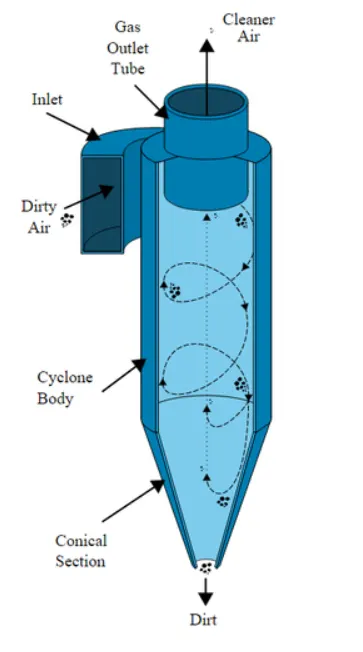
Given Data
- Boundary Condition
- Inlet and wall: Reflect
- Outlet(Top): Escape
- Outlet(Bottom/ Dustbin): Trap
Procedure to Case 1:
- Geometry Setup
Import the given geometry and extract volume by selecting a fluid walls using extract volume.
- Import Geometry
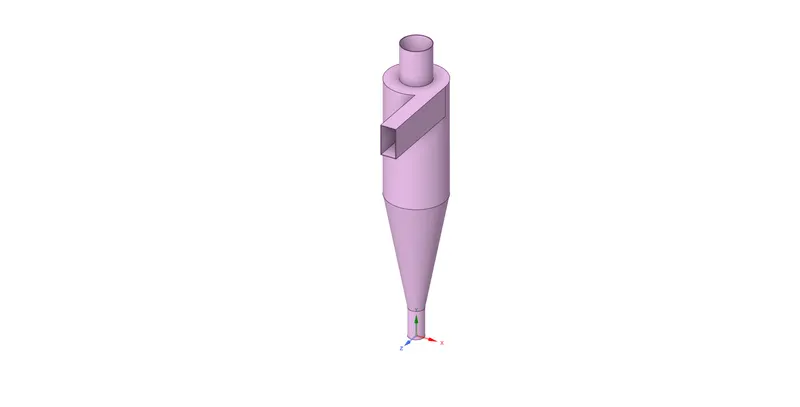
- Extract Fluid Volume Geometry
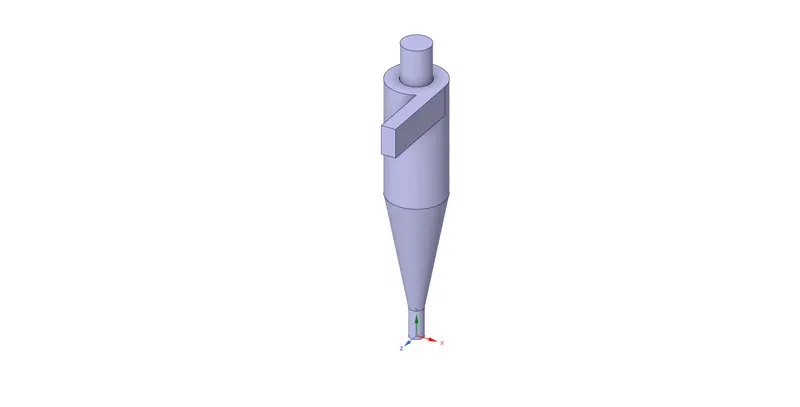
- Import Geometry
- Mesh
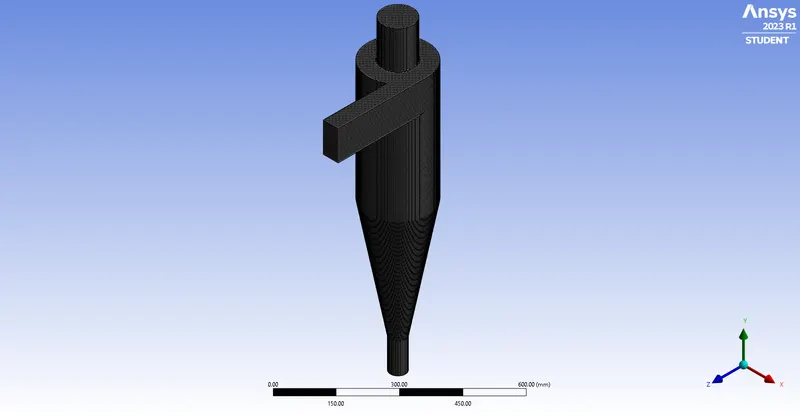
- Body Fitted method of mesh
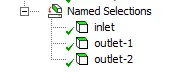
- Named selections are assigned to identify the inlets and outlets of the domain.
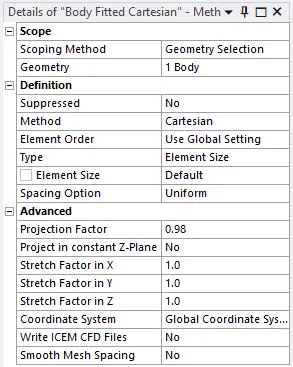
- Body Fitted method of mesh
- Setting Up Physics:
- Pressure based, steady-state solver. Gravity = 9.81 m/s2
- Model: K-Epsilon -> RNG, Swirl Dominated Flow
- Model: Discrete Phase model -> Interaction with continuous phase, update DPM sources every flow iteration, Max no of steps -> Create Injections.
- Discreat Phase
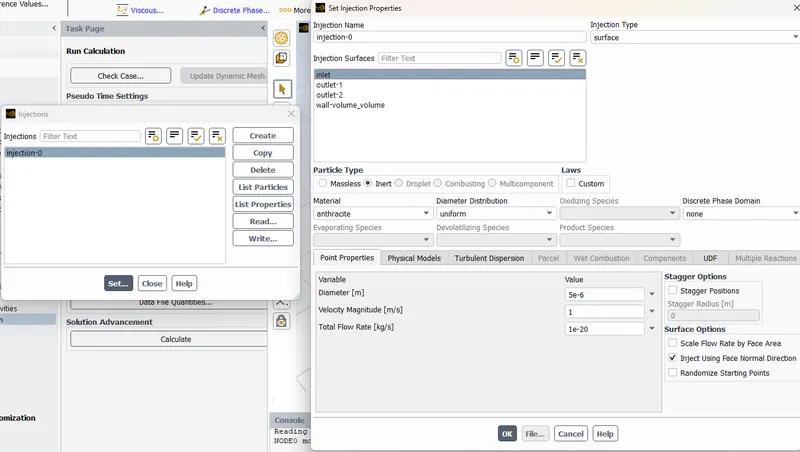
- Case 1.1
- `v` = `3 m/s`
- `d` = `1e-6m`
- Scaled Residuals
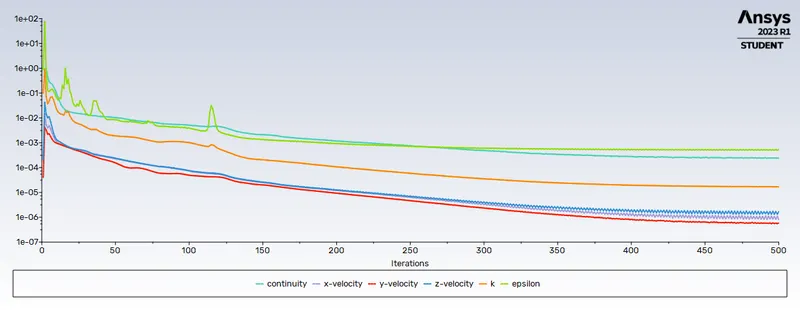
-
Area-Weighted Average [Pa]
Inlet= `31.836 Pa`
-
DPM Iteration Time & Separation Efficiency.
number tracked = 378, escaped = 78, trapped = 300
Separation Efficiency= `300/378*100`= `79.36%`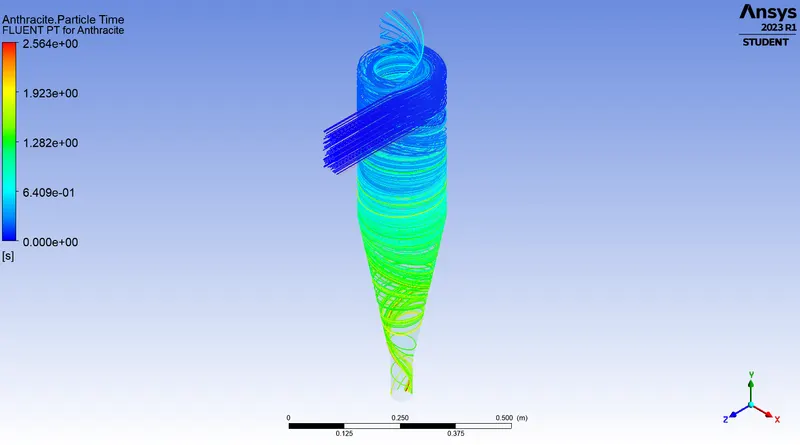
- Pressure contour & Pressure drop
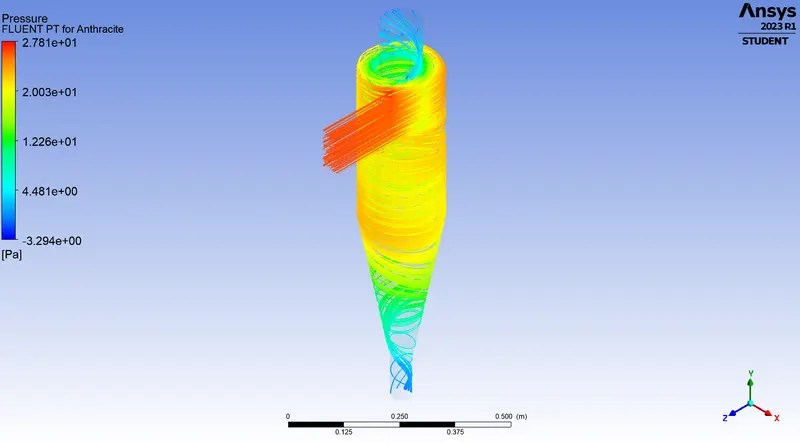
Max Pressure = `27.807 Pa`, Min Pressure = `-3.294Pa`
Pressure Difference = `31.201 Pa`
- Pressure contour & Pressure drop
- Case 1.2
- `v` = `3 m/s`
- `d` = `2e-6m`
- Scaled Residuals
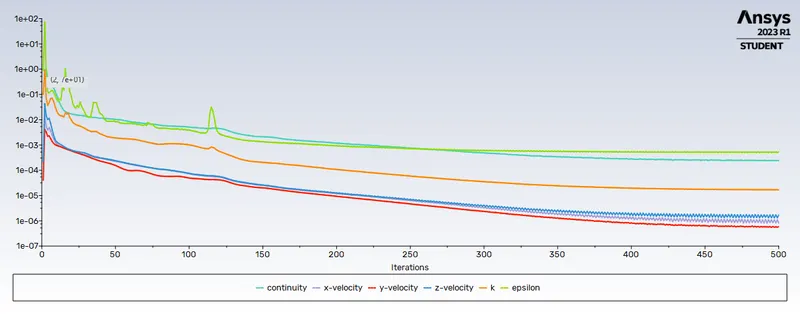
-
Area-Weighted Average [Pa]
Inlet= 31.836
- DPM Iteration Time & Separation Efficiency.
number tracked = 378, escaped = 79, trapped = 299
Separation Efficiency= `299/378*100`= `79%`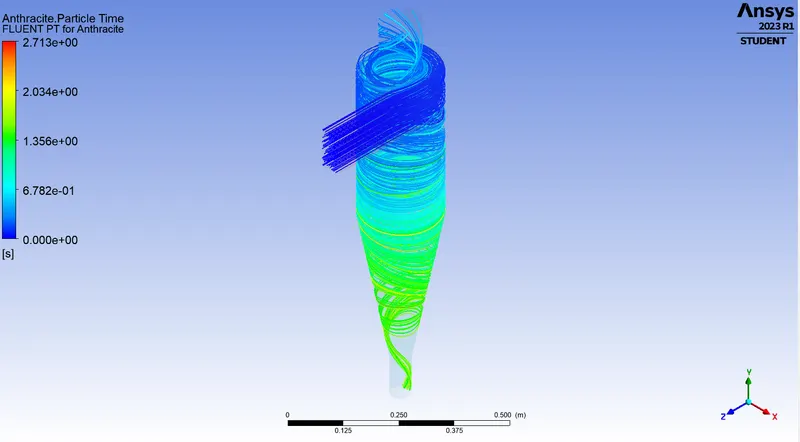
- Pressure contour & Pressure drop
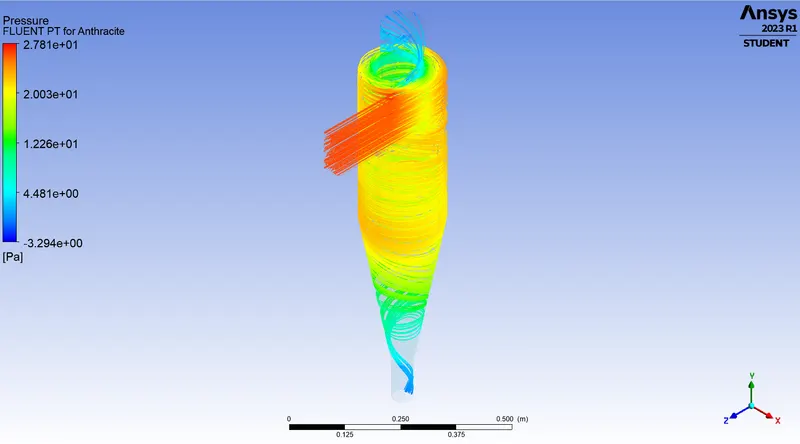
Max Pressure = `27.807 Pa`, Min Pressure = `-3.294Pa`
Pressure Difference = `31.101 Pa` - Case 1.3
- `v` = 3`m/s`
- `d` = `3e-6m`
- Scaled Residuals
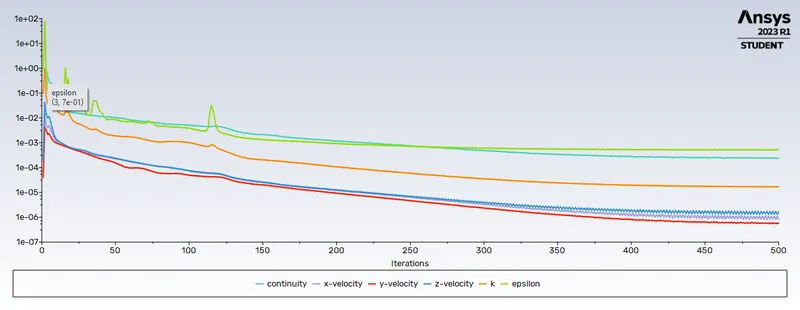
-
Area-Weighted Average [Pa]
Inlet= 31.836966
-
DPM Iteration Time & Separation Efficiency.
number tracked = 378, escaped = 73, trapped = 305
Separation Efficiency= `248/378*100`= `80.68%`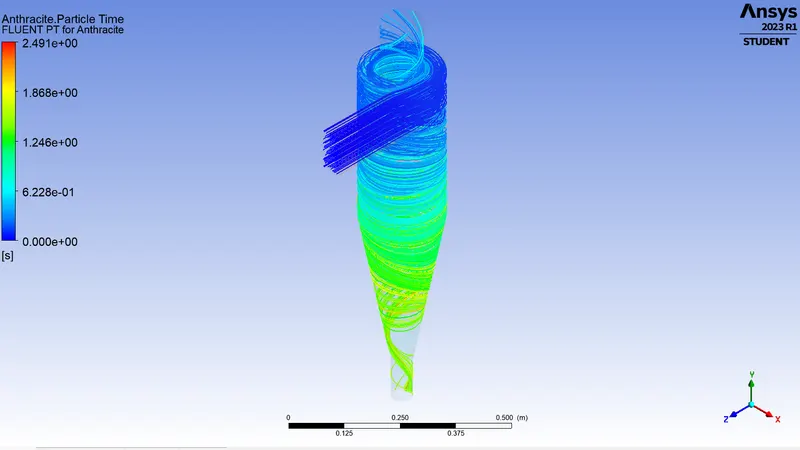
- Pressure contour & Pressure drop
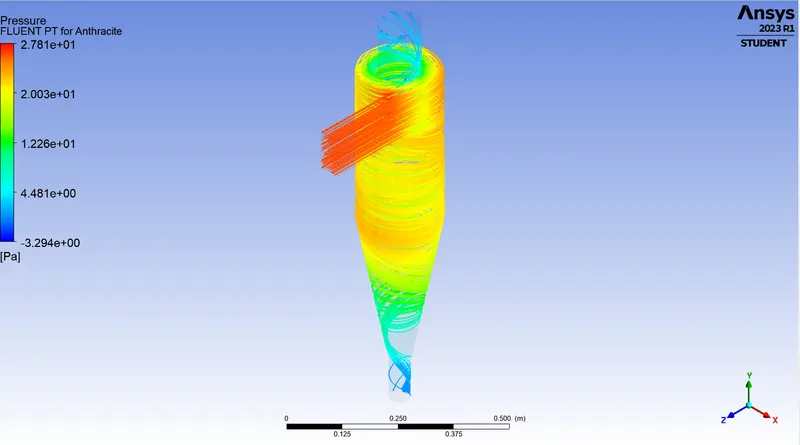
Max Pressure = `27.807 Pa`, Min Pressure = `-3.296 Pa`
Pressure Difference = `31.103 Pa`
- Pressure contour & Pressure drop
- Case 1.4
- `v` = `3m/s`
- `d` = `4e-6m`
- Scaled Residuals
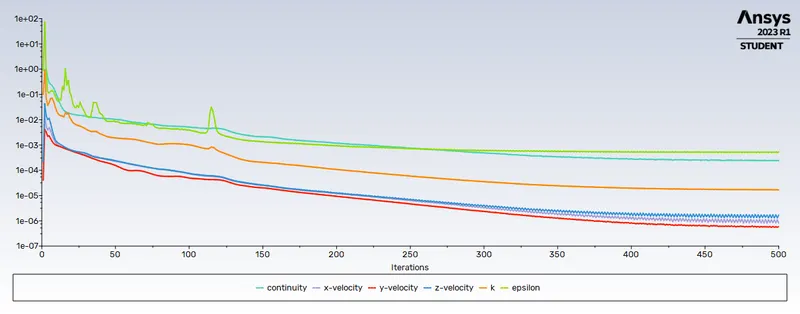
-
Area-Weighted Average [Pa]
Inlet= 31.836
-
DPM Iteration Time & Separation Efficiency.
number tracked = 378, escaped = 90, trapped = 288
Separation Efficiency= `288/378*100`= `76.19%`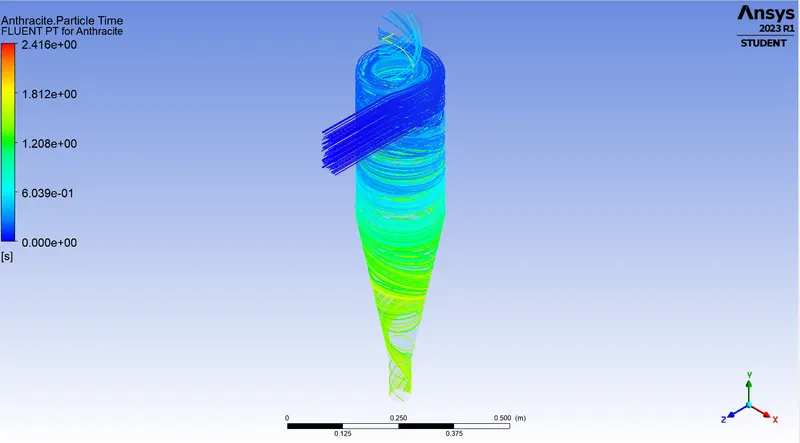
- Pressure contour & Pressure drop
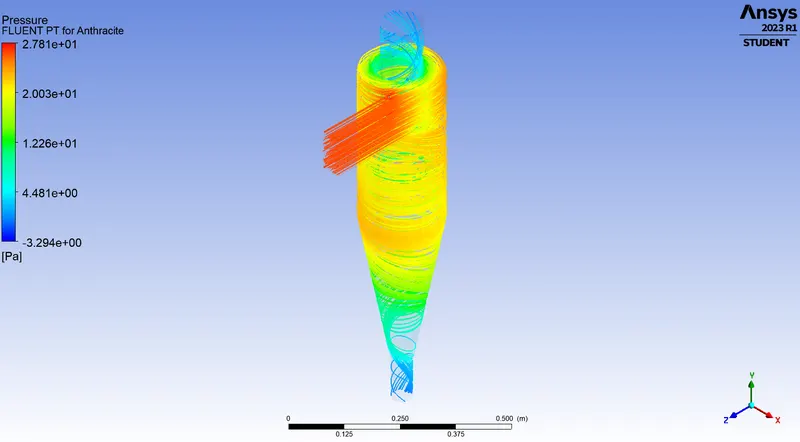
Max Pressure = `27.807Pa`, Min Pressure = `-3.294 Pa`
Pressure Difference = `31.101 Pa`
- Pressure contour & Pressure drop
- Case 1.5
- `v` = 3`m/s`
-
- `d` = `5e-6m`
- `d` = `5e-6m`
- Scaled Residuals
-
Area-Weighted Average [Pa]
Inlet= 31.836966
-
DPM Iteration Time & Separation Efficiency.
number tracked = 378, escaped = 130, trapped = 248
Separation Efficiency= `248/378*100`= `65.61%`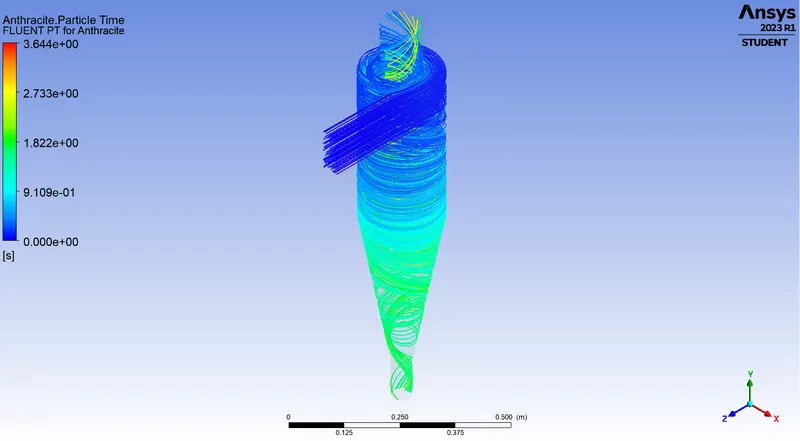
- Pressure contour & Pressure drop
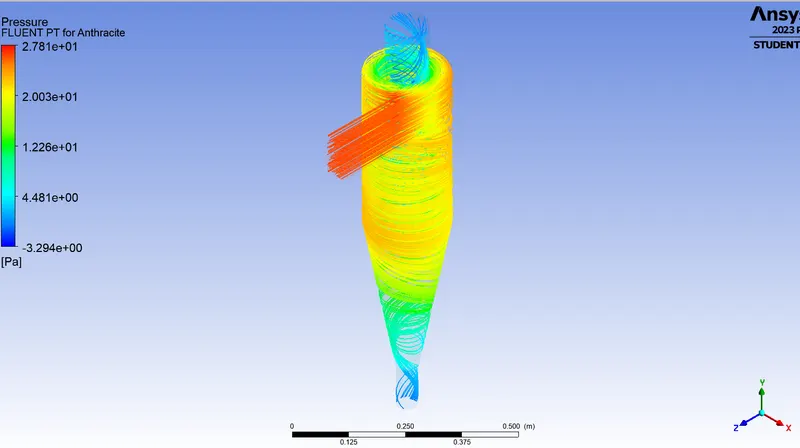
Max Pressure = `27.807 Pa`, Min Pressure = `-3.296 Pa`
Pressure Difference = `31.103 Pa`
- Pressure contour & Pressure drop
Case 2.1
- `v` = 1`m/s`
- `d` = `5e-6m`
- Scaled Residuals
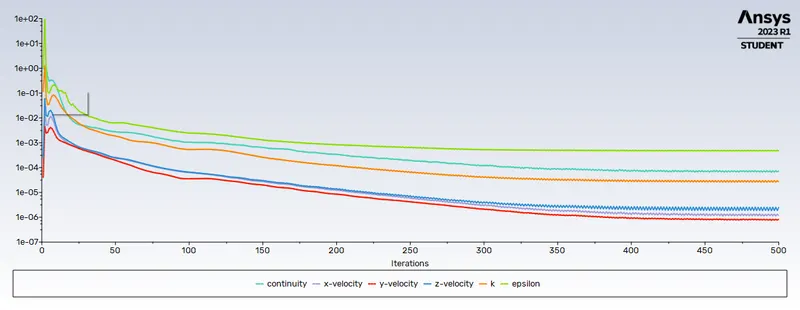
-
Area-Weighted Average [Pa]
Inlet= 2.9175813
-
DPM Iteration Time & Separation Efficiency.
number tracked = 378, escaped = 67, trapped = 311
Separation Efficiency= `311/378*100`= `82.275%`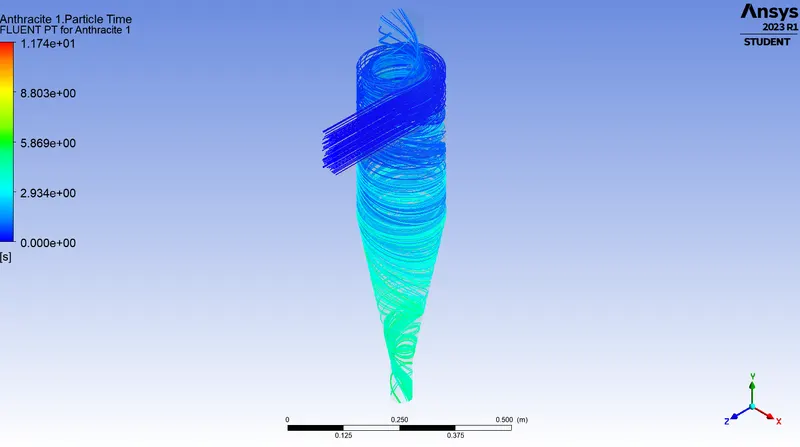
- Pressure contour & Pressure drop
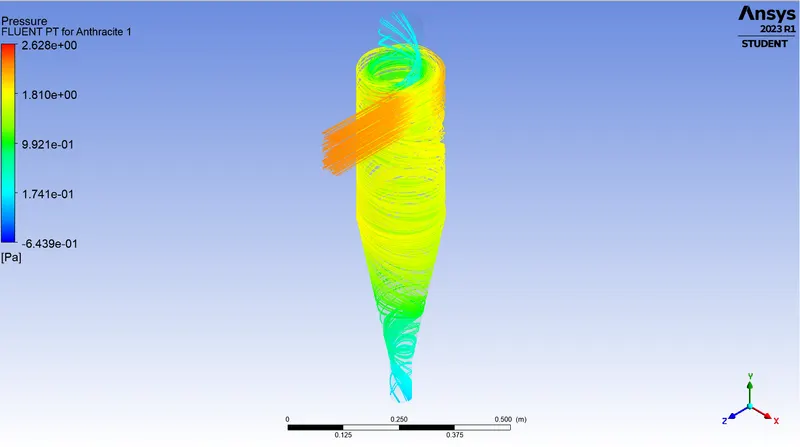
Max Pressure = `2.628 Pa`, Min Pressure = `-0.643 Pa`
Pressure Difference = `3.271 Pa`
- Pressure contour & Pressure drop
- Case 2.2
- `v` = 2`m/s`
- `d` = `5e-6m`
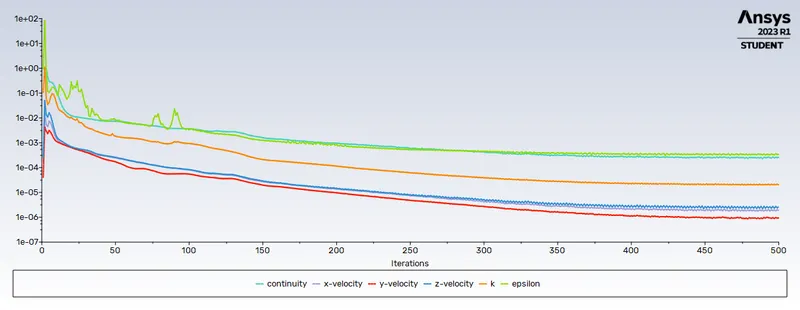
- Scaled Residuals
-
Area-Weighted Average [Pa]
Inlet= 13.802
- DPM Iteration Time & Separation Efficiency.
number tracked = 378, escaped = 90, trapped = 288
Separation Efficiency= `288/378*100`= `70.19%`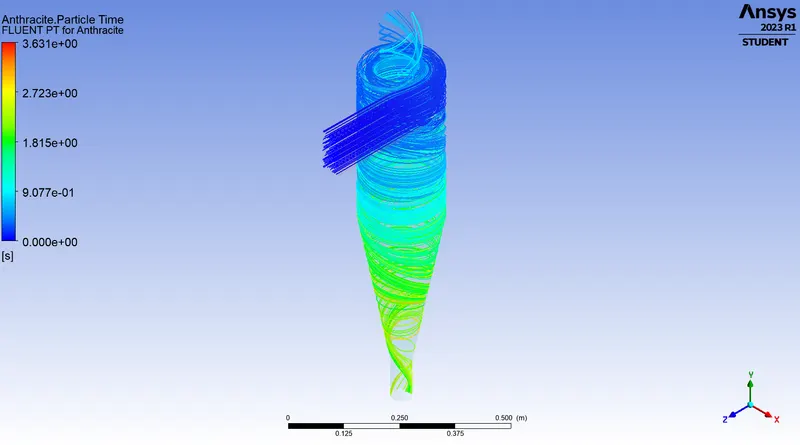
- Pressure contour & Pressure drop
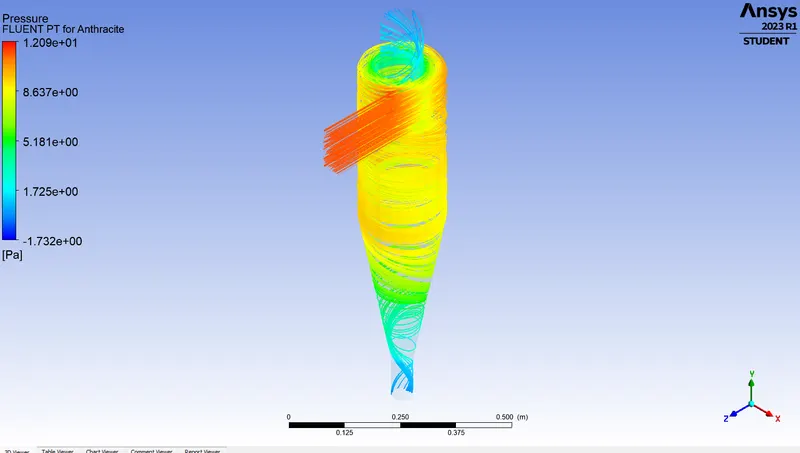
Max Pressure = `12.093 Pa`, Min Pressure = `-1.7318 Pa`
Pressure Difference = `13.824 Pa` - Case 2.3
- `v` = 3`m/s`
- `d` = `5e-6m`
- Scaled Residuals
-
Area-Weighted Average [Pa]
Inlet= 31.836966
-
DPM Iteration Time & Separation Efficiency.
number tracked = 378, escaped = 130, trapped = 248
Separation Efficiency= `248/378*100`= `65.61%`
- Pressure contour & Pressure drop
Max Pressure = `27.807 Pa`, Min Pressure = `-3.296 Pa`
Pressure Difference = `31.103 Pa`
- Pressure contour & Pressure drop
- Case 2.4
- `v` = `4m/s`
- `d` = `5e-6m`
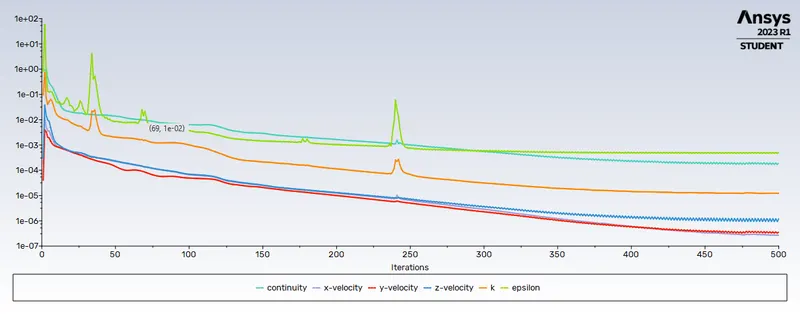
- Scaled Residuals
-
Area-Weighted Average [Pa]
Inlet= 57.767
-
DPM Iteration Time & Separation Efficiency.
number tracked = 378, escaped = 119, trapped = 259
Separation Efficiency= `259/378*100`= `68.51%`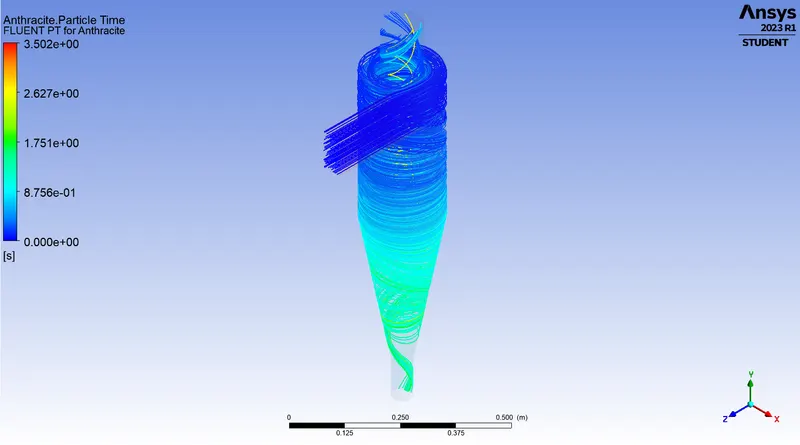
- Pressure contour & Pressure drop
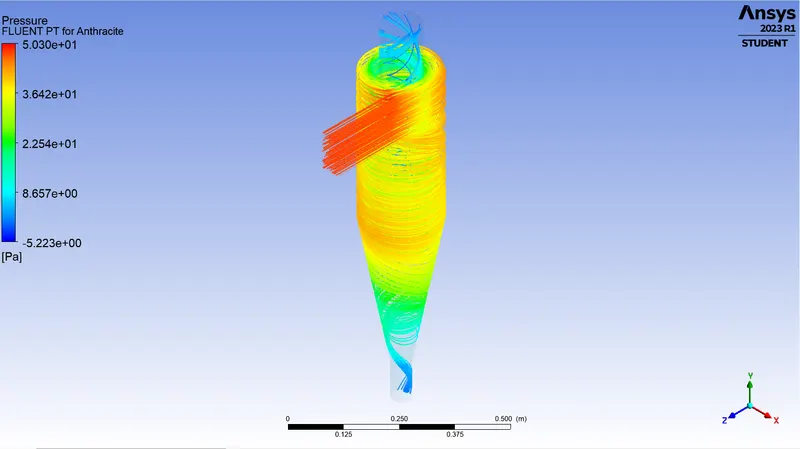
Max Pressure = `50.298 Pa`, Min Pressure = `-5.223Pa`
Pressure Difference = `55.521 Pa`
- Pressure contour & Pressure drop
- Case 2.5
- `v` = `5m/s`
- `d` = `5e-6m`
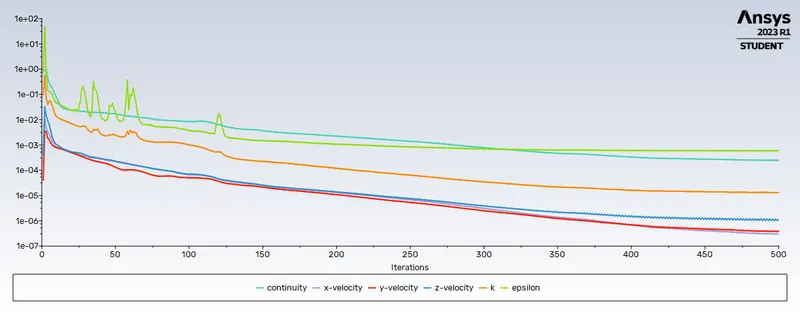
- Scaled Residuals
-
Area-Weighted Average [Pa]
Inlet= `91.833%`
-
DPM Iteration Time & Separation Efficiency.
number tracked = 378, escaped = 80, trapped = 276, incomplete = 22
Separation Efficiency= `276/378*100`= `73.01%`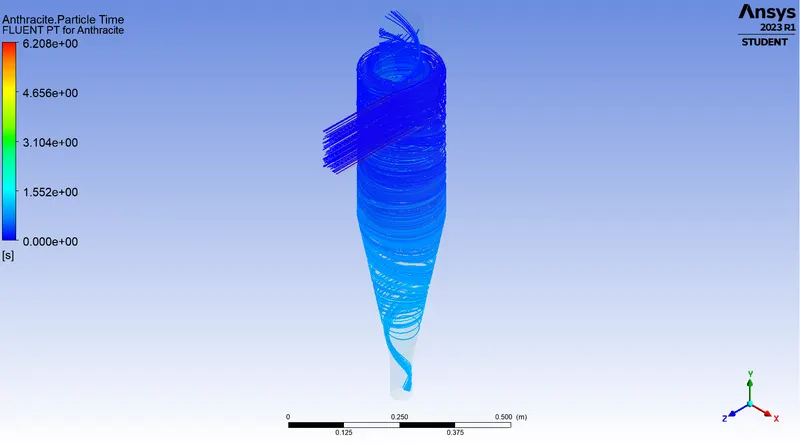
- Pressure contour & Pressure drop
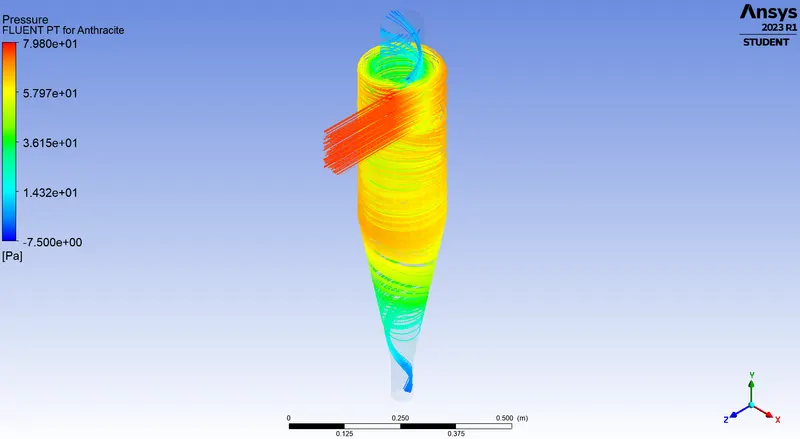
Max Pressure = `79.795 Pa`, Min Pressure = `-7.499 Pa`
Pressure Difference = `87.294 Pa`
- Pressure contour & Pressure drop
Result
- Separation efficiency:
It is defined as the fraction of particles of a given size collected in the cyclone, compared to those of that size going into the cyclone. Experience shows that the separation efficiency of cyclone separator increases with increasing particle mean diameter and density; increasing gas tangential velocity; decreasing cyclone diameter; increasing cyclone length; extraction of gas along with solids through the cyclone legs.
Separation efficiency = No. of particles trapped / No. of particles tracked * 100.
- Pressure Drop:
Pressure drop across the cyclone is of much importance in a cyclone separator. The pressure drop significantly affects the performance parameters of a cyclone. The total pressure drop in a cyclone will be due to the entry and exit losses, and friction and kinetic energy losses in the cyclone. Normally the most significant pressure drop occurs in the body due to swirl and energy dissipation.
Pressure drop = Total inlet pressure - Total Outlet Pressure (escape)
| Case | Practical Size | Practical Tracked | Practical Escaped | Practical Trapped |
Separation Efficiency(η)(%) |
| 1.1 | `1e-6` | 378 | 78 | 300 | 79.36 |
| 1.2 | `2e-6` | 378 | 79 | 299 | 79 |
| 1.3 | `3e-6` | 378 | 73 | 305 | 80.68 |
| 1.4 | `4e-6` | 378 | 119 | 259 | 68.51 |
| 1.5 | `5e-6` | 378 | 130 | 248 | 65.61 |
| Case | Velocities | Practical Tracked | Practical Escaped | Practical Trapped |
Pressure Drop |
Separation Efficiency(η)(%) |
| 2.1 | 1 | 378 | 67 | 311 | 3.271 | 82.275 |
| 2.2 | 2 | 378 | 90 | 288 | 13.824 | 70.19 |
| 2.3 | 3 | 378 | 130 | 248 | 31.103 | 65.61 |
| 2.4 | 4 | 378 | 119 | 259 | 55.521 | 68.51 |
| 2.5 | 5 | 378 | 80 | 276 | 87.294 | 73.01 |
Conclusion
- The efficiency of cyclone separators of the same size and configuration decreases as the particle size decreases.
- The efficiency of the cyclone separator s directly proportional to the flow velocity of the particulate. i.e. high-velocity yields higher efficiency
- Pressure drop only depends on the velocity of the particulate. As the velocity increases the pressure difference between inlet and outlet pressure increases.
- Pressure drop is dependent on velocity. For constant velocity with varying diameter sizes, the pressure drop remains almost constant.
- Increased velocity causes a higher pressure drop.