Week 8 - Simulating Cyclone separator with Discrete Phase Modelling
1) Empirical Models Used To Calculate The Cyclone Separator Efficiency
-
Stairmand Model: The Stairmand model is a widely used empirical model that relates the collection efficiency of a cyclone separator to its geometric parameters, including inlet velocity, cyclone diameter, and particle size. It assumes ideal conditions and provides a simple calculation for the overall collection efficiency.
-
Lapple Model: The Lapple model is another widely used empirical model that takes into account the effect of the cyclone body shape and the tangential velocity component on the separation efficiency. It provides a more refined calculation compared to the Stairmand model, considering the vortex flow pattern and particle trajectories within the cyclone.
-
Barth Model: The Barth model is a modified version of the Stairmand model that incorporates additional parameters such as cyclone height, inlet pipe diameter, and vortex finder length. It improves the accuracy of efficiency predictions by considering more detailed geometrical characteristics of the cyclone separator.
-
Leith and Licht Model: The Leith and Licht model is a semi-empirical approach that combines experimental data with theoretical considerations. It accounts for factors such as particle density, particle size distribution, and fluid viscosity to estimate the efficiency of cyclone separators. This model provides a more comprehensive analysis of the separation process.
CFD ANALYSIS ON CYCLONE SEPARATOR
CFD analysis of a cyclone separator involves simulating the flow behavior and particle separation efficiency within the separator using computational fluid dynamics techniques. It allows for a detailed understanding of the fluid dynamics, particle trajectories, and the performance of the cyclone separator under various operating conditions.
SIMULATION SETUP
GEOMETRY PREPARATION
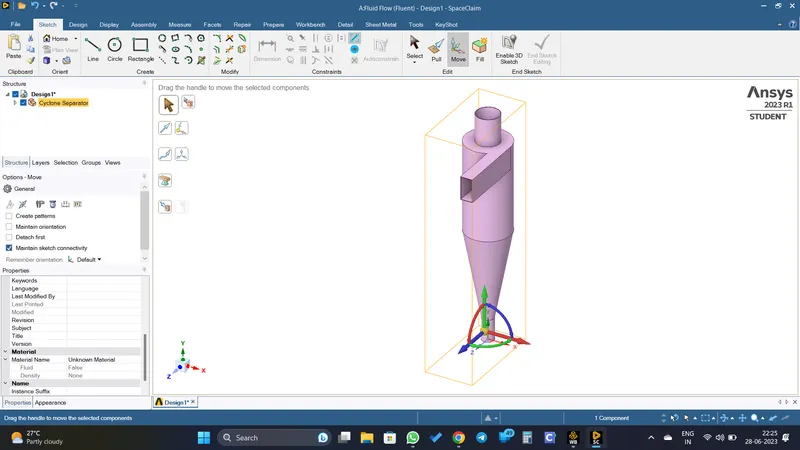
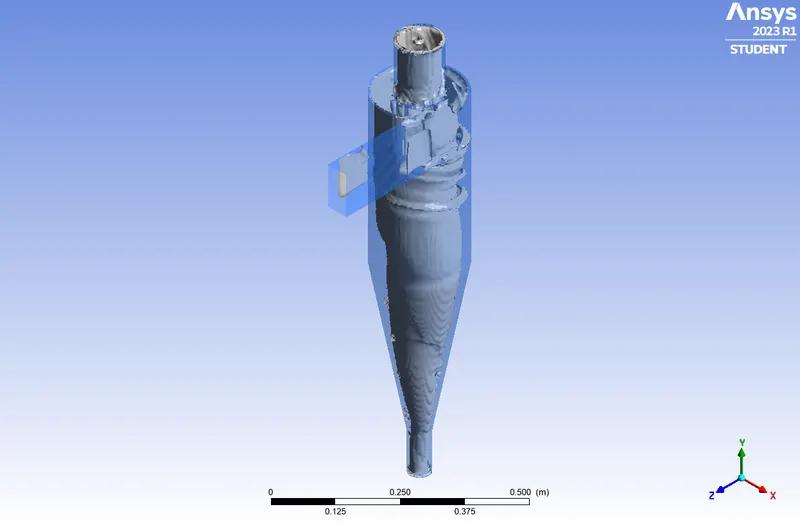
The given model is opened in ANSYS SpaceClaim
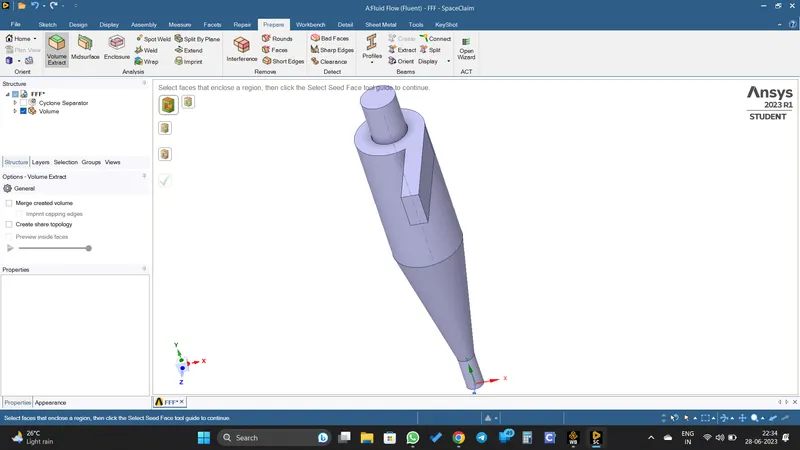
The fluid volume is extracted
MESHING
Then the model is opened in Meshing window.
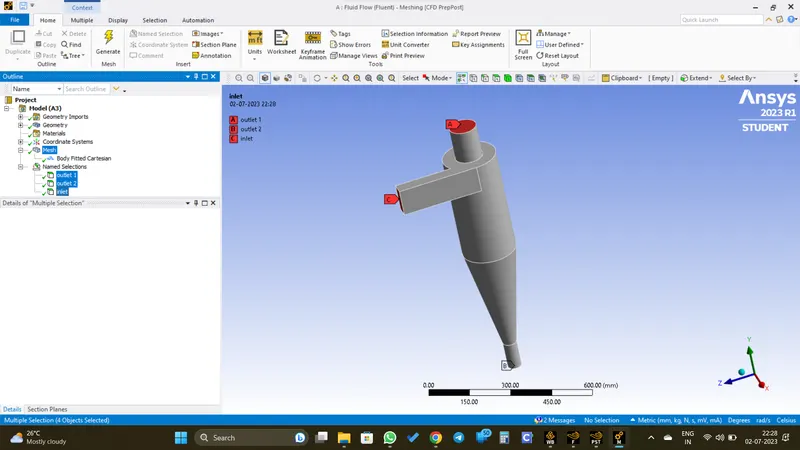
Name selection is done.
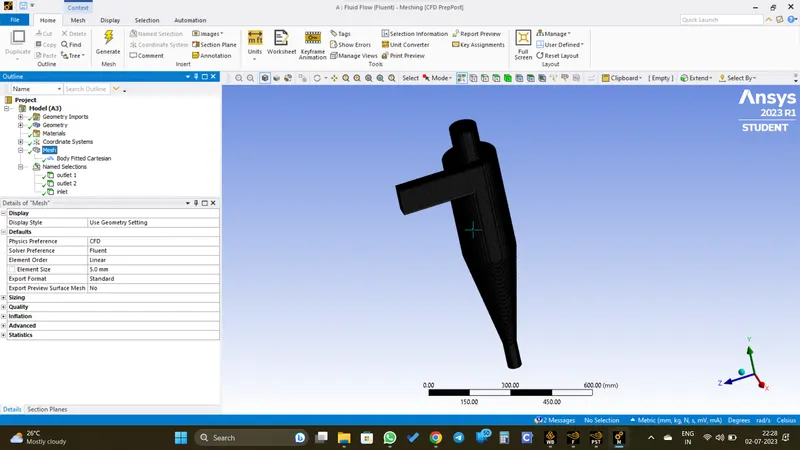
Meshing is created.
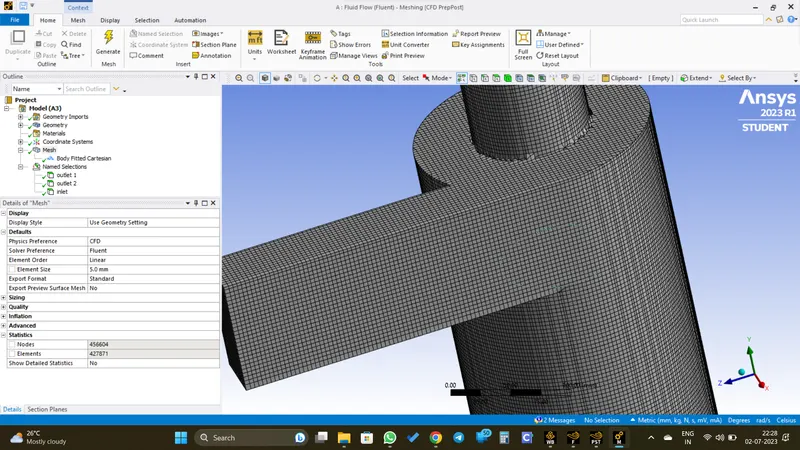
Mesh Parameters;
- Mesh method: Cartesian (structured mesh)
- Element size: 5 mm
- No: of elements: 427871
- No: of nodes: 456604
SIMULATION SETUP
The meshed model is opened in ANSYS Fluent
Simulation Parameters;
- Viscous Model: k-epsilon - RNG - Swirl Domianted Flow - Enhanced Wall Treatment
- Gravity is enabled (-9.82 m/s^2 in y direction)
- Injection of particle is created in DPM
- DPM Boundary Conditions
Inlet: Reflect
Outlet 1: Escape
Outlet 2: Trap
Wall: Reflect
- Solution Method
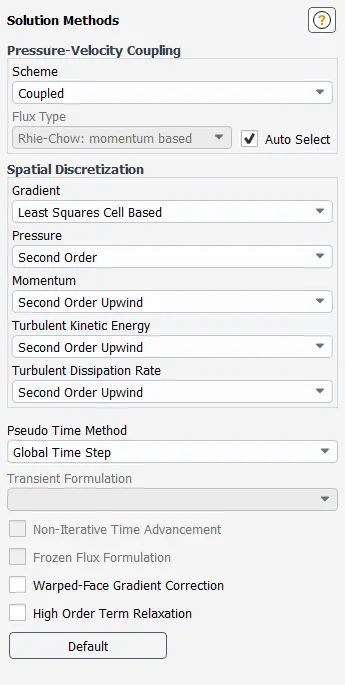
Then the simulation is ran.
RESULTS
2)
Case 1.1 - V = 3 `m`/`s` & d = 1 `mu m`
Residual Plot
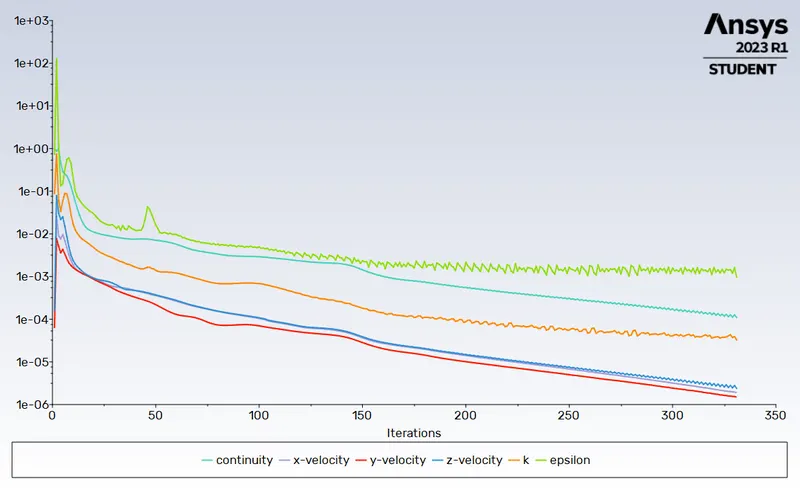
Particle Track
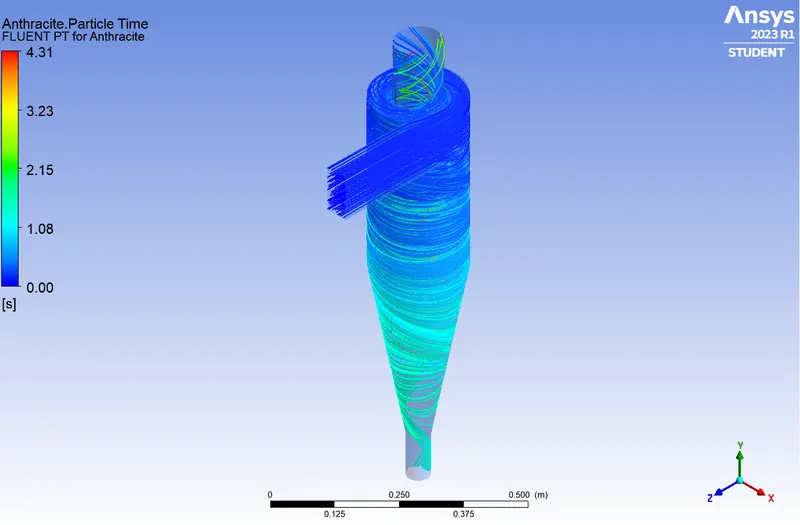
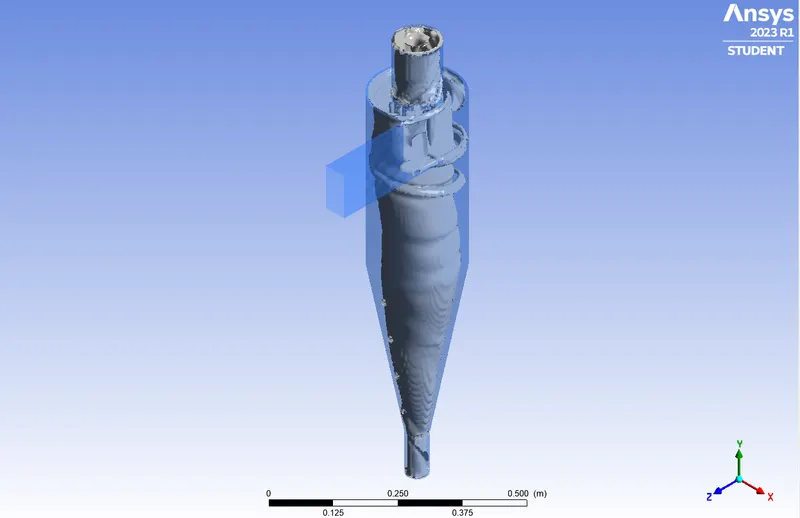
Vortex
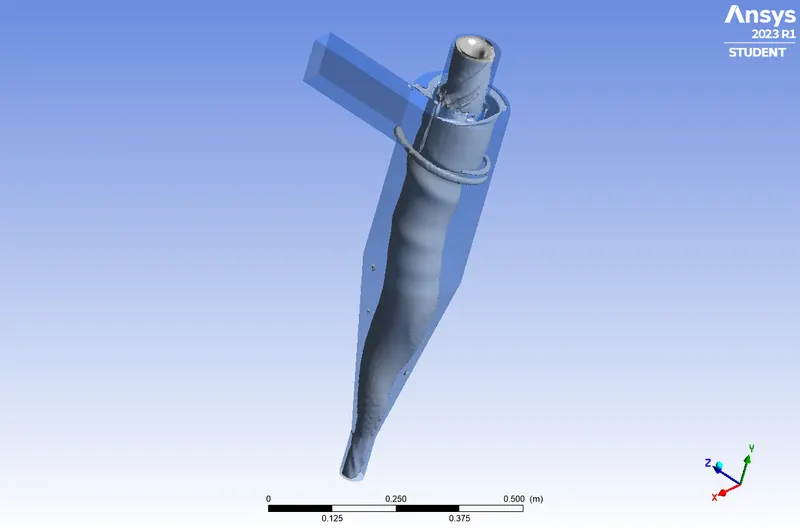
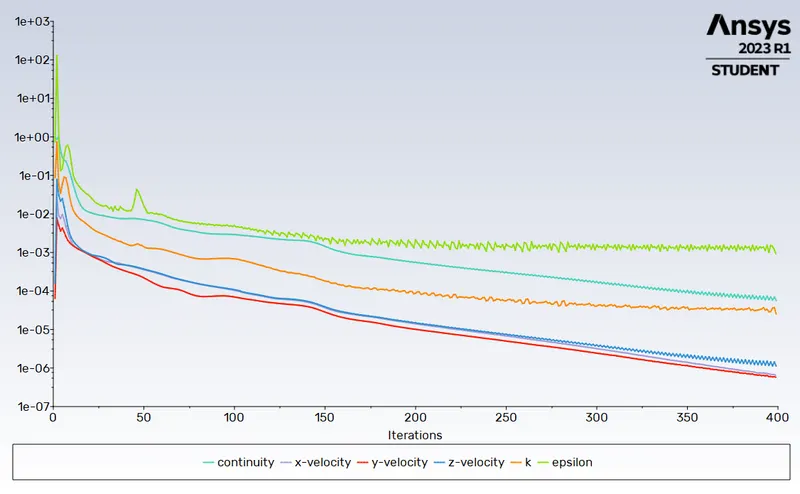
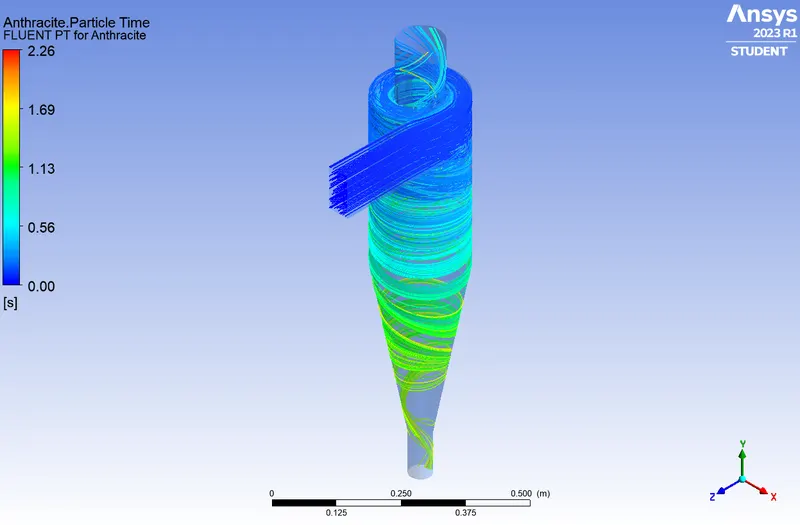
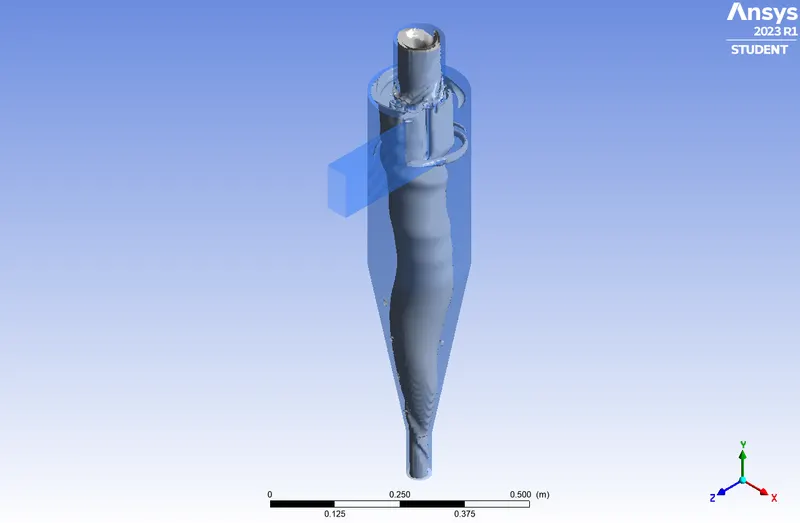
Case 1.2 - V = 3 `m`/`s` & d = 2 `mu m`
Residual Plot
Particle Track
Vortex
Case 1.3 - V = 3 `m`/`s` & d = 3 `mu m`
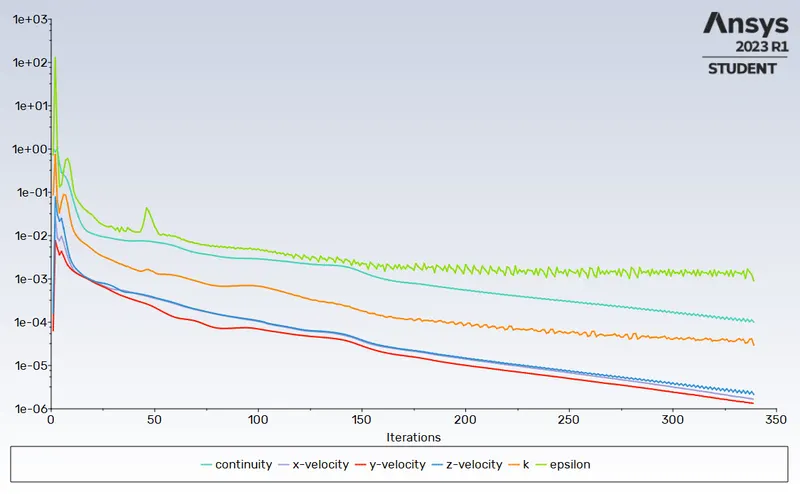
Residual Plot
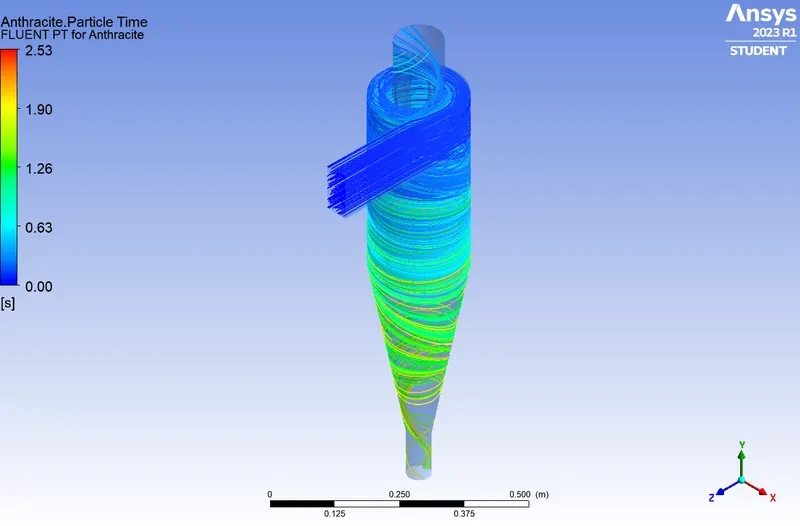
Particle Track
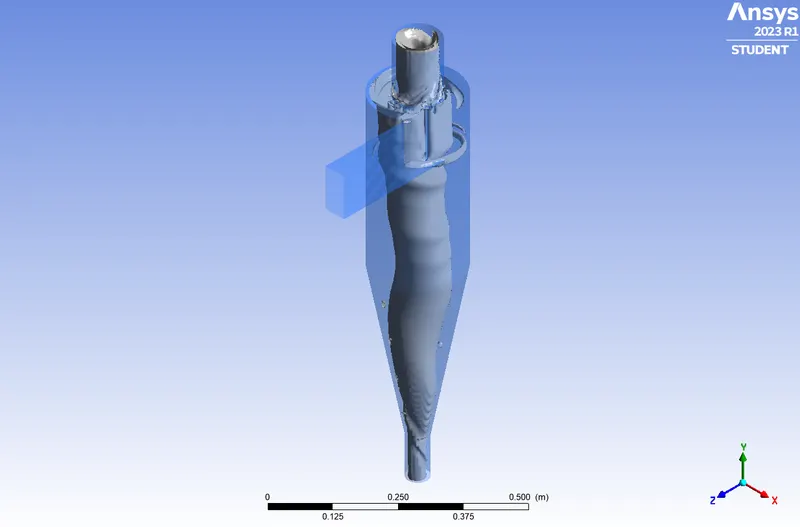
Vortex
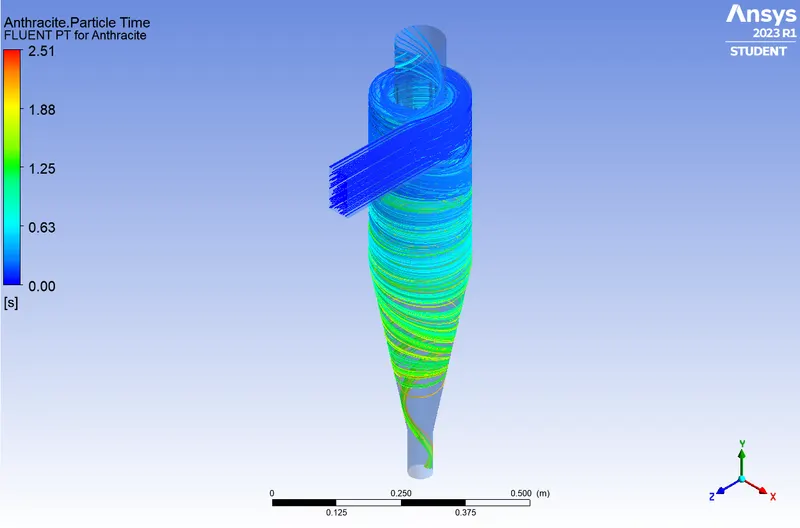
Case 1.4 - V = 3 `m`/`s` & d = 4 `mu m`
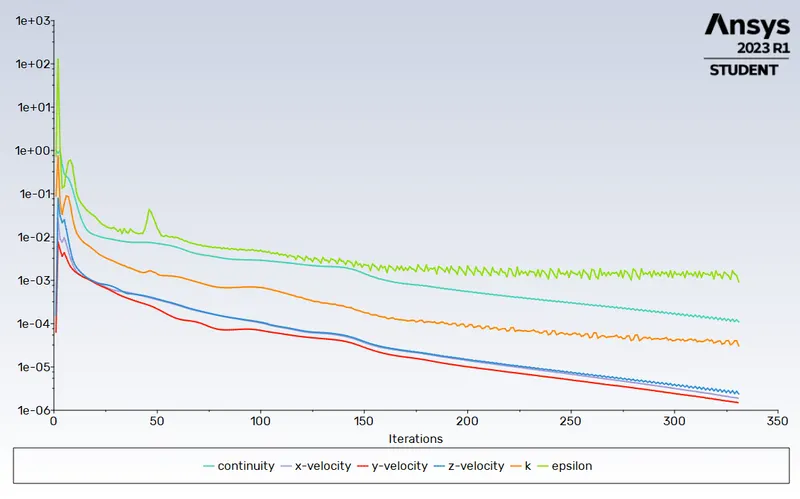
Residual Plot
Particle Track
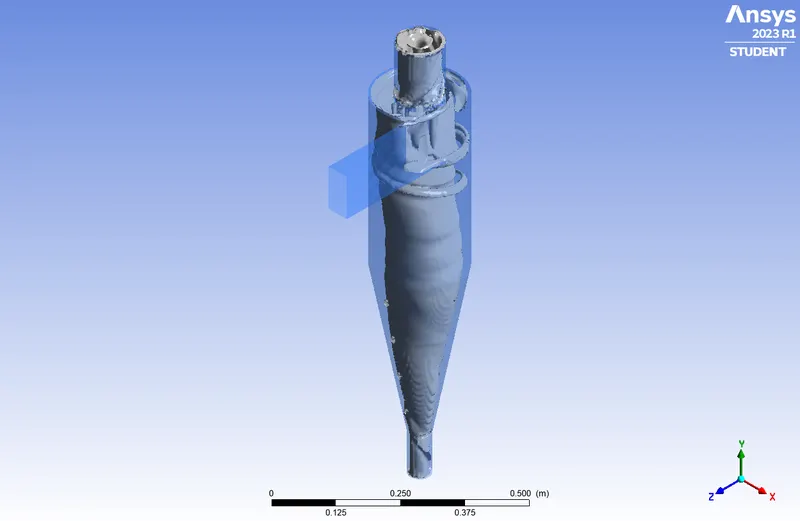
Vortex
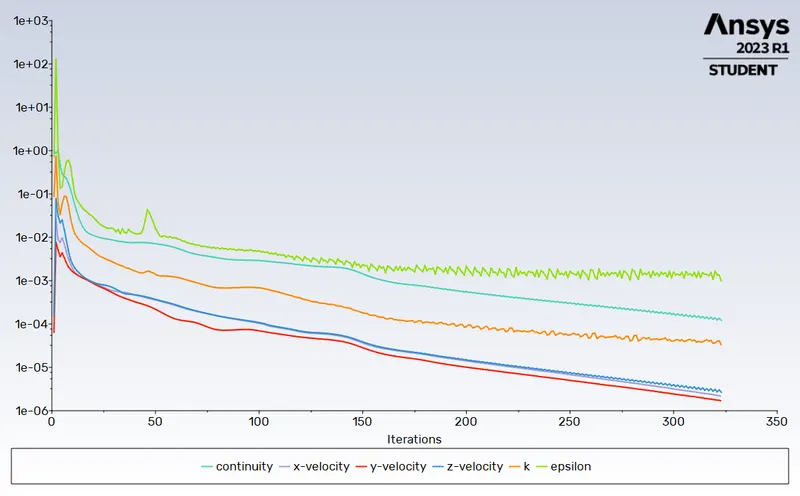
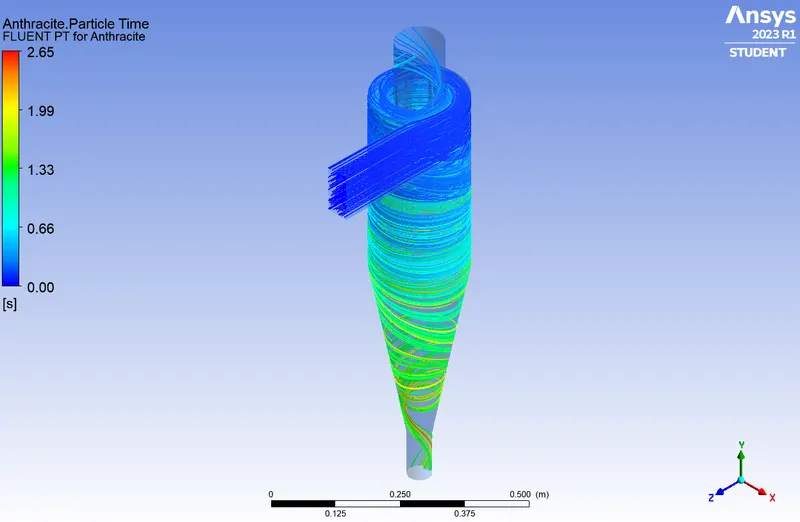
Case 1.5 - V = 3 `m`/`s` & d = 5 `mu m`
Residual Plot
Particle Track
Vortex
3)
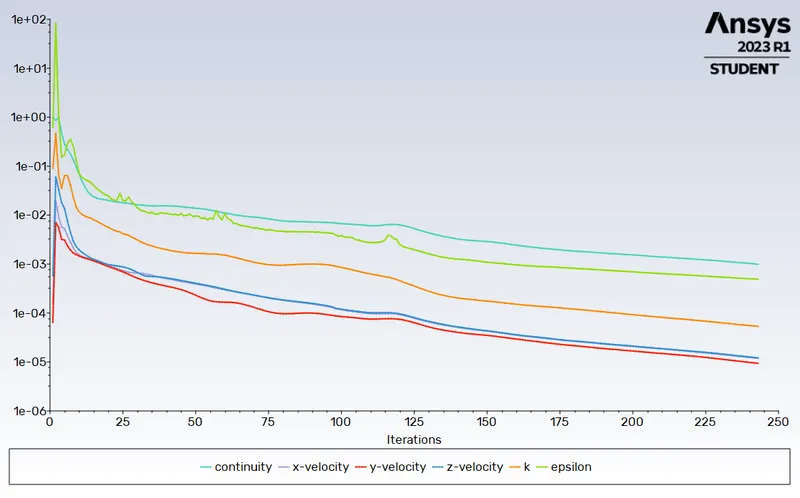
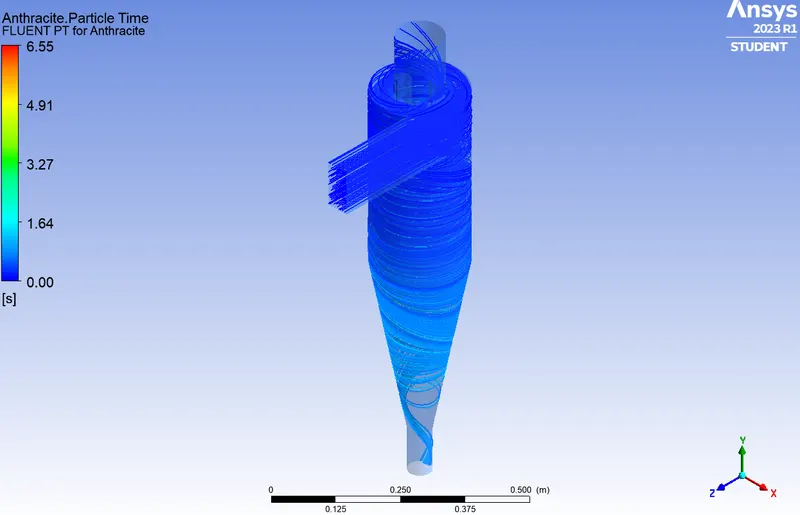
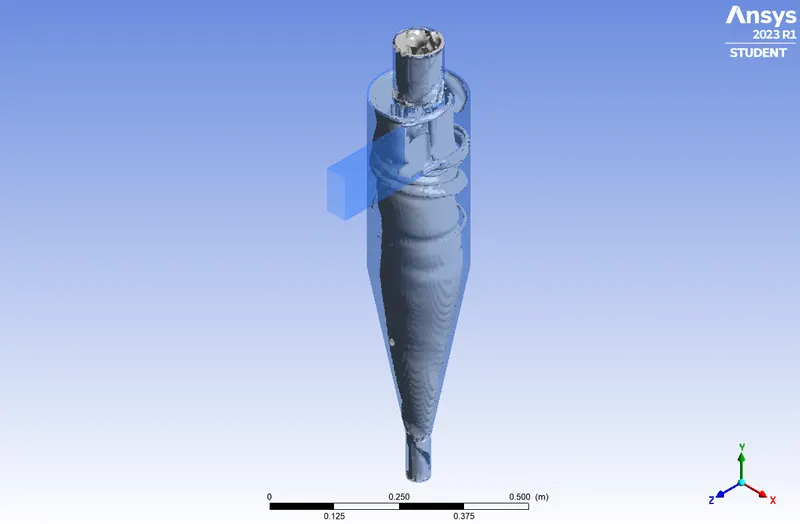
Case 2.1 - V = 1 `m`/`s` & d = 5 `mu m`
Residual Plot
Particle Track
Vortex
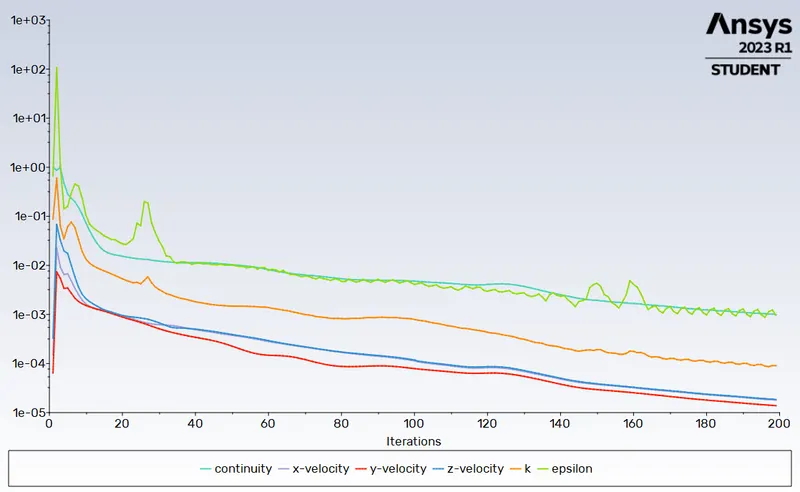
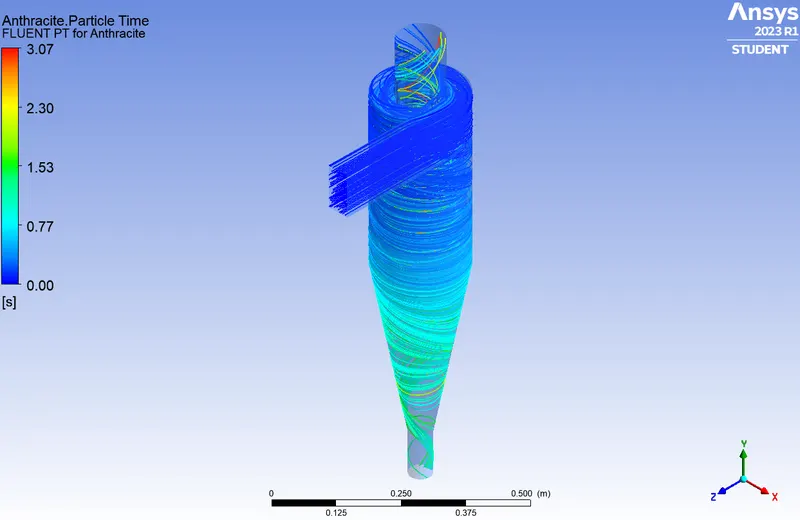
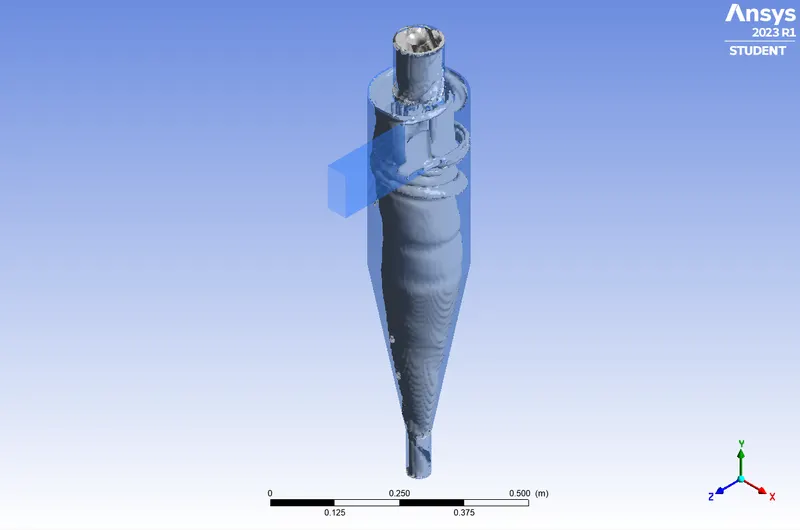
Case 2.2 - V = 2 `m`/`s` & d = 5 `mu m`
Residual Plot
Particle Track
Vortex
Case 2.3 - V = 3 `m`/`s` & d = 5 `mu m`
Residual Plot
Particle Track
Vortex
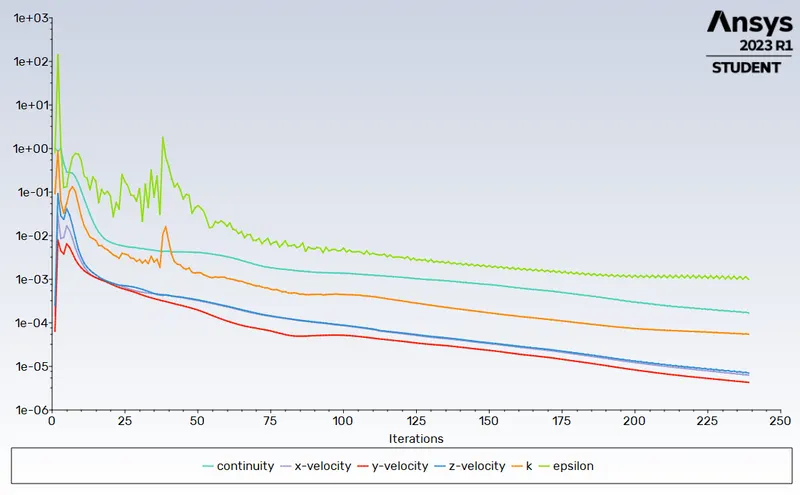
Case 2.4 - V = 4 `m`/`s` & d = 5 `mu m`
Residual Plot
Particle Track
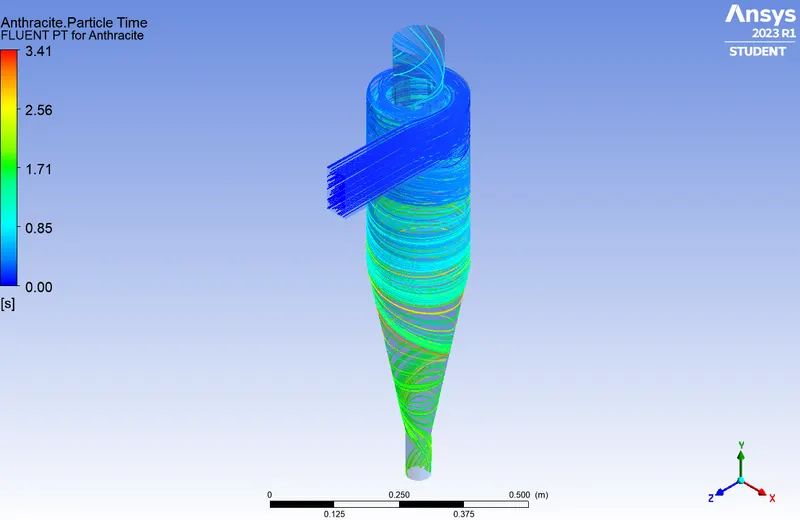
Vortex
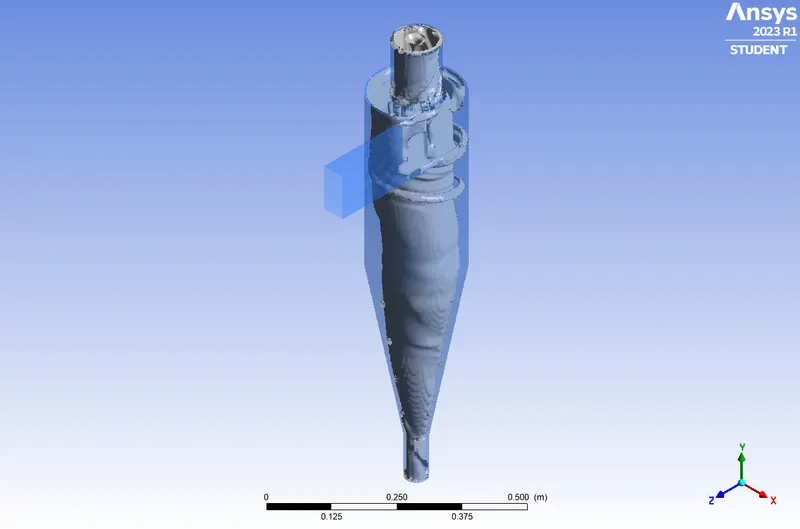
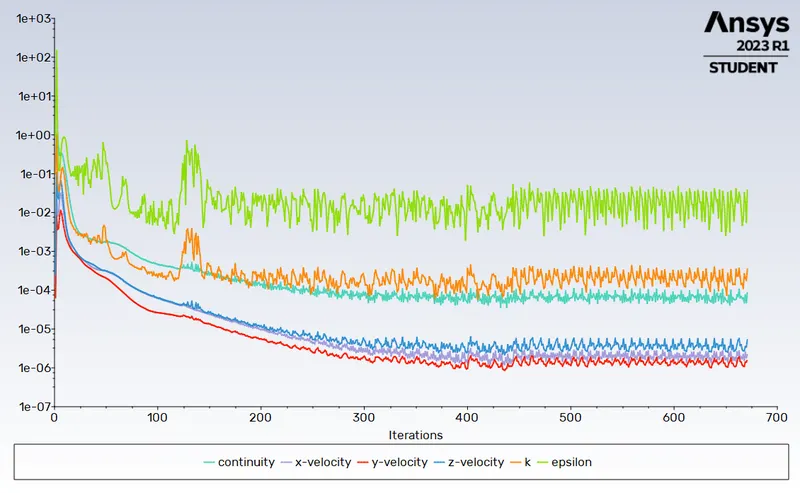
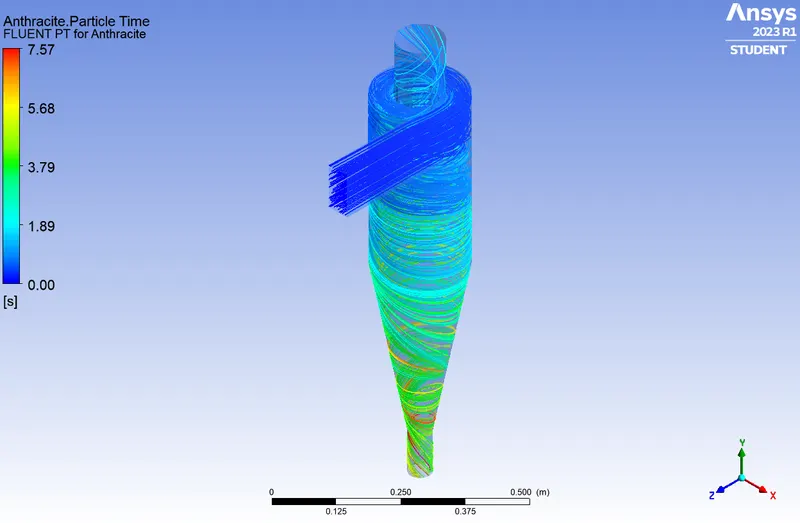
Case 2.5 - V = 5 `m`/`s` & d = 5 `mu m`
Residual Plot
Particle Track
Vortex
OBSERVATION
Below table shows the efficiency of the cyclone separator corresponding different particle size, particle velocity and flow velocity.
The efficiency of the cyclone separator is evaluated based on the percentage of particles captured by the separator.
| CASE | FLOW VELOCITY (`m`/`s`) | PARTICLE VELOCITY (`m`/`s`) | PARTICLE SIZE (`mu m`) | EFFICIENCY (%) |
| case 1.1 | 3 | 3 | 1 | 57.89 |
| case 1.2 | 3 | 3 | 2 | 65.32 |
| case 1.3* | 3 | 3 | 3 | 72.62 |
| case 1.4 | 3 | 3 | 4 | 70.95 |
| case 1.5 | 3 | 3 | 5 | 75.69 |
| case 2.1 | 1 | 1 | 5 | 69.75 |
| case 2.2 | 2 | 2 | 5 | 67.10 |
| case 2.3 | 3 | 3 | 5 | 75.69 |
| case 2.4 | 4 | 4 | 5 | 79.62 |
| case 2.5 | 5 | 5 | 5 | 83.06 |
NB: In case 1.3 the efficiency is not as expected because of incomplete particle tracking. This may be due to the following reasons;
- Inadequate Mesh Resolution
- Turbulence Modeling
- Particle-Particle and Particle-Wall Interactions
- Particle Properties
To improve the accuracy of particle capture in the simulation, it is important to ensure proper mesh resolution, select appropriate turbulence models, account for particle-particle and particle-wall interactions, and accurately represent the particle properties.
Due to the limitations of computational resource, the particle tracking is not improved further.
INFERENCE
-
Flow Velocity: As the flow velocity increases from case 1.1 to case 2.5, there is a general increasing trend in the efficiency of the cyclone separator. Higher flow velocities create stronger centrifugal forces, which enhance the separation of particles from the fluid stream.
-
Particle Velocity: Similar to the flow velocity, increasing the particle velocity also tends to improve the efficiency of the cyclone separator. Higher particle velocities help in achieving better separation as the particles are more effectively driven towards the walls of the cyclone.
-
Particle Size: In case 1.1 to 1.5, as the particle size increases from 1 μm to 5 μm, the efficiency increases. However, in case 1.3, with a particle size of 3 μm, the efficiency slightly increases because of the incomplete particle tracking. In case 2.1 to 2.5, with a constant particle size of 5 μm, the efficiency shows an increasing trend with increasing flow and particle velocities.
CONCLUSION
The simulation of the cyclone separator under different flow velocities, particle velocities, and particle sizes provides valuable insights into its performance. The efficiency of the cyclone separator, which represents the percentage of particles captured by the separator is determined.
From the results, it is observed that higher flow velocities and particle velocities lead to improved efficiency. This is attributed to the increased centrifugal forces and better particle-wall interaction, resulting in enhanced particle separation.
Cyclone separators are most effective in capturing larger particles due to their reliance on centrifugal force. Smaller particles may not experience sufficient centrifugal forces and tend to follow the gas stream, leading to reduced separation efficiency. Additionally, fine particles can exhibit strong particle-particle interactions, which can hinder separation.
For project file, click here