Week 2 - Flow over a Cylinder.
Karman Vortex Street
The phenomenon of Karman vortex street, also known as the von Karman vortex street, is a fluid dynamic phenomenon observed when a fluid, such as air or water, flows past a bluff body, causing alternating vortex shedding in its wake. This phenomenon was named after the Hungarian-American engineer and physicist Theodore von Karman, who extensively studied fluid dynamics.
When a fluid flows around a bluff body, such as a cylinder or a sphere, the flow separates from the body surface and creates regions of low pressure behind it. As the fluid passes the body, vortices form in the wake region due to the instability of the flow.
The alternating vortices in the Karman vortex street result in an oscillating force on the body. This force can lead to vibrations and oscillations, which can be of importance in various engineering applications. The frequency of the vortex shedding and the size of the vortices depend on the flow velocity, the characteristic dimensions of the body, and the properties of the fluid, such as its density and viscosity.
Flow Over Cylinder
AIM
- To simulate the flow over a cyliner for Reynolds number 100 and calculate Strouhal number.
- To calculate the drag and lift for Reynolds numbers 10, 100, 1000, 10000 and 100000.
THEORY
Reynolds Number
The Reynolds number (Re) is a dimensionless quantity used in fluid dynamics to characterize the flow regime and predict the type of flow (such as laminar or turbulent) around an object or within a fluid system.
The Reynolds number is defined as:
Re = (ρ * V * L) / μ
where:
- Re is the Reynolds number
- ρ is the density of the fluid
- V is the velocity of the fluid relative to the object or within the system
- L is a characteristic length or characteristic dimension of the object or the system
- μ is the dynamic viscosity of the fluid
The Reynolds number represents the ratio of inertial forces to viscous forces within the fluid flow. It is an important parameter because it helps determine the flow regime:
- For low Reynolds numbers (typically below 2,000), the flow is usually laminar. In laminar flow, the fluid moves in smooth, parallel layers with minimal mixing and turbulence.
- For high Reynolds numbers (typically above 4,000 or 5,000), the flow is generally turbulent. In turbulent flow, the fluid motion becomes chaotic and exhibits random fluctuations, mixing, and enhanced momentum transport.
Strouhal Number
The Strouhal number (St) is a dimensionless parameter used in fluid dynamics to describe the periodicity or frequency of vortex shedding phenomena. It relates the frequency of vortex shedding to the characteristic length and the velocity of the fluid flow.
The Strouhal number is defined as:
St = f * L / V
where:
- St is the Strouhal number
- f is the frequency of vortex shedding
- L is a characteristic length of the object or flow geometry
- V is the velocity of the fluid flow
The Strouhal number is a dimensionless quantity, meaning it does not depend on the specific units used for frequency, length, or velocity as long as consistent units are used.
The Strouhal number is particularly relevant in cases where vortex shedding occurs behind an object exposed to a fluid flow. For example, it is commonly used to describe the shedding of vortices behind a cylinder or bluff body. The Strouhal number is a characteristic parameter that helps to quantify the relationship between the frequency of vortex shedding and the flow velocity and object geometry.
ANALYSIS SETUP
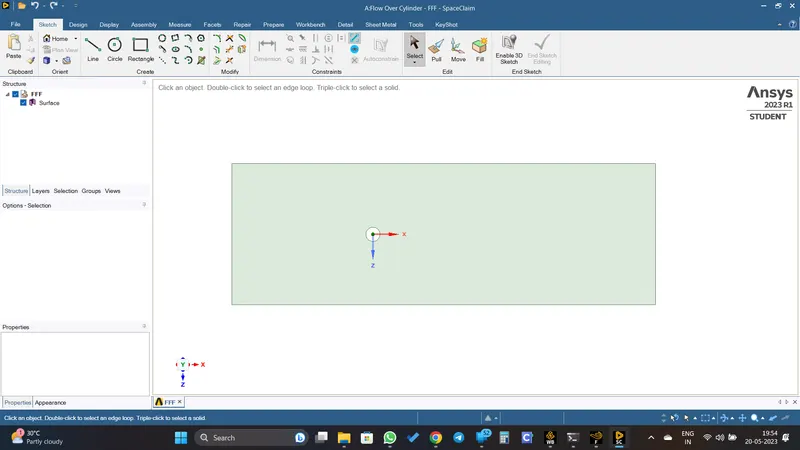
The model is created in spaceclaim as per the given dimensions in the lecture video.
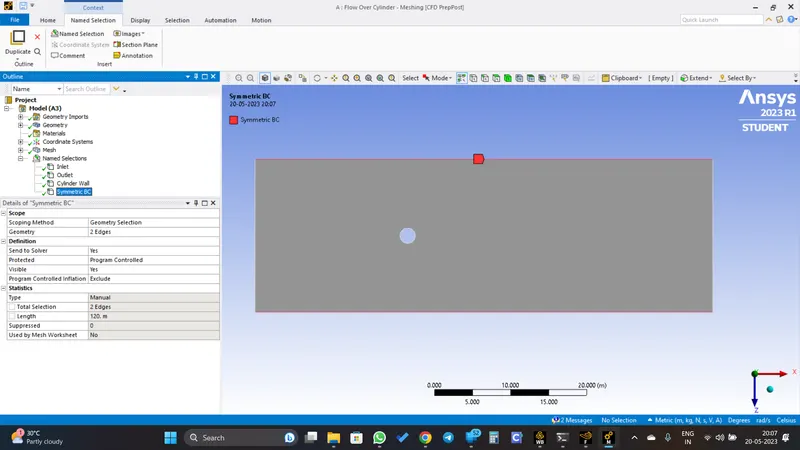
Then the model is opend in the meshing window. Before meshing, the faces of the model is named and done the meshing.
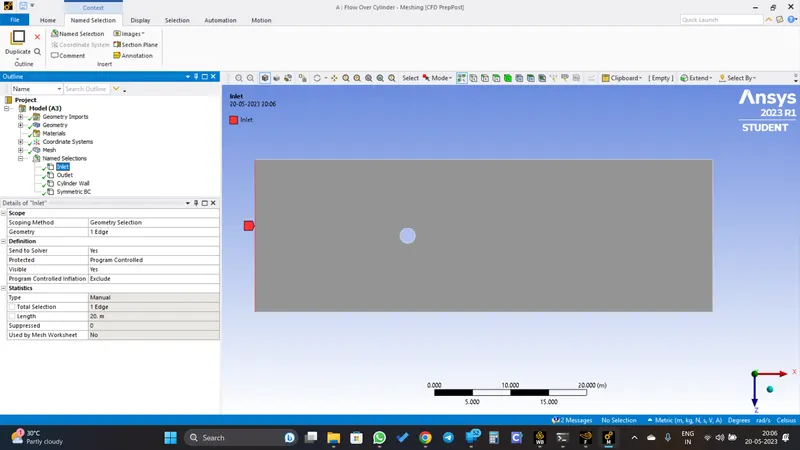
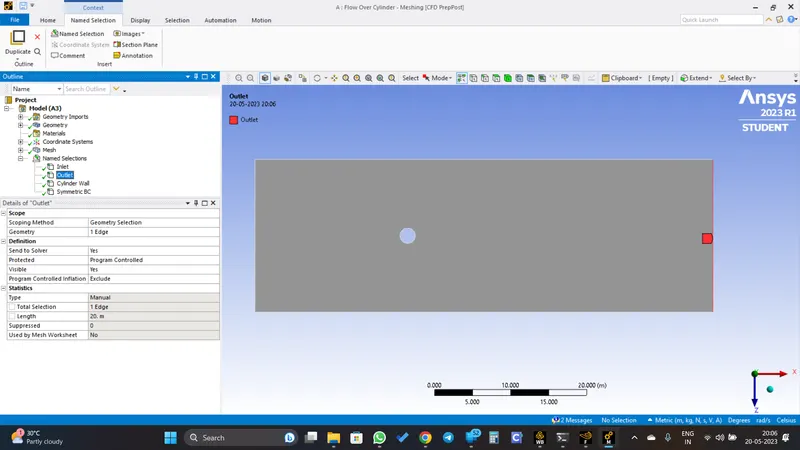
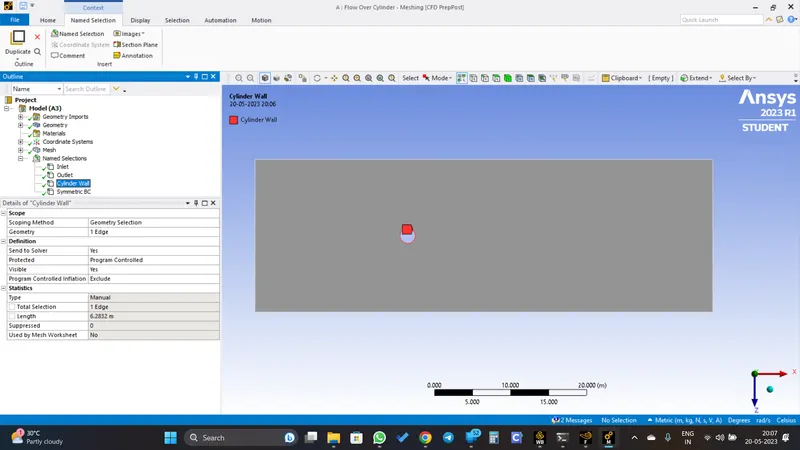
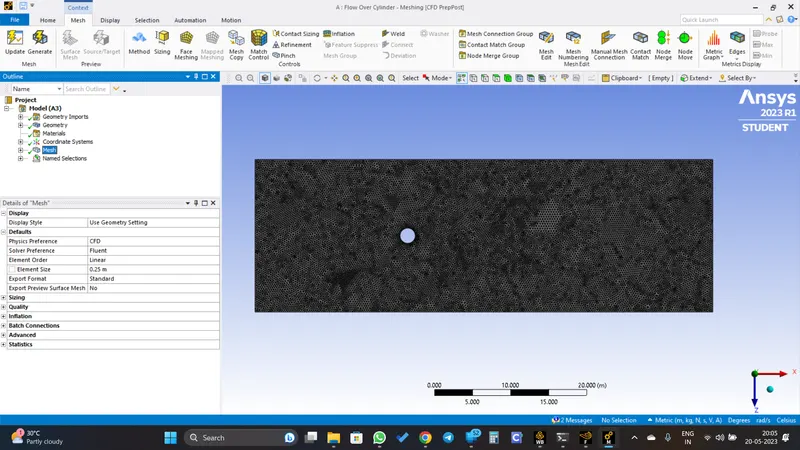
Mesh Properties;
- Element size : 250 mm
- No: of elements : 40528
- No: of nodes : 20710
Then created the inflation layes to capture the fluid properties around the cylinder wall in a better way.
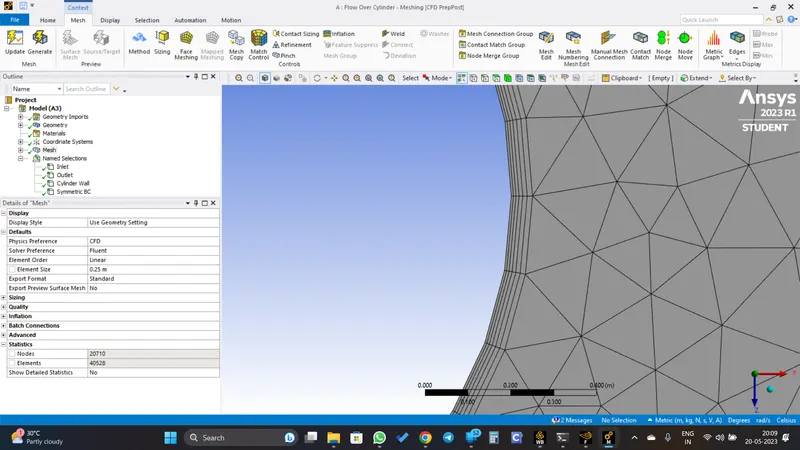
Inflation Layer Properties:
- No: of layers : 6
- Growth rate : 1.2
- First layer thickness : 5 mm
CASE 1
Simulation of the flow with the steady and unsteady case and calculate the Strouhal Number for Re= 100.
CASE 1.1
Simulation of the flow with the steady and calculate the Strouhal Number for Re= 100.
For the simulation the meshed model is opened in ANSYS solution window and given the following conditions.
- Under the Physics > general, Solver time is set to steaddy state.
- Under the boundary conditions inlet velocity is set to be 1 m/s
- In reference values, Area is set to be 2 `m^2` and length is 2 m and select compute from inlet.
- And the model is run for 500 iterations.
RESULTS
Scaled Residual
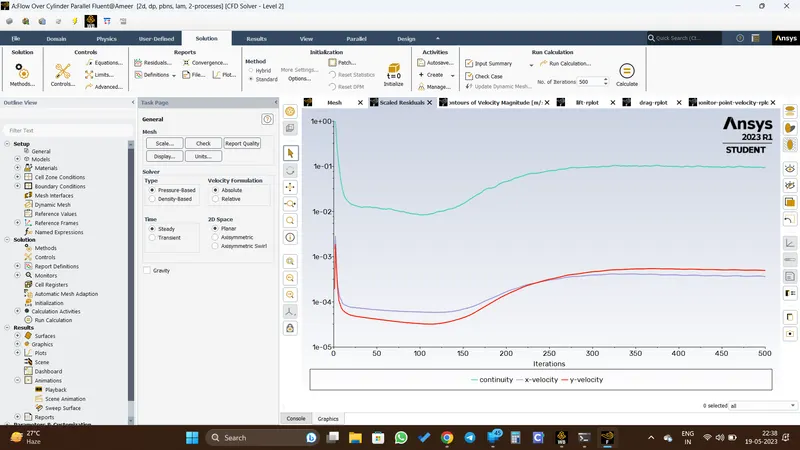
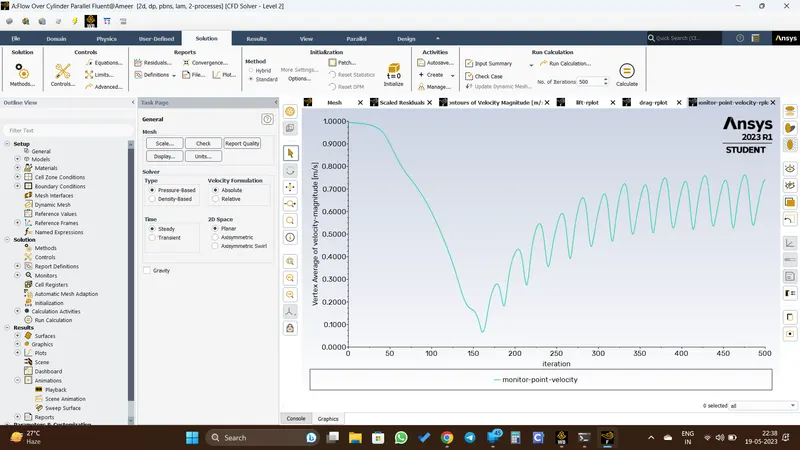
Monitor Point Velocity
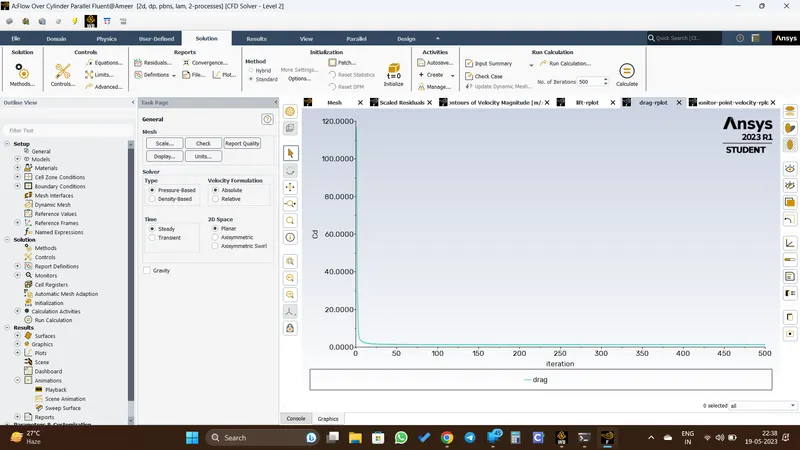
Drag
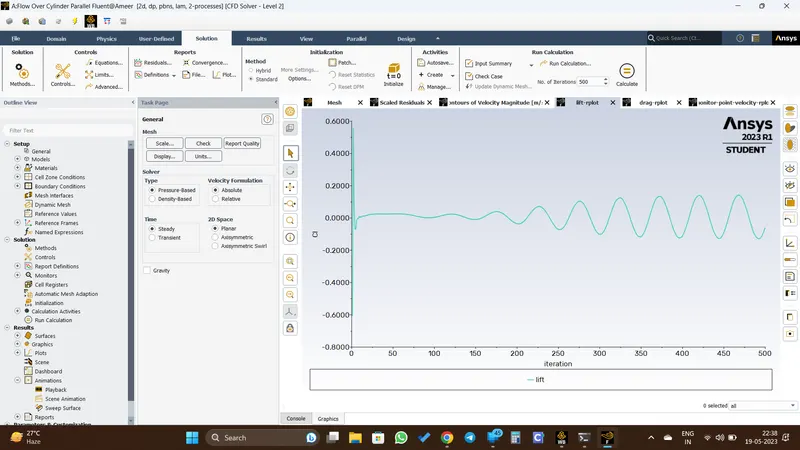
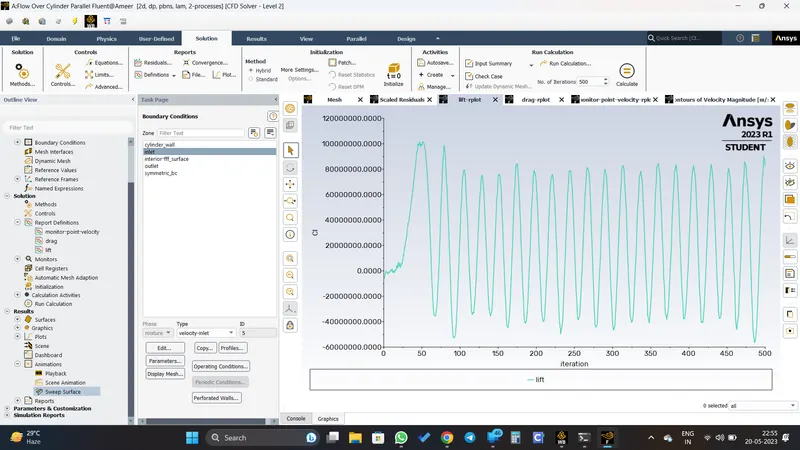
Lift
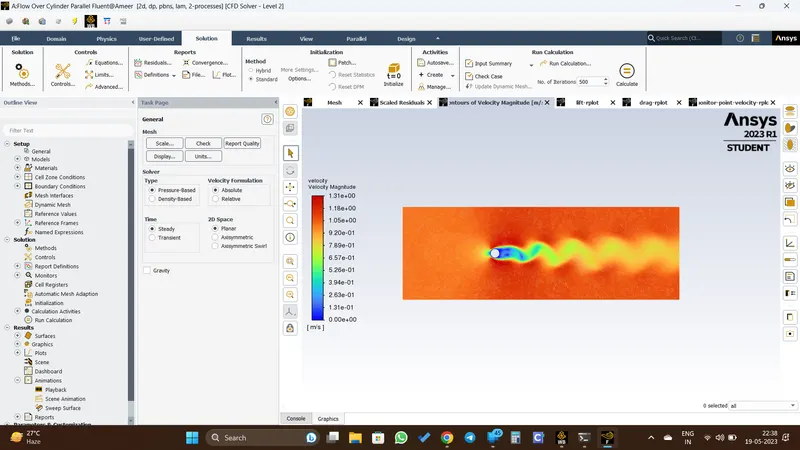
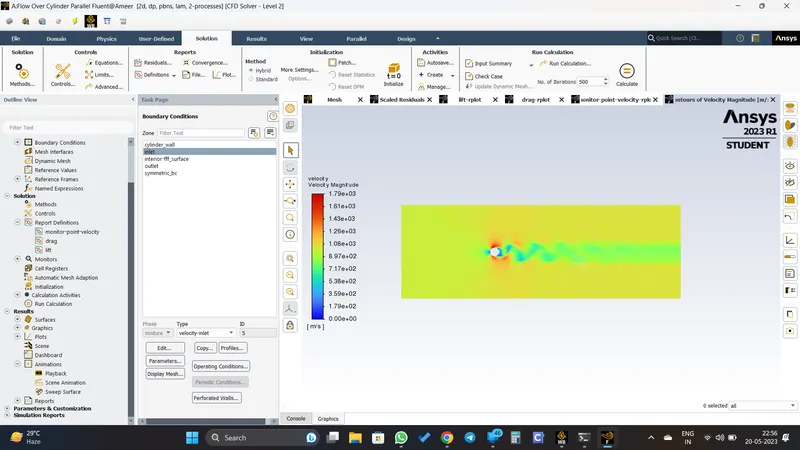
Velocity Contour
Strouhal Number
Plot of Strouhal Number is created using the Fast Fourier Transform (FFT);
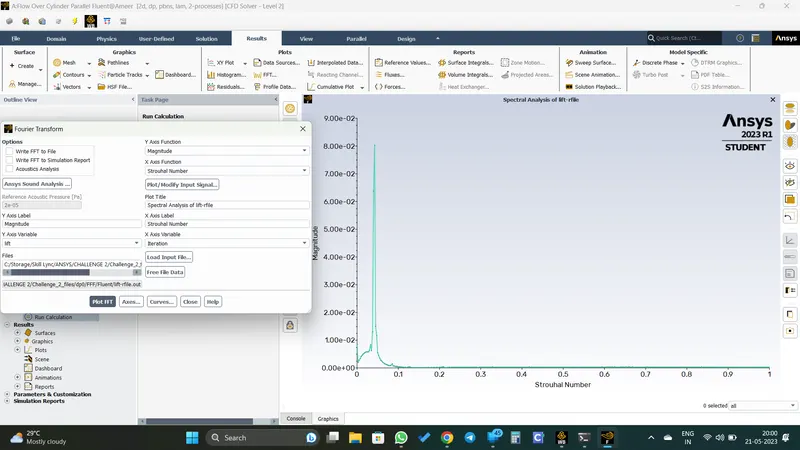
And the mazimum magnitude is 8.05e-02
CASE 1.2
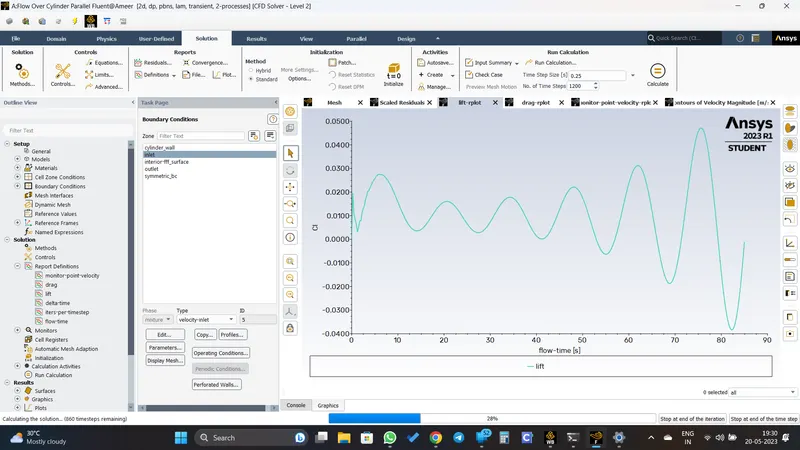
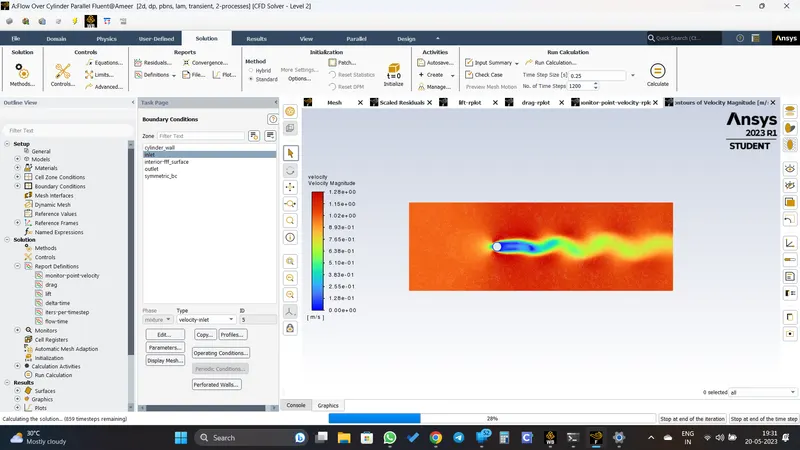
Simulation of the flow with unsteady state and calculate the Strouhal Number for Re= 100.
For this simulation the solver time is set to transient
- Time step size : 0.25
- No: time steps : 1200
ie, the model is run for 300 s
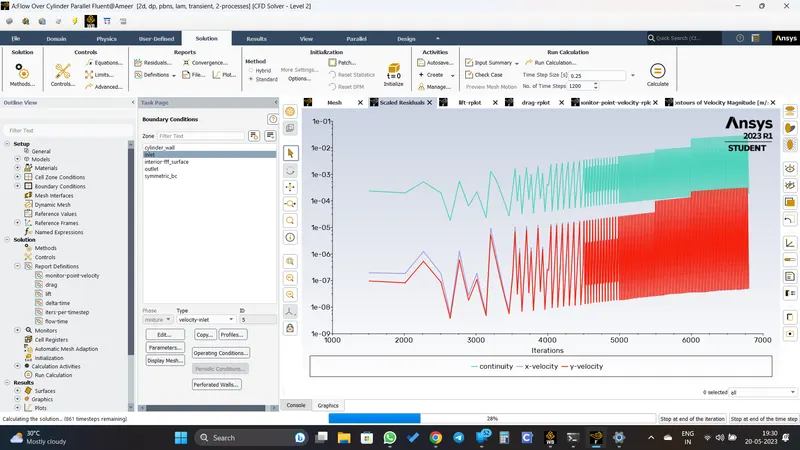
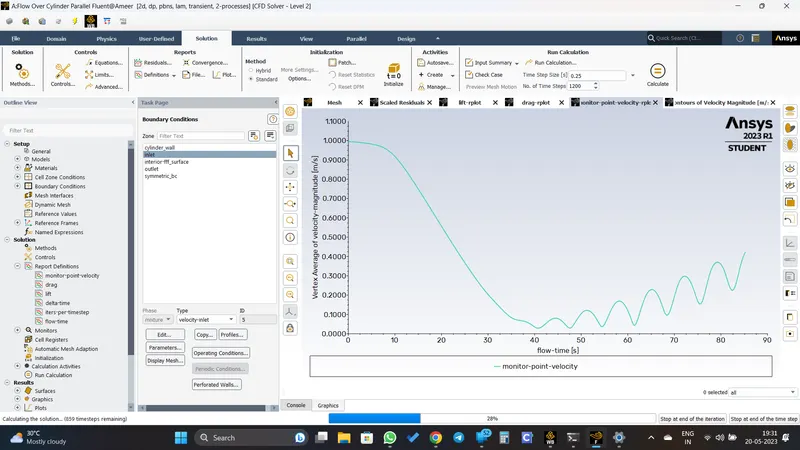
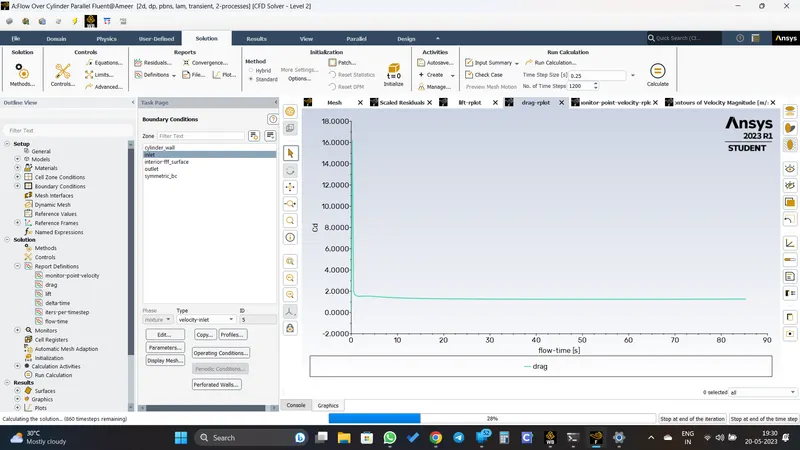
But running for 300 s is taking too much time and cause to crash the software due to the sytem hardware limitation. So the calculation is stoped at around 85th second, where it almost converged.
Scaled Residual
Monitor Point Velocity
Drag
Lift
Velocity Contour
CASE 2
Simulation of the flow with the steady state solver and calculate the coefficient of drag and lift over a cylinder by setting the Reynolds number to 10,100,1000,10000 & 100000.
All the other flow parameters are same as on the case 1.
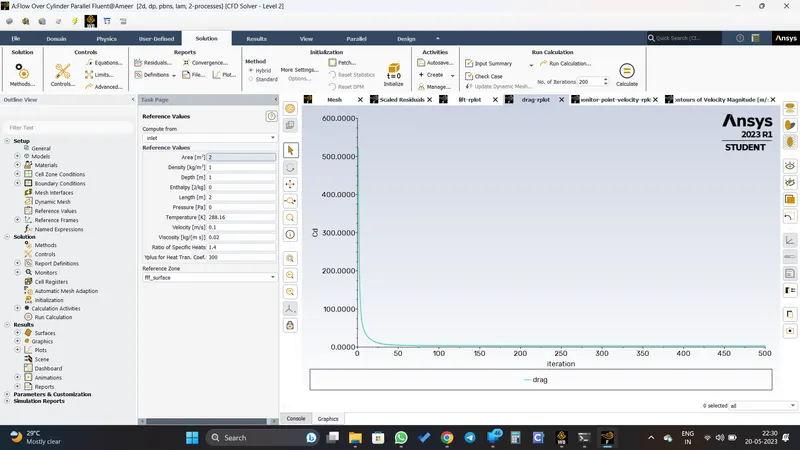
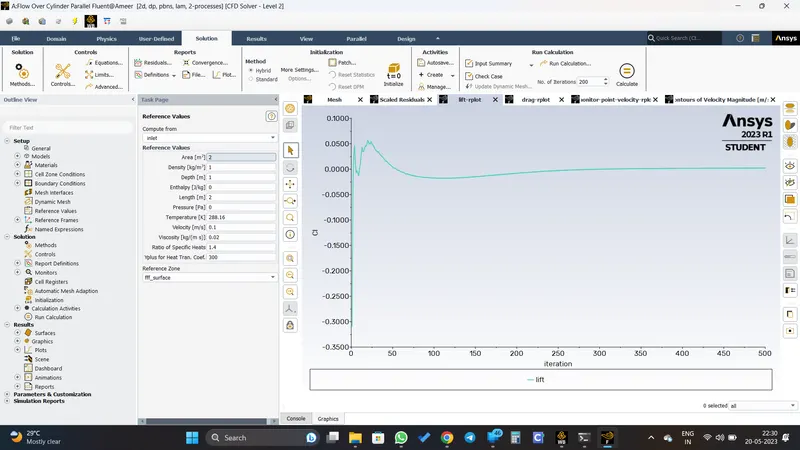
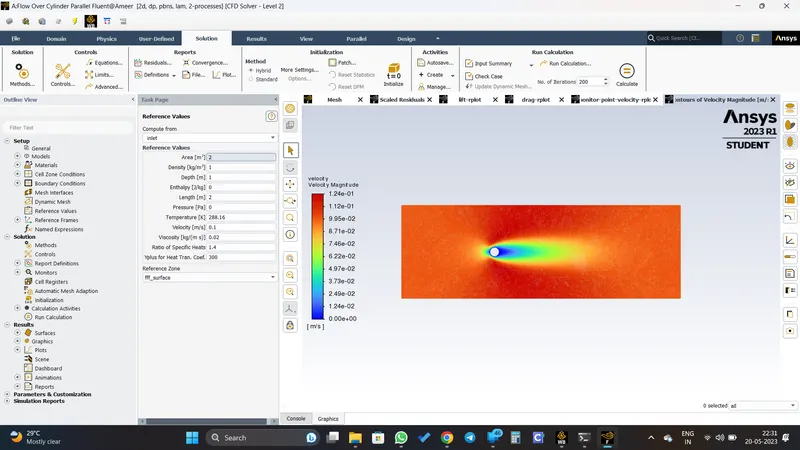
CASE 2.1
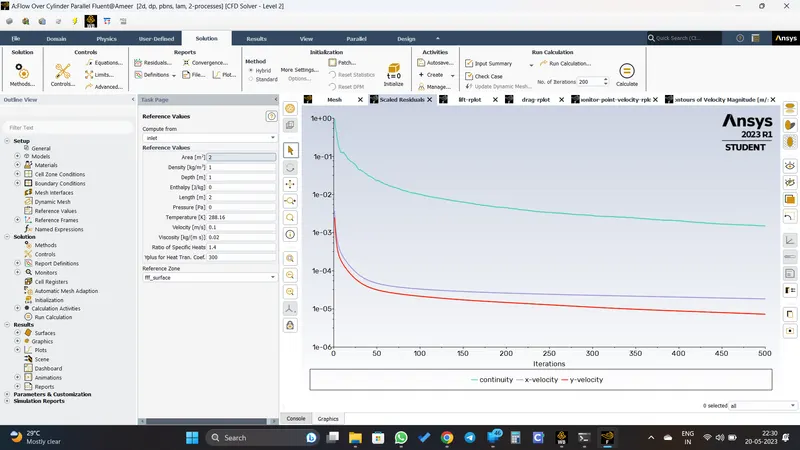
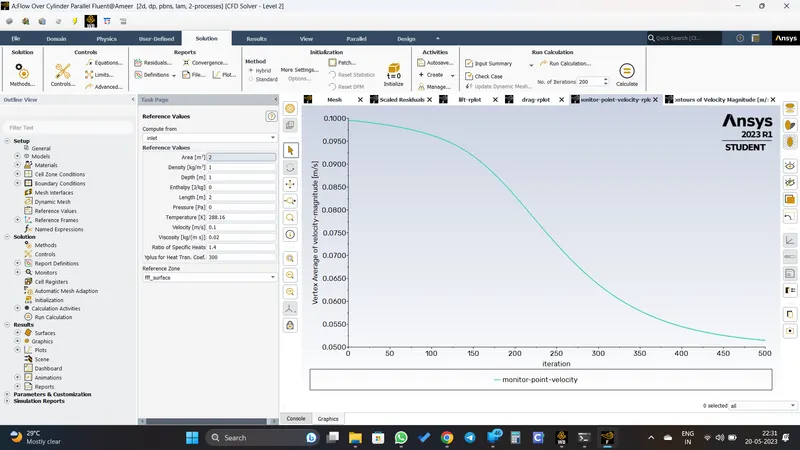
- Re = 10
- Inlet velocity = 0.1 m/s
Result
Scaled Residual
Monitor Point Velocity
Drag
Lift
Velocity Contour
CASE 2.2
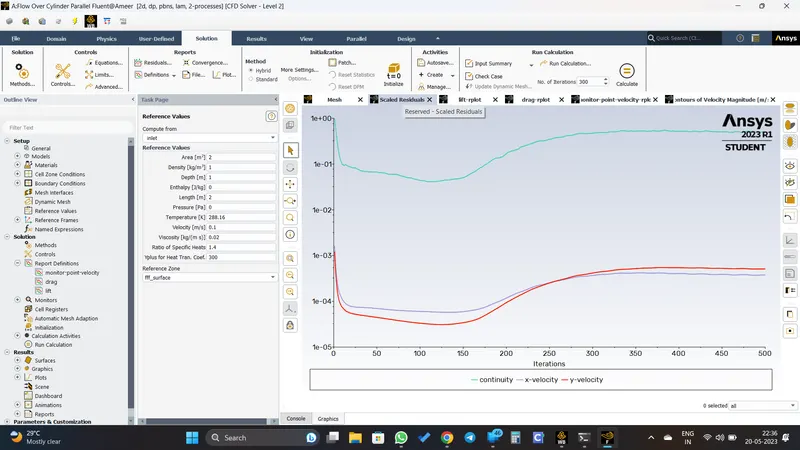
- Re = 100
- Inlet velocity = 1 m/s
Result
Scaled Residual
Monitor Point Velocity
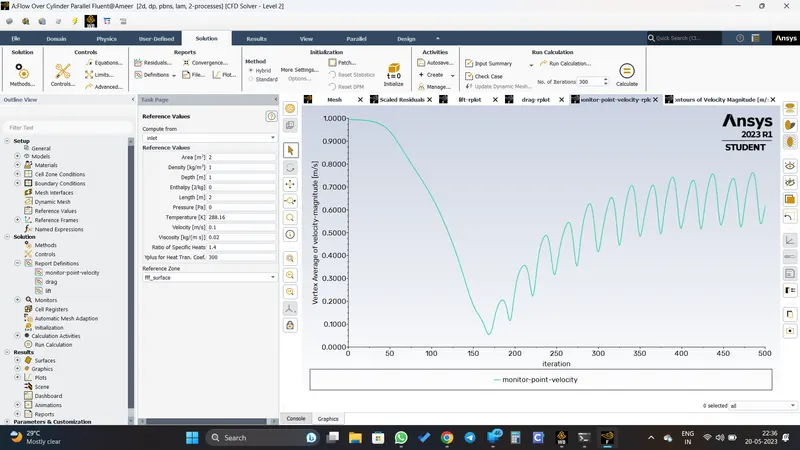
Drag
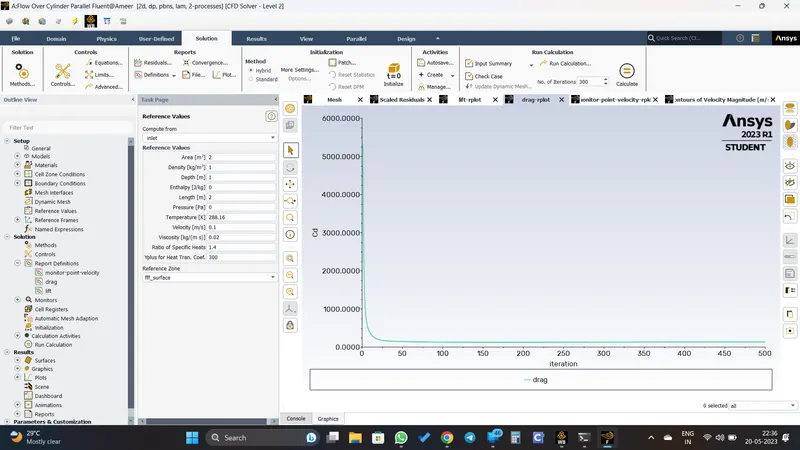
Lift
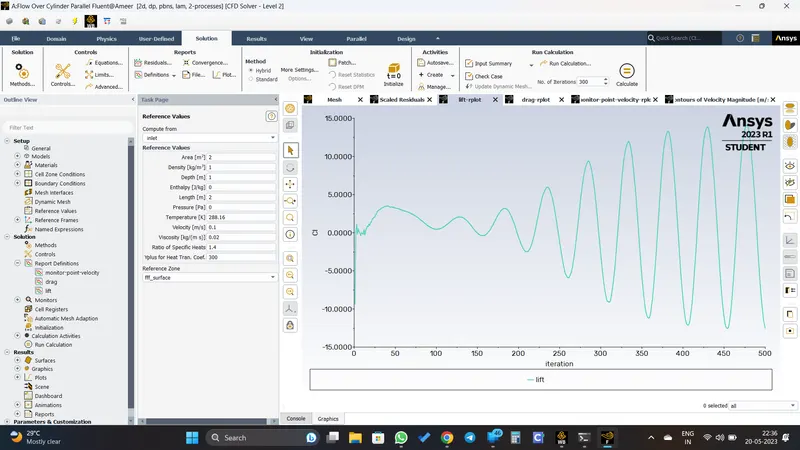
Velocity Contour
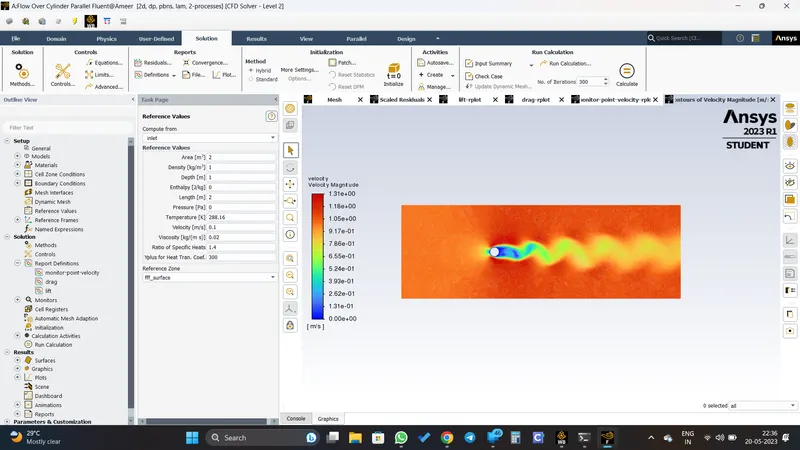
CASE 2.3
- Re = 1000
- Inlet velocity = 10 m/s
Result
Scaled Residual
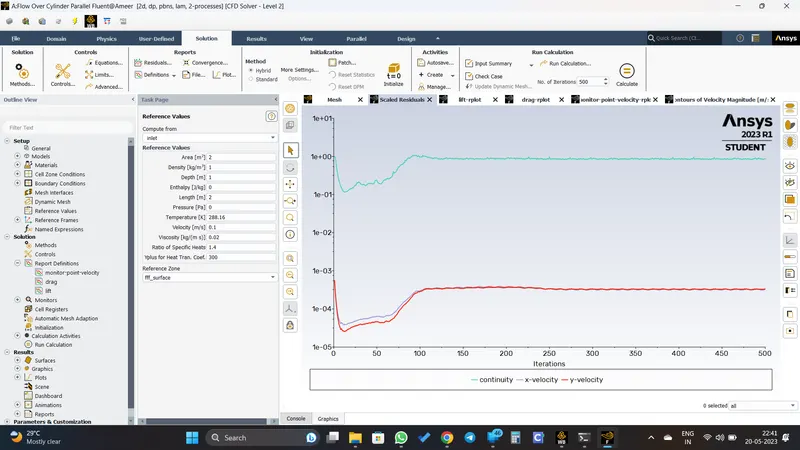
Monitor Point Velocity
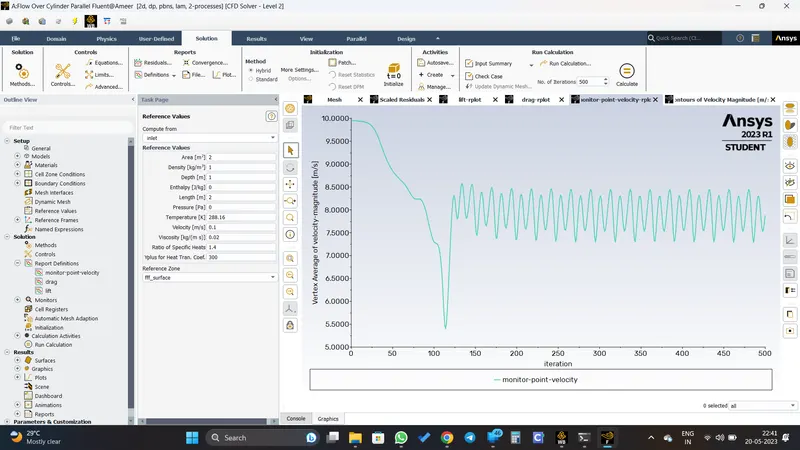
Drag
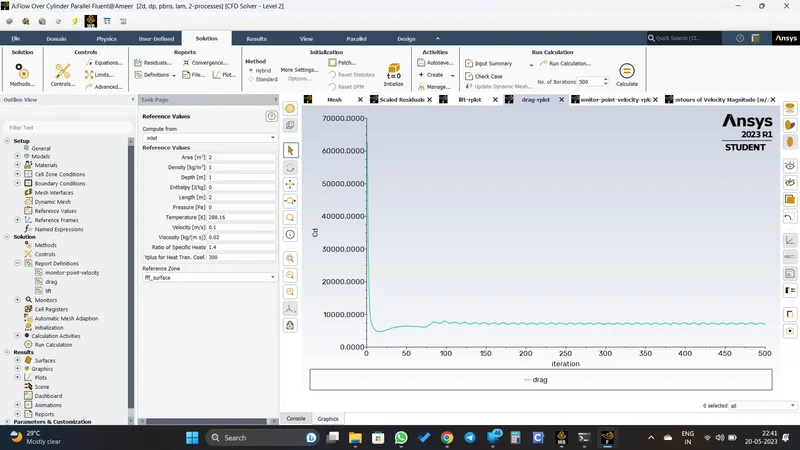
Lift
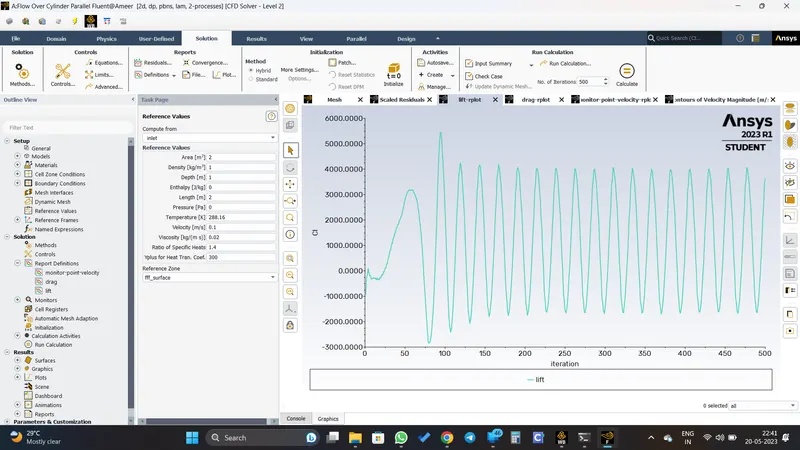
Velocity Contour
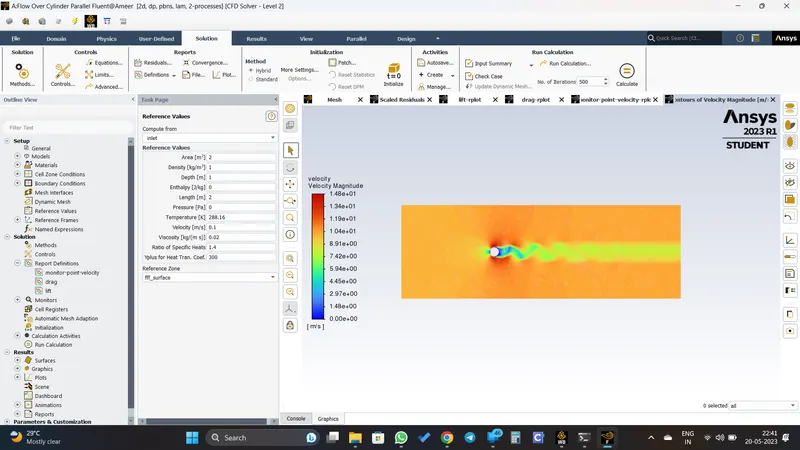
CASE 2.4
- Re = 10000
- Inlet velocity = 100 m/s
Result
Scaled Residual
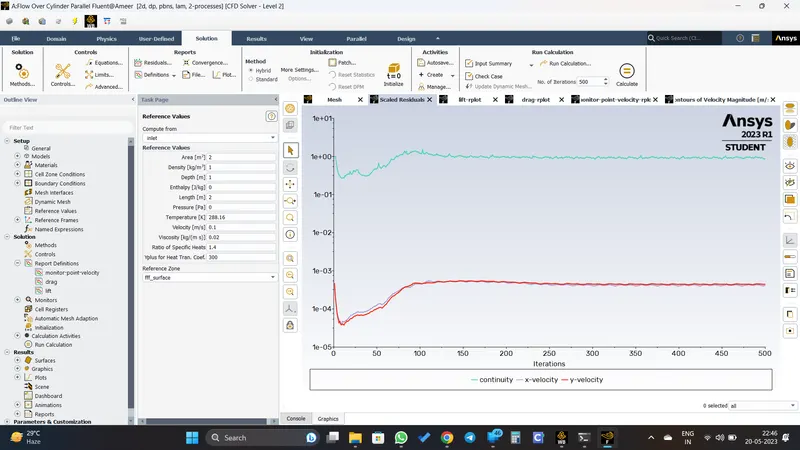
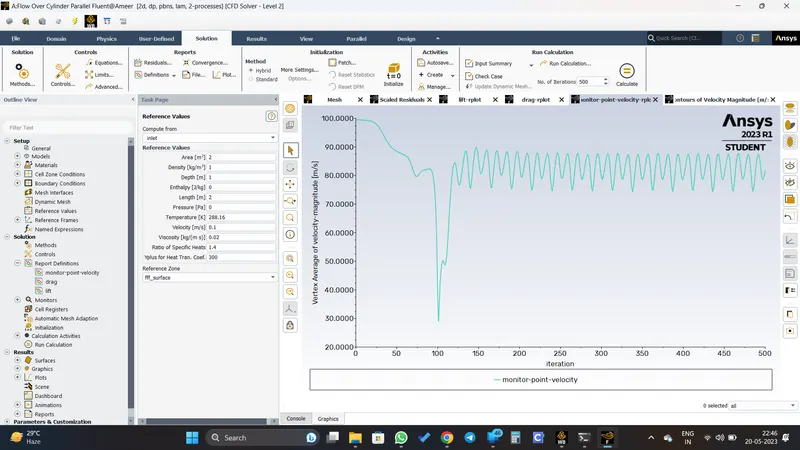
Monitor Point Velocity
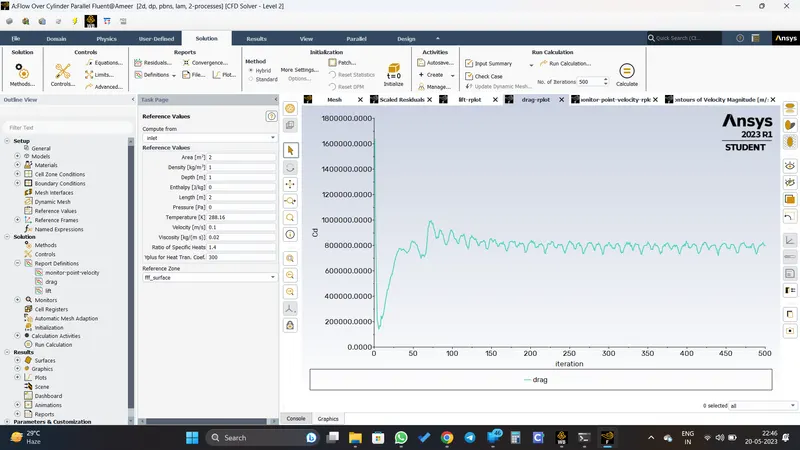
Drag
Lift
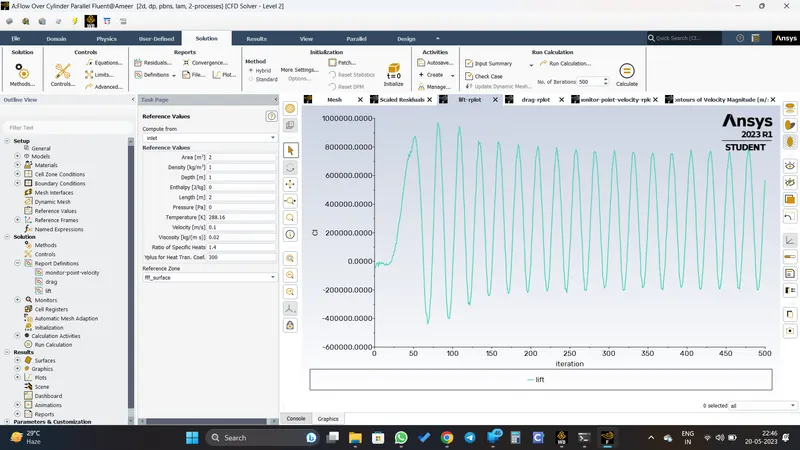
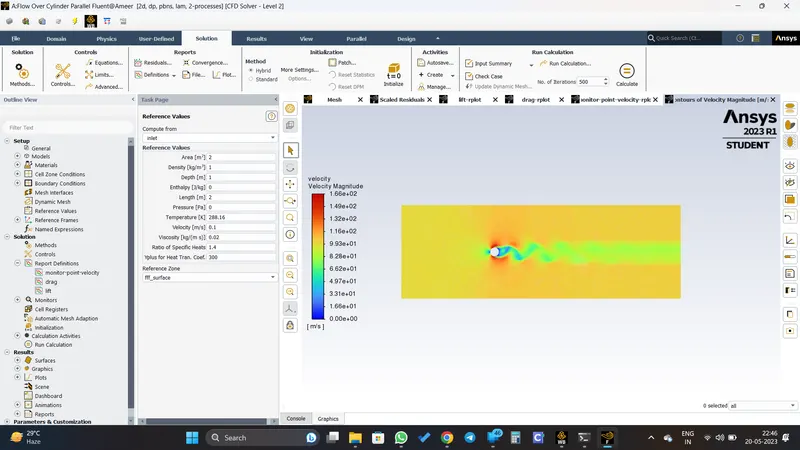
Velocity Contour
CASE 2.5
- Re = 100000
- Inlet velocity = 1000 m/s
Result
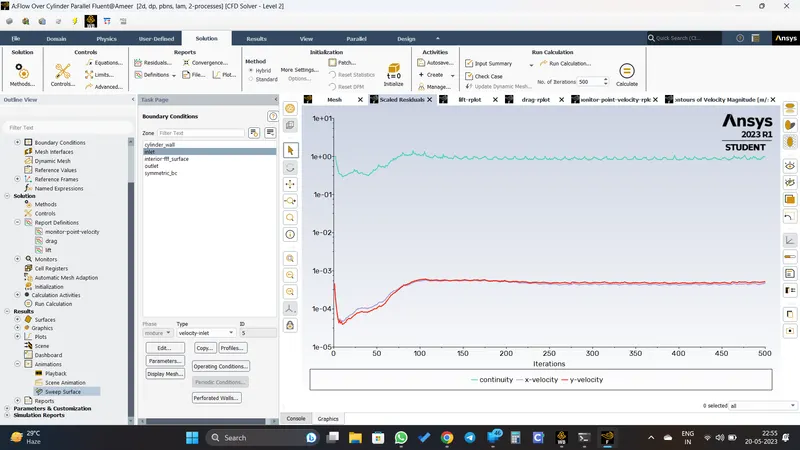
Scaled Residual
Monitor Point Velocity
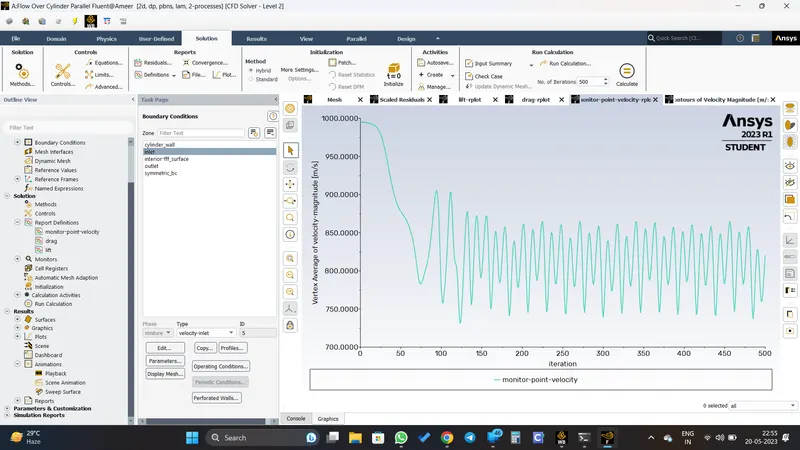
Drag
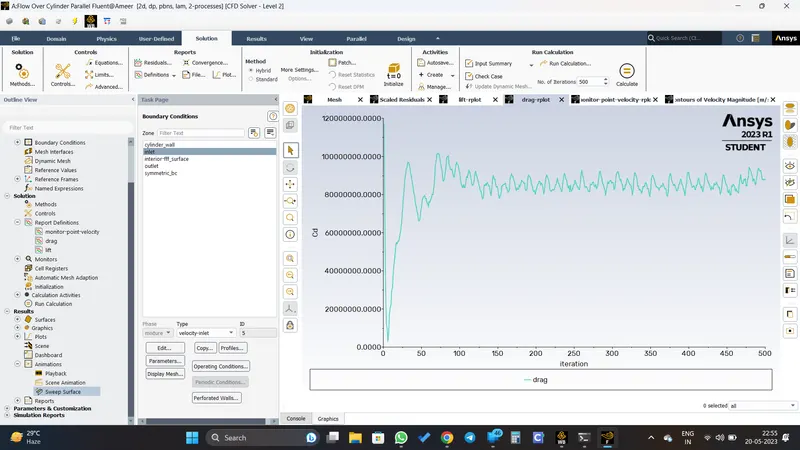
Lift
Velocity Contour
OBSERVATIONS
When observing the velocity contour we can see that the flow is perfectly laminar at Reynolds number 10 and starts to become turbulent from Reynolds Number of 100.
While it is generally true that flow becomes turbulent at higher Reynolds numbers, there are cases where turbulence can occur even at low Reynolds number.
Flow disturbances, such as impinging jets, wakes, or FLOW PASSING OVER AN OBSTACLE, can induce local turbulence even at lower Reynolds numbers. These disturbances can generate shear layers, vortices, and flow instabilities that cause the transition to turbulence.
Effect Of Reynolds Number On The Coefficient Of Drag
At low Reynolds numbers (Re), the flow is typically in the laminar region, where the fluid moves in smooth, ordered layers. In this region, the Cd value is relatively low and remains relatively constant. The laminar flow has well-defined streamlines and experiences minimal mixing, resulting in lower drag forces.
As the Reynolds number increases and the flow transitions to the turbulent region, the Cd value tends to increase. Turbulent flow is characterized by irregular motion with higher levels of mixing and increased drag. Turbulence cause additional momentum exchanges and vortices that contribute to higher drag forces compared to laminar flow.
It's also important to note that the exact behavior of Cd with increasing Reynolds number can vary depending on the specific shape and geometry of the object.
REFERENCE
- "Computational Fluid Dynamics: Principles and Applications" by Jiri Blazek - Chapter 6 - "External Flows"
For Project Model, Click here