Week 8 - Simulating Cyclone separator with Discrete Phase Modelling
Aim: To perform analysis on cyclone separator and calculate the separation efficiency and pressure drop.
Objectives:
- To write a few words about any four empirical models used to calculate the cyclone separator efficiency.
- To perform an analysis on a given cyclone separator model by varying the particle diameter from 1 μm to 5 μm and calculate the separation efficiency in each case. Discuss the results. [Use both the velocity's as 3m/sec.]
- To perform an analysis on a given cyclone separator model by varying the particle velocity from 1 m/sec to 5 m/sec and calculate the separation efficiency and pressure drop in each case. Discuss the results. [Use particle diameter size as 5 μm for all cases & keep flow velocity same as particle velocity].
Geometry:
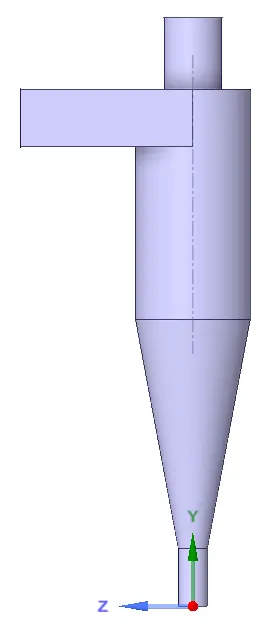
The model has a tangential entry duct at the top through which particle laden gas enters the separator. There are two outlets, one at the top & other at the bottom. Particles are trapped in the bottom outlet whereas gas escapes through the top outlet. The vortex is generated in the barrel & the cone.
Mesh:
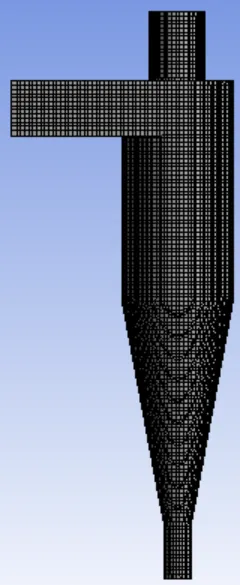
- Element size: 10 mm
- Body fitted Cartesian: 10 mm
- The face selecting tool is selected. The inlets, outlet1 (top) and outlet2 (bottom) is named. The inlet is through which the particles enter the lighter impurities escape through the top, and the heavier impurities are trapped in the bottom.
Setup:
- This analysis involves the orientation of the cyclone separator. As it is in the x-y plane, the acceleration due to gravity needs to be turned on. As acceleration due to gravity acts upwards, the g value is assigned as -9.81 in the positive y axis.
- Pressure based solver is used. Steady state analysis is done and the velocity formulation is normal to the boundary and absolute.
Physics set up:
- Turbulence modelling:
- The K-epsilon (2 equation) model with RNG and swirl dominated flow is selected. The wall mofunctions are standard wall functions.
- Since temperature is not involved, the Energy is not turned on.
DPM:
- Discrete phase modelling is opted for.
- The model is enabled for interaction with the continuous phase. DPM interval level is 10.
- For injection, the particle type is inert. From fluent database, anthracite is selected. It is released from the inlet, with velocity in the x-direction being 3m/s. This velocity may be manipulated further. The particle diameter chosen for the first analysis is one micrometre. The particle diameter is varied from one micrometre to five micrometre to calculate the separation efficiencies.
Boundary conditions:
- The boundary conditions are provided to three named selections, inlet, outlet (1) top and outlet (2) bottom.
- For inlet, the momentum conditions are v3locity is 3m/s in the x direction, being absolute and normal to the boundary. The DPM condition is reflect. This signifies that the particles are not allowed to escape or get trapped in the inlet.
- For the top outlet, the Momentum condition is basically pressure condition, The DPM condition is escape. Particles can escape from this Boundary
- The bottom outlet is also a pressure outlet, with the DPM condition being trap.
Results:
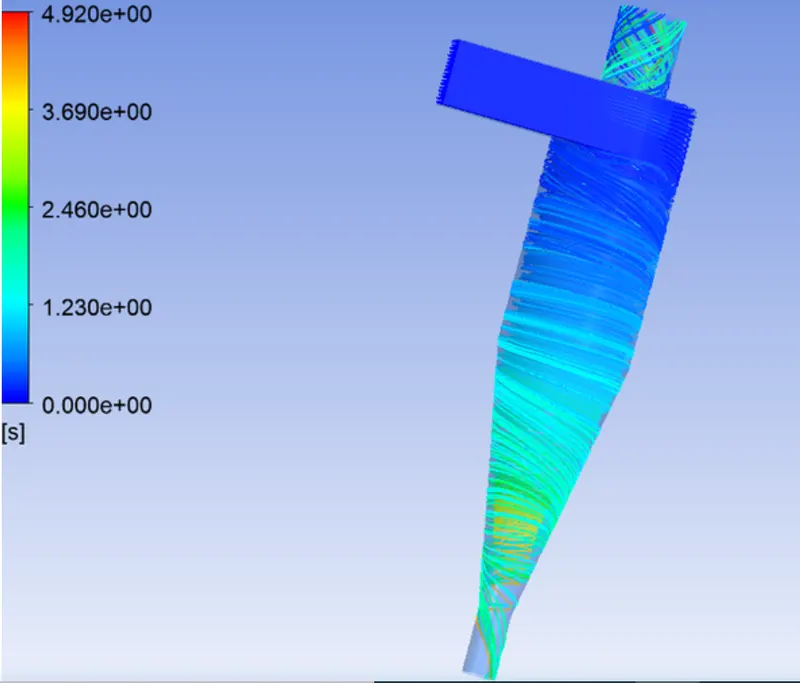
- Diameter of the particles = 1 micrometres
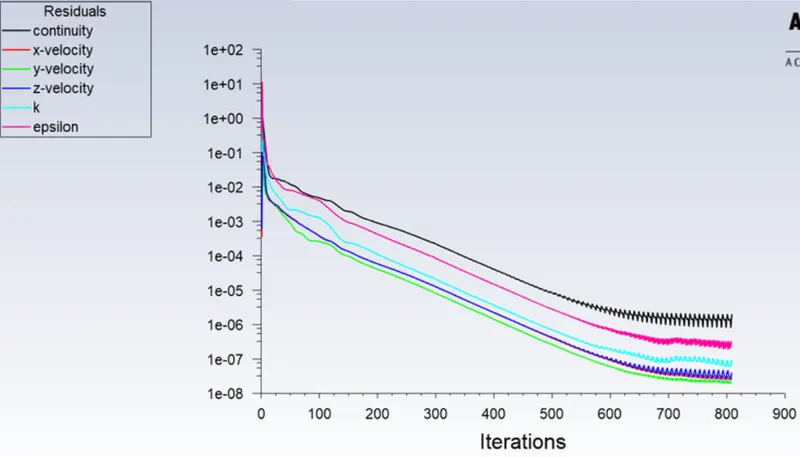
Residuals:
Particle tracking:

Separation Efficiency in % = (52 / 98) * 100
Separation Efficiency = 53.06 %
2. Diameter of the particles = 2 micrometres
Residuals:
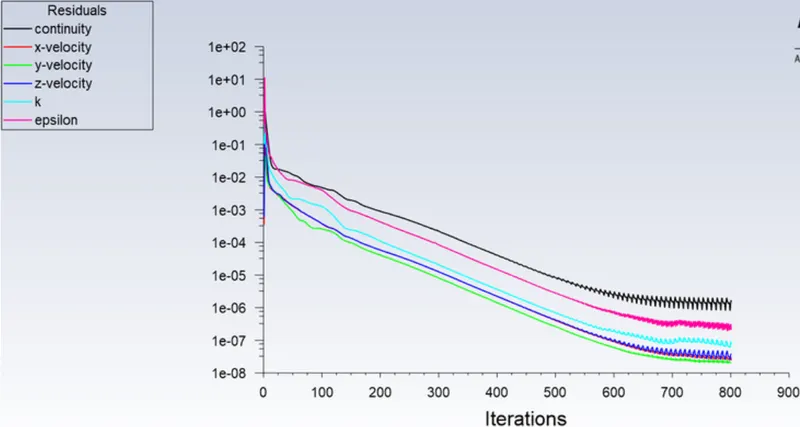
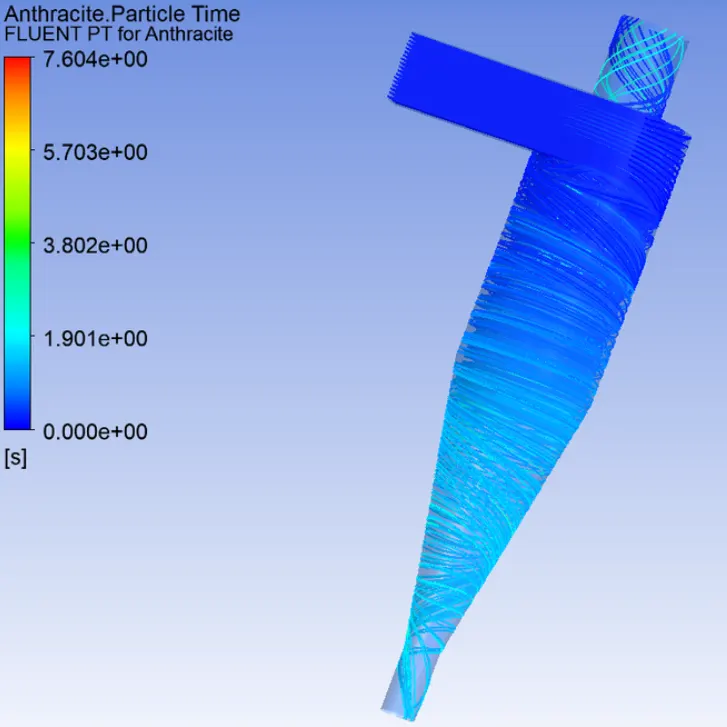
Particle tracking:

Separation Efficiency in % = (75 / 98) * 100
Separation Efficiency = 76.53 %
3. Diameter of the particles = 5 micrometres
Residuals:
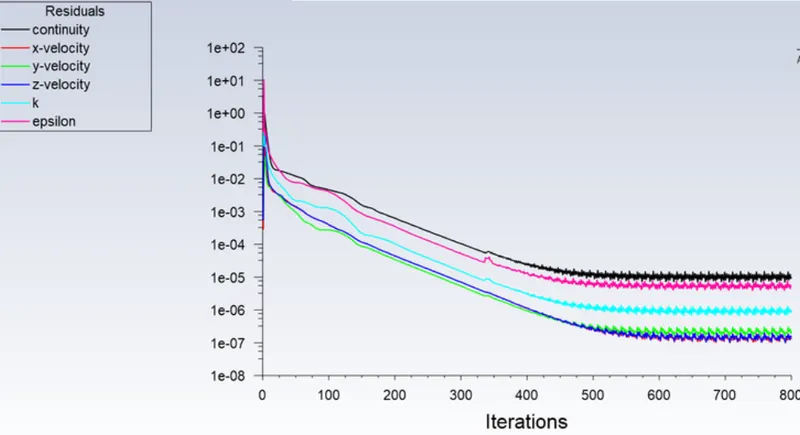
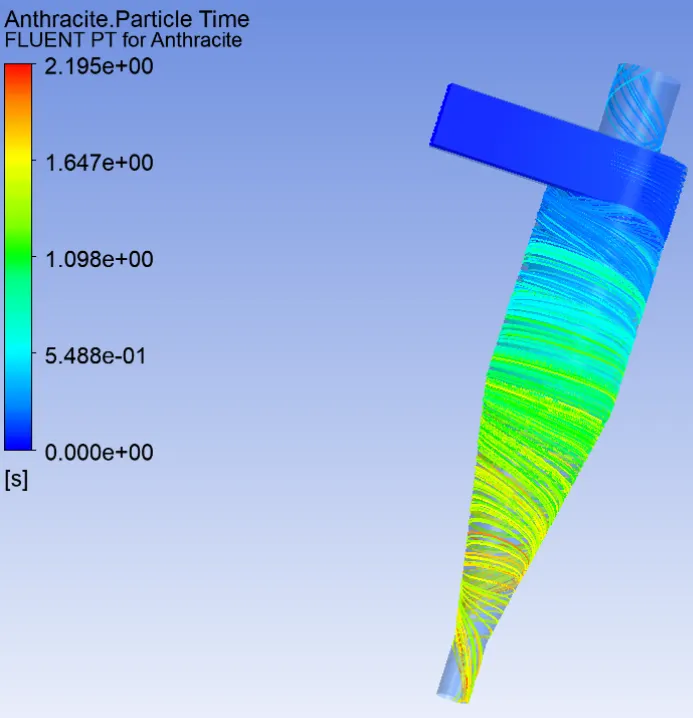
Particle tracking:

Separation Efficiency in % = (98 / 98) * 100
Separation Efficiency = 100 %
Varying the particle velocity from 1 m/sec to 5 m/sec
1. Velocity - 1 m/s
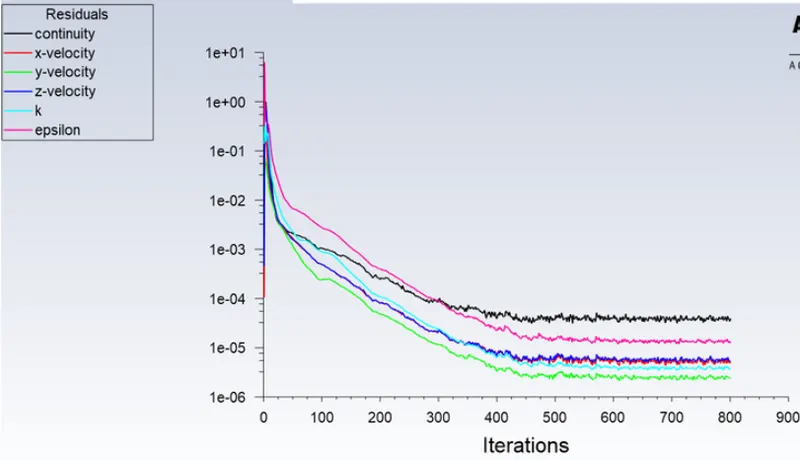
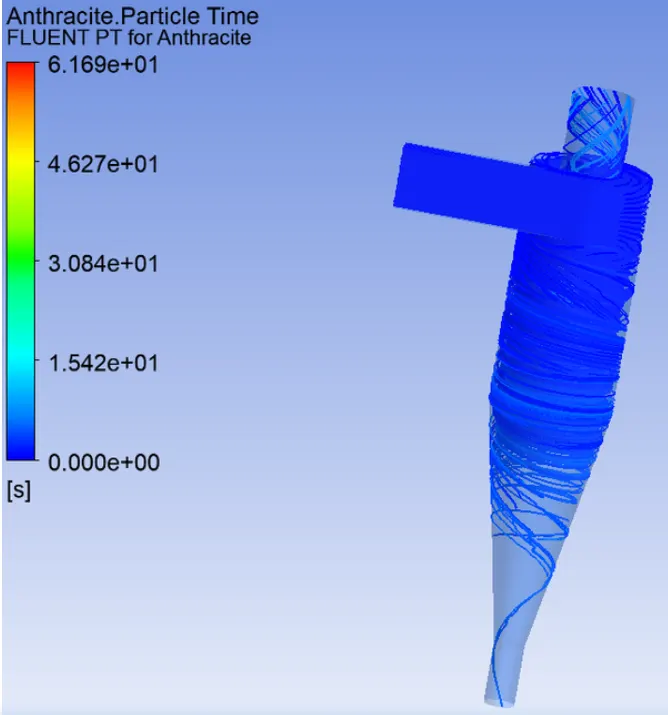
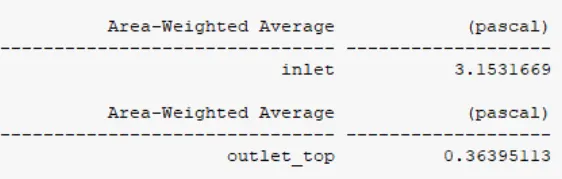
Pressure drop = Total inlet pressure - Total Outlet Pressure
= 3.15 – 0.36
Pressure drop =2.79 Pa
Particle tracking:

Separation Efficiency in % = (7 / 98) * 100
Separation Efficiency = 7.14 %
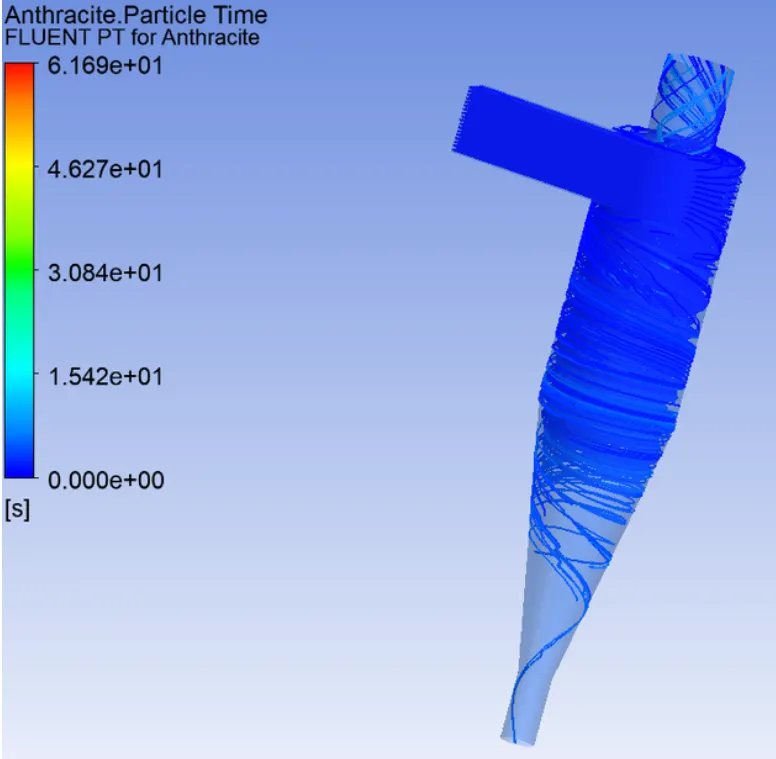
2. Velocity - 3 m/s
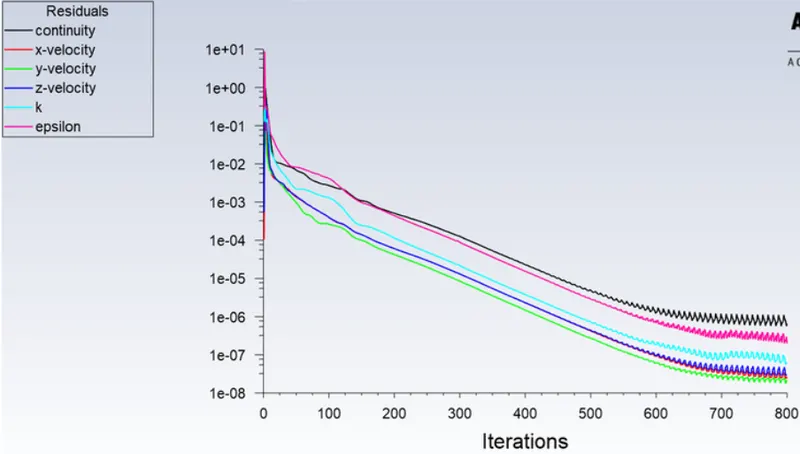
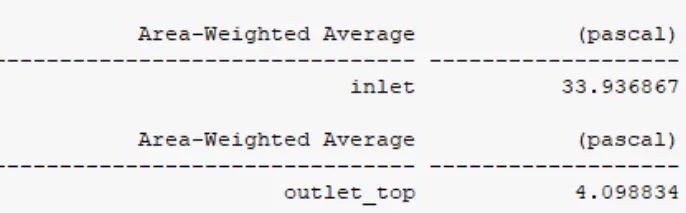
Pressure drop = Total inlet pressure - Total Outlet Pressure
= 33.93 – 4.09
Pressure drop =29.83 Pa
Particle tracking:

Separation Efficiency in % = (98 / 98) * 100
Separation Efficiency = 100 %
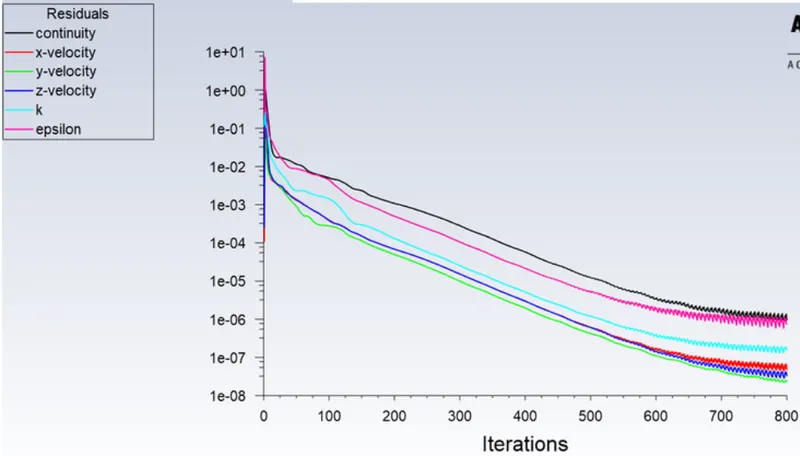
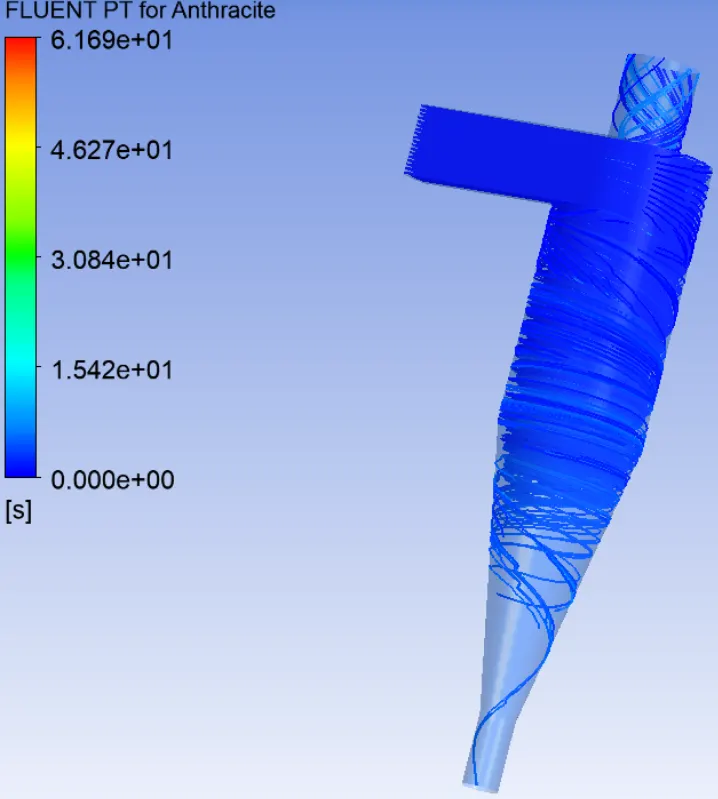
3. Velocity - 5 m/s
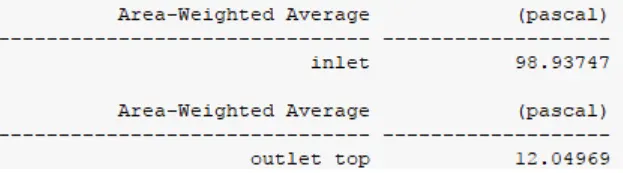
Pressure drop = Total inlet pressure - Total Outlet Pressure
= 98.93 – 12.04
Pressure drop =86.89 Pa
Particle tracking:

Separation Efficiency in % = (98 / 98) * 100
Separation Efficiency = 100 %