Week 8 - Simulating Cyclone separator with Discrete Phase Modelling
Aim:- To perform analysis on cyclone separator and calculate the separation efficiency and pressure drop.
Objective:-
- To write a few words about any four empirical models used to calculate the cyclone separator efficiency.
- To perform an analysis on a given cyclone separator model by varying the particle diameter from 1 μm to 5 μm and calculate the separation efficiency in each case. Discuss the results. [Use both the velocity's as 3m/sec.]
- To perform an analysis on a given cyclone separator model by varying the particle velocity from 1 m/sec to 5 m/sec and calculate the separation efficiency and pressure drop in each case.
Cyclone Sepereator:
Cyclone separators work much like a centrifuge, but with a continuous feed of dirty air. In a cyclone separator, dirty flue gas is fed into a chamber. The inside of the chamber creates a spiral vortex, similar to a tornado. The lighter components of this gas have less inertia, so it is easier for them to be influenced by the vortex and travel up it. Contrarily, larger components of particulate matter have more inertia and are not as easily influenced by the vortex.
EMPIRICAL MODELS FOR THE PREDICTION OF CYCLONE EFFICIENCY:
- Lapple Model
- Koch and Licht Model
- Li and Wang Model
- Iozia and Leith Model
- Lapple Model
Lapple model was developed based on force balance without considering the flow resistance. Lapple assumed that a particle entering the cyclone is evenly distributed across the inlet opening. The particle that travels from inlet half width to the wall in the cyclone is collected with 50% efficiency.
The Efficiency of collection of any size of the particle = `eta_i = 1/(1+(d_(pc)/d_(p.i)))`
- Koch and Licht Model
Koch and Licht (1977) collection theory recognized the inherently turbulent nature of cyclones and the distribution of gas residence times within the cyclone. Koch and Licht describe particle motion in the entry and collection regions with the additional following assumptions:
- The tangential velocity of a particle is equal to the tangential velocity of the gas flow.
- The tangential velocity is related to the radius of cyclone by: u Rn = constant.
The grade efficiency is given by `eta_i = 1-exp(-2.(G.tau_i.Q)/D^3.(n+1)^(.5/(n+1)))`
- Li and Wang Model
The Li and Wang model includes particle bounce or re-entrainment and turbulent diffusion at the cyclone wall. A two-dimensional analytical expression of particle distribution in the cyclone is obtained.
`eta_i = 1-exp(-lambda.theta_1)`
- Iozia and Leith Model
Iozia and Leith logistic model is a modified version of Barth model which is developed based on force balance. The model assumes that a particle carried by the vortex endures the influence
of two forces: a centrifugal force, Z, and a flow resistance, W.
`eta_i = 1/(1+(d_(pc)/d_(p.i))^beta)`
Pre-processing:
Geometry:
- Geometry was imported to spaceclaim.
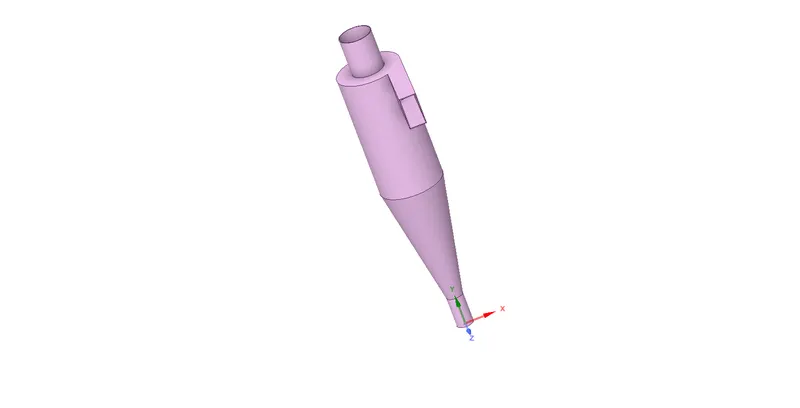
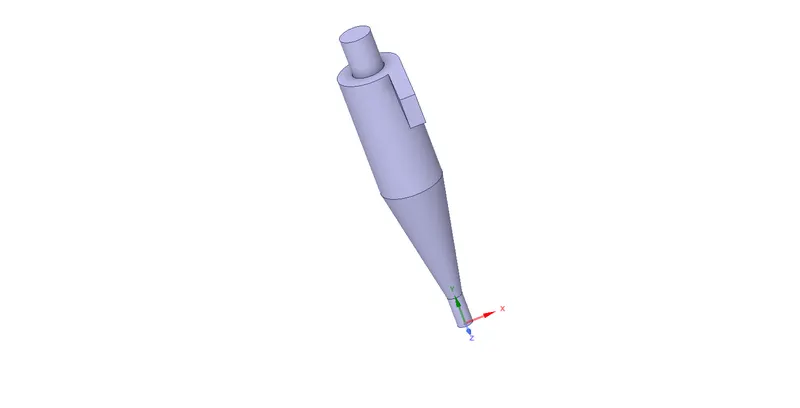
- Now the volume was extracted by using Volume extract option.
Meshing:
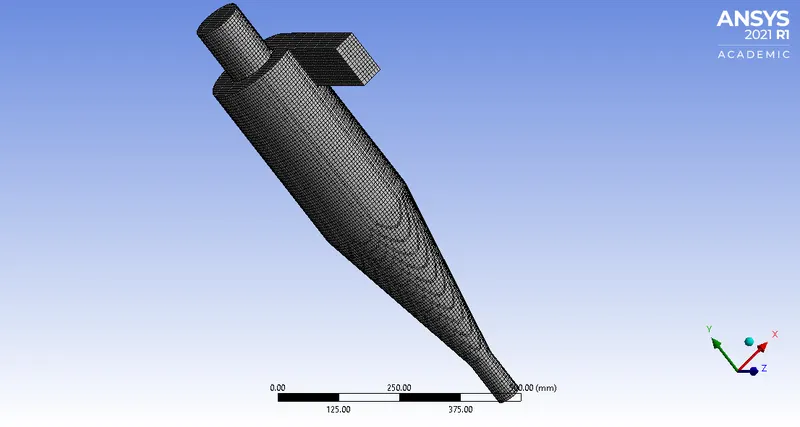
No of elements: 59627
Fluent Setup:
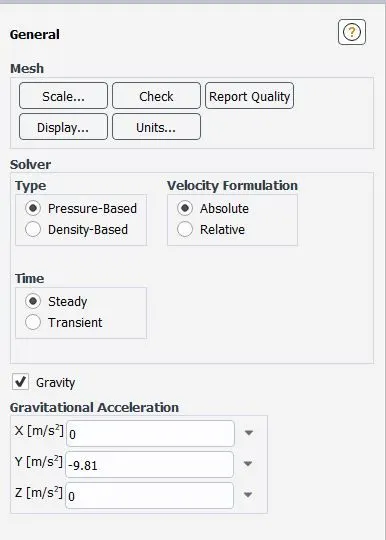
General Setup:
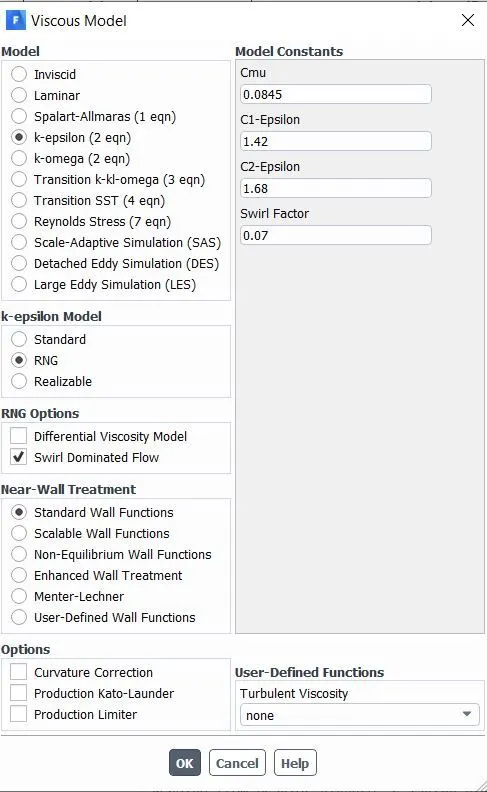
Viscous Model:
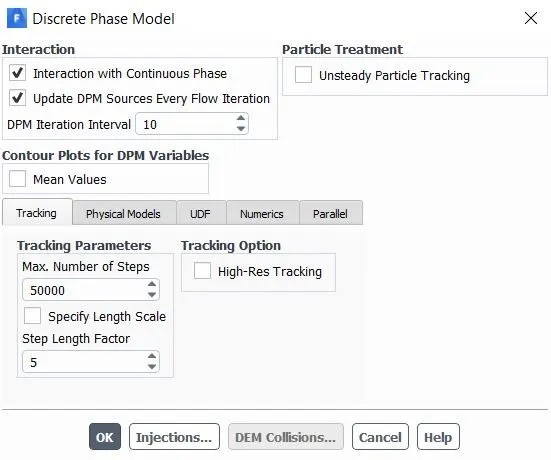
Discrete Phase model:
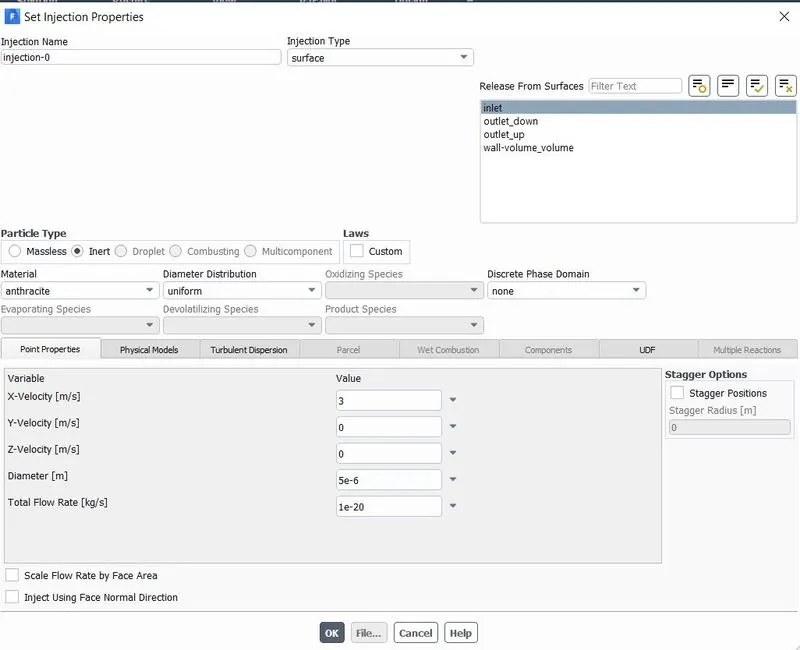
Injection Parameter:
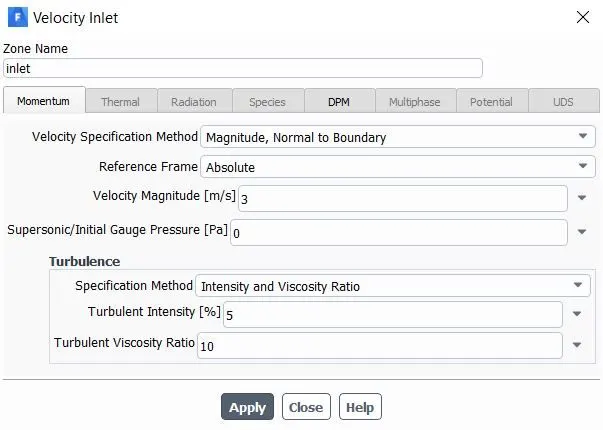
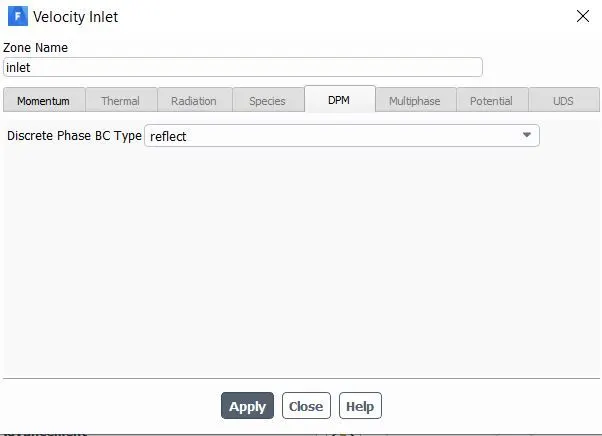
Inlet Condition:
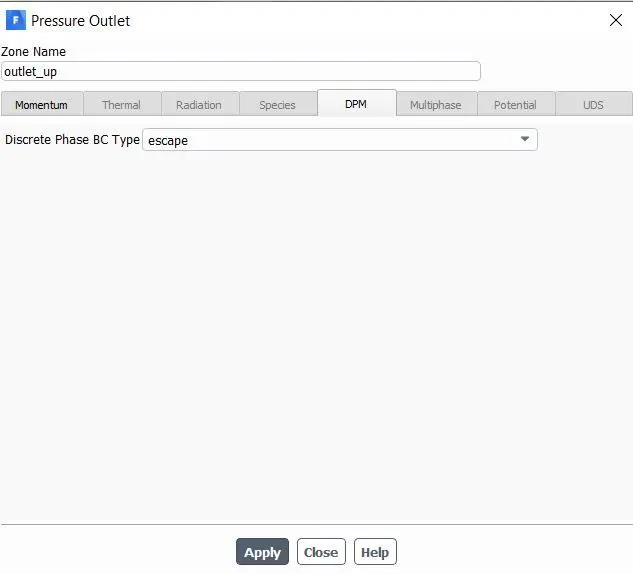
Outlet Condition(up):
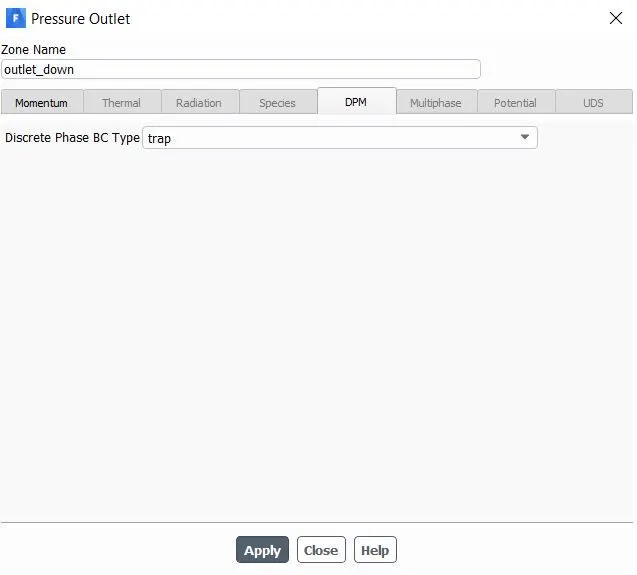
Outlet Condition (down)
Results:
Simulation Cases: a
| Case | Particle Size (`mu`m) | Particle and flow velocity (m/s) |
| 1 | 5 | 3 |
| 2 | 3 | 3 |
| 3 | 1 | 3 |
Simulation Cases: b
| Case | Particle Size (`mu`m) | Particle and flow velocity (m/s) |
| 1 | 5 | 5 |
| 2 | 5 | 3 |
| 3 | 5 | 1 |
1.Case: a
- Case 1
Particle Size : 5`mu`m
Particle and flow velocity: 3m/s
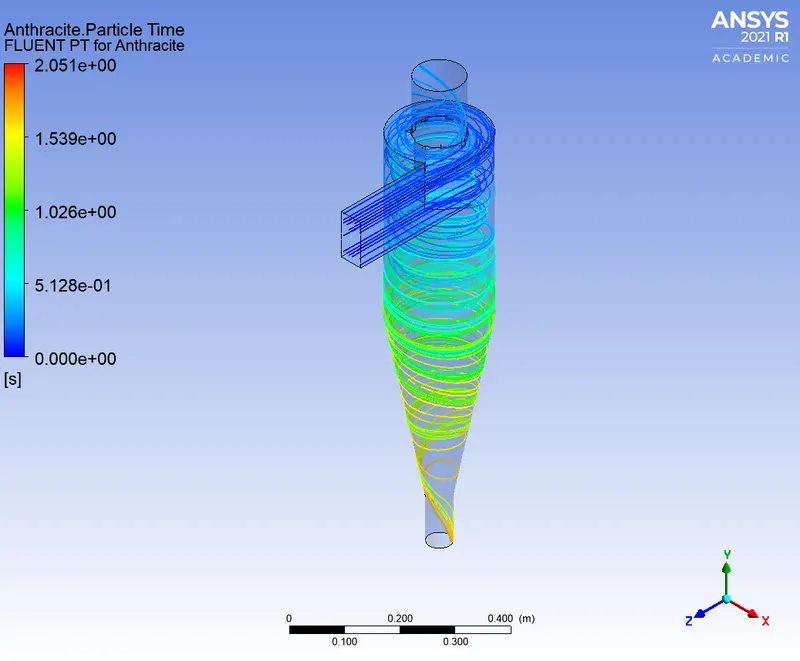
number tracked = 98, escaped = 17, trapped = 81
Separation Efficiency = No. of Particle Trapped / No. of particle Tracked
Separation Efficiency = 81/98 = 82.65%
- Case 2
Particle Size : 3`mu`m
Particle and flow velocity: 3m/s
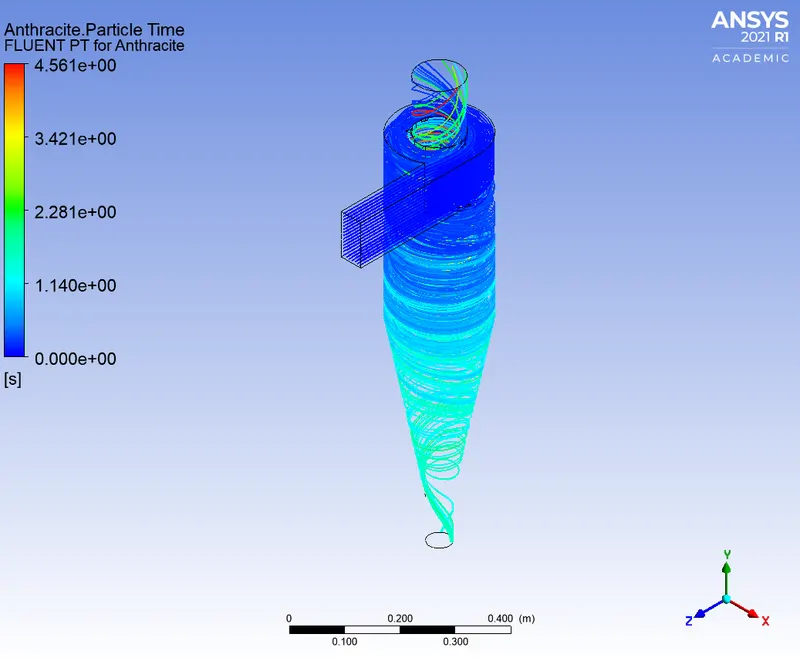
number tracked = 98, escaped = 25, trapped = 73
Separation Efficiency = No. of Particle Trapped / No. of particle Tracked
Separation Efficiency = 73/98 = 74.49%
- Case 3
Particle Size : 1`mu`m
Particle and flow velocity: 3m/s
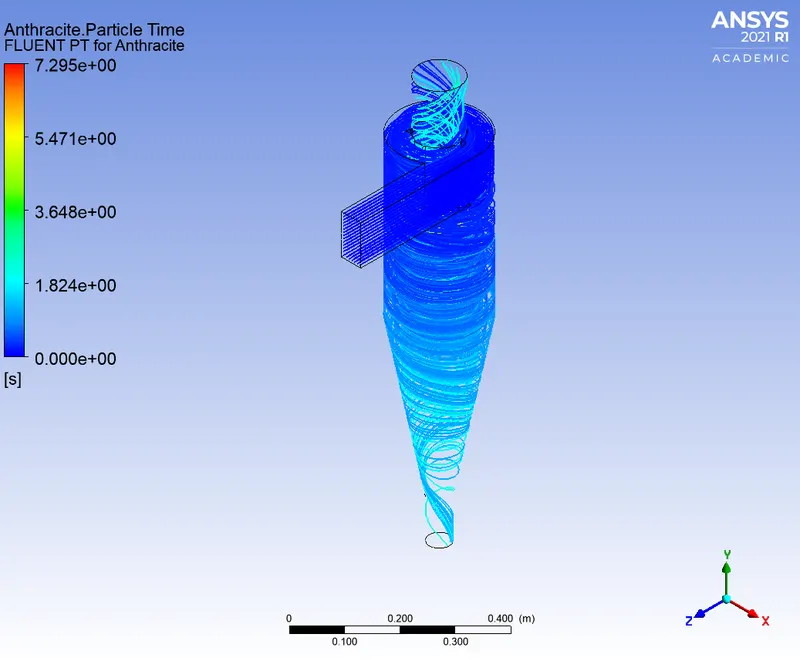
number tracked = 98, escaped = 32, trapped = 62, incomplete = 4
Separation Efficiency = No. of Particle Trapped / No. of particle Tracked
Separation Efficiency = 62/98 = 63.27%
2. Case b
- Case 1
Particle Size : 5`mu`m
Particle and flow velocity: 5m/s
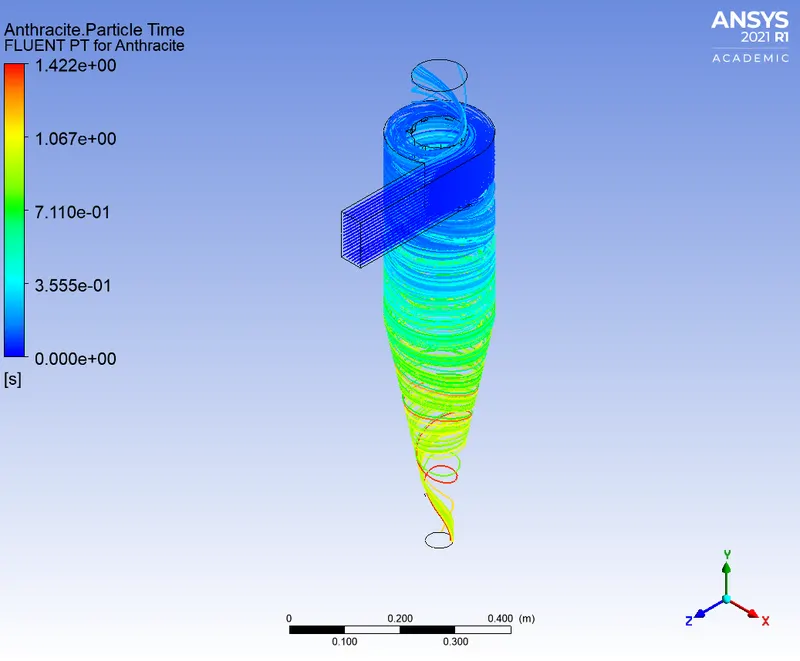
number tracked = 98, escaped = 18, trapped = 80
Separation Efficiency = No. of Particle Trapped / No. of particle Tracked
Separation Efficiency = 80/98 = 81.63%
- Case 2
Particle Size : 5`mu`m
Particle and flow velocity: 3m/s
number tracked = 98, escaped = 17, trapped = 81
Separation Efficiency = No. of Particle Trapped / No. of particle Tracked
Separation Efficiency = 81/98 = 82.65%
- Case 1
Particle Size : 5`mu`m
Particle and flow velocity: 1m/s
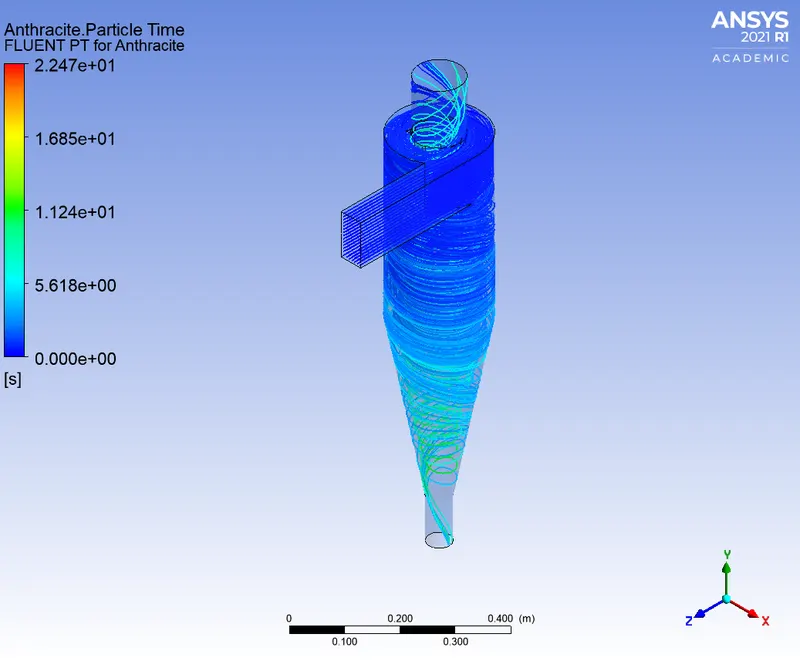
number tracked = 98, escaped = 25, trapped = 54, incomplete = 19
Separation Efficiency = No. of Particle Trapped / No. of particle Tracked
Separation Efficiency = 54/98 = 55.10%
Inferences & Conclusion:
- A discrete phase modeling of cyclone separator was done.
- Efficiencies were calculated.