Week 8 - Simulating Cyclone separator with Discrete Phase Modelling
SIMULAATION AND ANALYSIS OF CYCLONE SEPARATOR WITH DISCRETE PHASE
INTRODUCTION
CYCLONE SEPARATOR
A cyclone separator, also called a cyclonic dust collector, is a widely used air pollution control device that cleanses flue gases of particulate matter before such gases exit into the atmosphere. These devices are primarily labeled as pre-cleaners, as they are instrumental in removing large and abrasive particles from flue gases, which then go through additional filtration processes to remove fine particulate matter.
Cyclone separators work as a buffer against damage to enhanced filtration systems that can be adversely impacted by large and abrasive particulate matter. This, in turn, can negate the pollution control process applicable to flue gases emanating from production plants.
The efficiency of cyclone separators is subject to various factors,
- Size of the particulate matter.
- Density of the particulate matter.
- Size of the device.
- Velocity of the inlet gas.
- Smoothness of the separator wall.
Four empirical models used to calculate the cyclone separator efficiency,
I-IOZIA AND LEITH MODEL
Iozia and Leith model which is developed based on force balance. The model assumes that a particle carried by the vortex endures the influence of two forces: a centrifugal force, and a flow resistance. Core length and core diameter.The collection efficiency ηi of particle diameter dpi can be calculated from.
`ηi = (1)/( 1+((dpc) /( dpa)) β`
II-LI AND WANG MODEL
The Li and Wang model includes particle bounce or re-entrainment and turbulent diffusion at the cyclone wall. A two-dimensional analytical expression of particle distribution in the cyclone is obtained. Li and Wang model was developed based on the following assumption.
The radial particle velocity and the radial concentration profile are not constant, for uncollected particles within the cyclones.
Boundary conditions with the consideration of turbulent diffusion coefficient and particle bounce re-entrainment on the cyclone wall.
`c = c0 , at θ = 0`
`Dr = (1- α)wc,` at`r = D/2`
The tangential velocity is related to the radius of cyclone by uRn = constant
The resultant expression of the collection efficiency for particle of any size is given as
`ηi = 1 - exp {-λθ1}`
III-KOCH AND LICHT MODEL
och and Licht (1977) collection theory recognized the inherently turbulent nature of cyclones and the distribution of gas residence times within the cyclone. Koch and Licht describe particle motion in the entry and collection regions with the additional following assumptiion.
The tangential velocity of a particle is equal to the tangential velocity of the gas flow, i.e. there is no slip in the tangential direction between the particle and the gas.
The tangential velocity is related to the radius of cyclone by,`uRn =`constant.
IV-LAPPLE MODEL
Lapple model was developed based on force balance without considering the flow resistance. Lapple assumed that a particle entering the cyclone is evenly distributed across the inlet opening. The particle that travels from inlet half width to the wall in the cyclone is collected with 50% efficiency.The efficiency of collection of any size of particle is given by
`ηi = 1 /(1 + ((dpc) /( dpa) )2`
OBJECTIVE
- To write a few words about any four empirical models used to calculate the cyclone separator efficiency.
- To perform an analysis on a given cyclone separator model by varying the particle diameter from 1 μm to 5 μm and calculate the separation efficiency in each case. Discuss the results.
- To perform an analysis on a given cyclone separator model by varying the particle velocity from 1 m/sec to 5 m/sec and calculate the separation efficiency and pressure drop in each case.
PROCEDURE
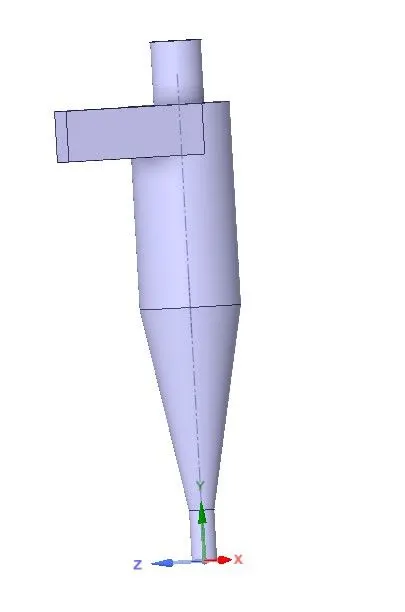
1-Geometry
Cyclone separtor a 3D model imported to spaceclaim to extract the volume and the extra edges.
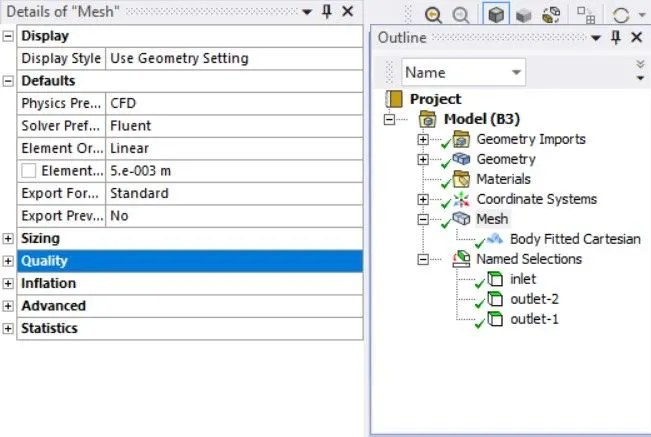
2-Mesh setup-
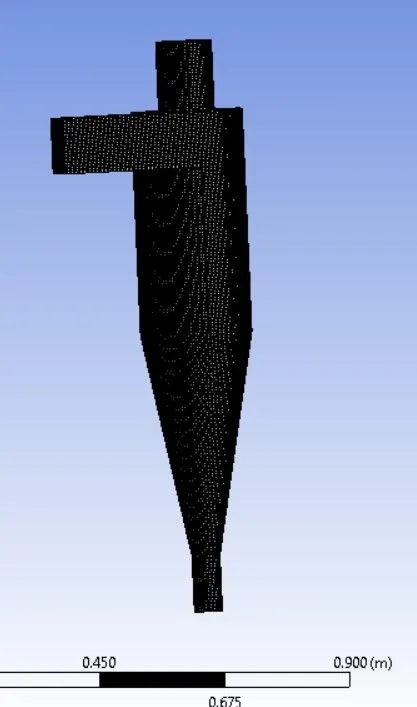
The mesh-
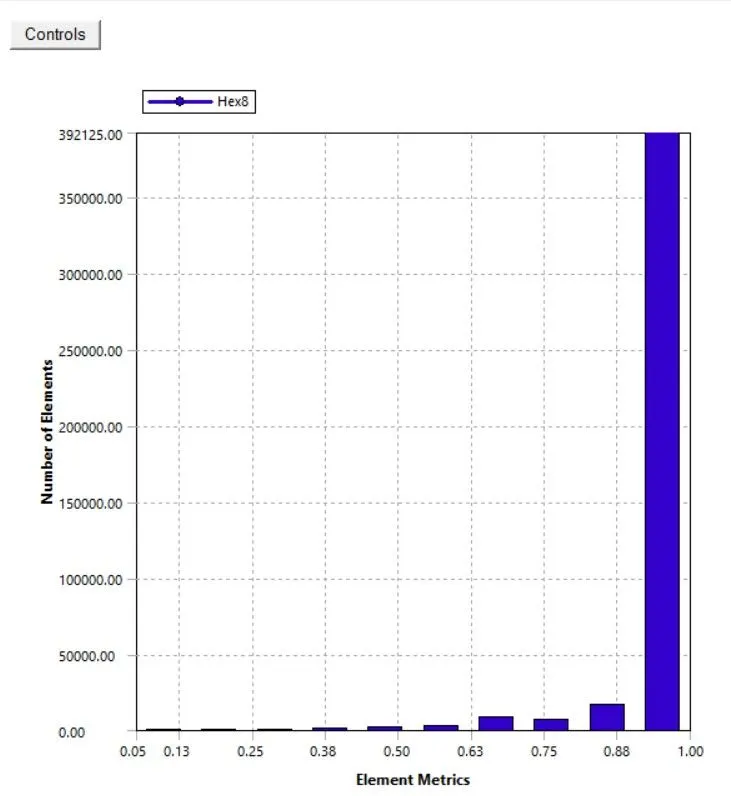
Mesh quality
Boundaries-
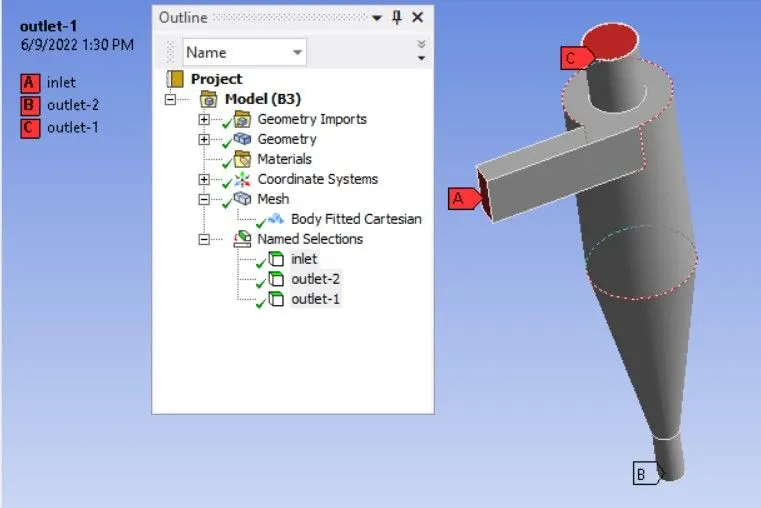
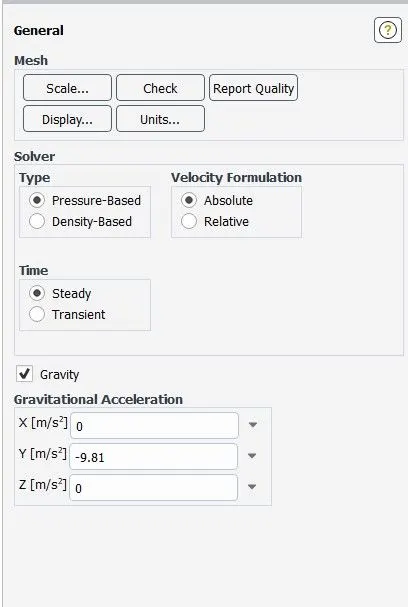
3-Simulation setup in ansys fluent
Solver setup
Viscous model
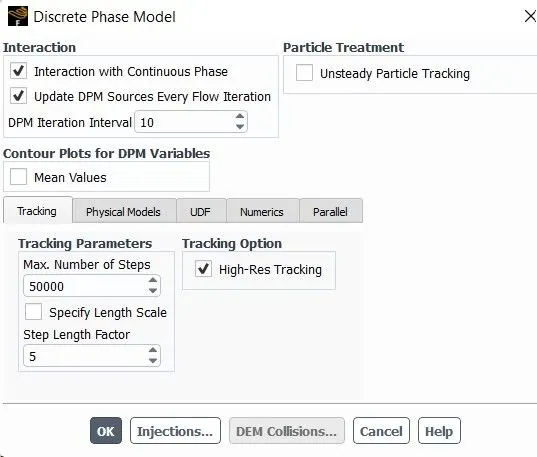
Discrete phase Model
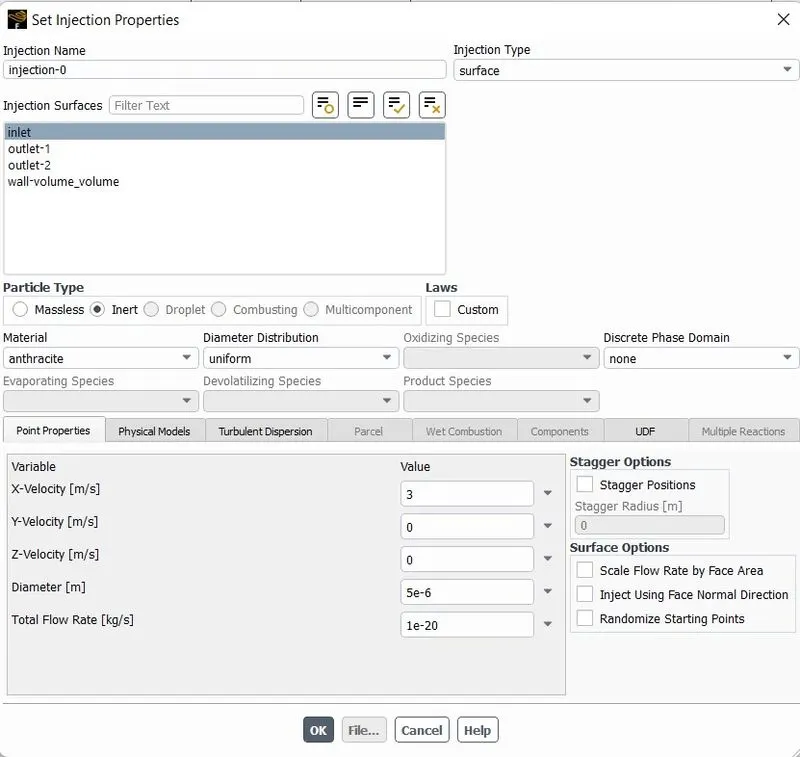
Injection properties
Boundaries
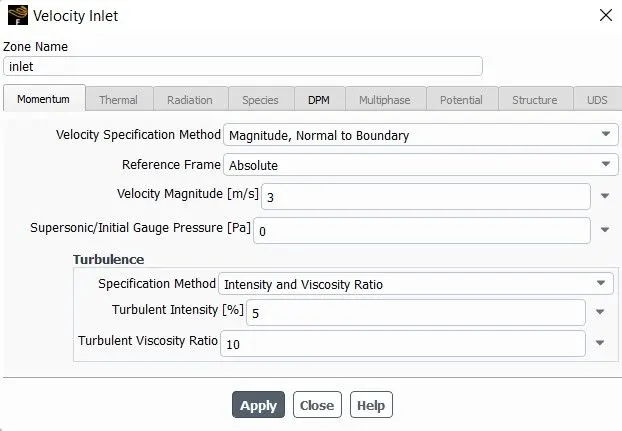
Inlet
Outlet-Escape
Outlet 2-Trap
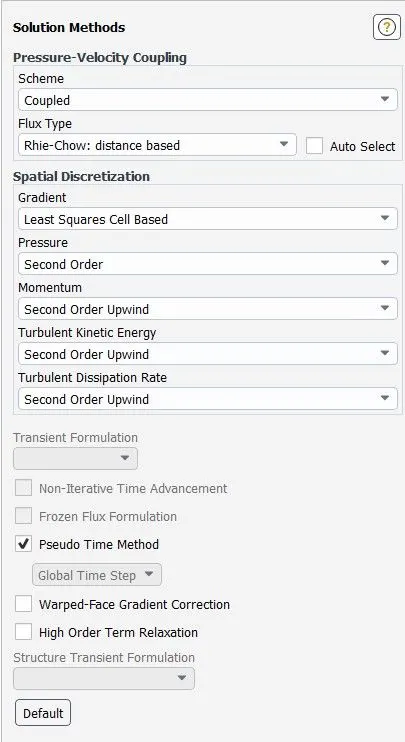
Solution Method
Initialization method(standard Initialization from inlet)
Below table is shown all the casses we are going to perform
| Cases | Division | Velocity(m/s) | Diameter of particle(m) |
| 1 |
a- b- c- |
3 |
1e-6 3e-6 5e-6 |
| 2 |
a- b- c- d- |
1 2 4 5 |
5e-6 |
RESULTS
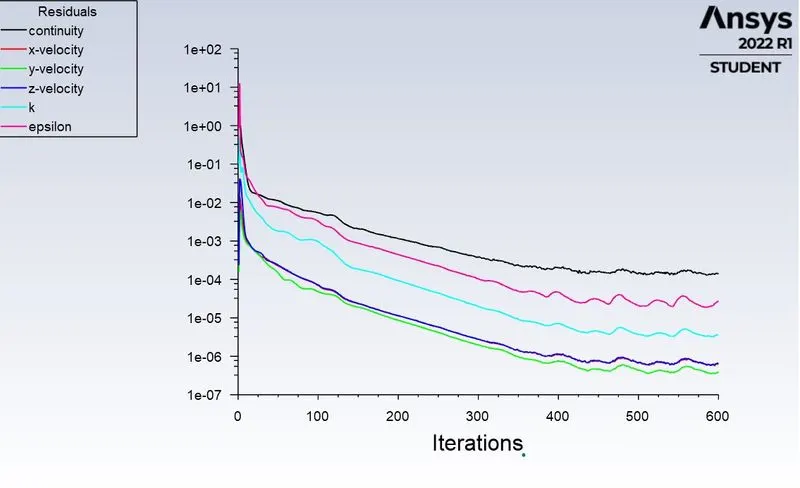
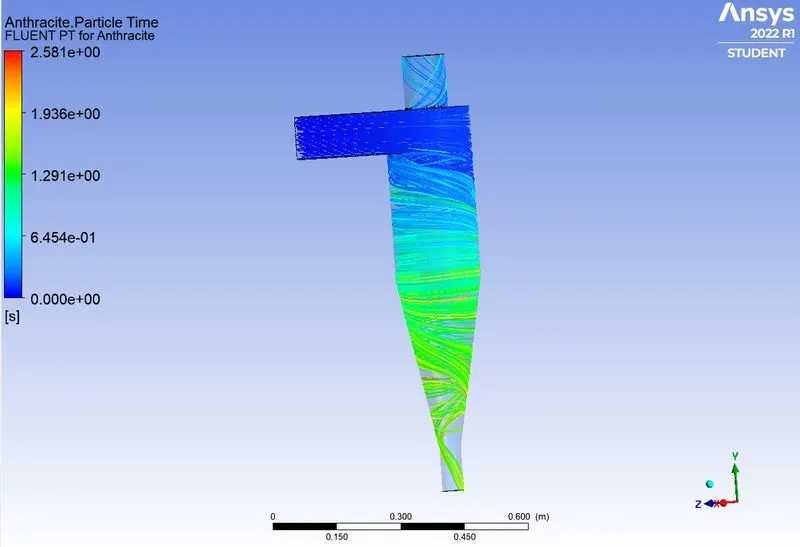
Case1(a)
Residuals
Particle time Plot(velocity)
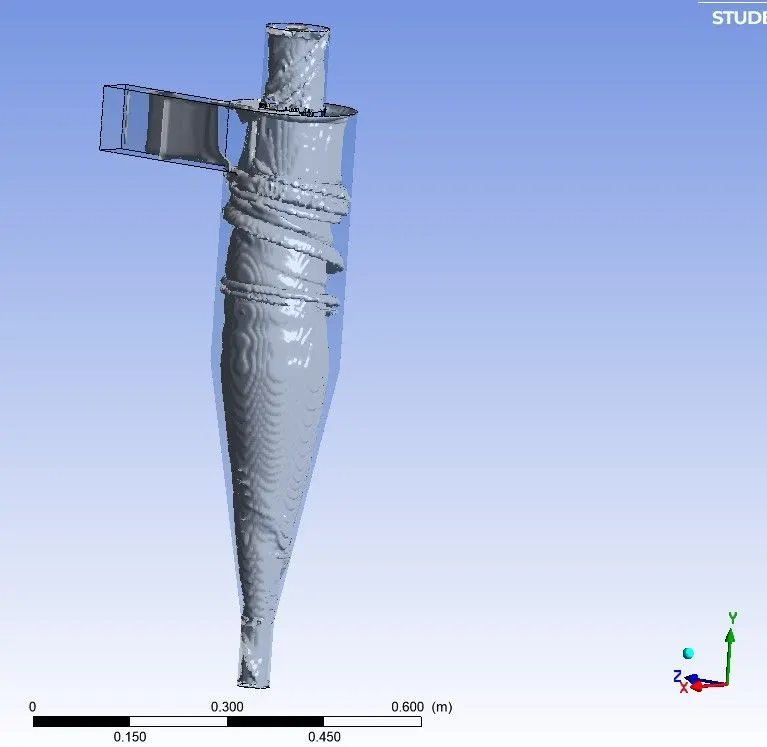
Swirling vortex
Case1(b)
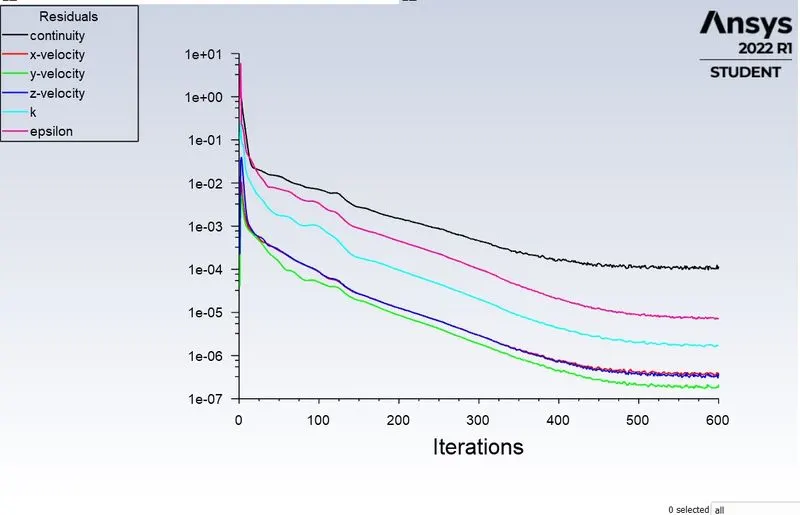
Residuals
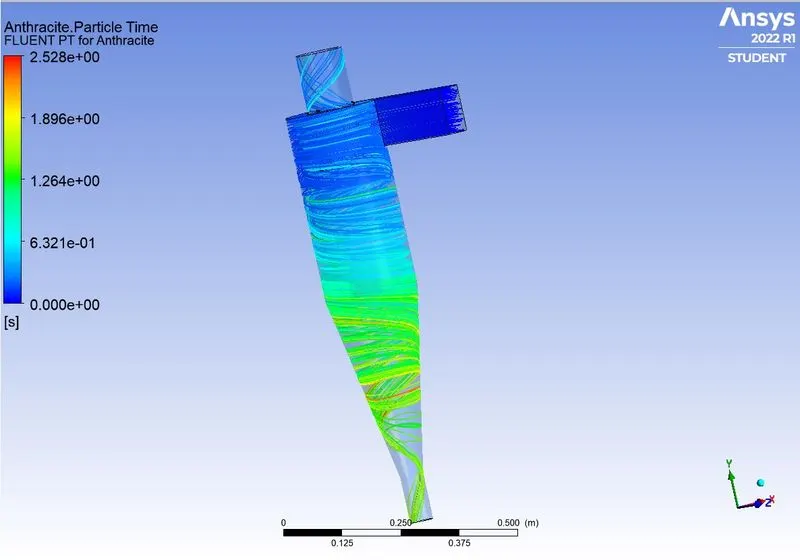
Particle time Plot(velocity)
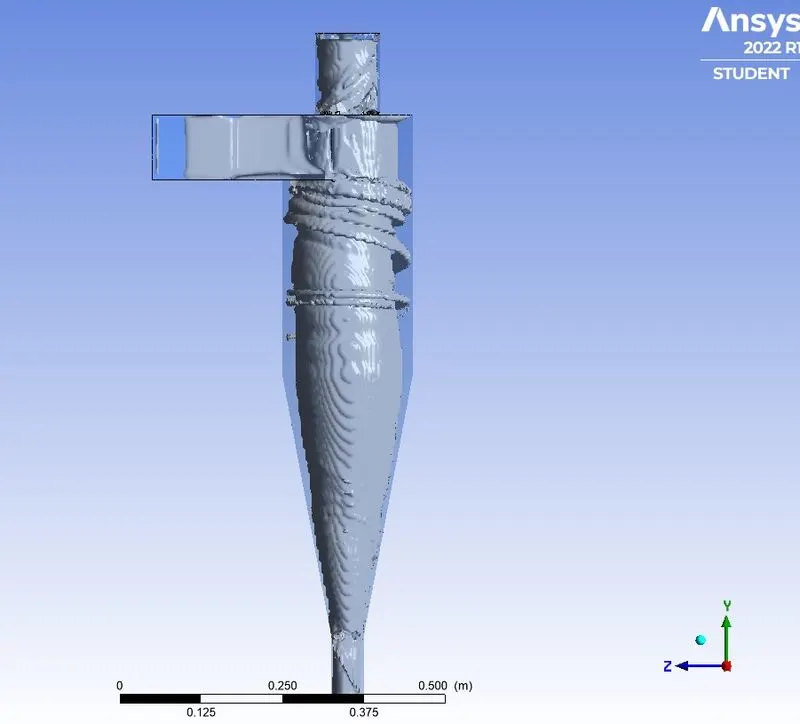
Swirling vortex
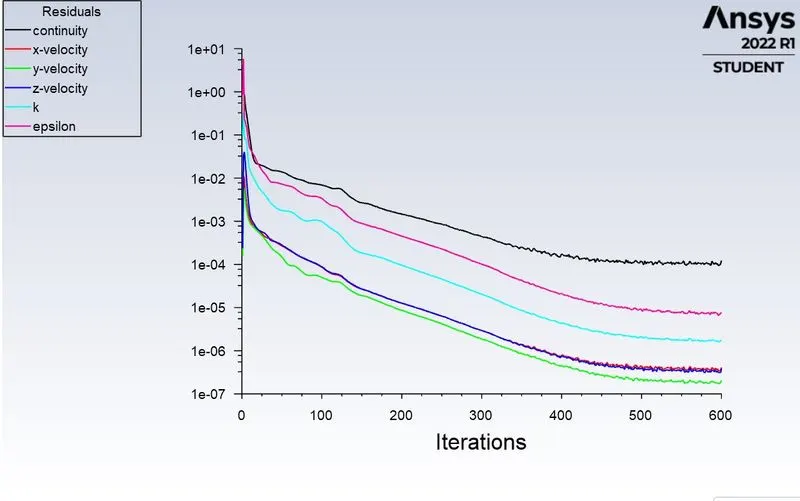
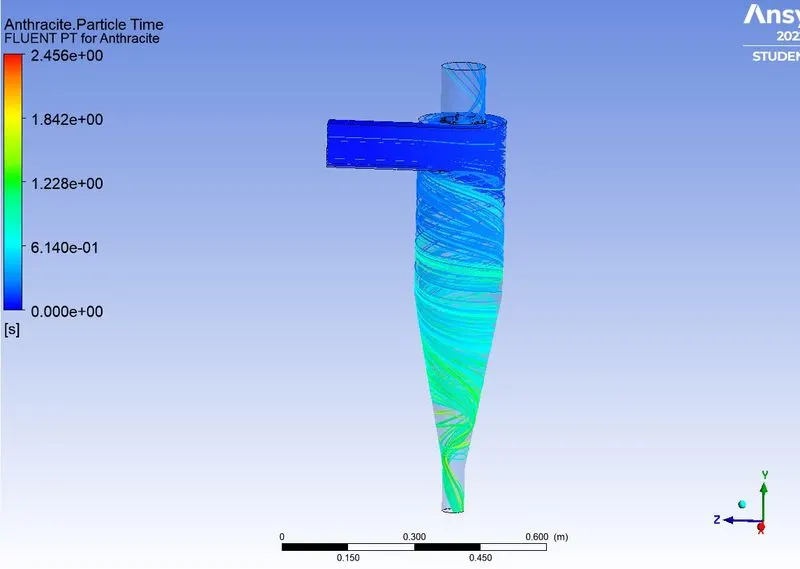
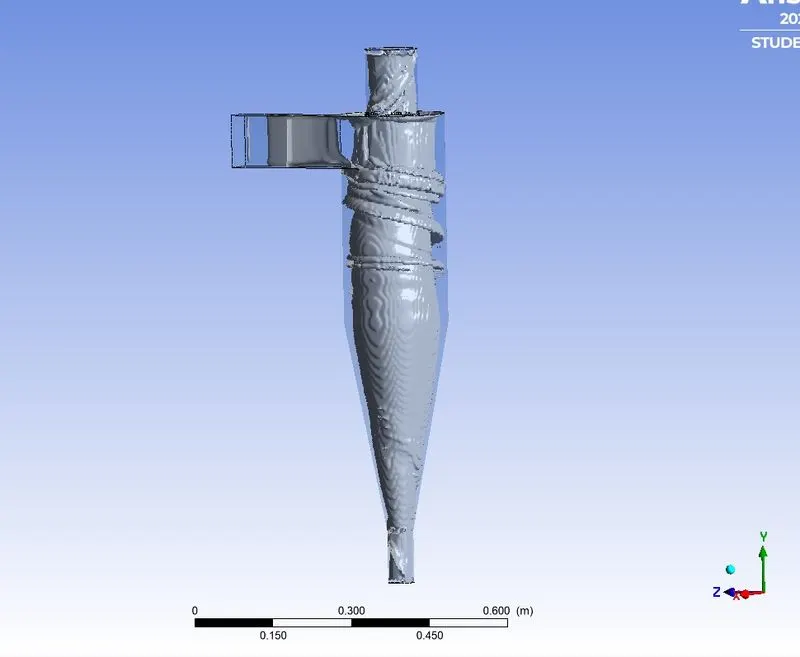
Case1(c)
Residuals
Particle time Plot(velocity)
Swirling vortex
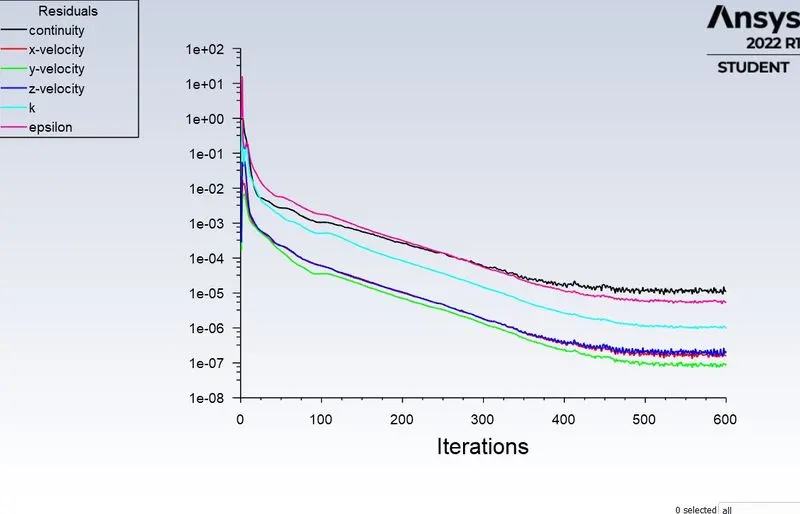
Case2(a)
Residuals
Particle time Plot(velocity)
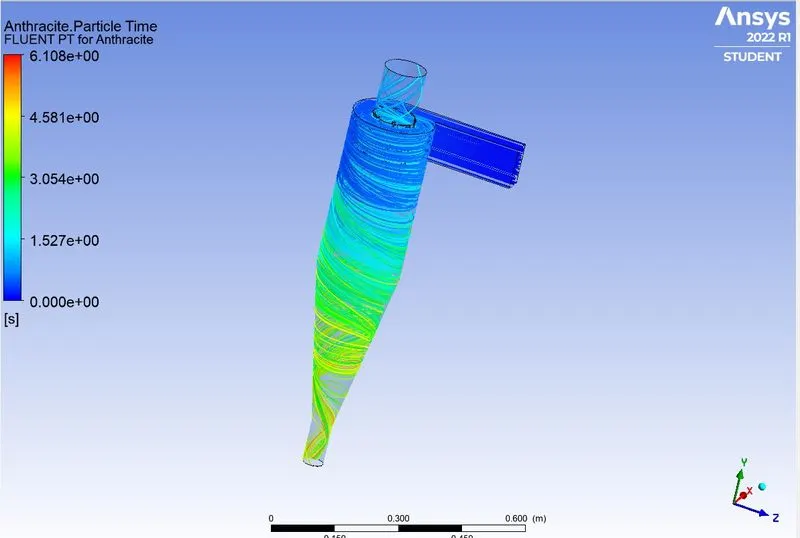
Swirling vortex
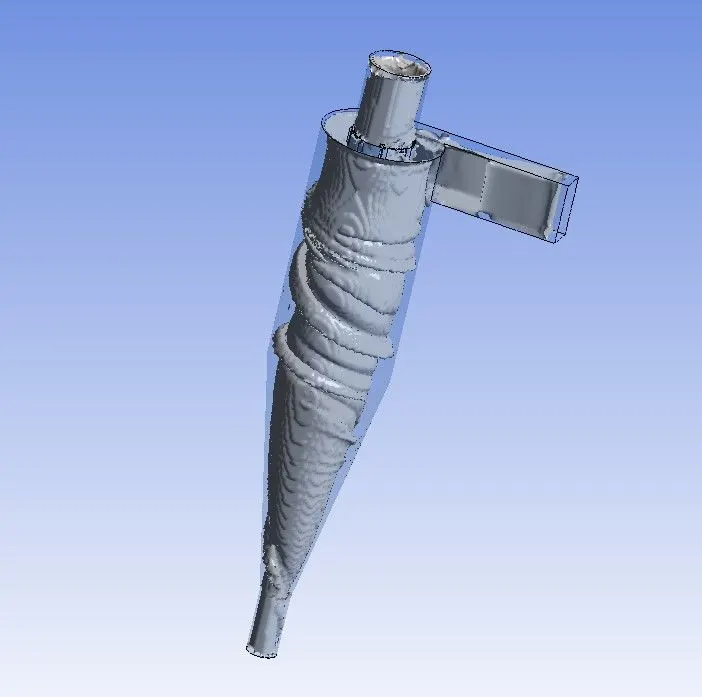
Case2(b)
Residuals
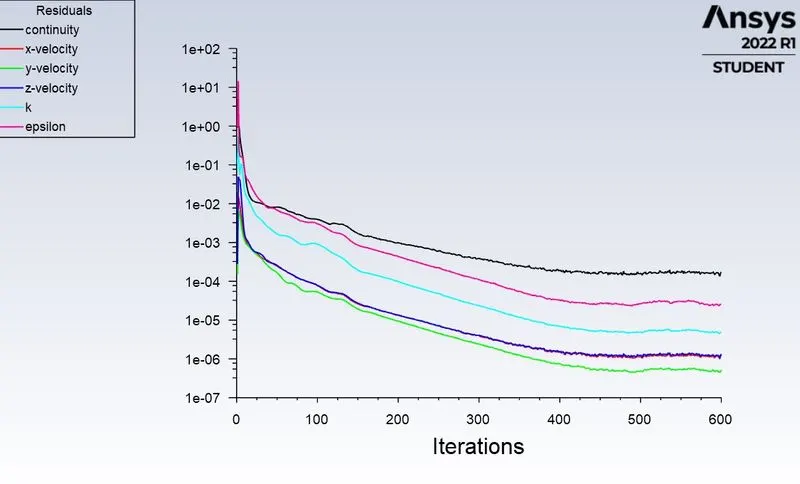
Particle time Plot(velocity)
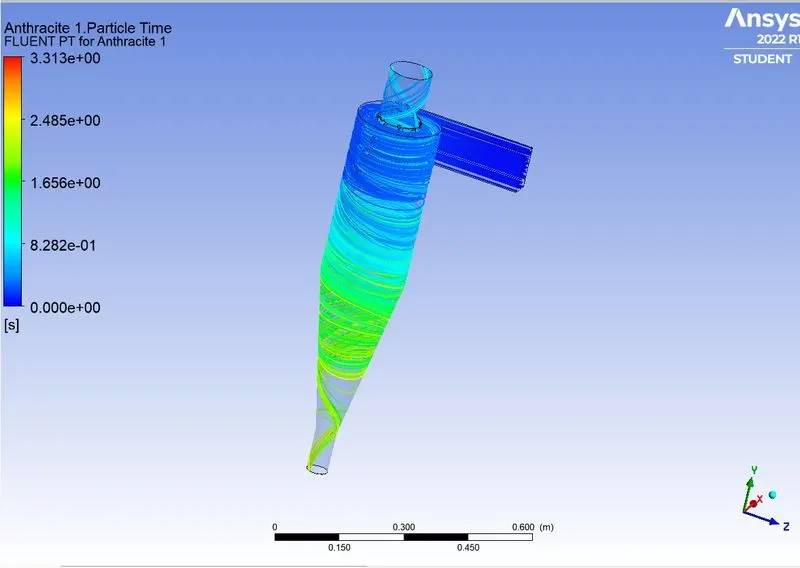
Swirling vortex
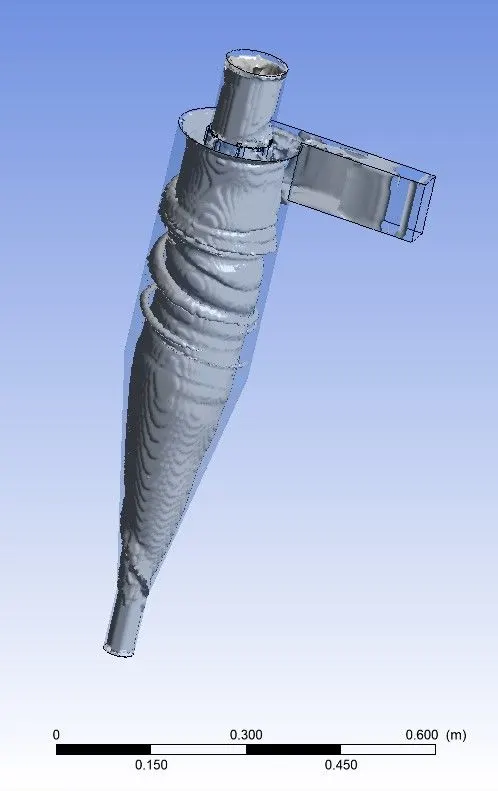
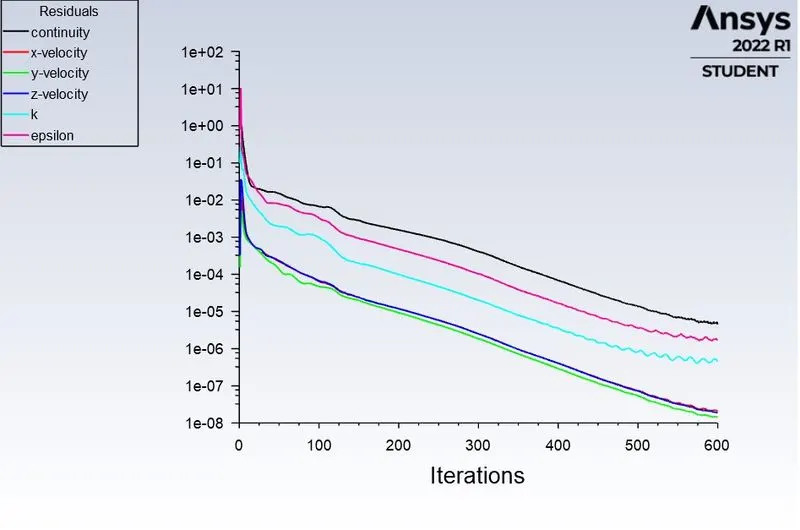
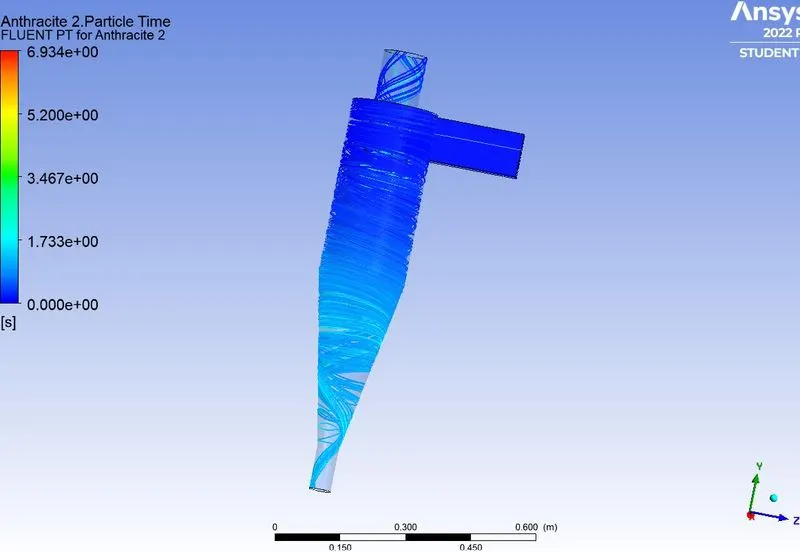
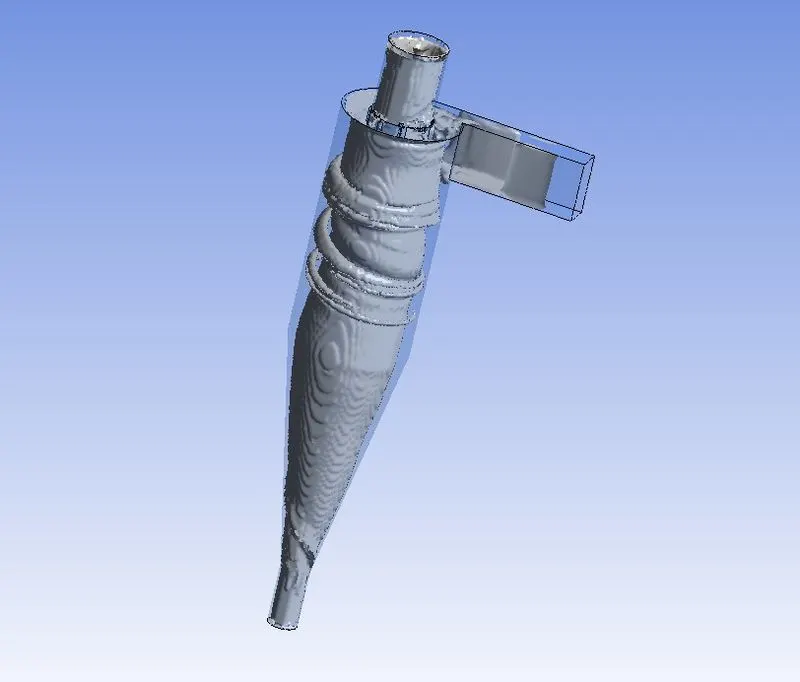
Case2(c)
Residuals
Particle time Plot(velocity)
Swirling vortex
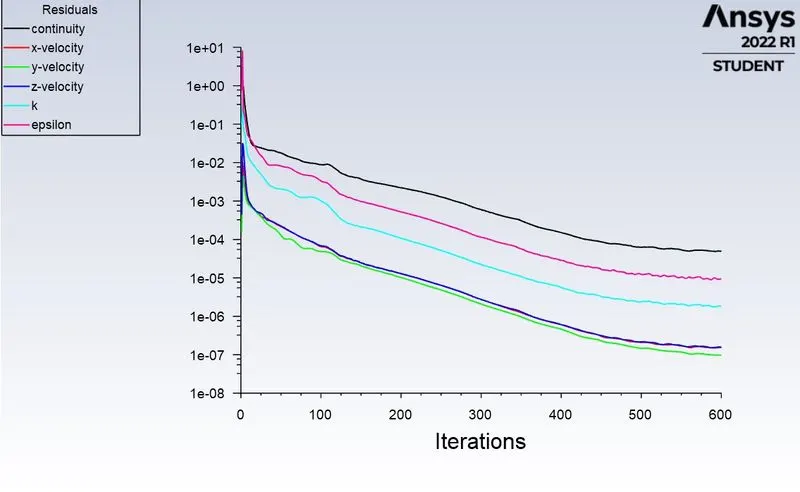
Case2(d)
Residuals
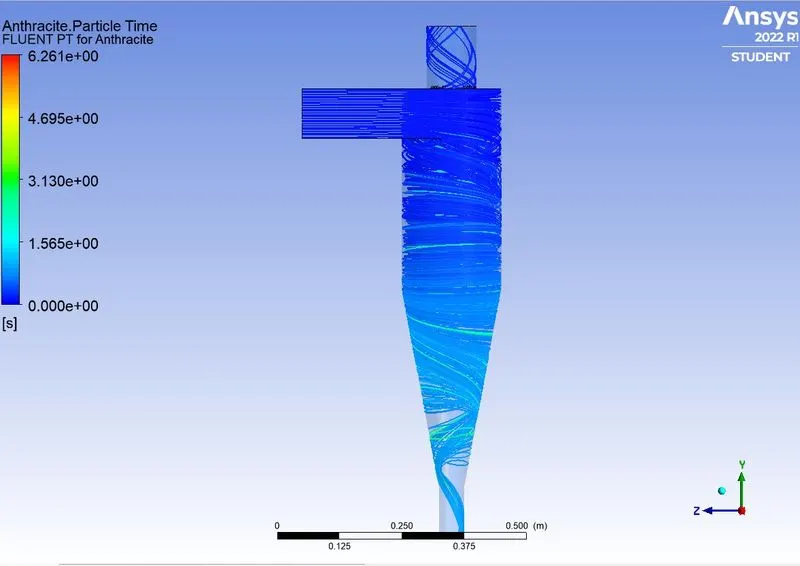
Particle time Plot(velocity)
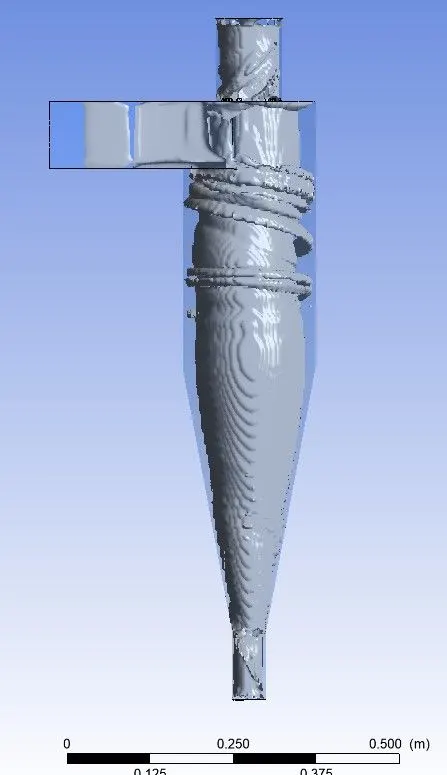
Swirling vortex
OBSERVATION
TABLE-1(FOR CASE 1)
| PARTICLE SIZE | PARTICLE TRACKED | ESCAPED | TRAPPED | INCOMPLETE |
| 1`mum` | 378 | 70 | 308 | na |
| 2`mum` | 378 | 78 | 300 | na |
| 3`mum` | 378 | 129 | 249 | na |
TABLE-2(FOR CASE-2)
| PARTICLE SIZE | VELOCITY | PARTICLE TRACKED | ESCAPED | TRAPPED | INCOMPLETE |
| `5mum` | 1m/s | 378 | 66 | 312 | na |
| `5mum` | 2m/s | 378 | 87 | 291 | na |
| `5mum` | 3m/s | 378 | 129 | 249 | na |
| `5mum` | 4m/s | 378 | 115 | 257 | 6 |
| `5mum` | 5m/s | 378 | 82 | 284 | 12 |
CONCLUSION
A numeriacal techniquie based on CFD approach is used in this work to study the flow of air and particle through cyclone .Renolds stress model methodlogy is used to predict the turbulance behaviour of the flow and discrete phase model is used to predict the particle trajectory through cyclone separtor .All the dimensional parameter of cyclone are kept constant except particle diameter,fluid velocity and prticle velocity.We can infer from the results that separation efficience incresse with increse in particle diameter and it remains stable if inlet velocity is increased.Optimization of cyclone separtor model is possible using numerical techniques od cfd approach.