Week 8 Multi cell Battery Pack
Question:
How weakest cell limits the usable capacity of the battery pack? What is the solution?
Answer:
Weakest cell:
The battery configuration in series or parallel connection can have a different voltage on each cell. The weakest cell in the battery pack could have more stress than other cells so that it will become the fastest damage. This research will find the lowest energy cell in the battery pack for traction drive application. The identification and analysis of the weakest cell is performed on the charging and discharging process with direct measurement. The result shows that the weakest cell located in the middle of the battery pack. The weakest cell have 2.75 V and the health battery cell has 2.9 V.
In the battery, if there is a low charge in the cell that is known as the weakest cell , due to that cell the discharging problem took place which can be more useful and a problematic because, if the difference betweeen the stable charge of the battery and the weakest cell is of 30% then the discharge will be took place 30% faster than the normal discharge place, so that we cannot able to fully use the battery, which has the disadvantage that the battery's performance can be made as worst, but it has an advantage that, the battery cells wont be discharged fully(except weakest cell) so that the life cycle of all other cells can be increased because they wont be having any full discharge in their life time.
There are some balancing methods with which these problems can be rectified.
(i)Active cell balancing and
(ii)Passive cell balancing
Active cell balancing:
Active cell balancing during discharge:
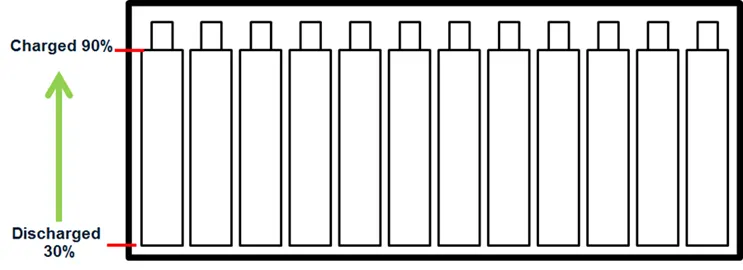
The diagram below represents a typical battery stack with all cells starting at full capacity. In this example, full capacity is shown as 90% of charge because keeping a battery at or near its 100% capacity point for long periods of time degrades lifetime faster. 30% represents fully discharged to prevent deep discharge of the cells.
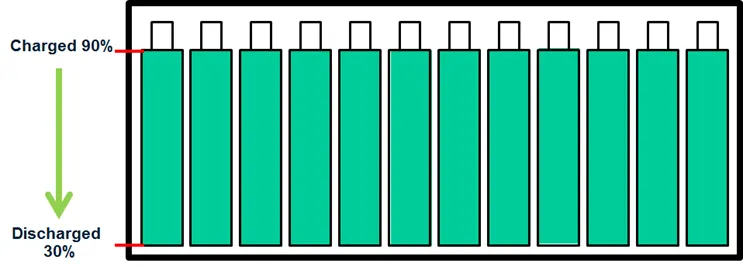
Over time, some cells will become weaker than others, resulting in a discharge profile represented by the figure below
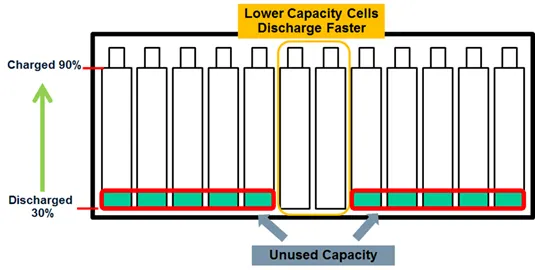
It can be seen that even though there may be quite a bit of capacity left in several batteries, the weak batteries limit the runtime of the system. A battery mismatch of 5% results in 5% of the capacity unused. With large batteries, this can be an excessive amount of energy left unused. This becomes critical in remote systems and systems that are difficult to access since it results in an increase in the number of battery charge and discharge cycles, which reduces the lifetime of the battery, leading to higher costs associated with more frequent battery replacement.
With active balancing, charge is redistributed from the stronger cells to the weaker cells, resulting in a fully depleted battery stack profile.
Active Cell Balancing While Charging
When charging the battery stack without balancing, the weak cells reach full capacity prior to the stronger batteries. Again it is the weak cells that are the limiting factor; in this case they limit how much total charge our system can hold. The diagram below illustrates charging with this limitation.
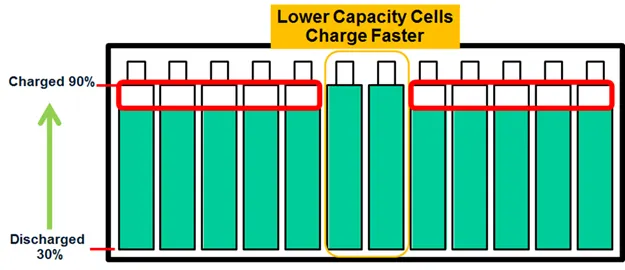
With active balancing charge redistribution during the charging cycle, the stack can reach its full capacity. Note that factors such as the percentage of time allotted for balancing, and the effect of the selected balancing current on the balancing time are not discussed here, but are important considerations
Passive cell balancing:
In the automotive and transportation marketplace, large battery stacks provide high output power without producing harmful emissions (that is, carbon monoxide and hydrocarbons) associated with gasoline-powered combustion engines. Ideally, each individual battery in the stack equally contributes to the system. However, when it comes to batteries, all batteries are not created equally. Even batteries of the same chemistry with the same physical size and shape can have different total capacities, different internal resistances, different self-discharge rates, etc. In addition, they can age differently, adding another variable in the battery life equation.
A battery stack is limited in performance by the lowest capacity cell in the stack; once the weakest cell is depleted, the entire stack is effectively depleted. The health of each individual battery cell in the stack is determined based on its state of charge (SoC) measurement, which measures the ratio of its remaining charge to its cell capacity. SoC uses battery measurements such as voltage, integrated charge and discharge currents, and temperature to determine the charge remaining in the battery. Precision single-chip and multichip battery management systems (BMS) combine battery monitoring (including SoC measurements) with passive or active cell balancing to improve battery stack performance. These measurements result in:
- Healthy battery state of charge independent of the cell capacity
- Minimized cell-to-cell state of charge mismatch
- Minimized effects of cell aging (aging results in lost capacity
Passive and active cell balancing offer different advantages to the battery stack and Analog Devices offers solutions in our battery management product portfolio for both methods. Let’s first examine passive balancing.
Initially, a battery stack may have fairly well matched cells. But over time, the cell matching degrades due to charge/discharge cycles, elevated temperature, and general aging. A weak battery cell will charge and discharge faster than stronger or higher capacity cells and thus it becomes the limiting factor in the run-time of a system. Passive balancing allows the stack to look like every cell has the same capacity as the weakest cell. Using a relatively low current, it drains a small amount of energy from high SoC cells during the charging cycle so that all cells charge to their maximum SoC. This is accomplished by using a switch and bleed resistor in parallel with each battery cell.
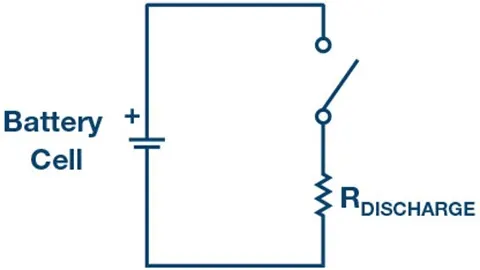
The high SoC cell is bled off (power is dissipated in the resistor) so that charging can continue until all cells are fully charged.
Passive balancing allows all batteries to have the same SoC, but it does not improve the run-time of a battery-powered system. It provides a fairly low cost method for balancing the cells, but it wastes energy in the process due to the discharge resistor. Passive balancing can also correct for long-term mismatch in self discharge current from cell to cell.
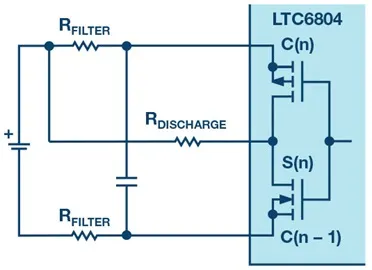
Analog Devices has a family of multicell battery monitors that include passive cell balancing. These devices feature a stackable architecture, allowing hundreds of cells to be monitored. Each device measures up to 12 series of connected battery cells with a total measurement error of less than 1.2 mV. The 0 V to 5 V per cell measurement range makes them suitable for most battery chemistries. The LTC6804 is shown below
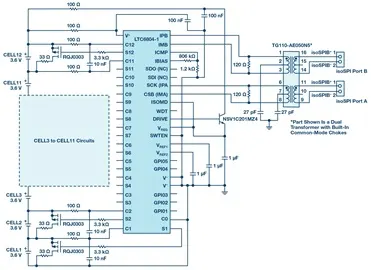
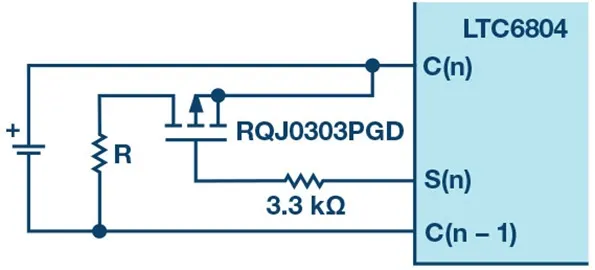
The LTC6804 features internal passive balancing and can also be configured with external MOSFETs if desired . It also has an optional programmable passive balancing discharge timer that allows the user more system configuration flexibility.