Week - 8 Mass Scaling
Aim: To determine effects of mass scaling on run time of the simulation
Explanation:
Explicit method is one of the ways to solve a partial differential equation. An Explicit FEM analysis does the incremental procedure and at the end of each increment updates the stiffness matrix based on geometry changes (if applicable) and material changes (if applicable). Then a new stiffness matrix is constructed and the next increment of load (or displacement) is applied to the system. In this type of analysis the times increments need to be small enough the results will be accurate. The time increments/time step is guided by Courant–Friedrichs–Lewy criteria which states that time step is limited by the stress wave propagation through the type of element under study.
The CFL is given by
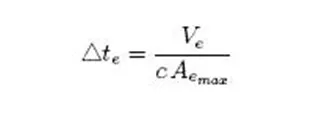
Where Ve is the element volume , Aemax is the largest side and c is plane stress sound speed
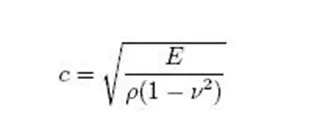
As evident from the formula for the elements which are small and fine, the stable time step reduces significantly and hence increase computational costs.
Mass scaling is used to artificially increase the mass of some of the elements, thereby increasing the stable time step increment so as to perform the same analysis with fewer increments and hence make computational costs economical. However this has the same influence on inertial effects as artificially increasing loading rates. Care has to be taken not use it excessively as it produces erroneous results because of the mass addition.
The given problem has the meshed model with all the boundary conditions, load and database cards.
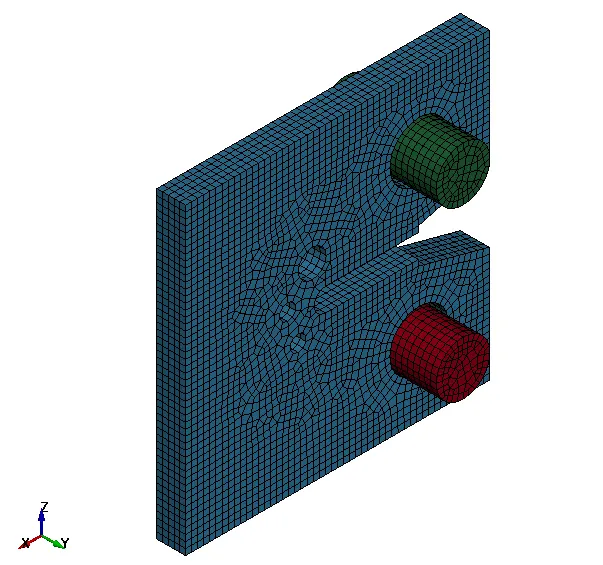
Following is the procedure and steps followed to check the variation of mass scaling on the runtime to process the solver simulation.
In LS Dyna, mass scaling can be activated by using CONTROL_TIMESTEP under CONTROL keyword.
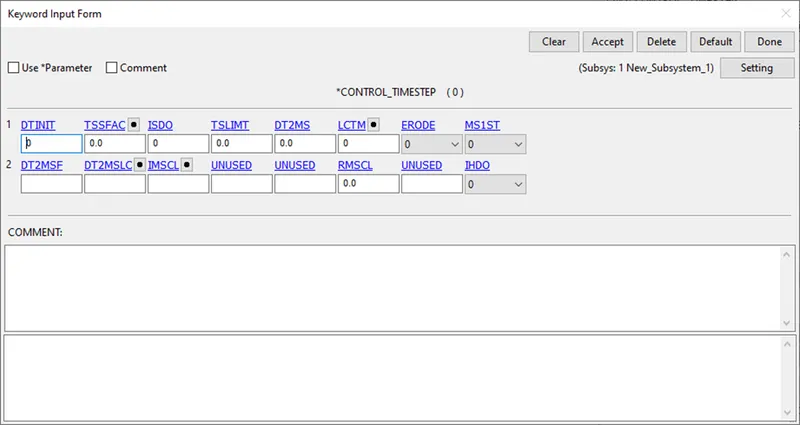
The required inputs are DT2MS which is the time step requested by the user. This value can either be positive or negative. Negative value is preferred to positive value because the negative value prompts LS DYNA to increase the time step and hence add mass only for the elements below the value specified and positive value prompts to mass scale all the elements less than or more than the time step requested.
TSSFAC is the time step scaling factor, which when used defaults to 0.9. This value indicates the factor by which DT2MS is introduced in each step. This is one of the conservative approaches to control the DT2MS further.
In the problem given, the DT2MS value is specified as 3.5e-5 with a negative sign to indicate mass scaling for elements below the threshold time step.
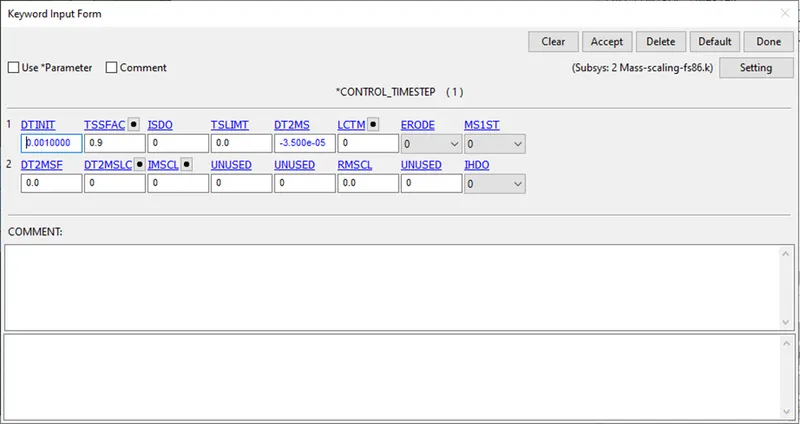
The mass scaling has been increased for the following set of simulations with respect to the base value of -3.5e-6. The simulations were carried out by increasing from 25% up to 200% with maximum percentage of mass limited to 8%.
The run estimates presented and compared here were reported during the start of the simulation.
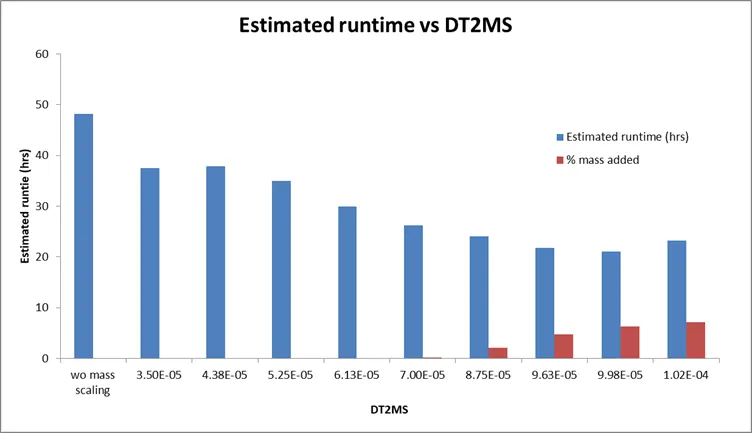
The %mass added for the initial mass scaling steps is negligible. As the D2MS value increases, the %mass added increases resulting in decreasing run time. The optimised value of DT2MS is found to be 9.975e-5 resulting in 21.08 hrs.
The optimised DT2MS value of 9.975e-5 were ran by varying the time step scale factor from 0.5 to 0.9
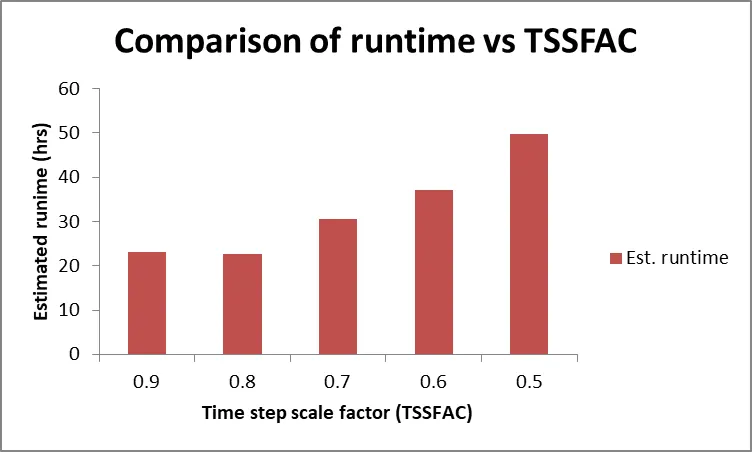
Since, the time scale factor is inversely proportional to the run time; however the value of 0.8 TSSFAC has minimum run time.
IMPLICIT SOLVER IMPLEMENTATION:
The problem given above can be implicitly solved with the following modifications.
CONTROL_IMPLICIT_GENERAL
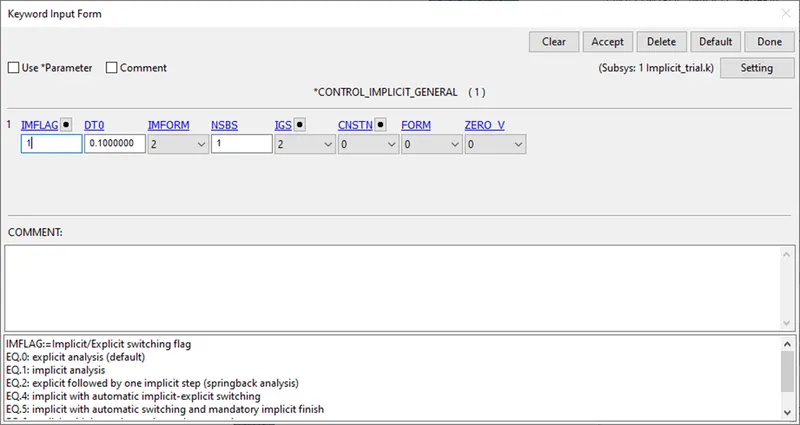
The implicit solver can be activated by using CONTROL_IMPLICIT_GENERAL keyword and switching IMFLAG to 1. The initial time is assumed to be 0.1.
CONTROL_IMPLICIT_AUTO
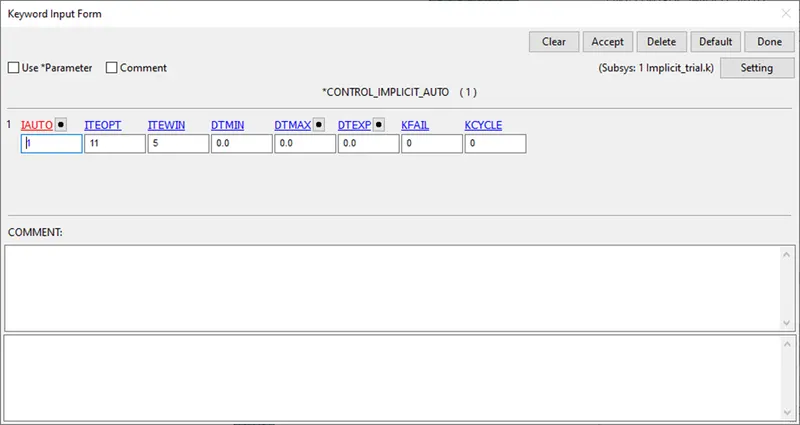
Automatic time step control algorithm is toggled with the default values of ITEOPT 11 and ITEWIN of 5.
CONTROL_IMPLICIT_SOLUTION:
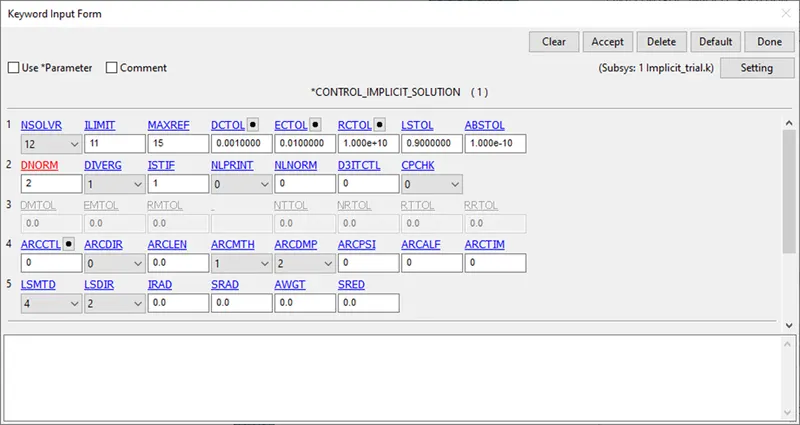
Since the stress strain curve of one of the material is non linear, and a piecewise plastic material card is used, non-linear solver- Nonlinear with BFGS updates + optional arclength is used.
CONTROL_IMPLICIT_SOLVER:
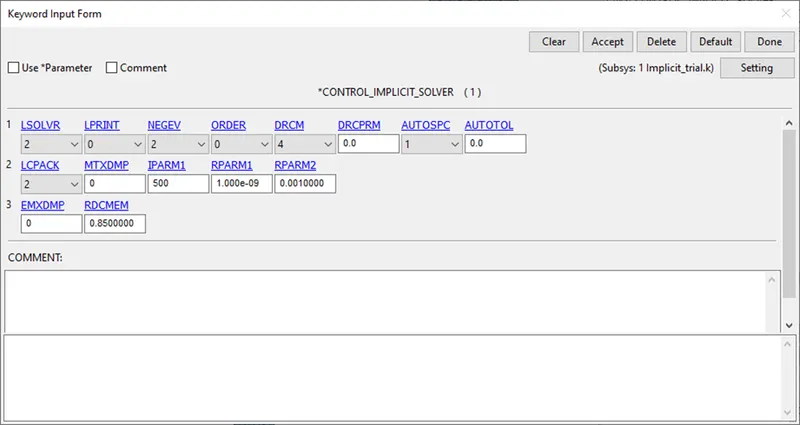
The default-Parallel multi-frontal sparse solver with default values is used to invert the stiffness matrix.
CONTACT:
Since there is an initial penetration between the parts, lower pin and lower surface, and upper pin and upper surface, though it is an implicit analtsis, MORTAR card as recommended cannot be used. Hence, an AUTOMATIC_SURFACE_TO_SURFACE card is defined. IGNORE option is set to 1 to ignore the initial penetration.
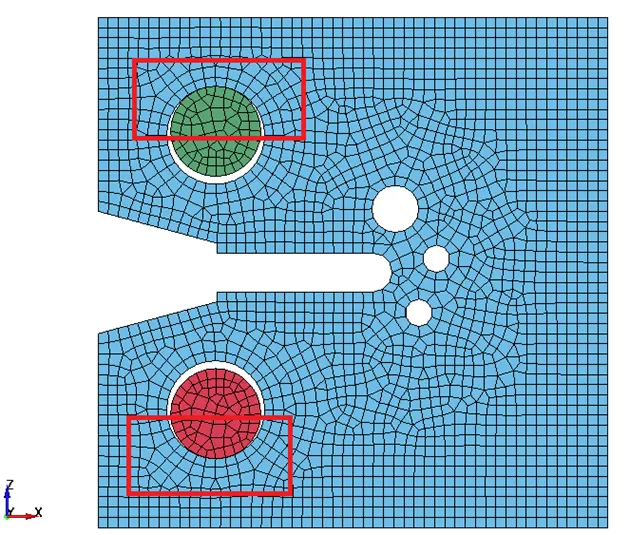
Initial penetration
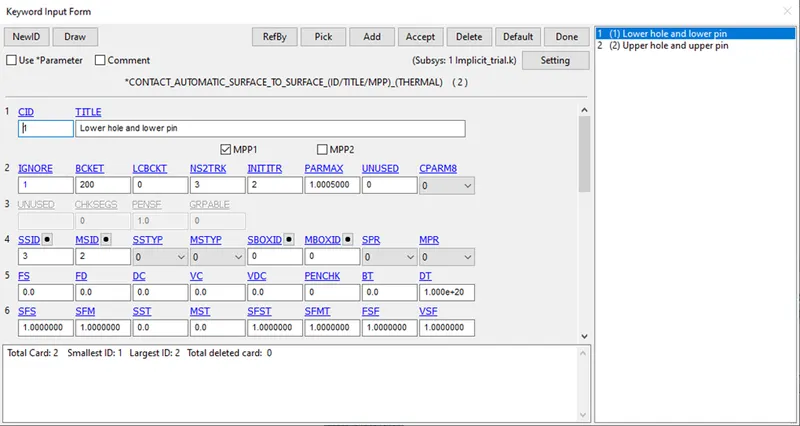
Between lower hole and lower pin.
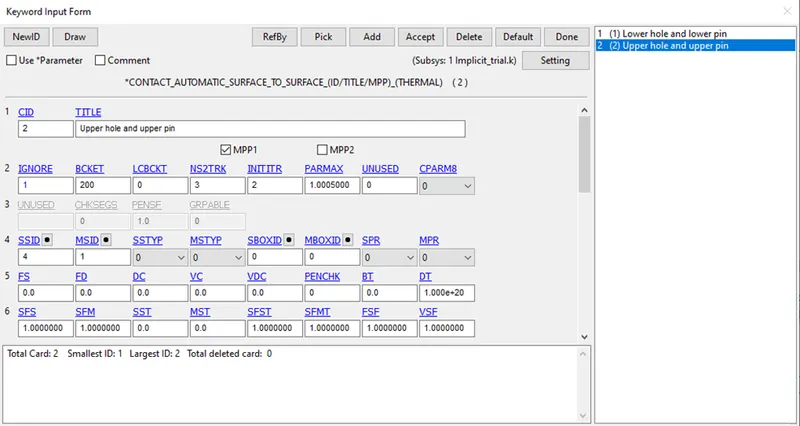
Between upper hole and upper pin.
Conclusion:
The simulations were run to study the effects of mass scaling on the run time. The simulations were run by increasing the default value of DT2MS by a factor of 25%, 50%, 75%, 100% etc.. with limit to the %mass added to 8.
The optimised solution was found to be at DT2MS value of 9.975e-8. With the optimised value of DT2MS the effects of time scaling factor (TSSFAC) on run time were carried out. The optimised value of TSSFAC was found to be 0.8.
The given problem was implemented with the Implicit solver by making necessary changes/modifications.
Please follow the link to access the input and output files : https://drive.google.com/drive/folders/18XuAQ8dAFO_SpAkPcpiCIhZoLdYJ2JAU?usp=sharing