Week - 8 Mass Scaling
MASS SCALING IN LS-DYNA
AIM: To check the
- Effect of mass scaling on RUNTIME.
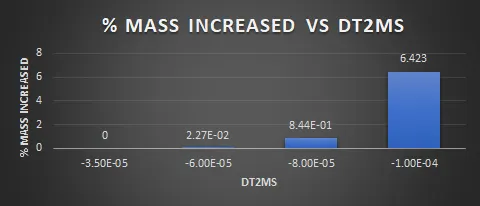
- Effect of dt2ms on % mass increase.
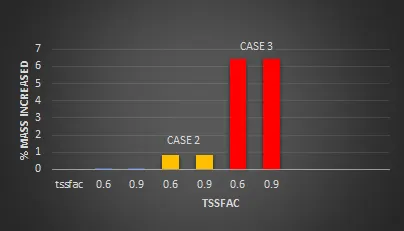
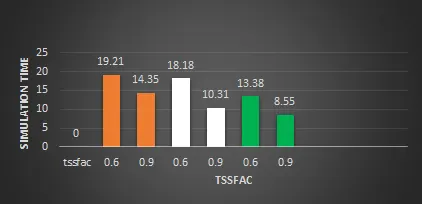
- Effect of tssfac on % mass increase and runtime.
Procedure:
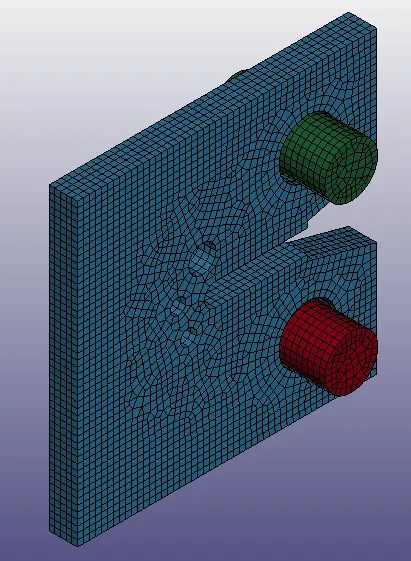
1. First model is imported.
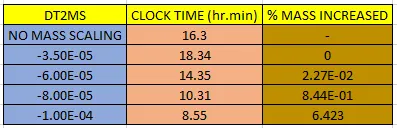
2. Now we have iterate the different values of tssfac and dt2ms in TIMESTEP card, to check their effects on runtime. These are the values considered while experimenting.
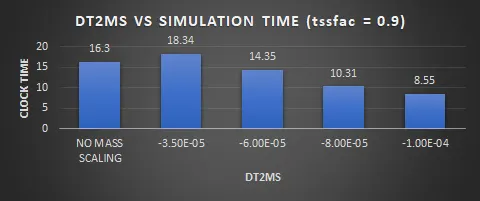
* In below results tssfac value is kept 0.9.
Observation:
- With increase in dt2ms value there is significant decrease in runtime.
- However, after dt2ms value increased from -8E-5 to -1E-4 percentage mass increase is very significant i.e. from .84% to 6.423%.
- So dt2ms value cannot be increased beyond -1E-4, if increased due to significant increase in inertia system can will become unstable.
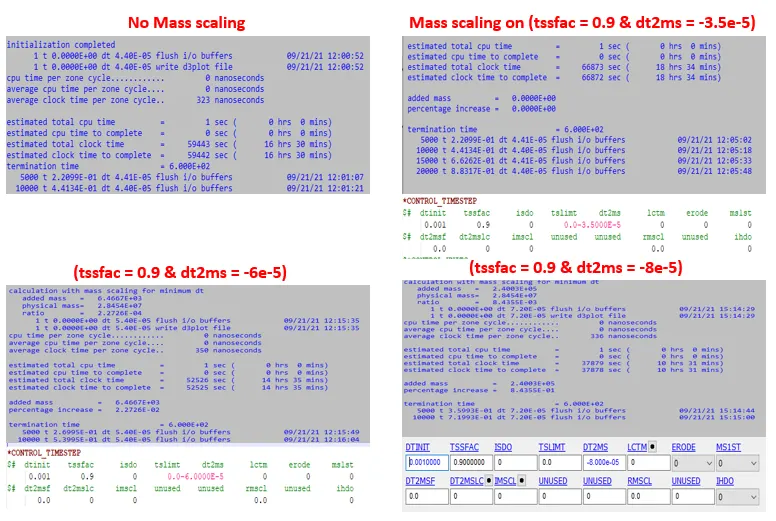
Effect of tssfac value on RUNTIME:
- tssfac value has no impact on %mass increased.
- Decreasing the value of tssfac, leads to increase in runtime.
- Low tssfac value give stability to system.
case 1: dt2ms = -6E-5
case 2: dt2ms = -8E-5
case 3: dt2ms = -1E-4
Implicit Simulation:
Implicit auto and implicit general cards are used. Complete simulation is completed in 112 sec. This is because implicit solver automatically change timestep using implicit auto card.

Result Observations:
- If we increase the value of dt2ms above critical value, %mass increase significantly (like from -8E-5 to -1E-4).
- dt2ms reduce the Runtime by significant amount almost 50% compairing no mass scaling and -1E-4 case.
- tssfac increase runtime.
- tssfac do not effect mass percentage.