Week - 8 Mass Scaling
Week 8 Challenge: Mass Scaling Challenge
Course: LS-DYNA for Structural Mechanics/ FEA
Submitted by: Amanpreet Singh Whan
Supervisor: Tholkappiyan D
August 18, 2021
Table of Contents
1 Introduction
LS-DYNA is an advanced general-purpose multiphysics simulation software package developed by the former Livermore Software Technology Corporation (LSTC), which was acquired by Ansys in 2019. While the package continues to contain more and more possibilities for the calculation of many complex real-world problems, its origins and core competency lie in highly nonlinear transient dynamic finite element analysis (FEA) using explicit time integration. LS-DYNA is used by the automobile, aerospace, construction and civil engineering, military, manufacturing, and bioengineering industries.
Mass-scaling is a term that is used for the process of scaling the element’s mass in explicit simulations to adjust its timestep. The primary motivation is to change (usually increase) the global compute timestep which is limited by the Courant’s stability criteria. Courant Friedrichs Levy's condition for convergence gives a stable time step for explicit analysis.
Ccfl = l /c
Where l is the smallest element length and c is the speed of the sound wave through the material. Since speed is inversely proportional to the mass or density of the material, therefore an increase in the mass or density of elements will decrease the speed of sound and thereby increase the time step for the simulation.
LS-DYNA allows two different types of mass-scaling using the DT2MS parameter from *CONTROL_TIMESTEP with the default set to no mass-scaling. When DT2MS is less than zero, LS-DYNA adds a mass of each element whose timestep is below abs (DT2MS) such that the element’s updated DT is equal to abs (DT2MS). When DT2MS is greater than zero, LS-DYNA adds mass to elements whose DT is below abs (DT2MS) and “removes” mass from elements whose DT is greater than zero. DT2MS>0 is seldom used while DTM2<0 is frequently used for overcoming the smallest computed timestep. Care must be taken when using DT2MS<0 to ensure that the added mass does not have an adverse effect on the simulation accuracy. It is common practice to limit the percentage of added mass to less than 5% (at part level) in dynamic simulations. It must be noted that the percentage of added mass is based on the total mass of the model which included rigid body, rigid walls, etc., and could be misleading if looked at the global level. LS-DYNA outputs the percentage of added mass at a component level which is a better indicator of the amount of added mass due to mass-scaling. The concept of mass-scaling for both options of DT2MS is graphically illustrated below.
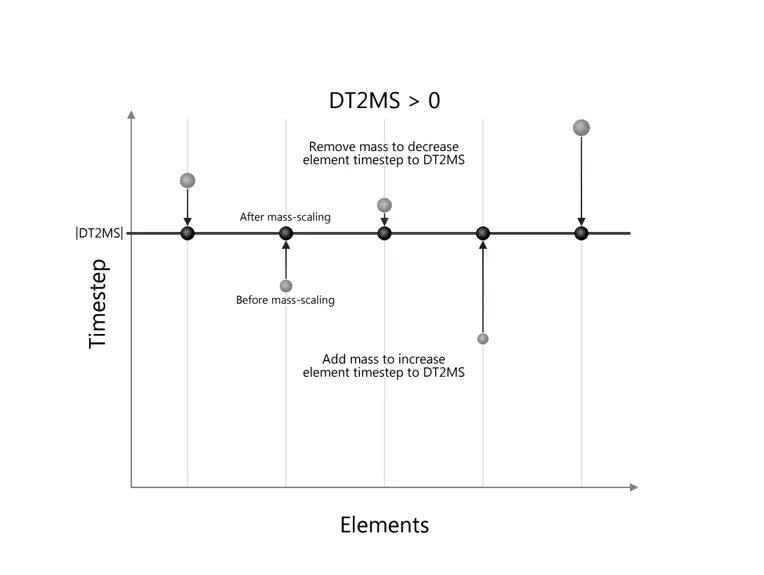
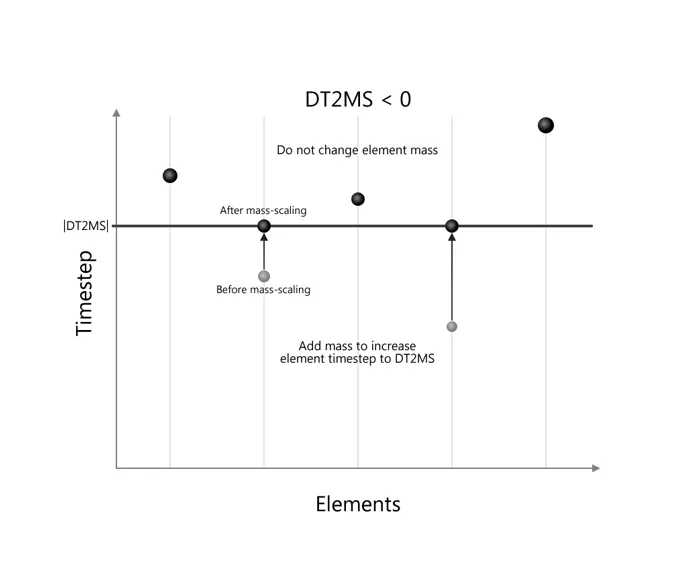
The purpose of the Week 8 challenge is to use mass scaling to reduce the runtime of a model and ensure the stability of the model remains intact after setting the mass scaling hard limit to 8 percent. In addition, compare the results of explicit and implicit schemes runtime.
2 Aims
- Use Mass Scaling to reduce the runtime for the simulation.
- Achieve a hard limit of 8% for mass scaling by optimizing DT2MS and TSSFAC parameters.
- Compare runtime results of explicit and implicit schemes.
3 Methodology and Results
The section describes different stages that were performed to set up the simulation file using an engineering tool LS-DYNA for the completion of the Week 8 Challenge task. These stages can be broadly categorized into creating an input deck containing different cards such as contact, control, database, element, hourglass, initial (velocity), keyword, MAT, node, part, section, and title.
Since the challenge requirements were to find an optimal value of DT2MS and TSSFAC parameters for establishing mass scaling hard limit of 8%, the trial-and-error approach was selected to find the optimal values for the discussed parameters.
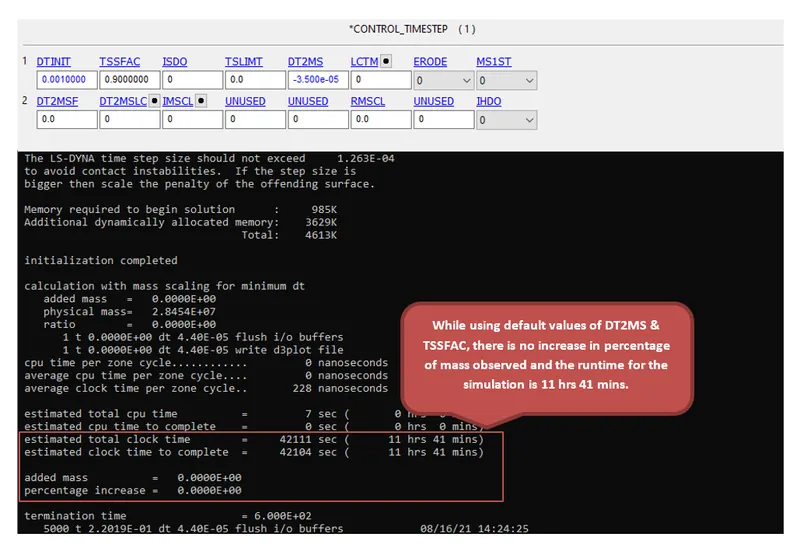
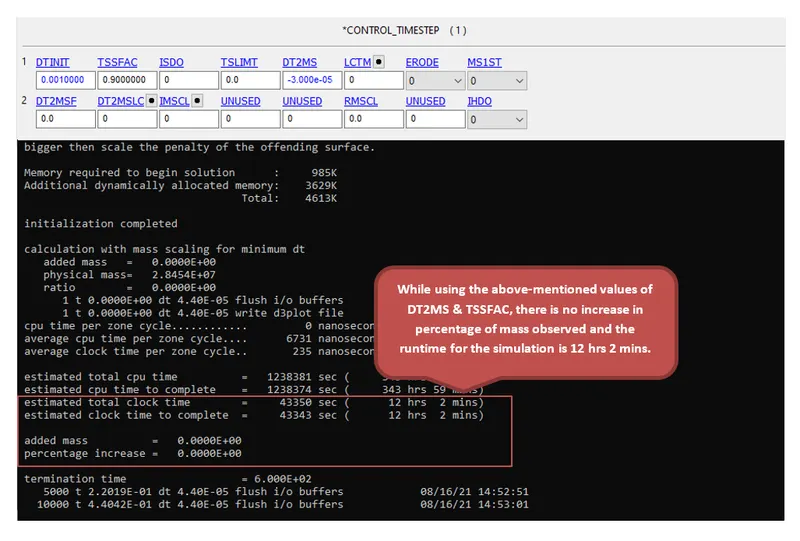
What follows hereafter is the set of images representing the results of percentage increase and addition of mass to the simulation for different values assigned to the DT2MS and TSSFAC parameters of the Control Timestep card.
Control Timestep Card: - DT2MS = - 3.500 E-05 & TSSFAC= 0.9
Control Timestep Card: - DT2MS = - 3.000 E-05 & TSSFAC= 0.9
Control Timestep Card: - DT2MS = - 4.000 E-05 & TSSFAC= 0.9
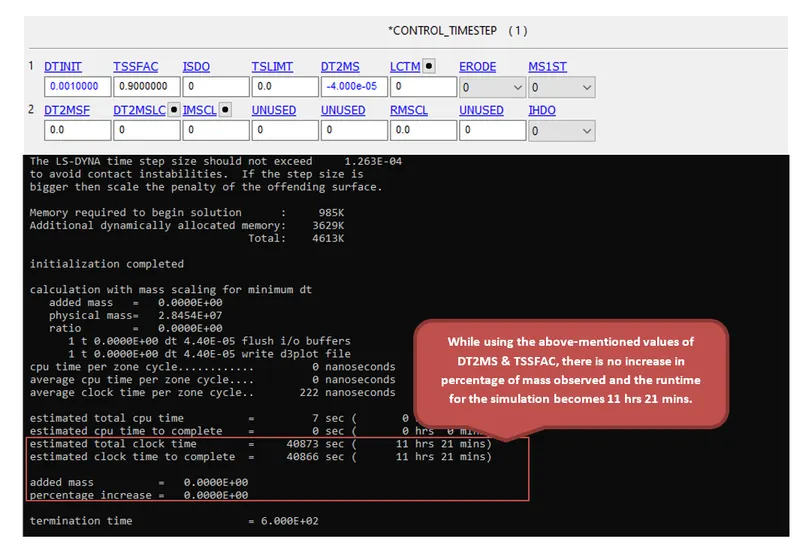
Control Timestep Card: - DT2MS = - 5.500 E-05 & TSSFAC= 0.9
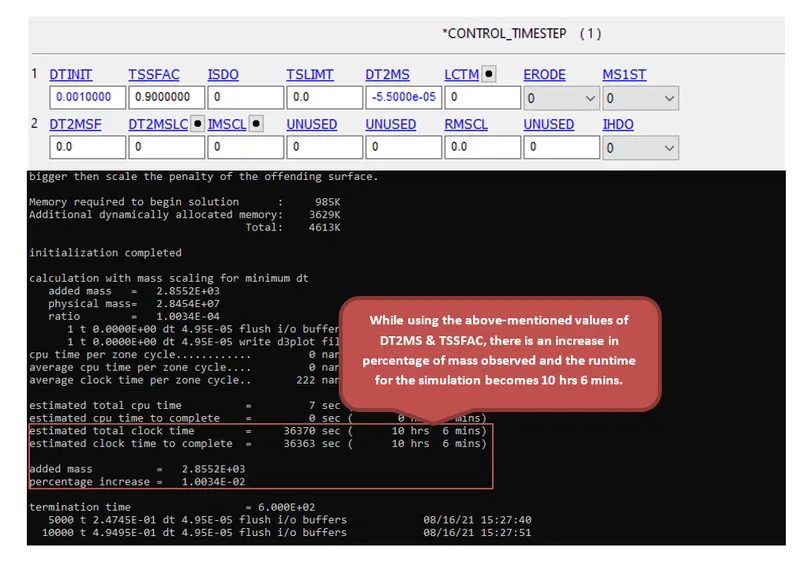
Control Timestep Card: - DT2MS = - 7.500 E-05 & TSSFAC= 0.9
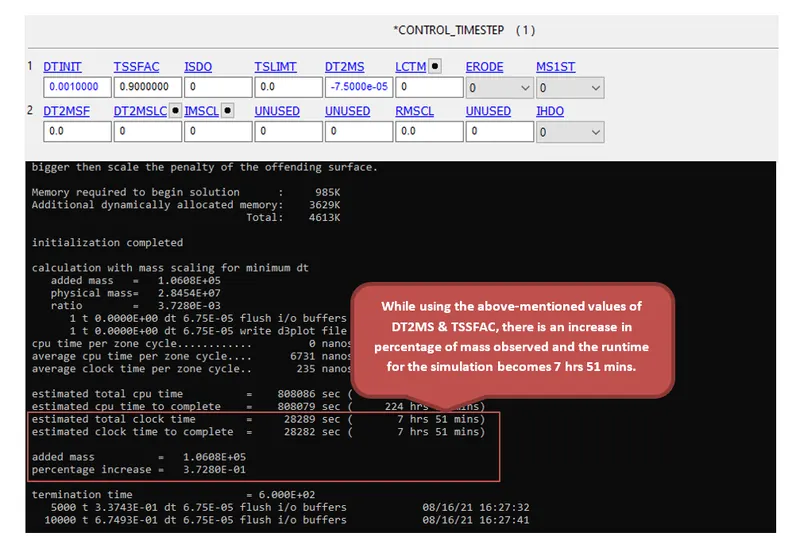
Control Timestep Card: - DT2MS = - 9.500 E-05 & TSSFAC= 0.9
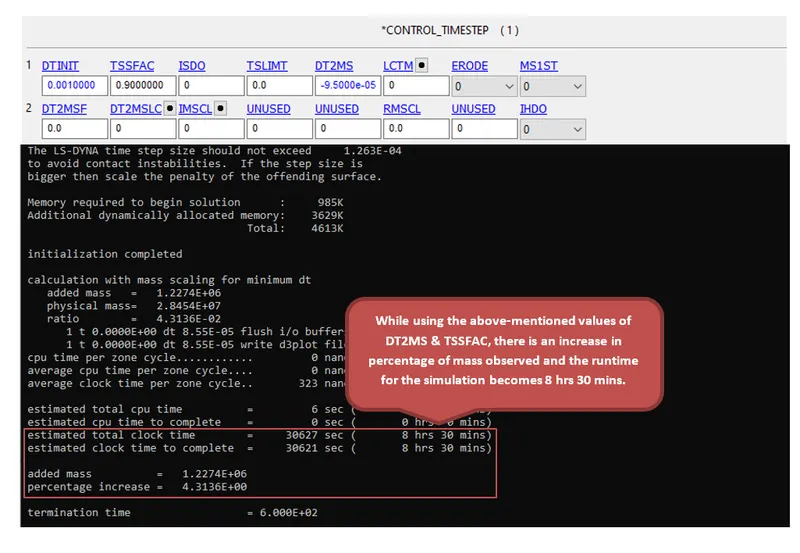
Control Timestep Card: - DT2MS = - 1.000 E-04 & TSSFAC= 0.9
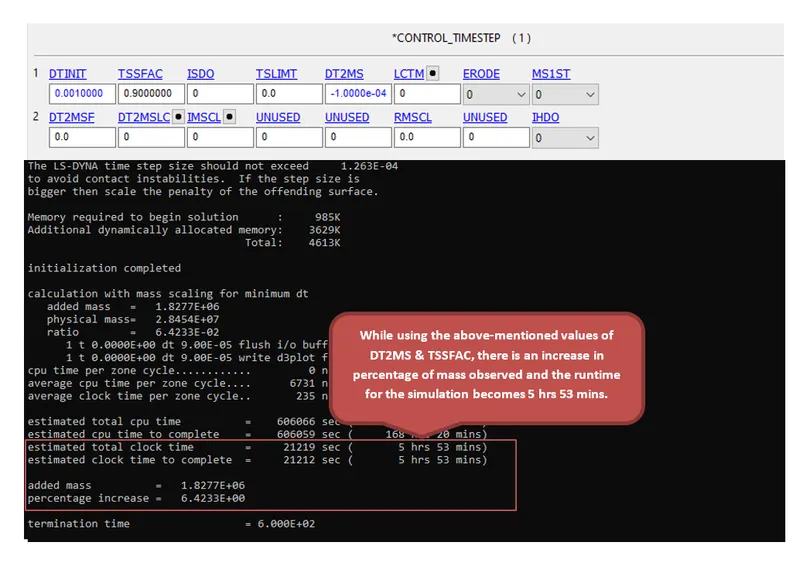
Control Timestep Card: - DT2MS = - 1.0100 E-04 & TSSFAC= 0.9
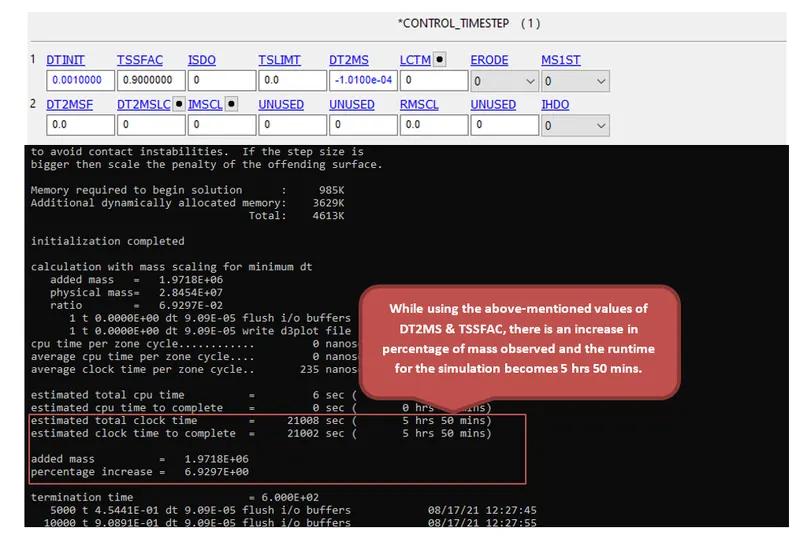
Control Timestep Card: - DT2MS = - 1.0200 E-04 & TSSFAC= 0.9
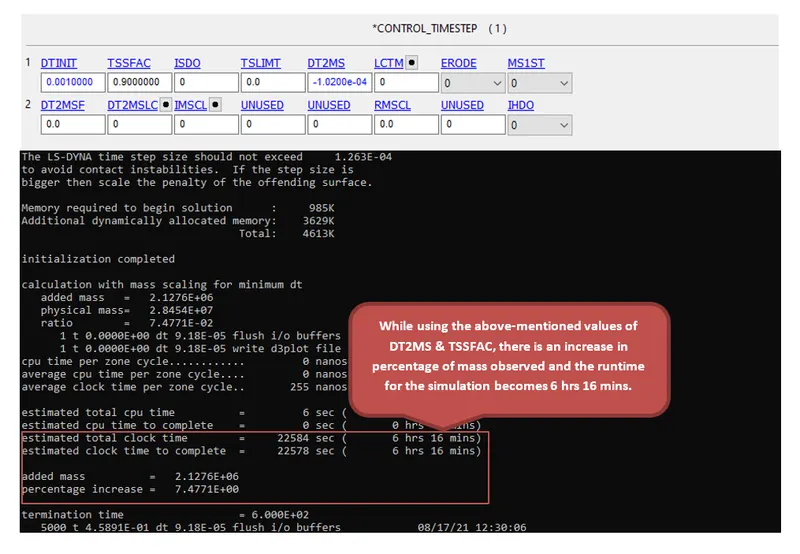
Control Timestep Card: - DT2MS = - 1.0288 E-04 & TSSFAC= 0.9
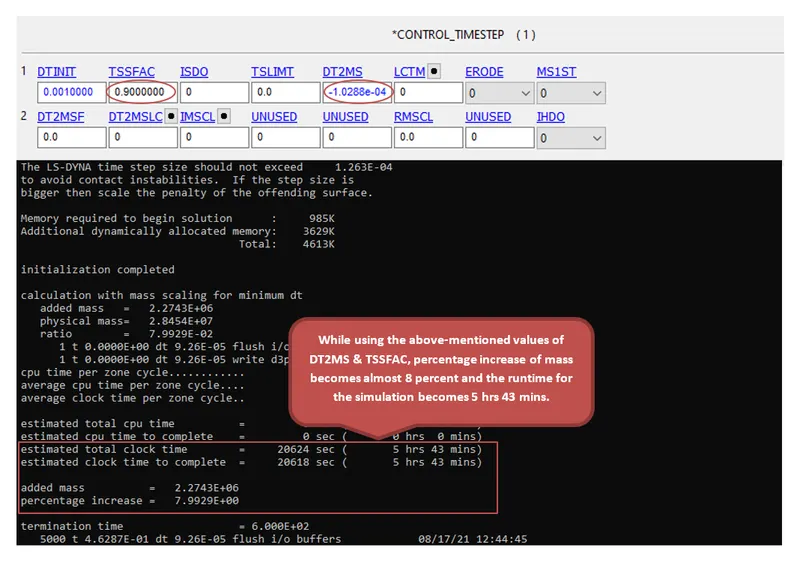
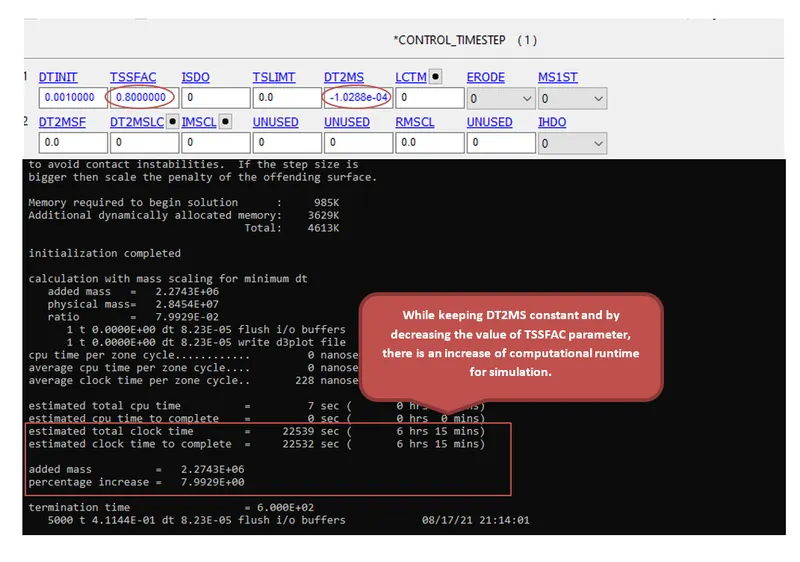
Control Timestep Card: - DT2MS = - 1.0288 E-04 & TSSFAC= 0.8
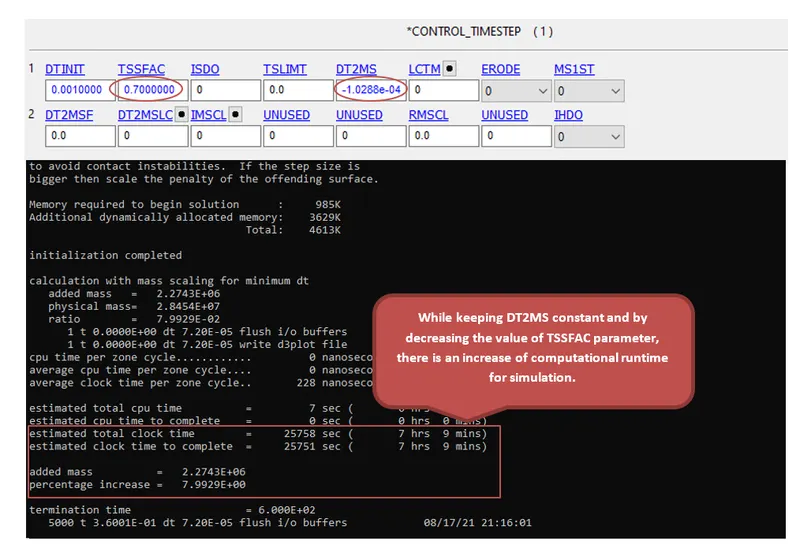
Control Timestep Card: - DT2MS = - 1.0288 E-04 & TSSFAC= 0.7
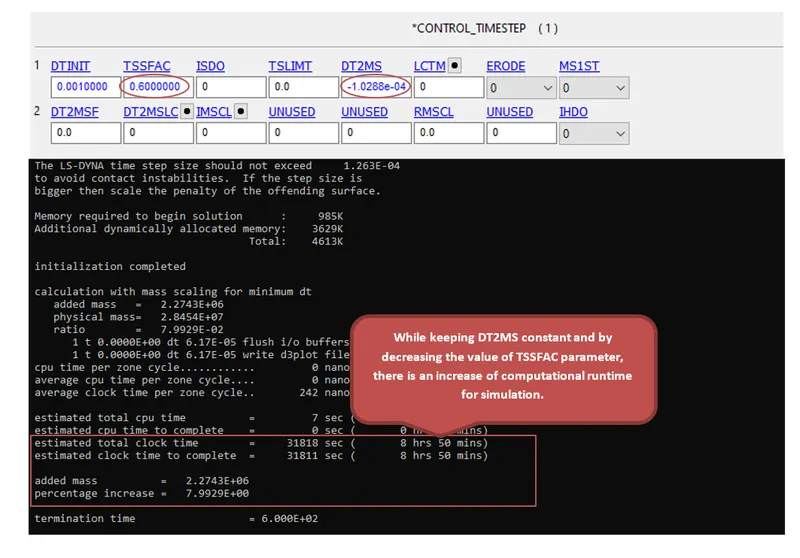
Control Timestep Card: - DT2MS = - 1.0288 E-04 & TSSFAC= 0.6
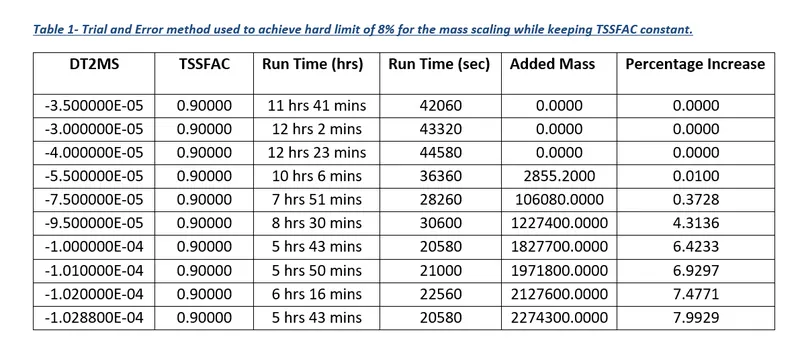
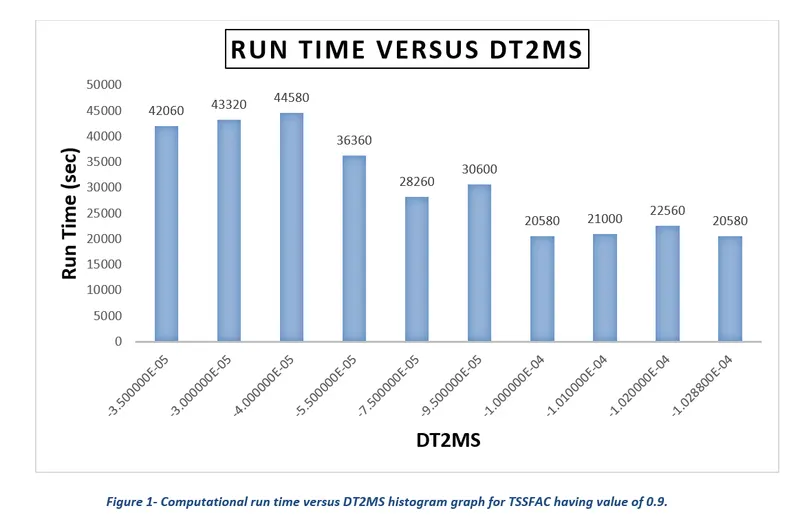
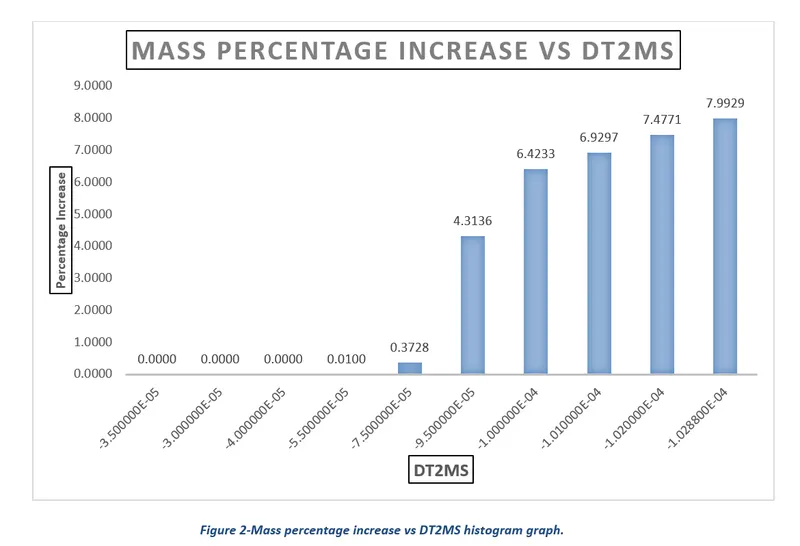
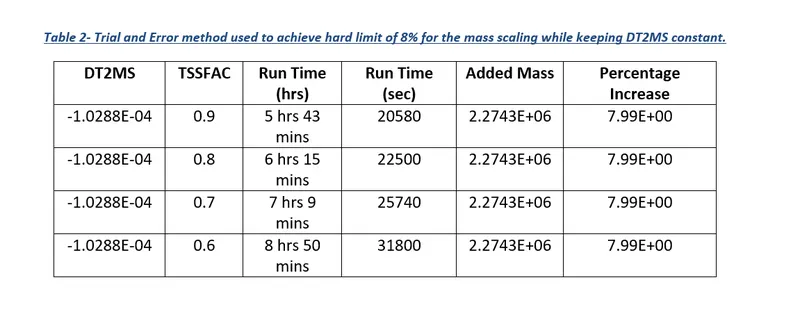
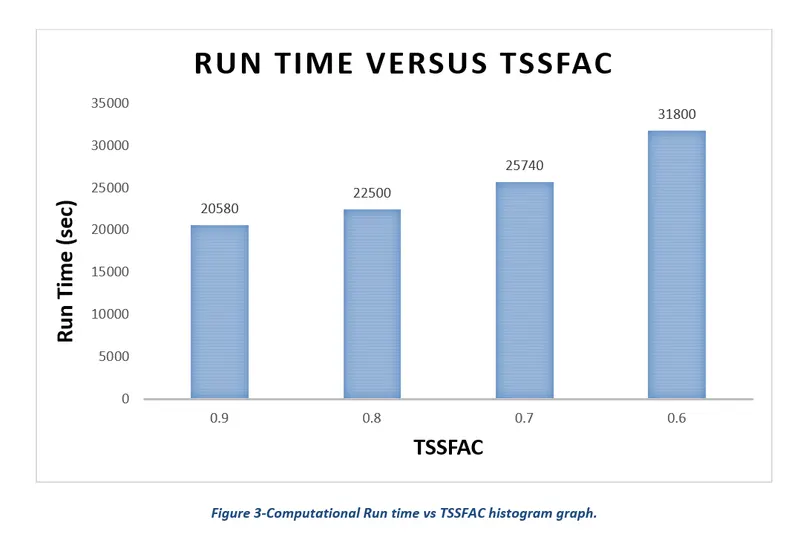
Considering the challenge requirements of achieving the hard limit of 8% on mass scaling by adjusting the values of DT2MS and TSSFA parameters in the CONTROL TIMESTEP card, a trial and error approach was followed to obtain optimum values of DT2MS and TSSFC parameters and the results are presented in Table 1.
From the Table 1, it can be seen that the mass percentage increase becomes approximately 8 % at DT2MS= -1.0288E-04 & TSSFAC=0.9. From figure 1, it can be observed that with an increase of DT2MS parameter value, there is not only an increase in mass percentage but also there is a significant reduction in computational runtime of the simulation.
From table 2, it can be seen that by keeping DT2MS constant and adjusting or decreasing the values of the TSSFAC parameter there is an increase of computational runtime for simulation.
Figures 2 and 3 conclude that the optimal values to be used for the DT2MS and TSSFAC parameters to establish a hard limit of 8 % on the mass scaling are -1.0288E-04 and 0.9 respectively.
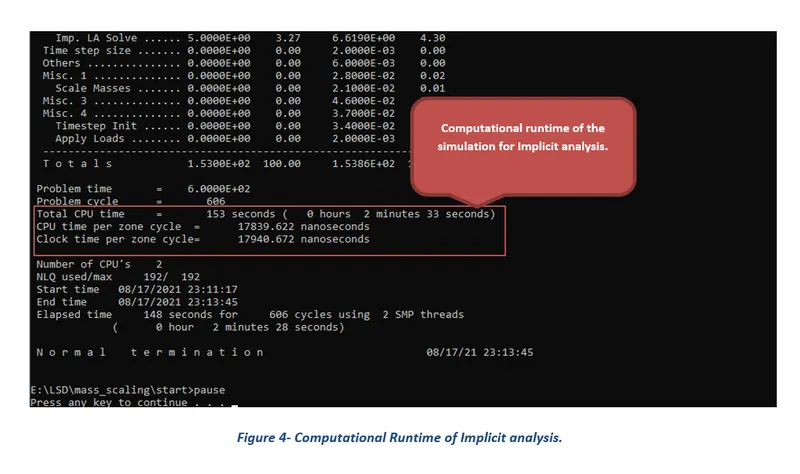
After creating the input deck and running simulation for implicit analysis, it was found that the total computational run time was around 2 mins and 33 seconds.
4 Conclusion
The main aim of the Week 8 challenge was to use mass scaling to reduce overall simulation run time alongside finding optimal values of DT2MS and TSSFAC parameters to establish a hard limit of 8% on the mass scaling of the explicit simulation. In addition, create an input deck to perform implicit analysis for the same model and compare the runtime results of both explicit and implicit analysis. The overall simulation runtime for explicit analysis was decreased from 11 hrs 41 mins to 5 hrs 43 mins by adjusting DT2MS and TSSFAC parameters with optimal values. However, the overall simulation runtime for the implicit analysis was found to be 2 mins and 33 seconds.