Week 8: Literature review RANS derivation and analysis
AIM: to Derive from Reynolds Decomposition to the Navier Stokes Equation to come up with Reynold's stress.
INTRODUCTION:
What is RANS?
its Full form is Reynold's Average Navier Stokes.
this Equation Solves the Average Velocity Fields and the Magnitude of Turbulence Fluctutations.
THEORY:
Reynold's Number
It Quantifies the Turbulence Level in the system.
it is the Ratio of Intertia force to the Viscous Force.
Re=ρVD/μ
- Re is the Reynolds number
- ρ is the density of the fluid
- V is the velocity of flow
- D is the pipe diameter
- μ is the viscosity of the fluid
Re<2000-----> Flow is Laminar
2000<=Re<=4000------> Flow is in a Transitional Phase
Re>4000--------> Flow is Turbulent
Reynold's Number is Dimensionless Unit
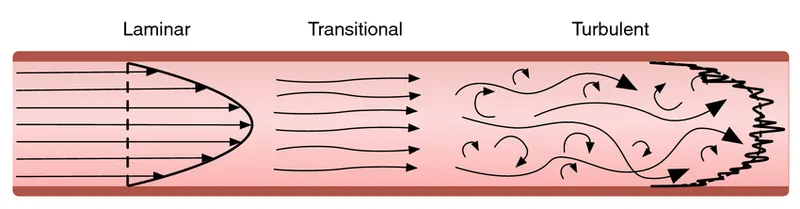
Reynolds stress
RANS DERIVATION
- U(x,y,z,t)= Ʉ(x,y,z)+U’(x,y,z,t)
Ʉ------->function of space
U’-------->Fluctuation’s space
- Ʉ(x,y)=[ ∫U(x,y,t)dt)/ t(int) ]
Note: in this integral
The Lower Limit =0;
The Upper Limits=t(int);
- Ṽ(x,y)=[ ∫ V(x,y,z)dt
- [ ∫ U’(x,y,z,t)dt ] / t(int) = 0;
- U(x,y,z,t)= Ʉ(x,y)+U’(x,y,z,t) ;
- {[∫ U(x,y,z,t)dt ] / t(int)]} =[ ∫ Ʉ(x,y) + ∫ U’(x,y,z,t) ]/ t(int)] ;
- Ʉ(x,y,z)= Ʉ(x,y,z)+ [ ∫ U’(x,y,z,t) ]/ t(int)];
- [ ∫ U’(x,y,z,t) ]/ t(int)] = 0;
=> ∂u/∂x + ∂v/∂y = 0;
Apply Decomposition Law
- ∂(Ʉ+U')/∂x + ∂(Ṽ+V')/∂y =0;
- [ ∫ {∂(Ʉ+U')/∂x}dt + {∂(Ṽ+V')/∂y}dt ]=0;
Now Expanding and Solving this Equation we will get.
also Cancel some of the Fluctuating Components
we will get Continuity Equation and ie
∂u/∂x + ∂v/∂y = 0;
MOMENTUM EQUATIONS
=> ∂U/∂t + U∂U/∂x + V∂V/∂y = -dp/dx + μ {∂^2(U)/∂(y^2)};
=> ∂U/∂t + U∂U/∂x + V∂V/∂y = [-dp/dx + μ {∂^2(U)/∂(y^2)}]/p;
=> ∂U/∂t + U∂U/∂x + V∂V/∂y = (-∂p/pdx) + γ{∂^2(U)/∂(y^2)};
we know that
∂(U.V)= U∂U/∂x + V∂V/∂y
Hence Sustitute this Red Marker Equation to Aqua Highlighter Equation
we get
=> ∂U/∂t + ∂(U.V)+2U∂U/∂x = (-∂p/∂x/p)+ γ{∂^2(U)/∂(y^2)};
Now more Simplify it, we get
=> ∂U/∂t + ∂(U.V)+ ∂(U^2)/∂y = (-∂p/∂x/p)+ γ{∂^2(U)/∂(y^2)};
Now Apply Reynold's Decomposition Equations
=> [∫ {∂(Ʉ+U')/∂t}dt + {∂(Ʉ+U')^2/∂x}dt + {∂[(Ʉ+U')(Ṽ+V')]/∂y}dt ] = [ ∫-{{∂(ṗ+p')/∂x}/p}dt + γ{∂^2(Ʉ+U')/∂(y^2)/ t(int) };
Our Average Fluctuating Quantity is going to zero hence our New Equation will become
∂U/∂t + ∂(Ʉ^2)/∂x + ∂(Ʉ.Ṽ) = (-∂ṗ/∂x)/p + γ{∂^2(Ʉ)/∂(y^2)}- [∫{∂(U'^2)/∂x}]dt - ∫ {∂(U'V')/∂y}dt]/t (int) ;
[∫{∂(U'^2)/∂x}]dt=0;
Hence the new Eqn will be
∂U/∂t + ∂(Ʉ^2)/∂x + ∂(Ʉ.Ṽ) = (-∂ṗ/∂x)/p + γ{∂^2(Ʉ)/∂(y^2)} - ∫ {∂(U'V')/∂y}dt]/t (int) ;
(-∂ṗ/∂x)/p--------> Pressure Terms
γ{∂^2(Ʉ)/∂(y^2)}--------> Viscous statics
∫ {∂(U'V')/∂y}dt]/t (int)------> Momentum Diffusivity due to Reynold's Stress.
CONCLUSION: Hence the Reynold's Stress has been Derived