Week 8: Literature review - RANS derivation and analysis
Objective:
Apply reynold's decomposition to the NS equations
- Understanding of the terms Reylond's stress
- Difference between turbulent and molecular viscosity
Reynold's Decomposition:
Is a mathematical technique used to separate the expectation value of a quantity from its fluctuations i.e given
Instantaneous Velocity@ any point in time and space = Time-Averaged quantity + Fluctuating Component
`u(x,y,z)=baru(x,y,z)+u'(x,y,z,t)`
Time averaged quantities:
`baru(x,y)=(1)/(t)*int_0^tu(x,y,z)dt`
since we are integrating,we get average quantity and this average quantities doesnot change with time.Therefore,.`baru`
Equation-1 implies
`1/(t)*int_0^tu(x,y,z,t)dt=(1)/(t)int_0^tbaru(x,y,z)dt+1/(t)int_0^tu'(x,y,z,t)dt`
where,`baru`is not function of time
hence,when we integrate fluctuating component it's always be zero
`1/(t)*int_0^tu'(x,y,z,t)dt=0`
Therefore,when we integrate fluctuating terms for longer time period this term is zero
Continuity Equation
1-D Navier stoke equation
countinuity equation
`(delu)/(delx) =0`
substituting
`u=baru+u'`
`(del(baru+u'))/(dx)=0`
Take time average of whole equation,
`1/(t)int_0^t[(del(baru+u'))/(delx).dt]=0`
`1/(t)int_0^t[(del(baru))/(dx).dt]+1/(t)int_0^t(del(u'))/(delx).dt=0`
since,time integrating of fluctuating componentb is zero
`(del(baru))/(delx)*1/tint_0^t dt=0`
`(del(baru))/(delx).(t-0)/(t)=0`
`(del(baru))/(delx)=0`
`(del(u'))/(delx)=0`
Time averaged flow filed and unsteady velocity fluctuations field obeys continuity
Conservation of momentum:
Conservation form of N-S equation is,
`rho[((delu)/(delt))+u.(delu)/(delx)+v.(delu)/(dely)]= -(dP)/(delx)+ mu. (del^2u)/(dely^2)`
where,`nu=(mu)/(rho)`
Equation will be rewriten as,
`(delu)/(delt)+u.(delu)/(delx)+v.(delu)/(dely)=-(1)/(rho).(delP)/(delx)+nu.(del^2u)/(dely^2)`
From Product rule, `(del(u.v))/(dely)=u.(delu)/(dely)+v.(delu)/(dely)`
`(delu)/(delt)+2u.(delu)/(delx)+(del(u.v))/(dely)=-(1)/(rho)(delP)/(delx)+v.(del^2u)/(dely^2)`
`(delu)/(delt)+(delu^2)/(delx)+(del(u.v))/(dely)=-(1)/(rho).(delP)/(delx)+v.(del^2u)/(dely^2)`
Put,`u=baru+u' and v=barv + v'`
Applying reylond's Decomposition
`(1)/(t)int_0^t[(del(baru+u'))/(dt)+(del(baru+u')^2)/(dx)+(del(baru+u').(barv+v'))/(dely)].dt=(1)/(t)int_0^t[-(1)/(rho)*(d(barP+P'))/(dx)+(nu.del^2(baru+u'))/(dy^2)]*dt`
since,time averaged of fluctuation terms is zero.Equation is reduced to
`(del(u))/(delt)+(del(baru)^2)/(delx)+(del(u')^2)/(delx)+(del(baru.barv))/(dely)+(del(u'.v'))/(dely)=(-1)/(rho)*(delbarP)/(delbarx)+nu*(del^2baru)/(dely^2)`
`(delu)/(delt)+(delbaru^2)/(delx)+(del(baru*barv))/(dely)=-(1)/(rho)*(delbarP)/(delx)+nu*(del^2baru)/(dely^2)-(1)/(t)*int_0^t(del(u'*v'))/(dely)*dt`
Assume changes along X-direction is negligible comapre to changes along y-direction inside boundary layer
`(1)/(t)int_0^t(del(u')^2)/(delx)*dt=0`
Equation becomes:
`(delu)/(delt)+(del(baru^2))/(delx)+(del(baru*barv))/(dely)=-(1)/(rho)*(delbarP)/(delx)+nu*(del^2(u))/(dely^2)-(1)/(t)int_0^t((del(u'.v'))/(dely)*dt)`eqaution(1)
Considering RHS of above equation:
RHS simplifying
`-(1)/(rho)*(delbarP)/(delx)*(1)/rho*(del)/(dely)[mu*(delbaru)/(dely)-(rho)/(t)int_0^t(del(u'.v').dt)]`
`1/(rho)*(delbarP)/(delx)` Pressure term
`mu*(delbaru)/(dely)`Molecular Viscosity
`rho/(t)int_0^t(u'.v').dt`Momentum Diffusivity
Reynold's Stress:
It is the component of the stress tension in a fluid obtained from averaging opwration over Navier-Stoke equation to account for turbulent fluctuations in fluid momentum
LHS equation(1) is considered as negligible (interial forces) and pressure drop is very much small compared .The interial forces are zero due due to laminar flow
`mu(delbaru)/(dely)-rho/(t)int_0^t(u'.v').dt=0`
outside the viscous sub-layer turbulent viscosity dominates
Reynolds stress due to turbulent mixing`tau= -(rho)/(t)int_0^tu'v'dt`
Both u' and v' prime interleated as follows
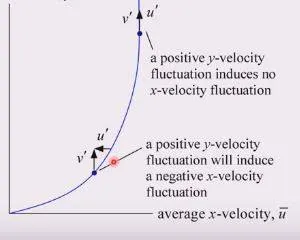
so the product u' and v' is not equal to zero ,but it is negative in the above plot v' is positive so u' is
negative
Reynolds stress due turbulent mixing directly proportional to`(delbaru)/(dely)`
Reynolds stress due to turbulent mixing = `-(rho)/(t)int_0^tu'v'dt`=`rho*epsilon *(delbaru)/(dely)`
epsilon=eddy diffusivity of momentum
Turbulent Viscosity:
The coefficient that relates the average shear stress and rate of velocity gradient in the turbulent flow is called turbulent viscosity.The turbulent transfer of momentum byeddie give rise to internal fluid friction on a large scaleIt is know as eddy viscosity These are enormos in nature and to capture these details is near impossible,if done computationally,it is very costly
Molecular viscosity:
It is a fuid property and is the same as viscosity.Its co-efficient is the same as dynamic viscosity.Molecular viscosity is the transport of mass motion momentum solely by random motions of individual molecules not moving together in coherent groups.Molecular viscosity is analogous in laminar flow to eddy viscosity in a turbulent flow
Molecular viscosity=`mu`; turbulent viscosity =`rho *epsilon`
Molecular Kinematic viscosity =`nu=(mu)/rho`;turbulent kinematic viscosity= `epsilon`
Differences between turbulent and molecular viscosity:
- The turbulent viscosity depends on fluid flow whereas molecular viscosity depends only on fluid properties
- The turbulent viscosity is pressent only in the turbulent flow regionbut molecular viscosity is present in all fluid flows
- The turbulent viscosity is non-linear and extremely hard to estimate where as molecular viscosity is easy to measure