Week 8: Literature review - RANS derivation and analysis
AIM:
- To derive the Reynolds Averaged Navir Stokes(RANS) Equations.
OBJECTIVE:
- To find the Reynolds stress expressions, apply Reynolds decomposition to the Navier-Stokes equations. Understanding the distinction between turbulent viscosity and molecular velocity is also important.
LITERATURE REVIEW:
- Fluid flow is classified into three types: laminar flow, transient flow, and turbulent flow. In general, the flow can be calculated using the Reynolds Number.
- A low Reynolds Number denotes laminar flow, in which the flow is sequential and parameters such as pressure and velocity remain constant.
- A high Reynolds Number denotes turbulent flow, in which the flow is chaotic and the parameters fluctuate.
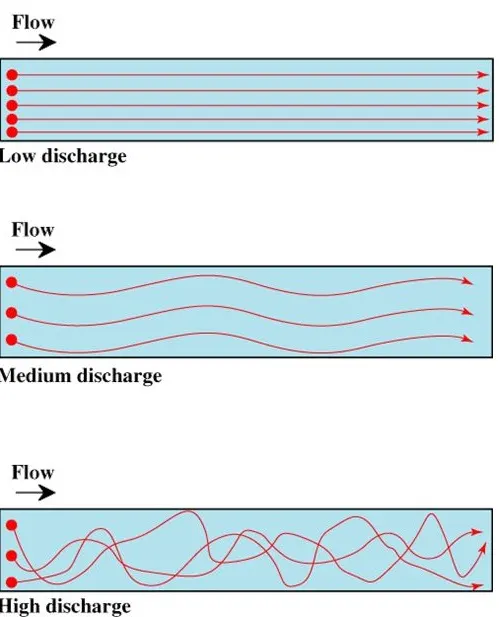
- Turbulence modelling is the development and application of a mathematical model to forecast the effects of turbulence. The Reynolds stress and turbulent viscosity are calculated using turbulent modelling. Turbulence can be modelled using a technique known as Direct Numerical Simulations (DNS), in which the Navier-Stokes equation is solved over a turbulent time step. Because the turbulent time step is so small, the computational cell size is required to solve the problem. As a result, the turbulence model is employed to capture the effect of turbulence in coarse grid size.
- The Navier-Stokes equations govern fluid flow velocity and pressure. Each of these quantities in a turbulent flow can be decomposed into a meaningful part and a fluctuating part. The Reynolds Averaged Navier Stokes equations govern the mean flow when the equations are averaged. Because the Navier-Stokes equations are nonlinear, velocity fluctuations appear in the RANS equations as a nonlinear term from convective acceleration. This is referred to as Reynolds stress.
- The Navier-Stokes equation governs the motion of fluids and can be thought of as Newton's second law of motion for fluids. The equation is formed by combining the fluid's continuity equation, momentum equation, and energy equation. This is significant in fluid flow modelling.
- Governing Equations of boundary layer :
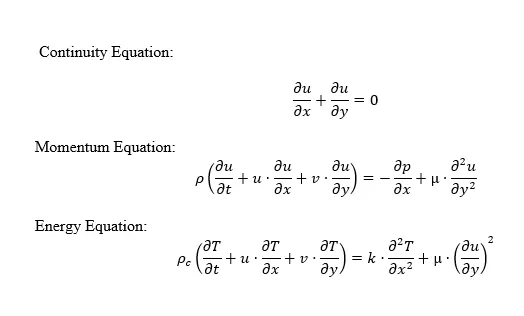
- The Reynolds Average Navier Stokes equations are time-averaged equations of fluid flow motion. The quantity is decomposed here into its time-averaged and fluctuating components. RANS equations are commonly used to describe turbulent flows. These equations can be combined with approximations based on flow turbulence properties to provide approximate time-averaged solutions to the Navier-Stokes equations. Turbulence modelling is the development and application of a mathematical model to predict the effects of turbulence. The Navier-Stokes equations govern the velocity and pressure of a fluid flow.
- Ina turbulent flow, each of these quantities may be decomposed into a meaningful part and a fluctuating part. Averaging the equations gives the Reynolds Averaged Navier Stokes equations which govern the mean flow. The nonlinearity of Navier Stokes equations means the velocity fluctuations appear in the RANS equations in the non-linear term from the convective acceleration. This term is known as Reynolds stress.
- In fluid dynamics, the Reynolds stress is the component of the total stress tensor in a fluid obtained from the averaging operation over the Navier-Strokes equation to account for turbulent fluctuations in fluid momentum. If we find the frequency of the fluctuation and inverse we can calculate the Turbulent Time-scale.
- The time scale is small, and the events take place over a very short distance. We can capture the effect of turbulence using the Turbulence Model, but with a coarser grid and a larger time step. Taking actual governing equations, integrate them over a much longer time scale than the turbulent time scale.
The Averaging Process is what it's called. - When using Reynolds Decomposition, the original set of equations is converted into the Reynolds Average Navier Stokes equation. Then, using these equations and a turbulence model, simulate turbulent flows. We get new terms that need to be shaped here.
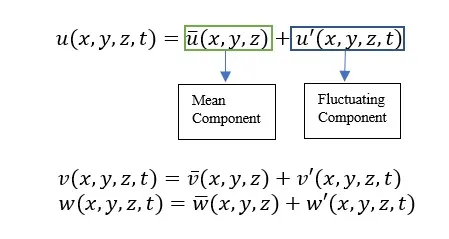
- RANS divides flow variables into mean and fluctuating terms. Where the Mean component represents the function of space, and the Fluctuating component represents the function of space and time.
Reynolds Decomposition:
Time-Averaged Quantities:
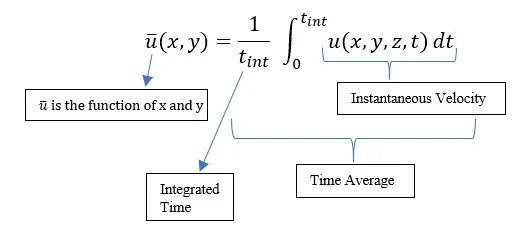
- As we are integrate, we get average quantities and these average quantities don't change with time.
Hence,

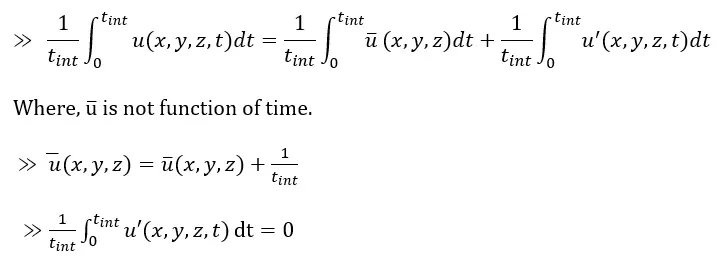
Here, when we integrate fluctuating terms for a longer period then the fluctuation tends to be zero.
Now apply the Integral rule to the Continuity equation:-
CONTINUITY EQUATION:
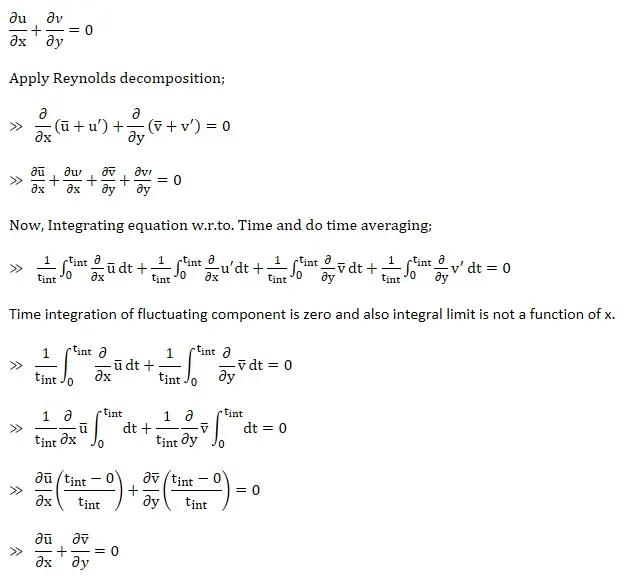
Therefore, Reynold's decomposition satisfies the continuity equation condition.
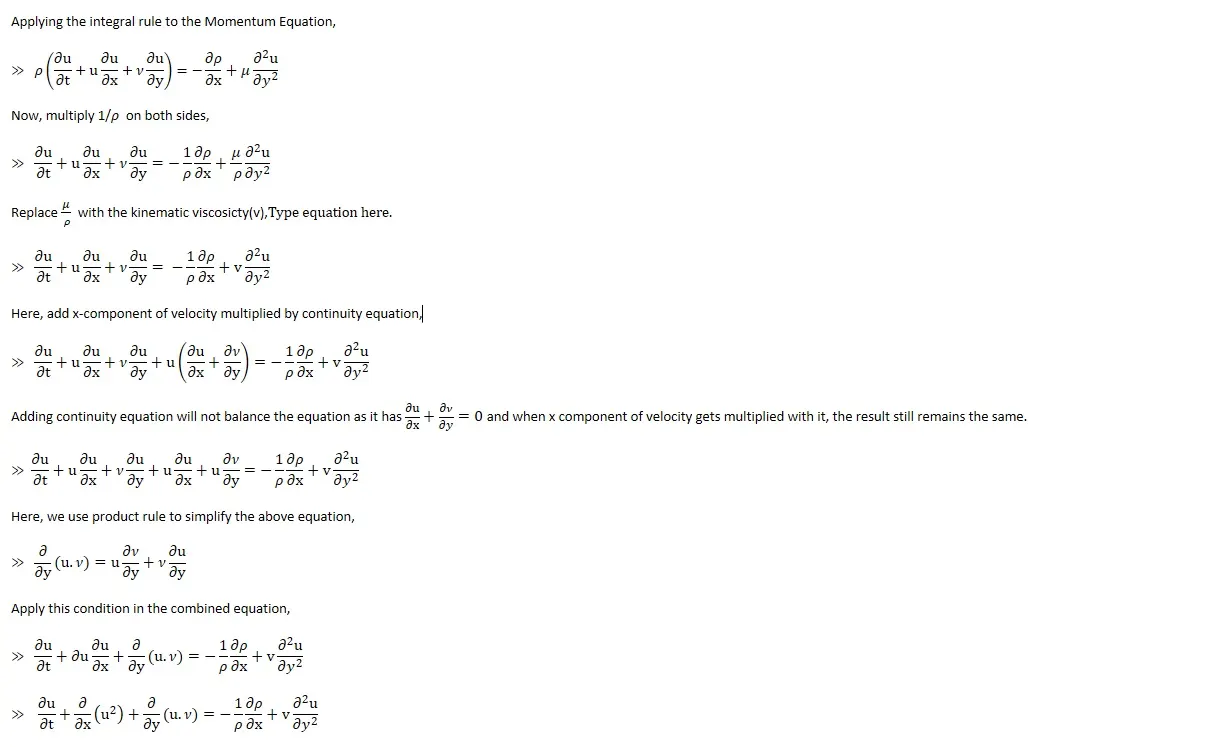
- MOMENTUM EQUATION:
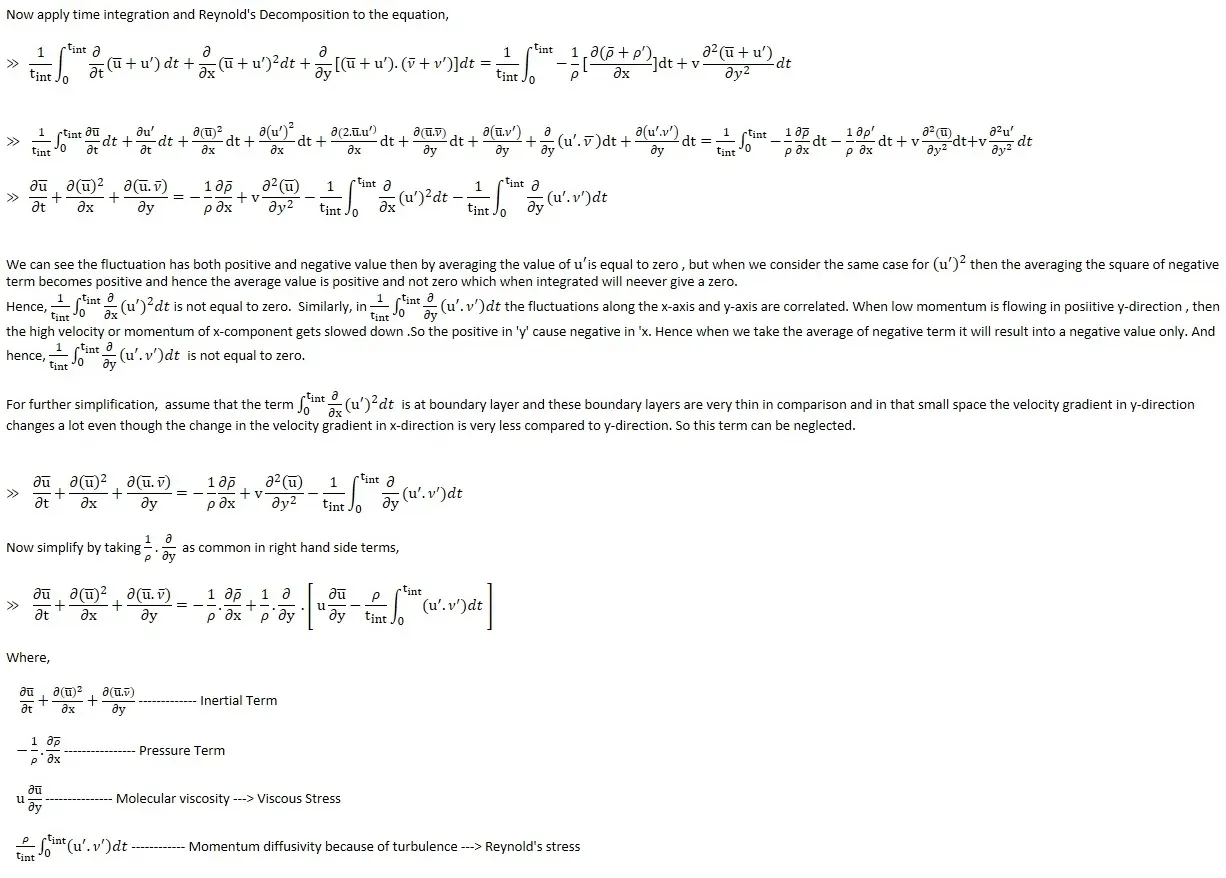
REYNOLD'S STRESS:
- Reynold's stress is the component of the total stress tensor in a fluid obtained from the averaging operation over the Navier-Stokes equation to account for turbulent fluctuations in fluid momentum. This stress offers significant effects on the complex interactions
- In the turbulent flows. In turbulent flow, the Reynolds stresses are usually large compared to viscous stresses. Reynolds stress provides the averaged effect of turbulent convection, which is highly diffusive.
- Reynolds stress tensor in the RANS equations represents a combination of mixing due to turbulent fluctuation and smoothing by averaging. The normal stresses are always non-zero because they contain squared velocity fluctuations. The shear stresses would be zero if fluctuations were statistically independent.
TURBULENT VISCOSITY:
- The turbulent viscosity hypothesis assumes that the Reynolds stresses and turbulent viscosity can be related to the mean velocity gradients and turbulent viscosity by the gradient diffusion hypothesis, in a manner analogous to the relationship between the stress and strain tensors in laminar Newtonian flow. The turbulent viscosity is not uniform, varying in space. It is assumed, however, to be isentropic. It is the same in every direction.
- The linear interface between different fluids in a turbulent fluid breaks apart to form sim-scale structures known as eddies. As these grow and shrink in size, they effectively change the surface area of the interface between fluids with different properties, thereby changing the net transfer of momentum and scalar properties through the interfaces.
MOLECULAR VISCOSITY:
- It is a resistance to the movement of one layer of fluid over another. It is linear and easy to quantify. It is always geometry-independent. The transport of mass motion momentum by random motions of individual molecules that are not moving in coherent groups is referred to as molecular viscosity. Molecular viscosity in laminar flow is analogous to eddy viscosity in turbulent flow.
- The turbulent viscosity is a fictitious concept, whereas molecular viscosity is a dynamic viscosity found in real fluids. Molecular viscosity is determined by fluid properties, whereas turbulent viscosity is determined by fluid flow. Turbulent viscosity dominates in high Reynolds number regions, whereas molecular velocity dominates in low Reynolds number regions. Because Molecular Viscosity is linear,
CONCLUSION:
- Hence by applying Reynold's decomposition to the NS equations, we have derived the expression for Reynold's Stress. The theory behind Reynold's stress is also studied.