Week 8: Literature review - RANS derivation and analysis
Aim:
Apply Reynold's decomposition to the NS equations and come up with the expression for reynold's stress.
Objective:
Apply reynold's decomposition to the NS equations and come up with the expression for reynold's stress.
- Explain your understanding of the terms reynold's stress.
- What is turbulent viscosity? How is it different from molecular viscosity?
Theory:
The fluid flow is bascially divided into 3 varieties i.e. streamline flow, Transient flow, and Turbulence flow. usually the flow will be determined mistreatment Sir Joshua Reynolds variety. an occasional Sir Joshua Reynolds variety corresponds to streamline flow wherever the flow is in asequential manner and parameters like pressure and speed remains constant. A high Sir Joshua Reynolds variety corresponds to turbulent flow wherever the flow is chaotic and therefore the paarameters area unit unsteady.
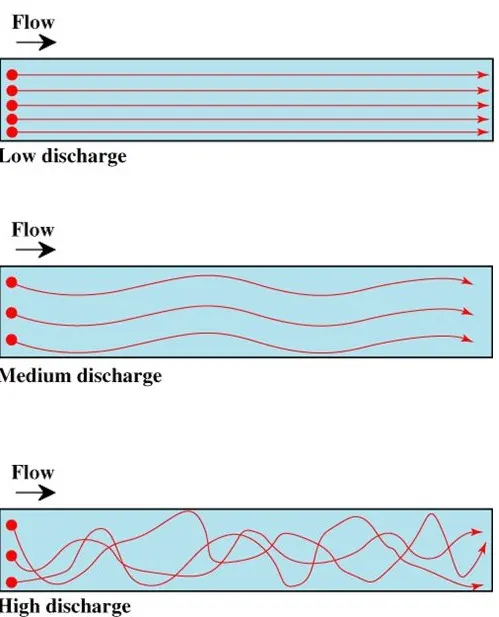
Turbulence Modeling is that the construction and use of a mathematical model to predict the results of turbulence. Turbunce modelling is employed to calculate the Reynolds stress and turbulent body. The impact of turbulence will be modelled employing a technique known as Direct Numerical Simulations (DNS),where the Navier Stokes equation is solved over a turbulent time step. because the turbulent time step isvery little, the process cell size is needed to unravel. Hence, the turbulence model is employed to capture the impact of turbulence during a coarse grid size.
The Navier Stokes equations govern the rate and pressure of a fluid flow. Ina flow, every of those quantities could also be rotten into a mean half and a luctuating half. Averaging the equations offers the Reynolds Averaged Navier Stokes equations wich govern the mean flow. The non dimensionality of Navier Stokes equations suggests that the rate fluctuations seem within the RANS equations within the non linear term from the convective acceleration. This term is thought because the Reynolds stress.
The Navier Stokes equation govern the motion of fluids and may be seen as Newton's second law of motion for fluids and may be seen as Newtons second law of motion for fluids. The equation consists of resolution the contunity equation , momentum equation and energy equation of fluid along.This is necessary within the fluid flow modelling.
Continuity equation:
`∂ u ∂ x + ∂ v ∂ y = 0`
Momentum equation:
`ρ ( ∂ u ∂ t + u ∂ u ∂ x + v ∂ u ∂ y ) = − d P d x + μ ∂ 2 u ∂ y 2`
Energy equation:
`ρ C ( ∂ T ∂ t + u ∂ T ∂ x + v ∂ T ∂ y ) = k ∂ 2 T ∂ x 2 + μ ( ∂ u ∂ y ) 2`
In the above equations, it is obvious that some terms are missing, this is because those terms can be neglected in a boundary layer when their magnitude is considered. The above 3 equations can be solved to obtain all effects of the flow including turbulence. This process is called Direct Numerical Simulation. But at the boundary layer, over the turbulent region, the velocity keeps changing over a small period. This time is called the turbulent time scale which is very small. Also, the velocity change occurs over a very small distance. If we use DNS for these small distances with a huge number of cells, we can capture the turbulence, but the simulation is going to take forever to finish. So, we use turbulence models. We take these governing equations and integrate them over a time step that is much larger than the turbulent time scale. This process is called averaging. We apply the Reynolds decomposition.
Reynolds Decomposition:
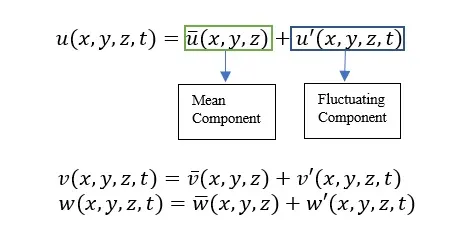
Time-Averaged Quantities:
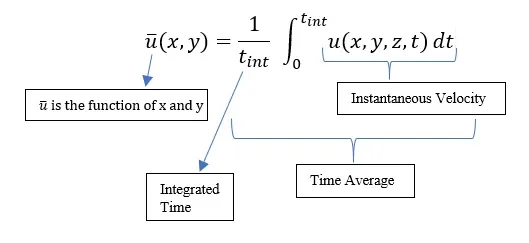
As we are integrating, we get average quantities and these average quantities doesn't change with time.
Hence ,

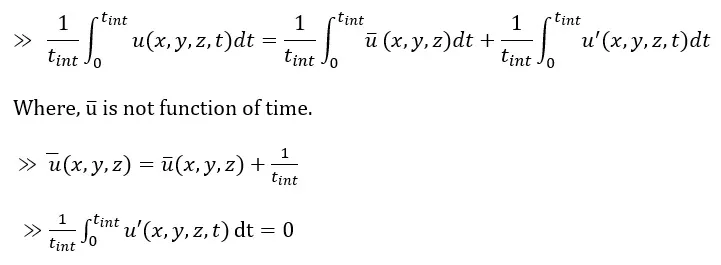
Here, when we integrate fluctuating terms for longer time period then the fluctuation tend to zero.
Now apply the Integral rule to the Contunity equation:-
Contunity Equation:
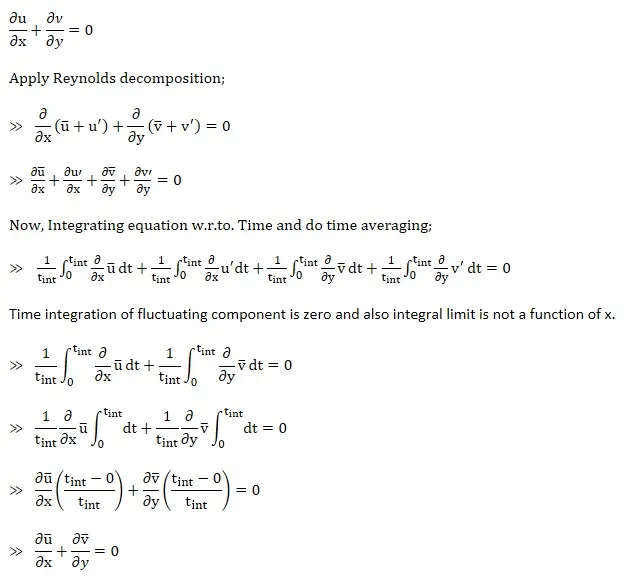
Therefore, the Reynold's decomposition satisfies the contunity equation condition.
Momentum Equation:
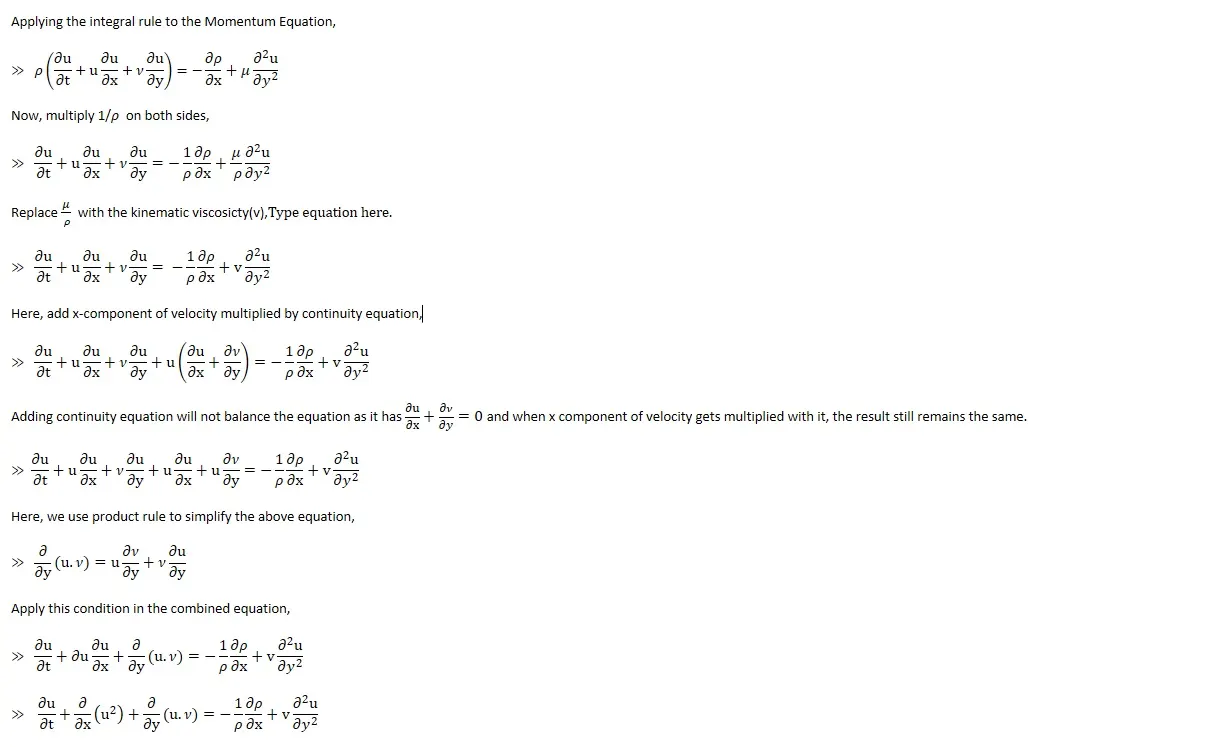
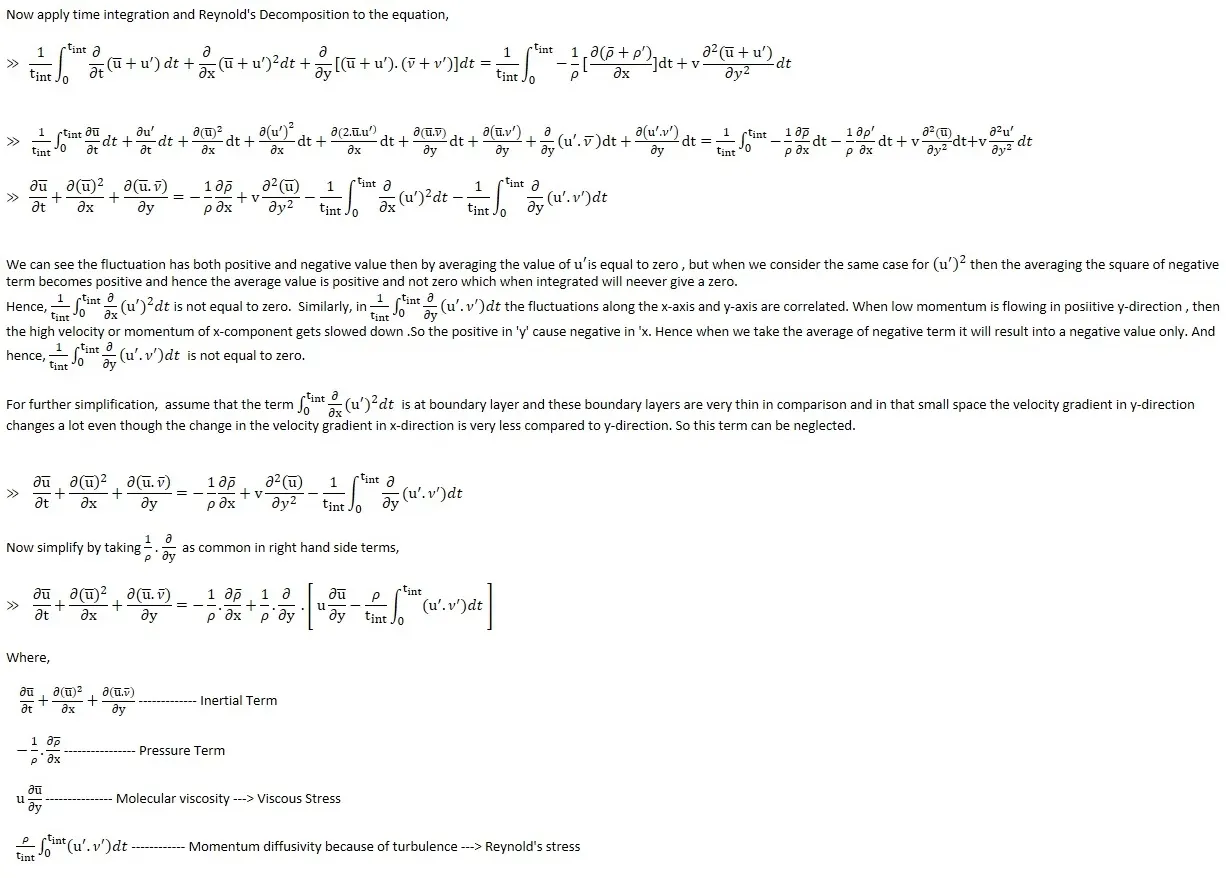
Reynolds Stress:
Reynold's stress is that the part of the entire stress tensor in a very fluid obtained from the averaging operation over the Navier-Stokes equation to account for turbulent fluctuations in fluid momentum. This stress offers a major effects of the advanced interactions within the turbulent flows.In flow the Sir Joshua Reynolds stresses square measure typically giant compared to viscous stresses. Sir Joshua Reynolds stress provides the averaged impact of turbulent convection, that is extremely spreading.Reynolds stress tensor within the RANS equations representsa combination of blending because of turbulent fluctuation and smoothing by averaging. the conventional stresses square measure forever non zero as a result of they contain square rate fluctuations. The shear stresses would be zero if fluctuations wer statistically freelance.
Turbulent Viscosity:
The turbulent consistence hypothesis assumes that the Sir Joshua Reynolds stresses will be associated with the mean rate gradients and turbulent consistence by gradient diffusion hypothesis, in a very manner analogous to the link between the strain and strain tensors in bedded Newtonian flow. The turbulent consistence isn't uniform i.e. it varies in house. it's but assumed to be physical property. it's same all told directions.
Ina turbulent fluid, linear interface between completely different fluids breaks apart to create sim-scale structures that square measure known as as eddies. As these grow and diminish the scale, they effectively alter the extent of the interface between the fluids with numerous properties, so by fixing Infobahn transfer of momentum and scalar properties through the interfaces.
Molecular Viscosity:
It isa resistance to the movement of 1 layerof fluid over the adjacent layer. it's linear and straightforward to live.It is forever freelance of pure mathematics. Molecular consistence is that the transport of mass motion momentum by random motions of individual molecules not moving along in coherent teams. Moleculer consistence is analogous in streamline flow to eddy consistence in flow.
The turbulent consistence may be an imagined conception however the molecular consistence is a coefficient of viscosity that's gift in real fluids. Molecular consistence depends on the properties of fluid however the turbulent consistence depends on the fluid flow. Turbulent consistence is dominant in regions with high {reynolds|Reynolds|Sir Joshua Sir Joshua Reynolds|painter} range whereas molecular rate is dominant within the regions with low Reynolds range.Molecular consistence is linear and therefore straightforward to live.
Conclusion:
Hence by applying Reynold's decomposition to the NS equations, we've derived for the expression for Reynold's Stress. the idea behind the Reynold's stress is additionally studied