Week 8: Literature review - RANS derivation and analysis
AIM
To determine the following term
NS Equation with expression output for Reynold's Stress understanding of the terms Reynolds stress
What is turbulent viscosity? How is it different from molecular viscosity?
Turbulent
In fluid dynamics, turbulence or turbulent flow is fluid motion characterized by chaotic changes in pressure and fluid velocity. It is in contrast to a laminar flow, which occurs when a fluid flows in parallel layers, with no disruption between those layers
REYNOLDS AVERAGED NAVIER-STOKES EQUATIONS
the hand of a time-averaging of the NS equations and the continuity equation for incompressible fluids, the basic equations for the averaged turbulent flow will be derived in the following. The flow field can then be described only with help of the mean values.
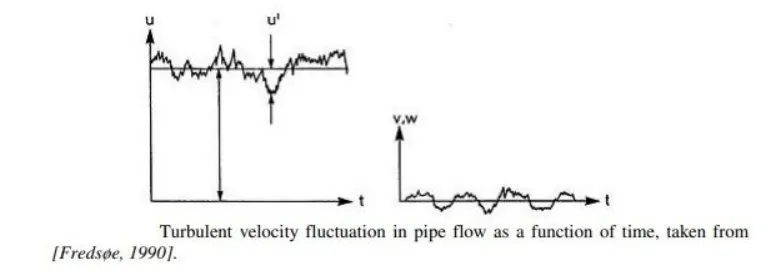
The momentary velocity component is u, the time-averaged value is namedu and the fluctuating velocity has the letter u'. With help of this definition, the decomposition can mathematically be written
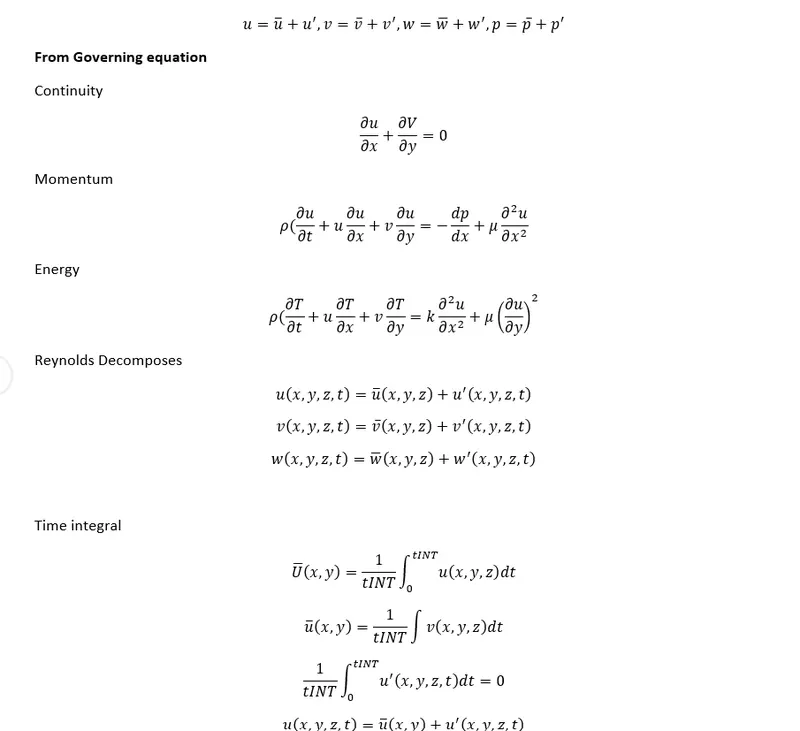
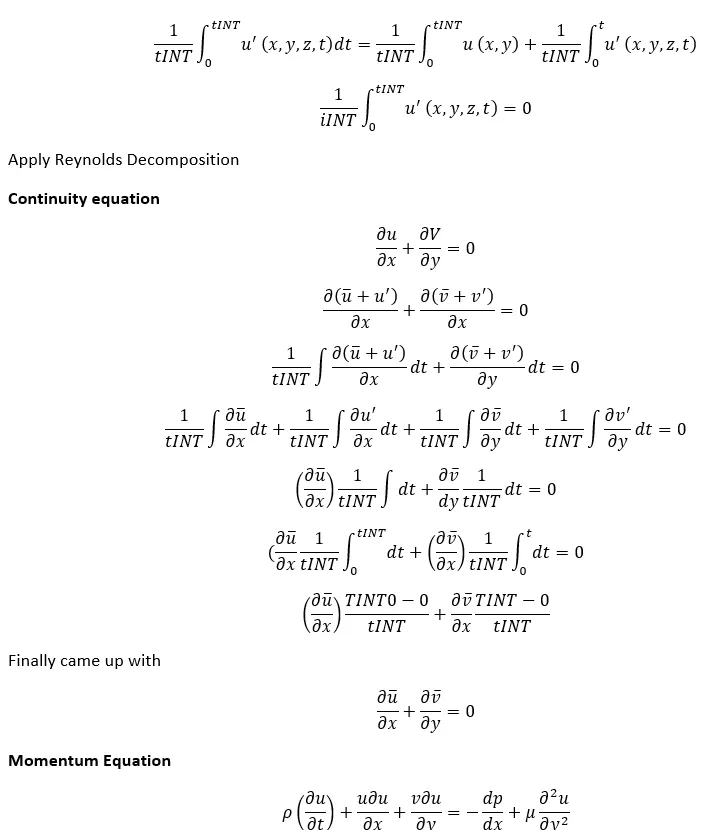
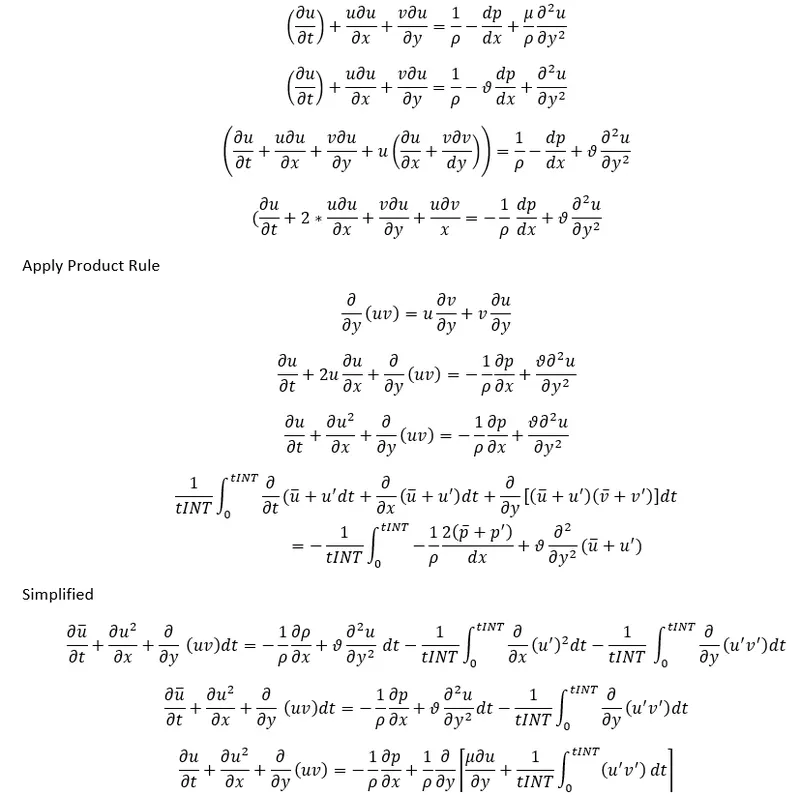
Reynolds stress
the Reynolds stress is the component of the total stress tensor in a fluid obtained from the averaging operation over the Navier-stroke equation to account for turbulent fluctuations in the fluid moments.
They arise from the nonlinear advection term when the Navier Strock equation is Reynolds decomposed and Reynolds averaged. The general form of the Reynolds stress tensor is
Tij =-ρui,uj
uuj is velocity correlation
Xi or j the momentum flux in direction
second order tensor
Reynolds stress equation model (RSM), also referred to as second-moment closures are the most complete classical turbulent model. In these models, the eddy-viscosity hypothesis is avoided and the individual components of the Reynolds stress tensor are directly computed
turbulent viscosity & molecular viscosity
The turbulent transfer of momentum by eddies creates internal fluid friction. It is the fundamental idea of how we define viscosity in turbulent flow, i.e. internal fluid resistance. Eddy viscosity explains what causes internal friction.
Molecular viscosity is the same as viscosity. The Coefficient of Molecular Viscosity is the same value as dynamic viscosity. Molecular viscosity is the transport of mass motion momentum solely by the random motions of individual molecules not moving together in coherent groups. Molecular viscosity is analogous in laminar flow to eddy viscosity in a turbulent flow
Conclusion
RANS is a closure loop problem for turbulent for computer expense compared to Large Eddy Simulation According to Log law, the selection of Turbulence modeling varies bases on that RANS model varies due to the mystery of turbulence, there is various models is calculated according to boundary layer and Reynolds number.