Week 5.1 - Mid term project - Solving the steady and unsteady 2D heat conduction problem
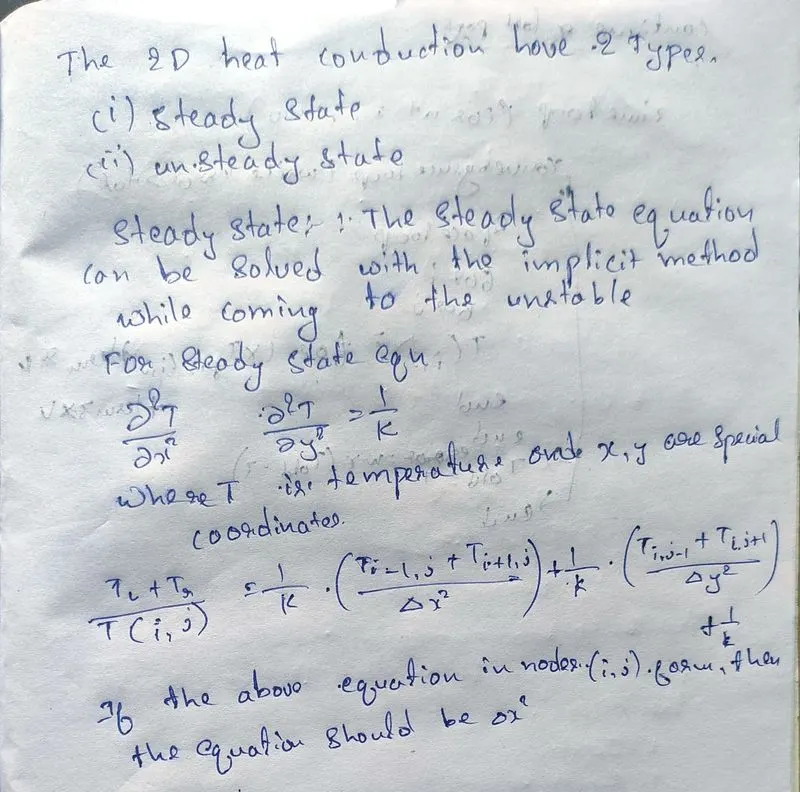
FUNCTION CODE:
% FOR JACOBI
function out=jacobi(t,told,i,j)
out=0.25*((told(i,j-1)+told(i,j+1)+told(i-1,j)+told(i+1,j)))
end

% FOR GS
function out=GS(t,told,i,j)
out=0.25*((t(i,j-1)+told(i,j+1)+t(i-1,j)+told(i+1,j)))
end

% FOR sor
function out=sor(t,told,i,j,f)
out=(1-f)*told(i,j)+f*(0.25*(t(i,j-1)+told(i,j+1)+t(i-1,j)+told(i+1,j)))
end
MAIN CODE:
%main program
clear all
close all
clc

% number of grid points along x and y axis
nx=10;
ny=10;
x=linspace(0,1,nx);
dx=x(2)-x(1);
y=linspace(0,1,ny);
z=fliplr(y);
f=1.1;
iter=1;

t=300*ones([nx,ny]);

% applying BC
t(1,:)=600;
t(end,:)=900;
t(:,1)=400;
t(:,end)=800;

% creating a copy
told=t;
r1=t;
error=19;
tol=1e-4;
for iterative_solver=1:3;
while(error>tol);
for i=2:nx-1;
for j=2:ny-1;
if(iterative_solver==1);
t(i,j)=jacobi(t,told,i,j);
elseif(iterative_solver==2)
t(i,j)=GS(t,told,i,j);
elseif(iterative_solver==3)
t(i,j)=sor(t,told,i,j,f);
end
end
end
error=max(max(t-told));
told=t;
[u1,v1]=meshgrid(x,z);

%plot
if(iterative_solver==1);
figure(1);
contourf(u1,v1,t);
[C,h]=contourf(u1,v1,t);
colorbar;
colormap(jet);
clabel(C,h);
xlabel('x-axis');
ylabel('y-axis');
title_text=sprintf('jacobi iterention number=%d',iter);
title(title_text);
pause(0.003);
elseif(iterative_solver==2);

figure(2);
contourf(u1,v1,t);
[C,h]=contourf(u1,v1,t);
colorbar;
colormap(jet);
clabel(C,h);
xlabel('x-axis');
ylabel('y-axis');
title_text=sprintf('GS iterention number=%d',iter);
title(title_text);
pause(0.003);
else

figure(3);
contourf(u1,v1,t);
[C,h]=contourf(u1,v1,t);
colorbar;
colormap(jet);
clabel(C,h);
xlabel('x-axis');
ylabel('y-axis');
title_text=sprintf('sor iterention number=%d',iter);
title(title_text);
pause(0.003);
end
iter=iter+1;
end
error=19;
ioter=1;
t=r1;
told=t;
end
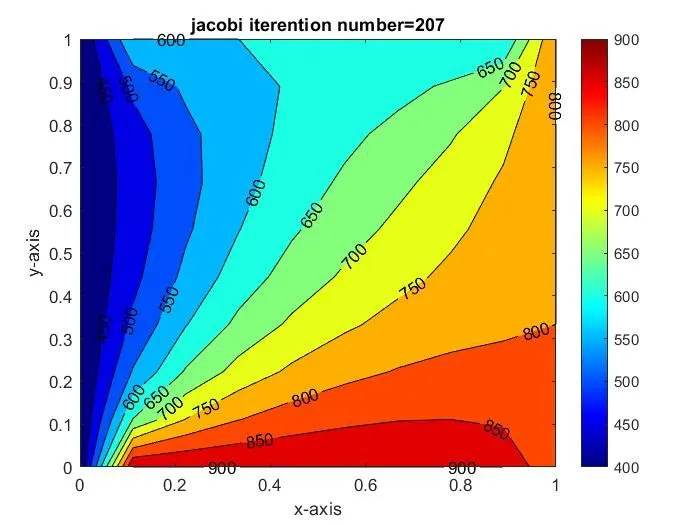
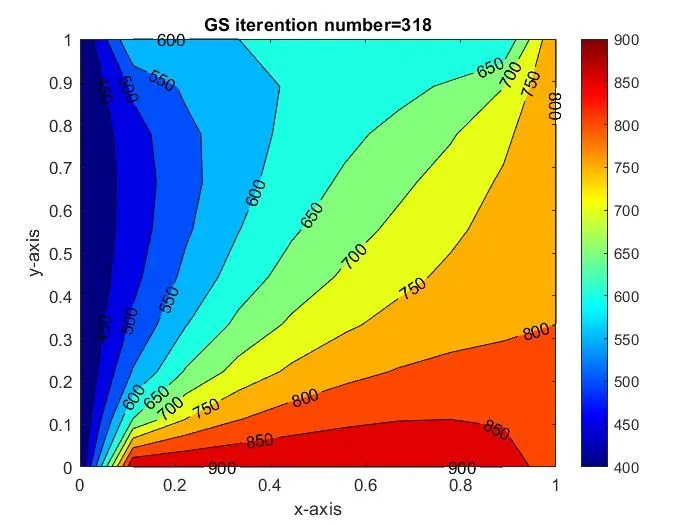
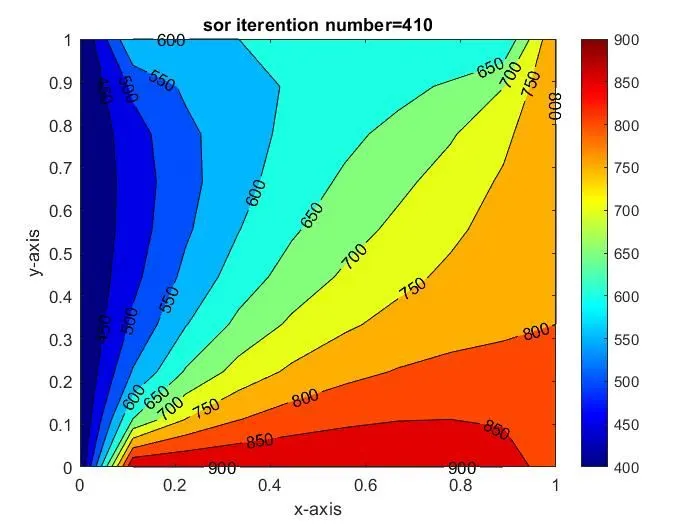
Result:
for unsteady:
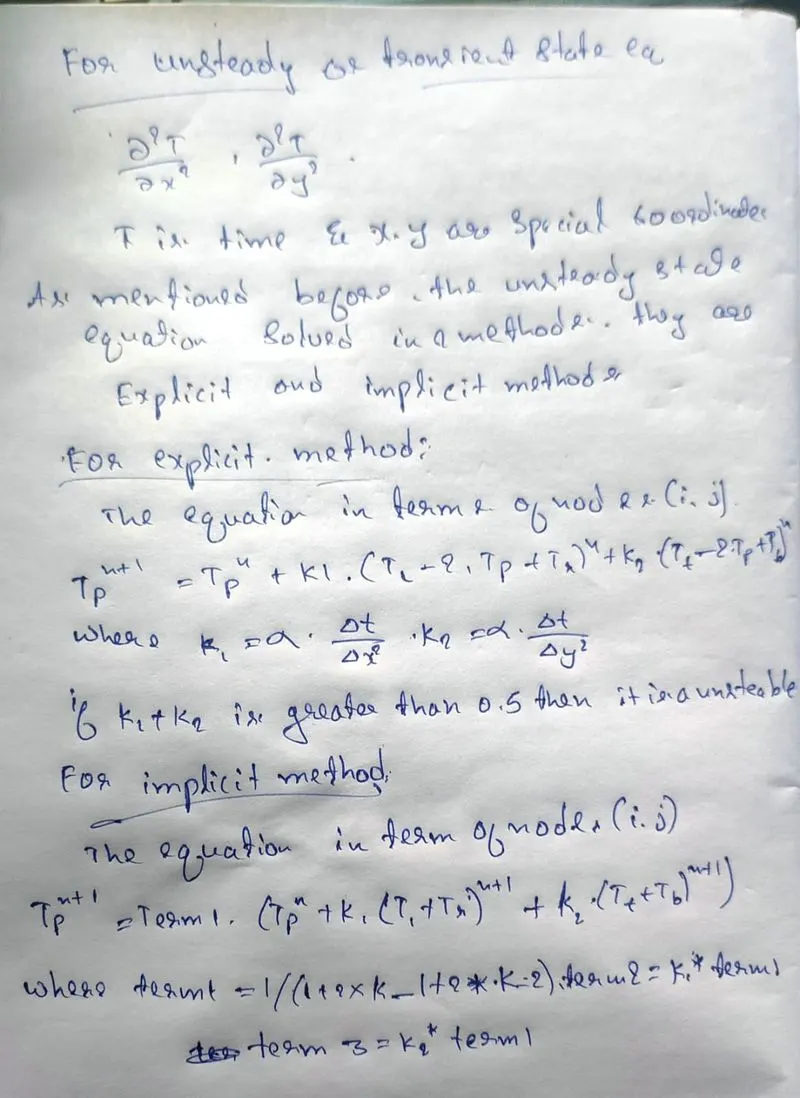
For Explicit Method:
clear all
close all
clc

% number of grid points along x and y axis
nx=10;
ny=10;
x=linspace(0,1,nx);
dx=x(2)-x(1);
y=linspace(0,1,nx);
dy=y(2)-y(1);
c=1;

%number of steps
nt=200;
% time steps
dt=0.001;
% CFL number
k=(c*dt)/dx^2;

t=ones([nx,nx])*673;

%applying BC
t(1,:)=600;
t(end,:)=900;
t(:,1)=400;
t(:,end)=800;

told=t;

tic
iter=1
for p=1:nt
   for i=2:nx-1
    for j=2:ny-1
        t(i,j)=k*(told(i-1,j)+told(i+1,j)+told(i,j+1)+told(i,j-1))+ (1-4*k)*told(i,j);
    end
    end
 error=max(abs(told-t));
 told=t;
 iter=iter+1;
end
time=toc;
figure(1)
[c,h]=contourf(x,fliplr(y),t);
colorbar;
colormap(jet);
clabel(c,h);
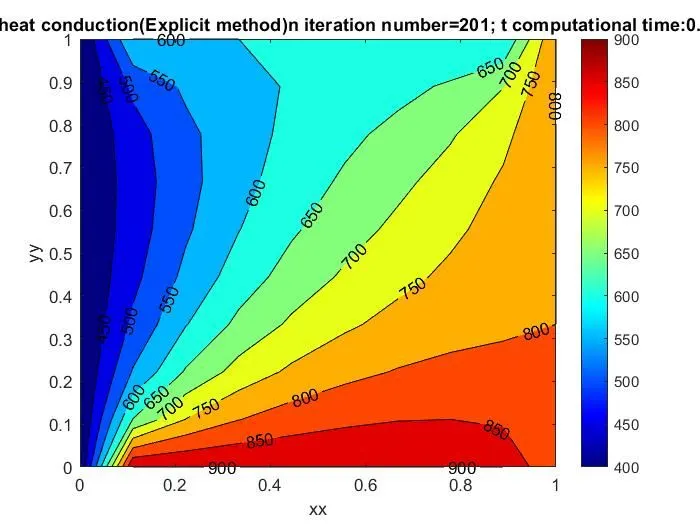
title(sprintf('2D unstudy heat conduction(Explicit method)n iteration number=%d; t computational time:%0.4f',iter,time));
xlabel('xx');
ylabel('yy');
RESULT:
FOR IMPLICIT METHOD:
FUNCTON CODE:
% FOR GS
function [iter,t]=jacob(told)

nx=10;
ny=10;
alpha=1.4;
dt=0.001;
x=linspace(0,1,nx);
dx=x(2)-x(1);
y=linspace(0,1,nx);
dy=y(2)-y(1);
tol=1e-4;

t=told;
t_initial=t;
t_previous=t;
iter=1;
 tic;

% defining k1 and k2
k1=alpha*(dt/dx^2);
k2=alpha*(dt/dy^2);
for nt=1:1400
    error=9e9;


    while error>tol

        for i=2:nx-1
            for j=2:ny-1
                term1=1/(1+2*k1+2*k2);
                term2=k1*term1;
                term3=k2*term1;
               t(i,j)=((t_previous(i,j)*term1)+term2*(told(i-1,j)+told(i+1,j))+(term3*(told(i,j-1)+told(i,j+1))));
            end
        end
        error_n=max(abs(told-t));
        error=max(error_n);
        told=t;
        iter=iter+1;
    end
t_previous=t;

end
time=toc;

figure(1)
contourf(x,fliplr(y),t);
%[C,h]=contourf(x,fliplr(y),t);
colorbar;
colormap(jet);
%clabel(C,h);
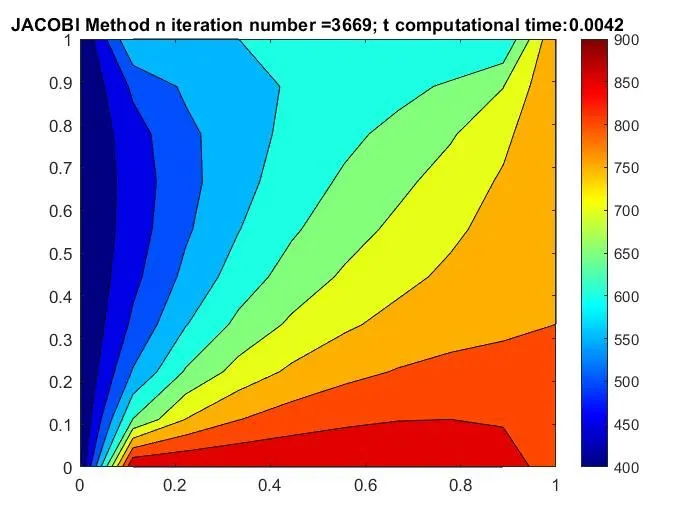
text=sprintf('JACOBI Method n iteration number =%d; t computational time:%0.4f',iter,time);
title(text);
end


% FOR JACOBI
function [iter,t]=gs(told)

nx=10;
ny=10;
alpha=1.4;
dt=0.001;
x=linspace(0,1,nx);
dx=x(2)-x(1);
y=linspace(0,1,nx);
dy=y(2)-y(1);
tol=1e-4;

t=told;
t_initial=t;
t_previous=t;
iter=1;
tic;

% defining k1 and k2
k1=alpha*(dt/dx^2);
k2=alpha*(dt/dy^2);
for nt=1:1400
    error=9e9;

    while error>tol

        for i=2:nx-1
            for j=2:ny-1

                term1=1/(1+2*k1+2*k2);
                term2=k1*term1;
                term3=k2*term1;
                t(i,j)=((t_previous(i,j)*term1)+term2*(t(i-1,j)+told(i+1,j))+(term3*(t(i,j-1)+told(i,j+1))));
            end
        end
        error_n=max(abs(told-t));
        error=max(error_n);
        told=t;
        iter=iter+1;
    end
    t_previous=t;
end
time=toc;

figure(2)
contourf(x,fliplr(y),t);
%[C,h]=contourf(x,fliplr(y),t);
colorbar;
colormap(jet);
%clabel(C,h);
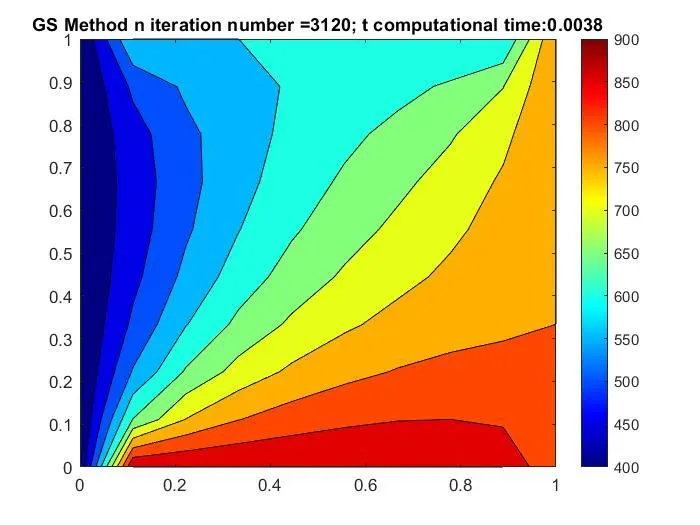
text=sprintf('GS Method n iteration number =%d; t computational time:%0.4f',iter,time);
title(text);

end

% FOR sor
function [iter,t]=SOR(told,f)

nx=10;
ny=10;
alpha=1.4;
dt=0.001;
x=linspace(0,1,nx);
dx=x(2)-x(1);
y=linspace(0,1,nx);
dy=y(2)-y(1);
tol=1e-4;


t=told;
t_initial=t;
t_previous=t;
tic;
iter=1;

% defining k1 and k2
k1=alpha*(dt/dx^2);
k2=alpha*(dt/dy^2);
for nt=1:1400
    error=9e9;


    while error>tol

        for i=2:nx-1
            for j=2:ny-1

                term1=1/(1+2*k1+2*k2);
                term2=k1*term1;
                term3=k2*term1;
                 t(i,j)=(1-f)*told(i,j)+f*((t_previous(i,j)*term1)+(term2*(t(i-1,j)+told(i+1,j))+(term3*(t(i,j-1)+told(i,j+1)))));
            end
        end
        error_n=max(abs(told-t));
        error=max(error_n);
        told=t;
        iter=iter+1;
    end
    t_previous=t;
end
time=toc;

figure(3)
contourf(x,fliplr(y),t);
%[C,h]=contourf(x,fliplr(y),t);
colorbar;
colormap(jet);
%clabel(C,h);
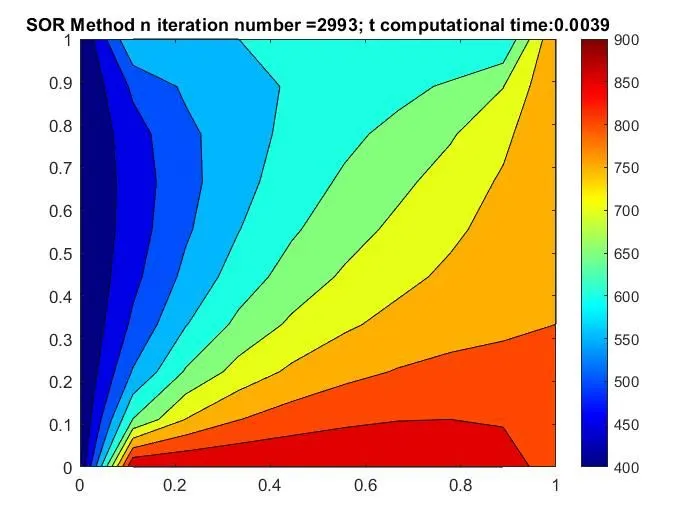
text=sprintf('SOR Method n iteration number =%d; t computational time:%0.4f',iter,time);
title(text);

end
MAIN CODE:
clear all
close all
clc

% number of grid points along x and y axis
 nx=10;
  ny=10;
f=1.2;


%applying BC
t=ones(nx,ny)*298;
t(1,:)=600;
t(end,:)=900;
t(:,1)=400;
t(:,end)=800;

alpha=1.4;
dt=0.001;


told=t;
t_initial=t;
t_previous=t;

for iterative_solver=1:3

    iterative_solver=1;
    [iter,t]=jacob(told);

    iterative_solver=2;
    [iter,t]=gs(told);

    iterative_solve=3;
    [iter,t]=SOR(told,f);
end
PLOT:
Conclusion:
While comparing botj Explicit and Implicit methods results,the Expliocit method is much quicker than the implicit method