Week 8: Literature review - RANS derivation and analysis
Aim - Literature review - RANS derivation and analysis
RANS Equation –
RANS is a numerical method to model a turbulent flow where in the flow quantities are decomposed into their time-averaged and fluctuating components. This process is called Reynolds decomposition.
Reynold's stress - The Reynolds stress is the component of the total stress tensor in a fluid obtained from the averaging operation over the Navier–Stokes equations to account for turbulent fluctuations in fluid momentum.
Turbulent viscosity-
The Turbulent -viscosity based k — є turbulence model has been used in the present work where the additional stresses arising out of turbulent fluctuations in the momentum equations are replaced by viscous type stresses analogous to their laminar counterpart. The turbulent or eddy viscosity μt is defined by the following relationship:
(2)єμt=ρCμk2/є
Molecular viscosity –
It is fluid property. Is the transport of mass motion momentum solely by random motion of individual molecule not moving together in coherent groups. It is analogous in laminar flow to eddy viscosity in a turbulent flow.
Difference between turbulent viscosity and Molecular viscosity
1.The turbulent viscosity is an imaginary concept but molecular viscosity is dynamic that is present in all fluids.
2.The turbulent viscosity depend on the flow of fluid and molecular viscosity depends on the fluid properties.
- The turbulent viscosity present in turbulent fluid and molecular viscosity present in the all type of fluid.
RANS derivation -
The Navier-Stokes equations can be derived from the basic conservation and continuity equations applied to properties of fluids.
Continuity Equation
The basic continuity equation is an equation which describes the change of an intensive property L. An intensive property is something which is independent of the amount of material you have. For instance, temperature would be an intensive property; heat would be the corresponding extensive property. The volume Ω is assumed to be of any form; its bounding surface area is referred to as ∂Ω. The continuity equation derived can later be applied to mass and momentum.
Reynold transform equation -
 Equation 1
this equation states that the change in the total amount of a property is due to how much flows out through the volume boundary as well as how much is lost or gained through sources or sinks inside the boundary.
Divergence Theorem
The Divergence Theorem allows the flux term of the above equation to be rexpressed as a volume integral. By the Divergence Theorem
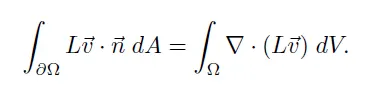
Equation 1 can be written as

Leibniz’s Rule states that
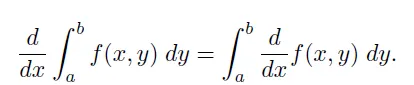
Therfore
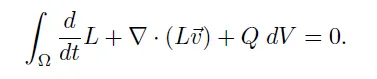
This relation applies to any control volume Ω; the only way the above equality remains true for all control volumes is if the integrand itself is zero.
Conservation of Mass-
Applying the continuity equation to density (the intensive property equivalent to mass), we obtain
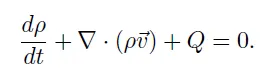
This is the same as conservation of mass because we are operating with a constant control volume With no sources or sinks of mass (Q = 0)
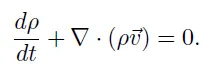
This is the equation of conversation of mass.
Conversation of Momentum
According to Newton’s laws
F =ma
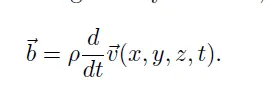
The body force →b is a force that acts throughout the body of fluid (as opposed to, say, a shear force, which acts parallel to a plane).
Applying the chain rule to the derivative of velocity, we get
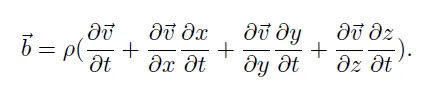
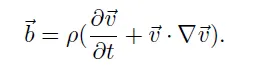
Substituting the value in parentheses for the definition of a material derivative, we obtain our final equation of

Equations of Motion
We assume that the body force on the fluid parcels is due to two components, fluid stresses and other, external forces.
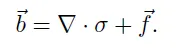
Here, σ is the stress tensor, and f→ represents external forces.
Stresses
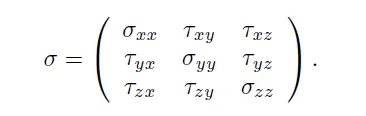
The equations of motion depend on the stress tensor σ. The tensor can be represented as
General Form of the Navier-Stokes Equation
The stress tensor σ denoted above is often divided into two terms of interest in the general form of the Navier-Stokes equation. The two terms are the volumetric stress tensor, which tends to change the volume of the body, and the stress deviator tensor, which tends to deform the body. . Thus, σ is broken down into
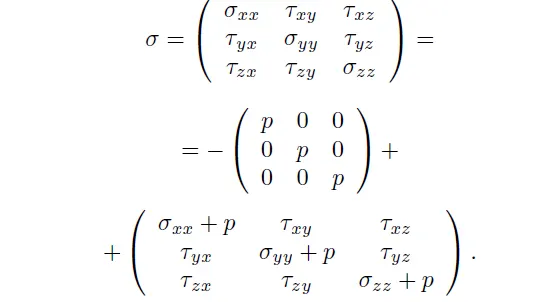
Denoting the stress deviator tensor as T , we can make the substitution
σ = −pI + T.
Substituting this into the previous equation, we arrive at the most general form of the Navier-Stokes equation:
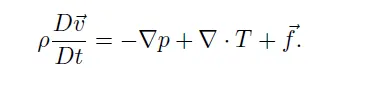
this is the general form of the Navier-Stokes equation