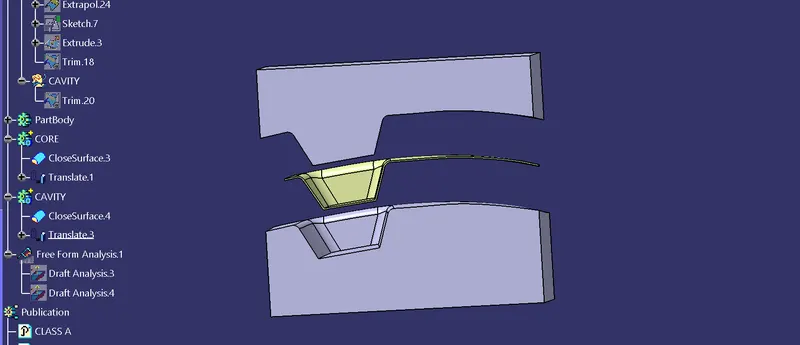
Week 8 - Challenge 5 - Core & Cavity Design
Aim :
Create the Core and cavity blocks for the switch bezel designed in the earlier challenge.
What is core ?
The core is the male part which forms the internal shape of molding.
What is Cavity ?
The cavity is the female part which forms external shape of molding.
Core and Cavity design Requirements :
Core and Cavity Design defines the core and cavity sides of a part, including any sliders or lifters that may be required, so as to produce a MoldedPart ready to be used with Mold Tooling Design. It includes functions that define:
-
The pulling directions,
-
the parting line
-
the parting surface,
-
the splitting surface,
along with analysis and fine tuning capacities.
Drafting :
Drafts are defined on molded parts to make them easier to remove from molds. There are two ways of determining the objects to draft: either by explicitly selecting the object or by selecting the neutral element, which makes the application detect the appropriate faces to use.
Draft angle :
A draft angle is calculated as a degree measurement (or, less often, an inch or millimeter measurement) from the vertical axis of a mold, and it helps account for thermoplastic shrinkage, a practical reality of the injection molding process for most materials. Usually the draft angle will be minimum of 3 degree.
Draft analysis :
Draft analysis is a process in which tha angles for the drafted faces are checked. The Draft Analysis command enables you to detect if the part you drafted will be easily removed. This type of analysis is performed based on color ranges identifying zones on the analyzed element where the deviation from the draft direction at any point, corresponds to specified values.
Parting surface :
- A parting surface is a surface that separates the mold block into two parts – the core and the cavity.
- Designed for the removal of the plastic product and the cold slug, the parting surface is where the core meets the cavity, and usually locates at the largest section of a product.
Parting lines :
The parting line is where the two halves of the mold meet around the parameter of the part. All parting lines need to seal properly when the mold is clamped in a molding machine.
Step 1 : Parting surface without component area
Creating parting surface without component area this acts as the core surface for the mould design . For this, Class B surface is published and extrapolated. This class B surface will act as the core surface in mould creating. Core is the male or solid part which holds the molten material and forms the internal shape of molding.
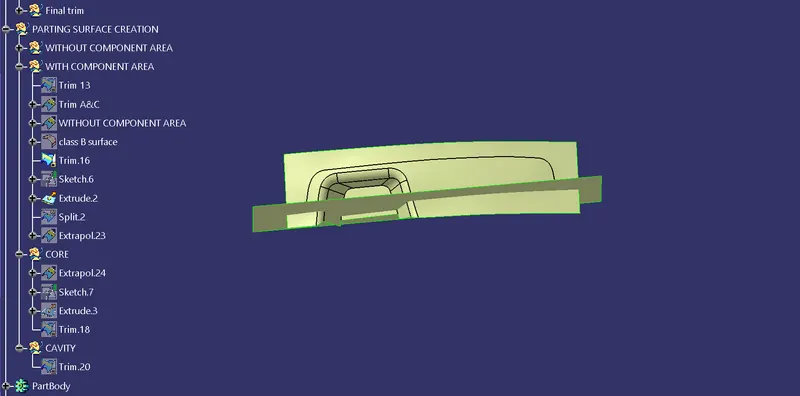
Step 2 : Parting surface with component area
Creating parting surface with component area this will be taken as the cavity surface. For that, the class A and C surfaces are published. Which tends to form the cavity part. Cavity is the female part which forms the external part of molding. Generally the defined A and C surface combination is trimmed or joined with the B surface extracted to form the cavity part.
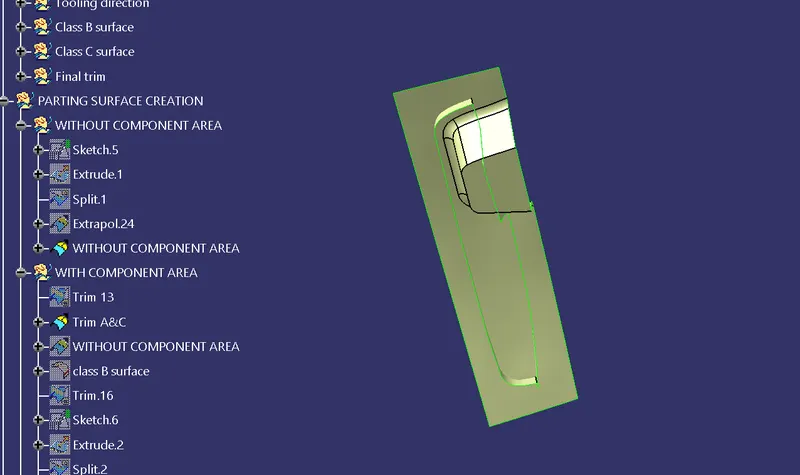
Step 3 :
The outer profile for the core and cavity is drawn and extruded. This core and cavity outer solid can be of any shape but basically rectangular solid pattern is taken into consideration.
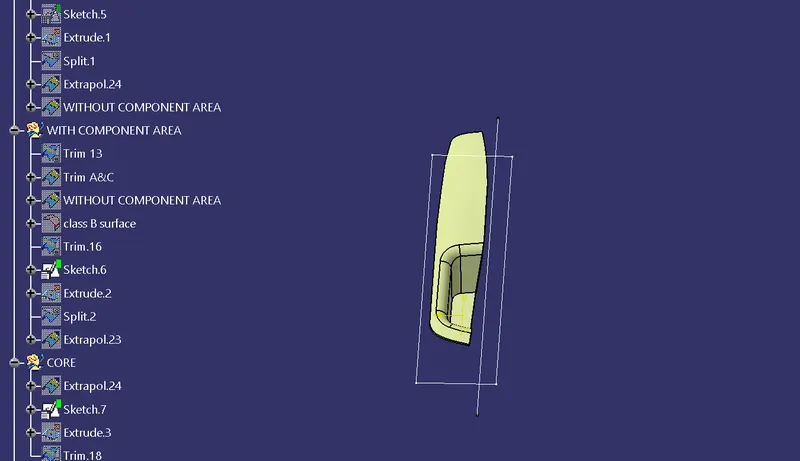
Step 4 :
Extruding the sketch that was drawn for the outer surface of the core and cavity. This is then trimmed with the corresponding B and (A & C ) surface to make them as the core and cavity respectively.
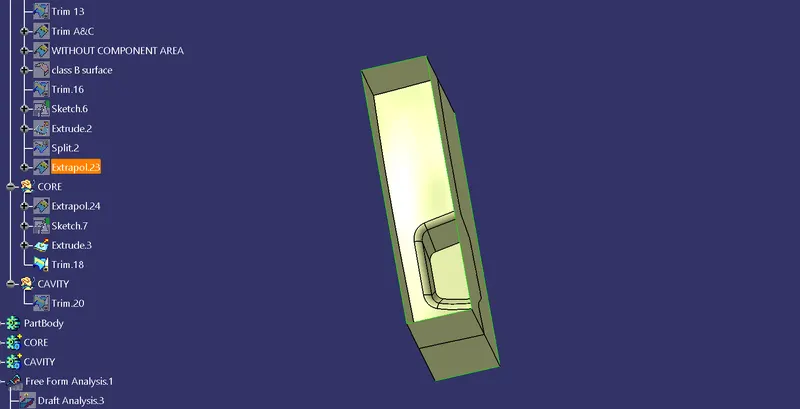
Step 5 :
Now the extruded outer rectangular surface is trimmed with the parting surface without component area , to create the core surface part. Core acts as the male part without any cavity it can be moved along the tooling axis.
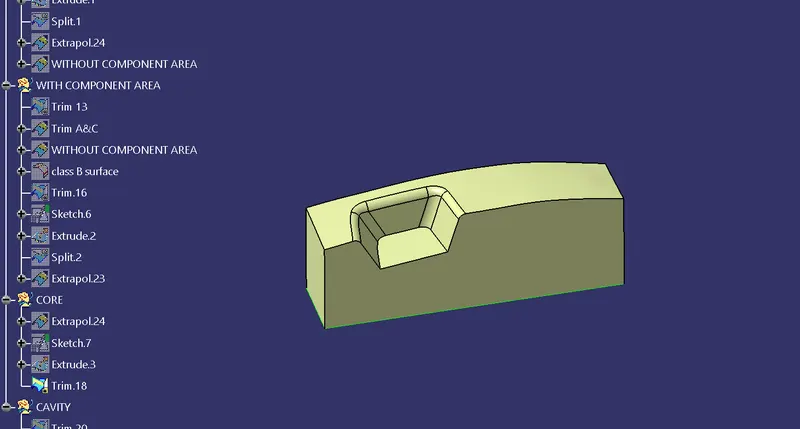
Step 6 :
Now the extruded outer rectangular surface is trimmed with the parting surface with component area , to create the cavity surface part. Cavity acts as the female part with a cavity portion where the molten plastic component filled with the help of injectors, it remains as the fixed portion.
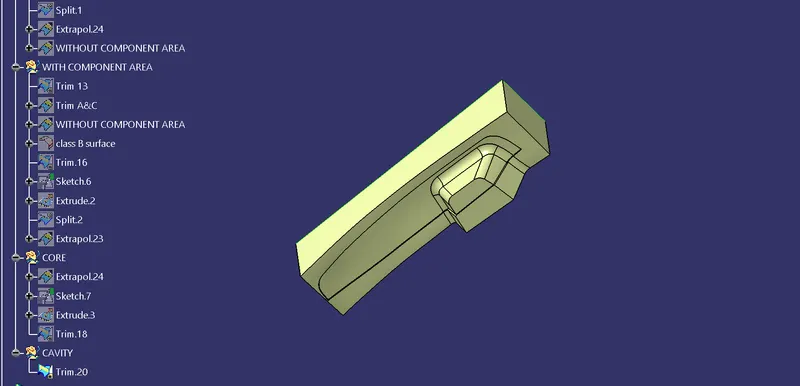
Step 7 :
Now the work bench is changed to part design and the surface created is converted into solid body with help of closed surface tool. Which is translated for a distance to separate core and cavity from the solid body given above.