Week 8 - Challenge 3 - Coin Holder Design
TITLE: Coin Holder Design
AIM: To create a Coin Holder Plastic component through the given Class-A surface. To begin with, the tooling axis for the given Class-A Surface is created for meeting the requirements of the draft angle and at the end perform the Draft analysis on the model.
REPORT: This report demonstrates the design of an Automotive Plastic Component – Coin Holder Plastic using industry principles such as Draft angles, Draft Analysis, Determining and implementing of Tooling Axis, Class A, Class B and Class C surfaces. The component is designed using Surface Design and Solid Design techniques in CATIA V5.
Dashboards and Coin Holders are often made of ABS plastic. It's also well-suited to heavy-duty applications, so it can be used for automotive body parts, too. Plastic used in cars, like ABS, helps the body absorb and redistribute energy during an impact, keeping passengers safe.
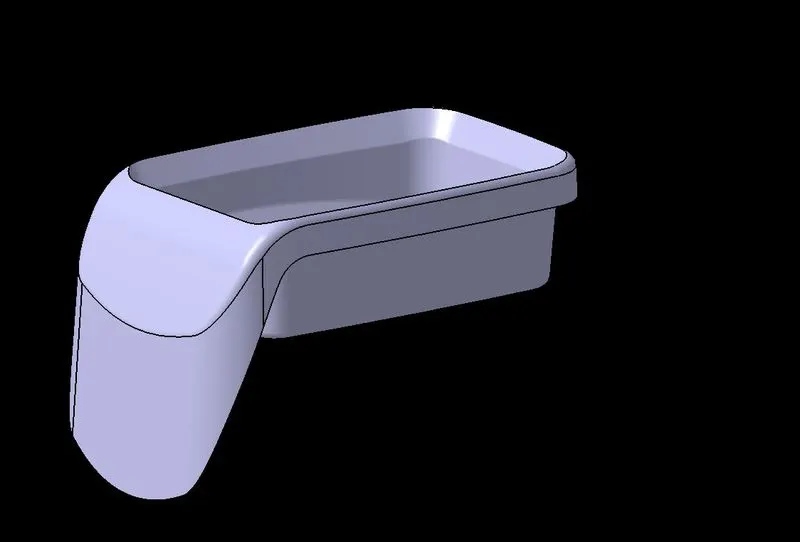
↑ COIN HOLDER ↑
The terms are briefly explained below:
Draft:
- Draft is an angular tapering given at the design stage to every Plastic Component that has to be manufactured.
- It is given in the direction of the Mold Movement.
- The Draft allows the parts to release easily from the mold without creating friction between the surface of component and the core and cavity plates.
- When a Plastic component cools down inside the mold, the natural tendency of it is to shrink and attach to the core or cavity half.
- The movement of mold opening causes friction on the walls of the component as well as the core/cavity blocks.
- This reduces the life of the mold as well as the component itself.
- The component may also have rough surface finish as well as weak structure due to this.
- This problem can be solved by giving draft to the component.
- Most applications require minimum draft angles of around 0.5º to 1º , however 3º draft angles are widely accepted for cost saving purpose.
- 7º Draft angles are given to textured surfaces like Instrument Panels.
- Minimum possible draft angles are given to screw bosses, ribs and stiffeners due to their critical nature.
-
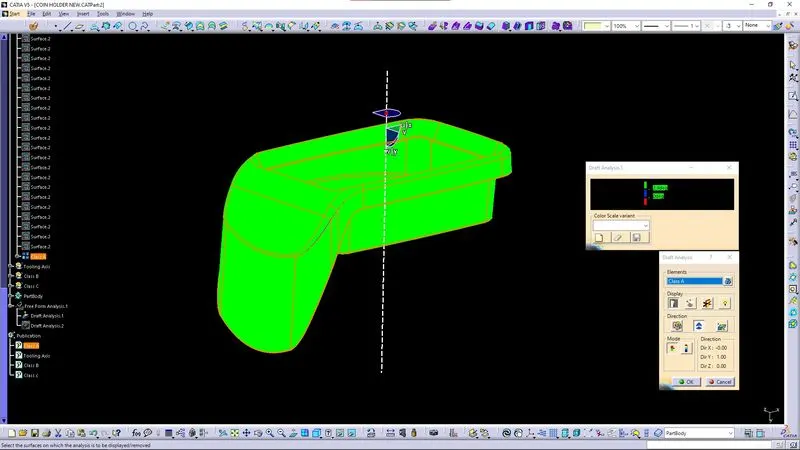
↑ DRAFT ANALYSIS FOR CLASS A SURFACE ↑
Draft Analysis:
- Draft Analysis is a tool in CATIA which identifies the zones which deviates from the specified values of angles along a defined draft direction using colour codes.
- It highlights the regions of draft using colours.
- Draft analysis is the first step performed after receiving the Class A of the component.
- Draft analysis should be passed in order to make the plastic component manufacturable.
- Acceptable draft angles are used as range for draft analysis.
For Analyzing the Draft of the Class A Surface:-
- Change View Mode Customization to Material mode
- Go to INSERT ---> ANALYSIS ---> FEATURE DRAFT ANALYSIS and move the compass to the Tooling Axis.
- Change the range to 3º. Apply the settings as Shown in Figure.
- As shown the target area has 0º draft angle which was the concerned face, since it's a flat surface.
- Thus, it passes the criteria of having suitable draft and the Class A can be further designed into a solid plastic component and manufactured.
-
Tooling Axis:
- Tooling Axis is the direction in which the Mold opens and closes. Part Drafts are given along this axis.
- Identify faces which can potentially create problems while manufacturing.
- Surfaces at angles along a desired Tooling Axis.
- Extract a plain surface and create a point on its center for Axis system creation.
- In this case Z axis can be a possible Tooling Axis Direction.
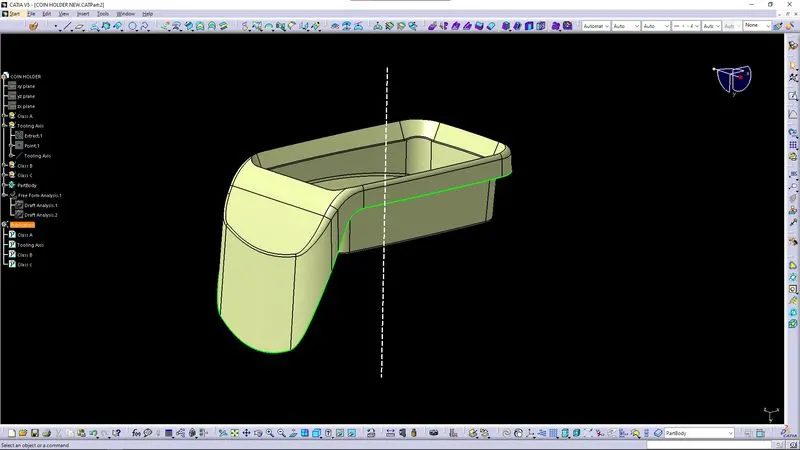
↑ TOOLING AXIS ↑
-
Class- A Surface:
- In automotive design, a class A surface is any of a set of freeform surfaces of high efficiency and quality.
- It is the visible aesthetic surface of any automotive component.
- Class A surface refers to those surfaces which are visible and abide to the physical meaning, in a product.
- This classification is primarily used in the automotive and increasingly in consumer goods industry.
- It is a requirement where aesthetics has a significant contribution.
- For this reason, the exterior of automobiles is deemed Class-A.
Class- B Surface:
- Class B surfaces are Engineering Surfaces which are invisible to the eyes or often on the back side of the Class A surfaces.
- It is mainly the thickness of the component or Class A.
- These surfaces need to be designed as per the Class A surface i.e., the continuity, thickness of the component, functionality etc should be maintained.
- These surfaces include the main engineering features such as Screw bosses, Ribs, Snaps, Stiffeners and fixations.
- B surfaces also do not contain any aesthetic styling content and textures since it is not visible to eyes.
Class- C Surface:
- Class C surfaces are connectors between Class A and B surfaces.
- This surface connects both A and B surfaces along the Tooling Axis.
- It contains the draft as per the design.
- It is basically the thickened surface between both A and B surface.
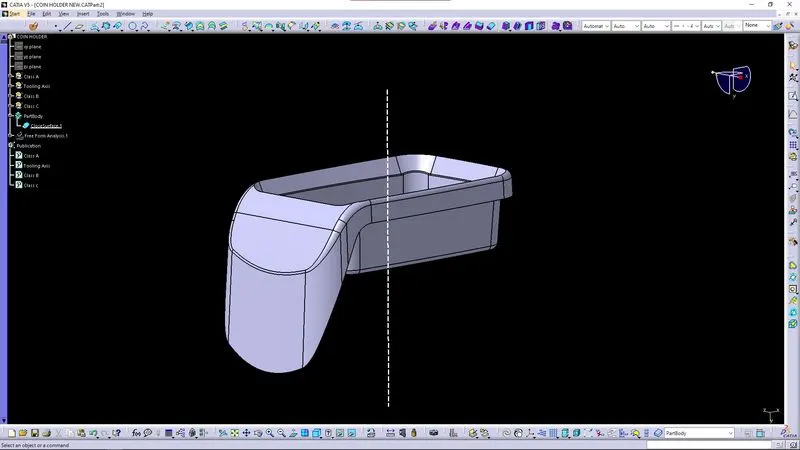
↑ CLASS A, B & C SURFACES ↑
-
Class B Surface:
- Extract the relevant surfaces from Class-A surface which excludes the Fillets and holes.
- Here the selected faces consist of Coin Holder rest surface, Walls and the Base surface.
- Extract of these surfaces is shown below.
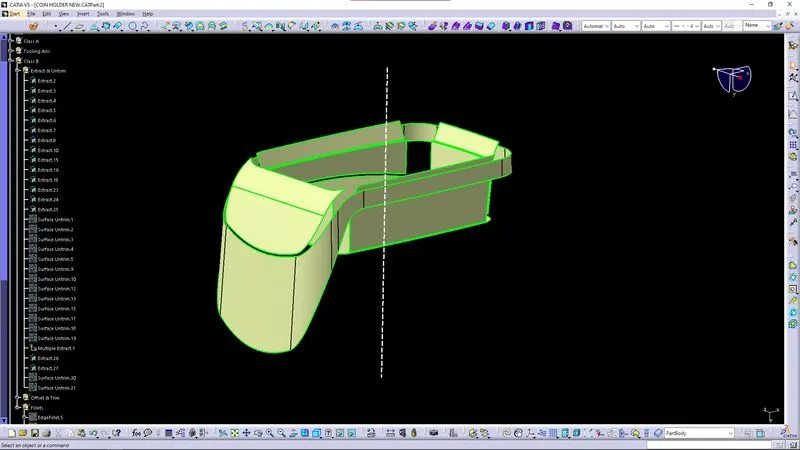
- Then after Extract and Offset, Extrapolate those extracted offset surface to create a Class B Surface.
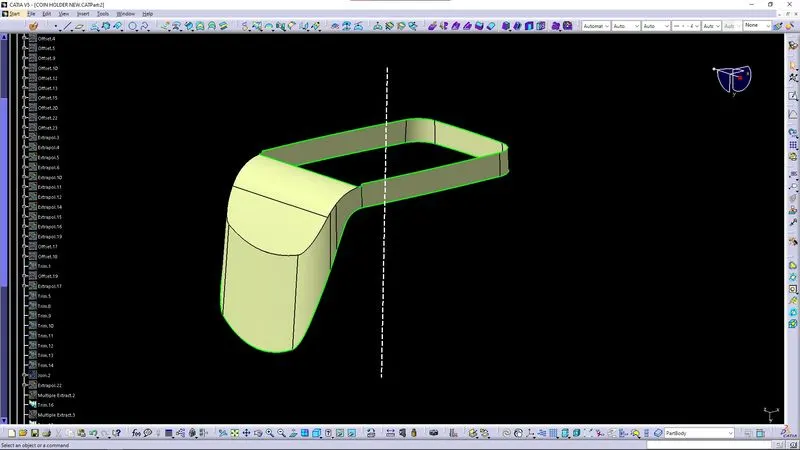
- Use multi-extract option, to extract the desired surface. multi-extract usually is used for variety for surfaces.
- Then untrim those extracted surfaces using Untrim option. After that, trim the excess portions off.
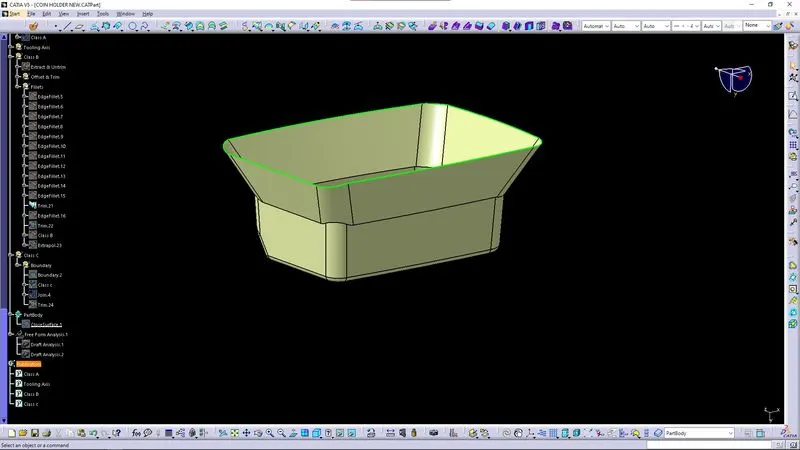
- With the extracted portions, trim the excess portions to obtain the desired shape.
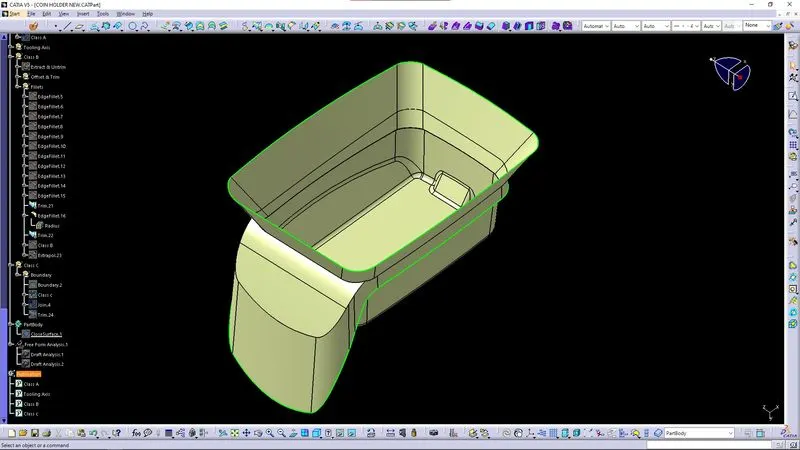
- Then, the two surfaces are trimmed to the required Thickness of the Part.
- In this case of Coin Holder, the thickness value is 2.5 mm.
- The offset faces are the part of B-Surface.
Creating fillets.
- Create Fillets while maintaining the part thickness between the Class A and Class B surfaces.
- The Value of Fillet is given by the equation (B surface fillet = A surface fillet ` Thickness of the Part).
- The sign + or – must be decided so as to maintain the part thickness which in this case is 2.5mm.
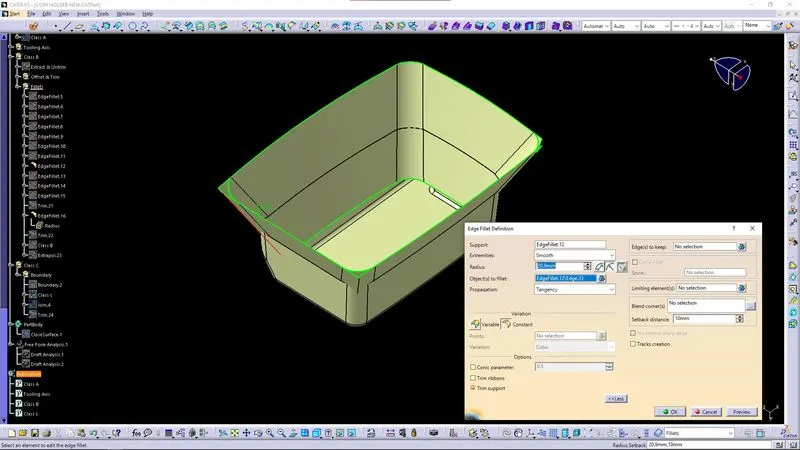
↑ FILLET 1 ↑
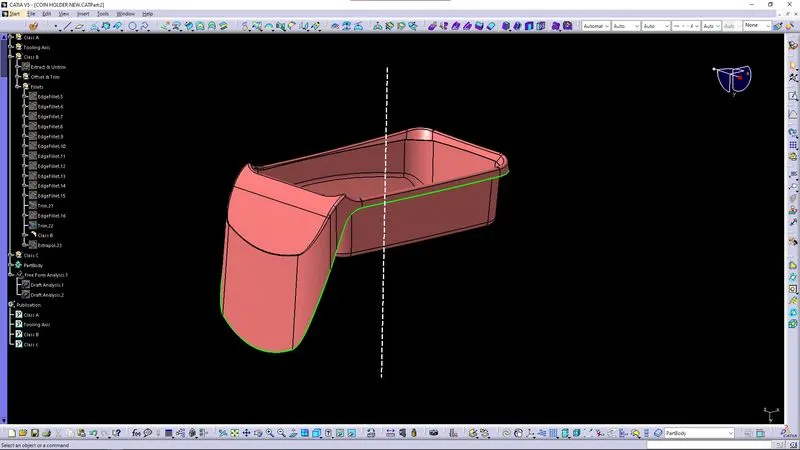
The obtained surface is the required Class B Surface is shown below.
-
Class C Surface:
- Using the Boundary feature, the upper sketch of CLASS A SURFACE is taken and created upto the vertexes of limit of both end point.
- Using Boundary Lines, Sweep option is carried on to create a draft length extension (5mm) and draft angle (3°).
- After the Sweep Operation, the two surfaces are joined together using Join option. And then trim the excessive portions to obtain the desired outcome.
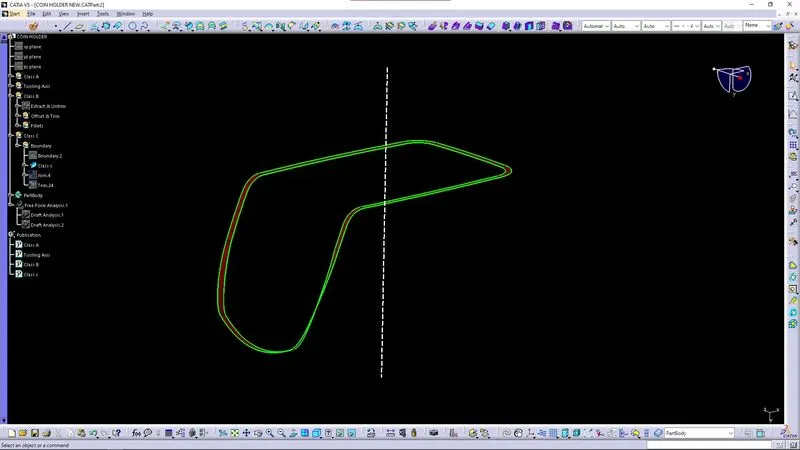
↑ CLASS C SURFACE (BOUNDARY, JOIN & SWEEP)↑
-
Final Closed Surface Creation:
- Join all the Swept surfaces along with the Class A Surface. In this case gaps occur while joining so use 0.003mm.
- Even this method doesn’t fill up the gap so extrapolate Class A to about only 0.5mm and trim it off with C surface.
- The Final trim should be one single Surface Entity without any gaps
↑ FINAL CLOSED BODY ↑
-
Perform Draft Analysis on the Final Closed Surface:
- Change View Mode Customization to Material mode
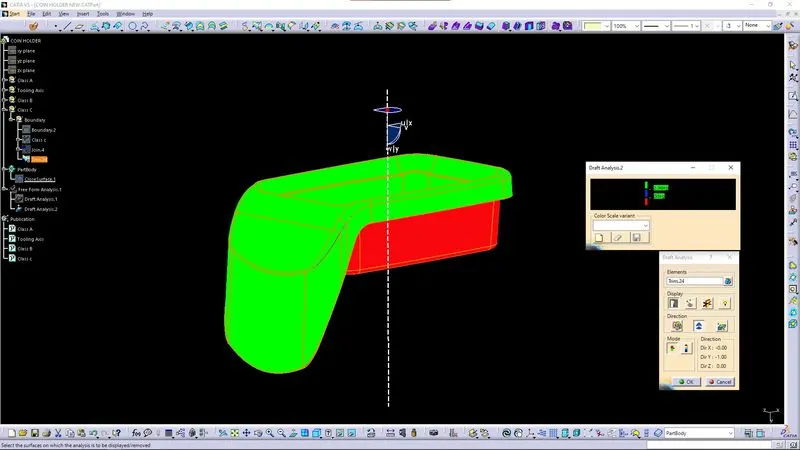
- Go to INSERT → ANALYSIS → FEATURE DRAFT ANALYSIS and move the compass to the Tooling Axis. Change the range to 2.9º. Apply the settings as shown.
- As shown the target area has 3º draft angle. Thus, it passes the criteria of having suitable draft and the Closed can be further designed into a solid plastic component and manufactured.
-
CONCLUSION:
The Design of Automotive Plastic Component – Coin Holder from Class A is completed using concepts of Draft angle, Draft Analysis for Class A and Final enclosed surface, Tooling Axis creation and implementation, Class B and Class C creation and conversion to a solid part.
- - -