Week 8:- 3D Finishing - Challenges 1
- 3D Finish process is the process where the design is beign completely finished and to be ready for final simulation and 2-D detailing.
- Points to considered while finishing a design:
- Hole Concentricity and hole sizes : Making sure each and every dowel as well as screw holes in two mating parts concentric.
The sizes of non-threaded portions is to be larger than threaded part designation. - Machining Area : The area which is machined after the part is casted is known to be a machining area. These are specific sized spaces to generally used to accomodate the mounted part. Ex: For Riser to be mounted the blade is machined on that specific area so that the mounting surfaces should align properly.
- Nominality: The various parts and features of assembly should be either have non-decimal value or decimal value in multiple of five.
- Holes colouring standard: These are standard practices for easy identification of certain feature function ex: The holes are of different colours depending on their function like
- Dowel holes: Blue coloured
- Unthreaded part of screw holes: Sea green coloured
- Threaded part of screw holes: Yellow coloured
- Pneumatic Lay-outing: Usually done so that no wear and tear takes place on pneumatic pipes because of weld spatter.
- Gaps Checking: The Standard Gaps between various is checked for smooth operation.
- Fasteners implementation: Fastener are implemented onto various units to mount them onto base unit, also fastener are used to mount the base unit onto the floor.
- Avoiding Clash between Different parts: Weld gun, clamp units, pin units, etc all should not clash with each other during panel mounting operation and welding operations.
- Mylars spliting as per panel profile: The mylars should have complete surface contact on either side of the panel.
- Proper renaming of Parts/Assemblies as per standard: All the make parts should have proper name including the parent number, own number and its name.
- Hole Concentricity and hole sizes : Making sure each and every dowel as well as screw holes in two mating parts concentric.
- Rough Locator: These are guiding parts used in manual loading of the panels. These are used for guiding panels in correct position and orientation. They are made up of Mild steel or similar metals.
Two types of rough locator is shown below (highlighted in Red outlines)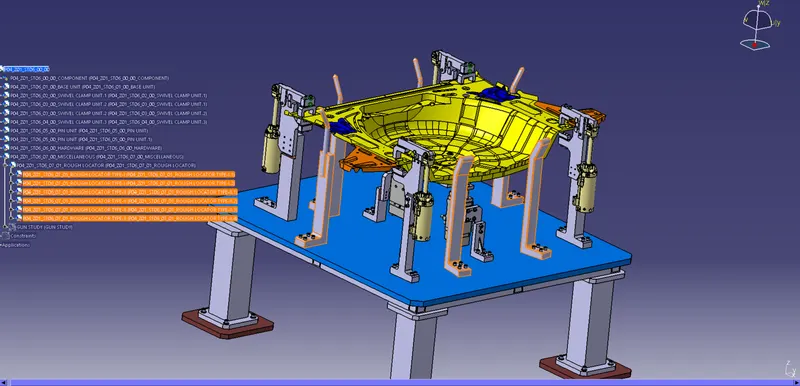
- The points that are considered while designing a rough locator:
- Height of Rough Locator should be not more than permissible height of the fixture.
- Entry point/Top Point of Rough Locator should be 10mm to 15mm above the panel.
- Rough Locator should have adjustment in direction of positive and negative direction of guiding plane.
- Minimum 2mm gap between Rough Locator and panel should be present.
- 5mm to 10mm adjustment should be present in direction of guiding plane.
- Gun Study: It is a process of orienting the Spot weld gun onto each and every weld point and making sure that the weld gun is not clashing with any units or other parts.
A similar is shown below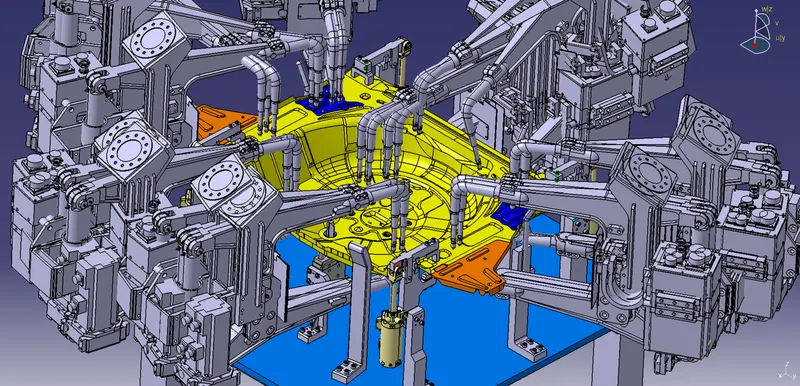
- The points need to consider during the gun study:
- The weld gun should have certain minimum clearance with each parts of the weld fixture assembly.
- The weld gun while welding should always be normal to welding plane.
- Pneumatic routing: It is a routing of pnuematic system (which is used for toggle clamps, pin cylinder and slides) so that no wear or tear happens in pipes due to weld spatter.
In Pneumatic routing all pipes from cylinder are shown connected to valve banks and passses through a safety box like structure. - Solenoid valve: A solenoid valve is an electromechanical device that controls the flow of fluids or gases by using an electromagnetic solenoid to actuate a valve mechanism. It is a type of on-off valve, meaning it can either be fully open or fully closed, allowing or blocking the flow of the fluid or gas through the system.
These are used to actuate the air flow in cylinders as per the sequence through manual or PLC operated system.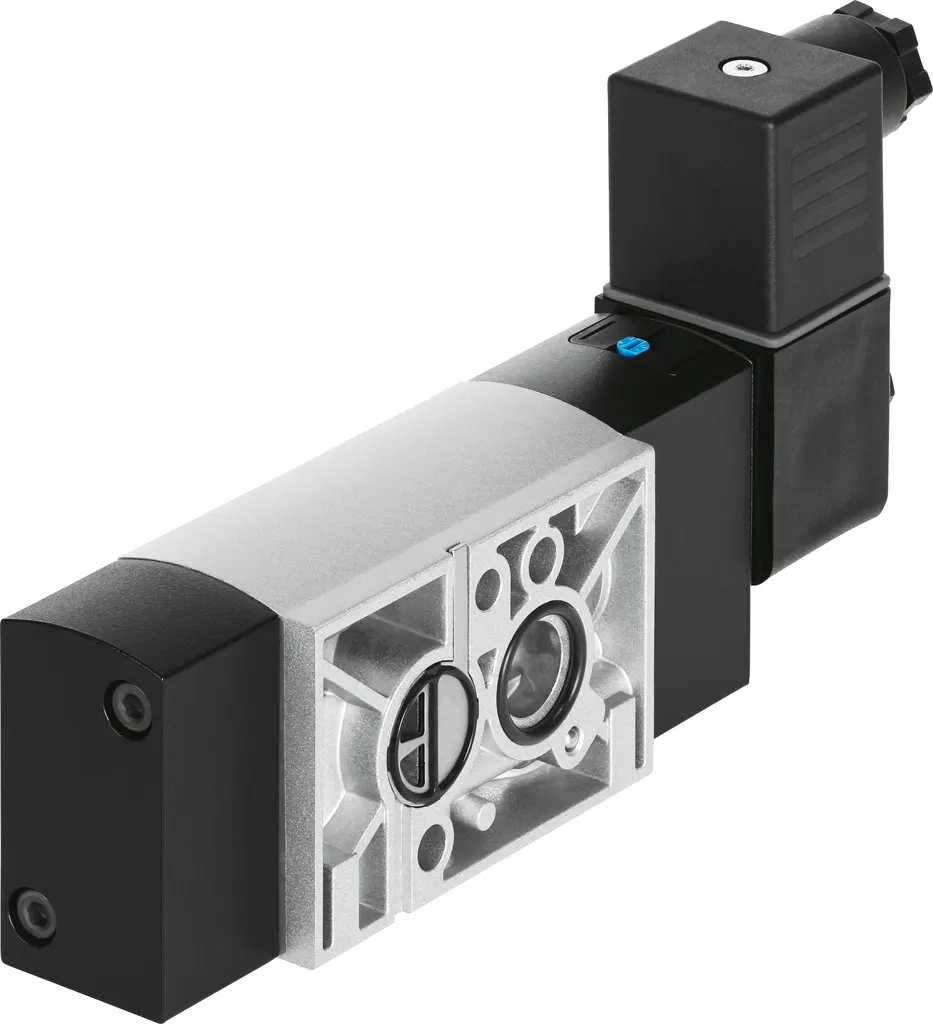
- Valve Bank: It is a system in which 'n' number of solenoid valves are mounted in order to maintain one inlet and outlet of air to all the valves. These are usually mounted on the fixture sides or on the base plate depending upon the various conditions.
A valve bank is a specialized assembly of multiple valves mounted onto a common block or plate. Valve banks are commonly used in hydraulic and pneumatic systems to control the flow, direction, and pressure of fluids or gases within the system. They provide a compact and organized solution for managing multiple valves in complex applications.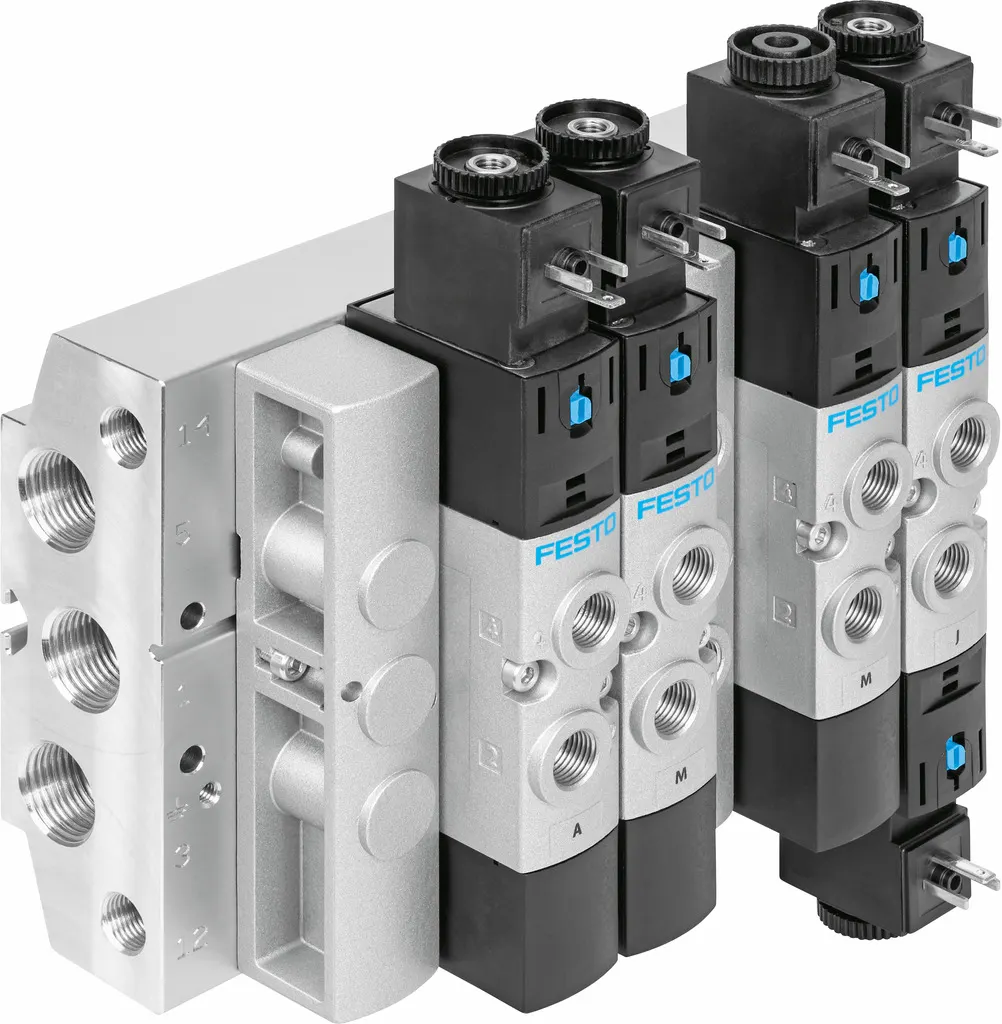
- Sensors: A sensor is a device or instrument that detects and measures physical properties or changes in the environment and converts them into electrical signals or other readable outputs. Sensors are essential components in various systems and technologies, enabling the collection of data and providing feedback to control processes, monitor conditions, or trigger specific actions.
In BIW fixtures, it is used to sense the car panel by using electrical sensors. This signal from the sensors will be fed to the PLC and so the next process will be executed by this signal. An example of a proximity sensor is given below.
Some key applications of sensors in automation:
1. Process Control: In manufacturing and industrial automation, sensors are used to monitor various parameters like temperature, pressure, flow rate, and level to maintain optimal conditions and regulate processes. For example, in a chemical plant, temperature sensors ensure precise control of reactor temperatures during chemical reactions.
2. Motion Control: Sensors such as encoders, proximity sensors, and accelerometers are used in robotic systems and machinery to monitor and control movement and positioning. They enable accurate motion control for tasks like pick-and-place operations and assembly.
3. Quality Assurance: Sensors are utilized in quality control processes to inspect products for defects or variations. Vision sensors, for instance, are used in production lines to check for imperfections in products, ensuring consistency and high-quality output.
4. Safety and Monitoring: Sensors play a vital role in ensuring the safety of automated systems. For instance, emergency stop buttons, light curtains, and safety mats use sensors to detect hazards and halt machine operations in case of personnel presence or potential danger.
5. Inventory Management: In automated warehouses and distribution centers, sensors like barcode scanners, RFID readers, and vision systems are used to track inventory levels, monitor stock movement, and facilitate seamless logistics operations.
6. Environmental Monitoring: Automation systems in smart buildings use various sensors to monitor environmental conditions like temperature, humidity, and occupancy. This data is then used to optimize heating, cooling, and lighting systems for energy efficiency and occupant comfort.
7. Automated Vehicles: In autonomous vehicles, a combination of sensors, such as LiDAR, cameras, and radar, provide real-time data about the vehicle's surroundings. This information is used to make decisions for navigation, collision avoidance, and lane-keeping.
8. Home Automation: In smart homes, sensors are used for various tasks, such as motion sensors for lighting control, temperature sensors for climate regulation, and door/window sensors for security purposes.
-
Sensors come in various types, each designed to detect and measure specific physical properties or changes in the environment. Here are some common types of sensors based on the physical quantities they measure:
1. Temperature Sensor: Measures the level of heat or cold in the environment or an object. Examples include thermocouples, thermistors, and infrared (IR) temperature sensors.
2. Pressure Sensor: Monitors changes in pressure levels in gases or liquids. Types include pressure transducers, piezoelectric sensors, and capacitive pressure sensors.
3. Proximity Sensor: Detects the presence or absence of objects within a certain distance. Types include inductive, capacitive, ultrasonic, and photoelectric proximity sensors.
4. Motion Sensor: Detects changes in an object's position, orientation, or acceleration. Examples include accelerometers, gyroscopes, and proximity sensors with motion detection capabilities.
5. Light Sensor: Measures the intensity of light or detects its presence. Types include photodiodes, phototransistors, and ambient light sensors.
6. Humidity Sensor (Hygrometer): Measures the amount of moisture in the air or a gas. Examples include capacitive and resistive humidity sensors.
7. Gas Sensor: Detects the presence and concentration of specific gases in the environment. Examples include carbon monoxide (CO) sensors, methane sensors, and carbon dioxide (CO2) sensors.
8. Force Sensor: Measures the applied force or strain on an object. Types include load cells, strain gauges, and piezoelectric force sensors.
9. Flow Sensor (Flow Meter): Measures the rate of fluid flow through a system. Examples include magnetic flow meters, turbine flow meters, and ultrasonic flow meters.
10. Level Sensor: Determines the level of liquids or solids in a container. Types include ultrasonic level sensors, capacitance level sensors, and float level sensors.
11. Image Sensor: Captures visual information and converts it into electrical signals. Examples include CCD (Charge-Coupled Device) and CMOS (Complementary Metal-Oxide-Semiconductor) image sensors used in cameras and vision systems.
12. Sound Sensor (Microphone): Converts sound waves into electrical signals for audio recording or detection purposes.
13. Biometric Sensor: Measures biological characteristics unique to individuals, such as fingerprints, iris patterns, or facial features, for authentication and security applications.
For BIW fixture specific applications: Proximity sensors, LASER sensors and Photo-Electric sensors - The fundamental points that need to consider while designing or selection of sensor are:
- Number of sensors: Each Panel should be sensed by 1 to 2 sensors depending on the size of panel. If more than one sensor than they are preferred to be in diagonal opposite ends of the panel.
- Adjustability: Every sensor should be mounted in 3 direction adjustable way.
- Sensor mounting: Every single loose panel which is to be welded in a tool should have a sensor.
- Number of sensors: Each Panel should be sensed by 1 to 2 sensors depending on the size of panel. If more than one sensor than they are preferred to be in diagonal opposite ends of the panel.