Week 7 State of charge estimation
1.Simulate the 3 test cases from harness dashboard and write a detailed report on the results
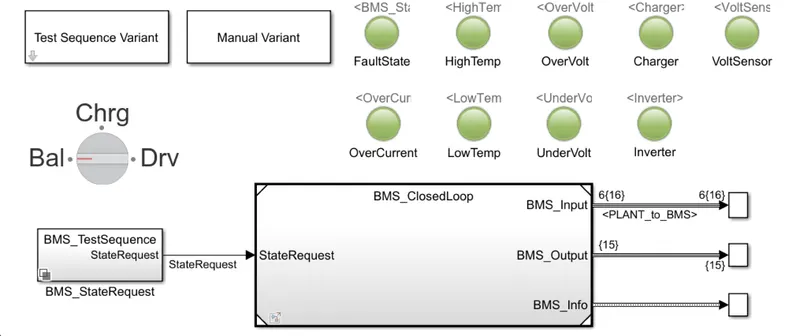
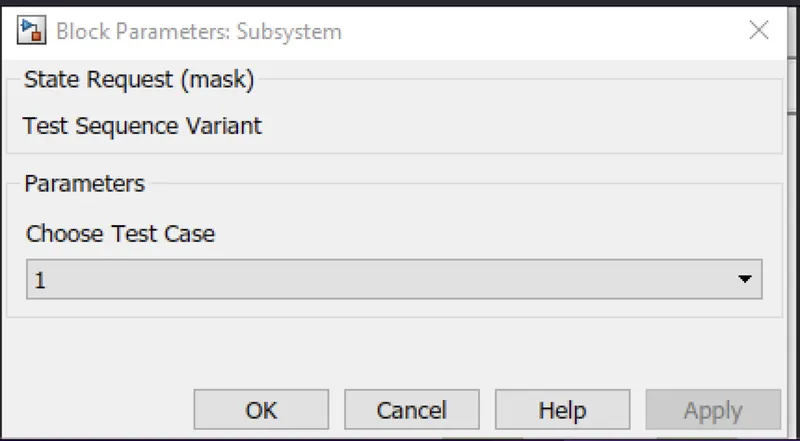
For Test sequence 1
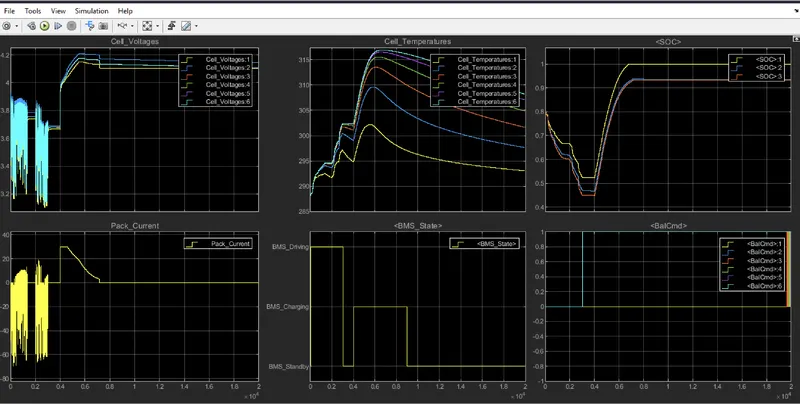
So we can see no errors and we check the plot for this model and is shown below.
From the above plot we can see the vehicle is initially in a driving state and charging was done to 90%.
So After charging it reaches standby mode. It can be seen in the BMS state plot. Battery temperature increases in driving and charging.
The Battery voltage was increased to 4.2V while charging.
The current plot shows the value of current supplied to the vehicle while driving.
Hence SOC decreased up to 50% in driving conditions and it was increased while charging
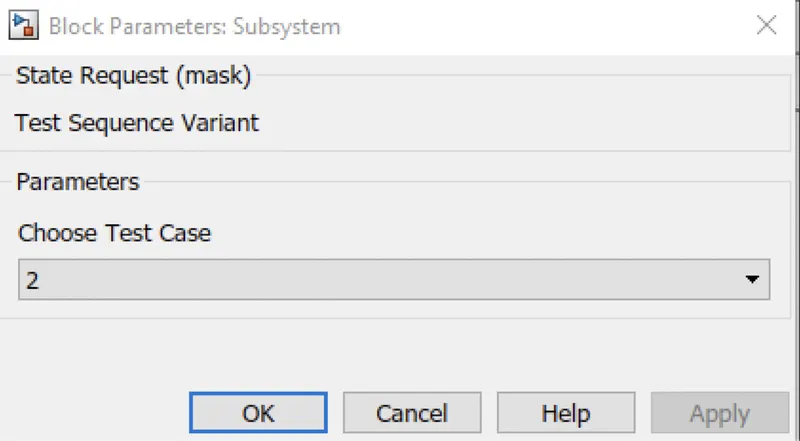
For test Sequence 2
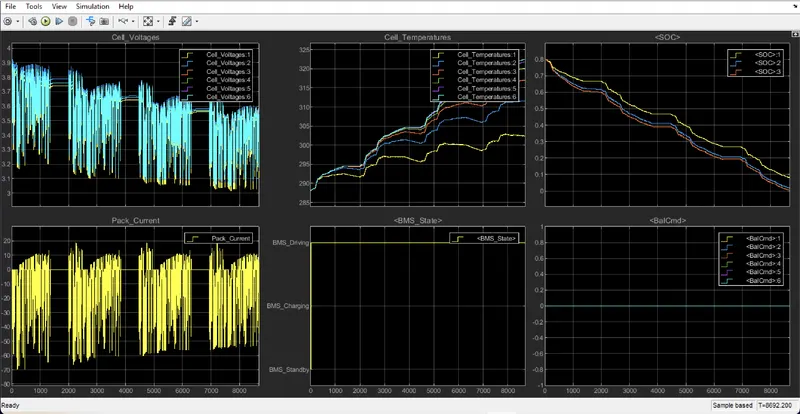
The stop time is 8692.200 seconds this is why because the vehicle has been completely discharged to 0% at that instant of time
Here in the driving cycle mode i.e 0-10000sec the cell voltage varies from 3.9 to 3.05v which is the cutoff voltage of a cell and the entire cell is drained upto 8692sec
so the cell temperatire changes from 288k to 322k
The SOC is decreased from 805 to 0%
Same in the charging mode i.e 10000 to 20000sec the cell got drained eariler befre it reaching this mode
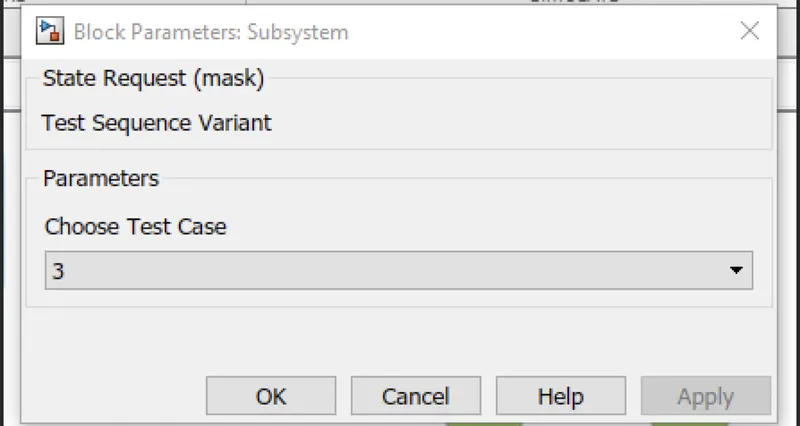
Test sequence 3
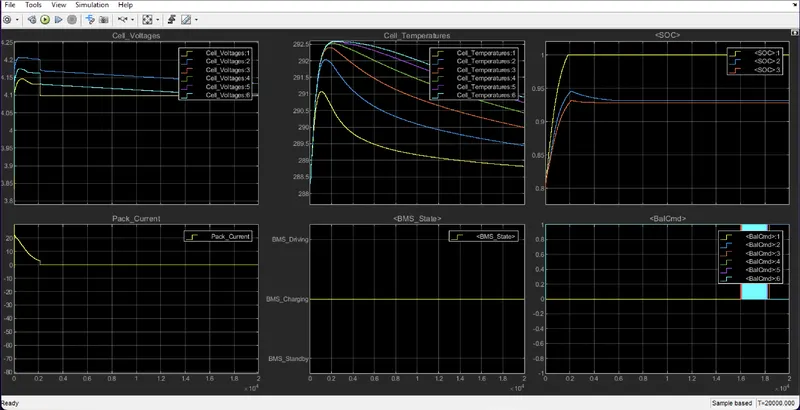
here we can see that the SOC had reached 100% when in the charing state and reamin same state for rest of the other time
So the temperature of the battery pack aslo reduced in the standing by mode
2.What is coulomb counting? Refer to the above model and explain how BMS implements coulomb counting for SOC estimation ?
The Coulomb counting method measures the discharging current of a battery and integrates the discharging current over time in order to estimate SOC. Coulomb counting method is done to estimate the SOC(t) , which is estimated from the discharging current,I(t) , and previously estimated SOC values,SOC(t-1). But there are several factors that affect the accuracy of Coulomb counting method including temperature, battery history, discharge current, and cycle life

The “coulomb counting” or CoulCount method was developed by Schmitt et al. as a heuristic method, although the underlying theory is reasonably accessible . It depends on the recording of the current noise only. The signal is filtered with a high-pass filter with a cut-off frequency of 0.01 Hz. The filter may be either analogue (although the implementation of a good-quality 0.01 Hz analogue filter is difficult) or digital. The absolute value of the measured current samples is then summed over time. A steep slope is taken as an indication of rapid corrosion, although it is not possible to calibrate this in terms of an estimated corrosion rate.
SOC estimation in BMS :
To improve the Coulomb counting method, a new technique called modified Coulomb counting method is proposed. The modified Coulomb counting method uses the corrected current to improve the accuracy of estimation. The corrected current is the function of discharging current. There is a quadratic relationship between the corrected current and discharging current of battery. By practice of experimental data.
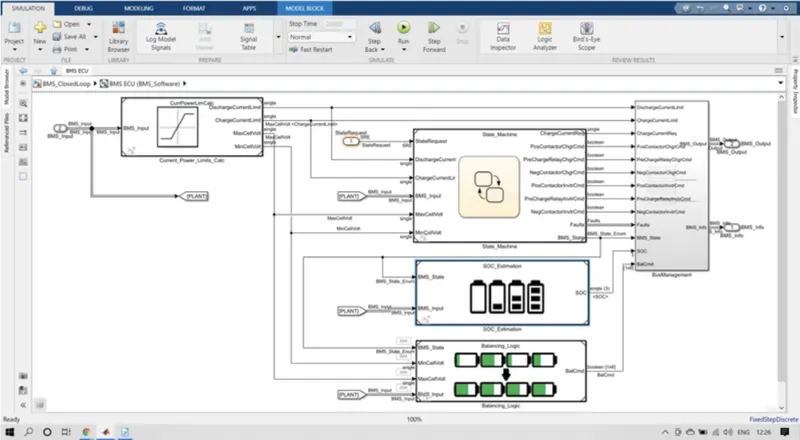
To see the model of coulomb counting technique in BMS model click the subsystem of SOC_Estimation and click Coulomb counting.
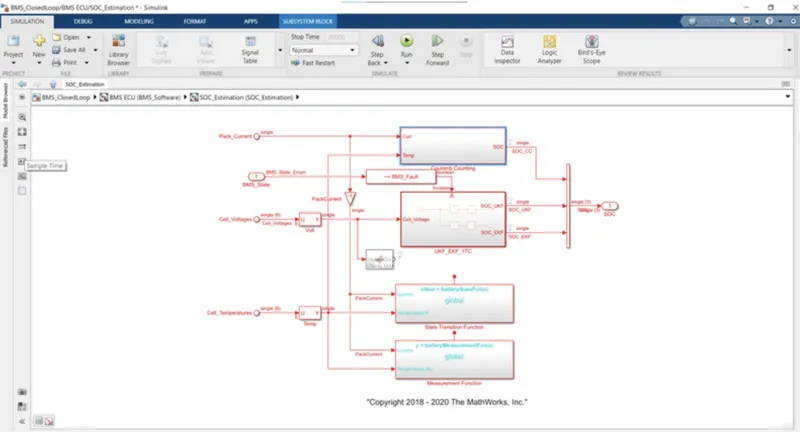
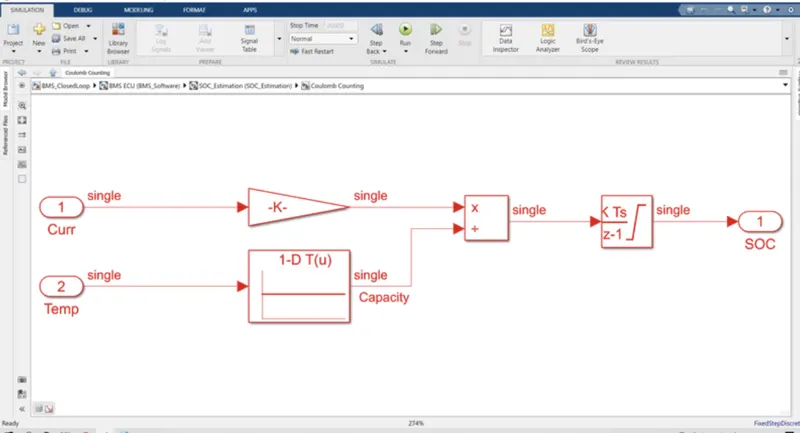
In the coulomb counting model, the pack current and temperature are the inputs for this model. The pack current is fed to the gain block with the vlue of 1/3600 to convert current in to Amph hours. The temperature is fed to the 1-D lookup table to give the inputs to divide block from the temperature input block. The Amph hour pack current and temperature get divided in the devide block and the output from the devide block is connceted to the Discrete- time integrator block to integrate the devided current and temperature signals.
The current is divided by the capacity due to temperature change and then intregrated with the gain value of -1 wo=ith sample time of -1 as discrete type integrator is used here.
The saturation limits are given which are 1 to 0. So that we get the SOC value from 0 to 1 multiplied with 100 to get percentage of SOC.
This Coulomb Counting methos is simple and require less computational compared to other two methods.