Week 7 State of charge estimation
Aim:
To explain What is coulomb counting, and to elaborate How BMS implements coulomb counting for SOC estimation
Procedure:
What is Coulumb counting:
* The coulumb counting method measures the discharging current of a battery and integrates the discharging current of a battery and integrates the discharging current over time in order to estimate SOC.
* The SOC is expressed as ratio of available capacity to the nominal capacity.
* The Common equation for calculating SOC is given, where SOC0 represents the initial SOC, bat-1 represents the curent across the battery and Q-rated is the nominal capacity of the battery.
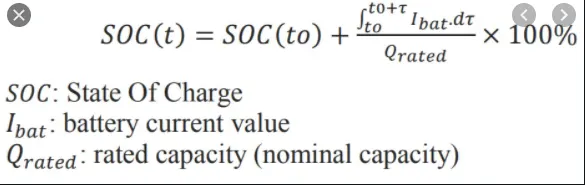
* But there are several factors which may affect the accuracy of the Coulumb counting are the access to the initial SOC is not agreed.
* The selfcharge may distort the real SOC value after a long shortage period and finally the reference capacity Q-rated must be updated in terms of battery ageing.
* The SOC estimation is performed by varying ambient temperature which is taken into an account, including temperature, battery, history, discharge current and cycle life.
Initial SOC determination:
* The OCV-SOC function relates open circuit voltage to its corresponding SOC value.
* This curve is actually determined experimentally by the OCV test by applying pulse load on the Li-ion battery, then the battery reach an equillibriumwhere the voltage is extracted in every 5% of Depth of Voltage.
* SOC from the initial OCV for that we consider the inverse function noted SOC-OCV relationship of Li-ion battery which can be approximated to piecewise linear curve.
SOC = f(OCV) = a*OCV-b
Charge mode:
* The typical charge procedure of a Li-ion battery consists of constant-current constant voltage process.
* The coulumb Counter is there and Q-gain represents the quantity of the charge accumulated during an operating period equal to 𝜏.
Q-gain = (t + 𝜏) = Q-gain(t) + ΔQ
* Thus the variation of the state of charge gained in this same operating period is obtained by the Eq.
ΔSOC(t + 𝜏) = (Q-gain(t + 𝜏)/Q-rated)*100
* By accumulating the preious state of charge indication and the obtained one, we can have the instantaneous value of SOC is obtained using below equation.
ΔSOC(t + 𝜏) = SOC(t) + ΔSOC(t + 𝜏)
* The value of DOD is updated in every charging operation in order to get it back in every switching to discharging mode.
SOC(t) + DOD(t) = 100%
Discharge Mode:
* if the battery is negative, then the battery is in discharging mode.
* In this mode, the coloumb counter is represented by Q-lost, means the amount of charges losses in the operating period 𝜏.
Q-lost = (t + 𝜏) = Q-lost(t) + ΔQ
Thr ==e value of DOD is calculated according to Eq below
DOD(t + 𝜏) = DOD(t) + ΔDOD(t + 𝜏)
ΔDOD(t + 𝜏) = (Q-gain(t + 𝜏)/Q-rated)*100
Self Discharge Mode:
* At the battery shortage periods, considering that Li-ion batteries reach 5% rate of self-discharge per month, the amount of charge losses per hour is calculated; the amount is designed by the constant,q per hour.
* Then the quantity of the charge dissipated in this phase Qoc is calculated by Eq representing the cumulative losses during the storage hours.
Qoc(h+1) = Qoc(h)+q(per hour)
* This value is added to the amount of charges lost Q-lost during the discharge mode and subtracted from the amount of charge accumulated Q-gain in the charge mode as expressed
Q-lost = Q-lost + Qoc
Q-tot = Q-tot - Qoc
* This compensation of self discharging loss is made at each open circuit period and before switching to another battery's mode.
Temperature Monitoring:
* Different studies have highlighted that the temperature has an important effect on the battery and behaviour and at low values the released capacity from the battery decreases dramatically.
* At the initial SOC determination phase, we are considering the effect on the temperature variation for range 5-15 degC.
Implementation in BMS:
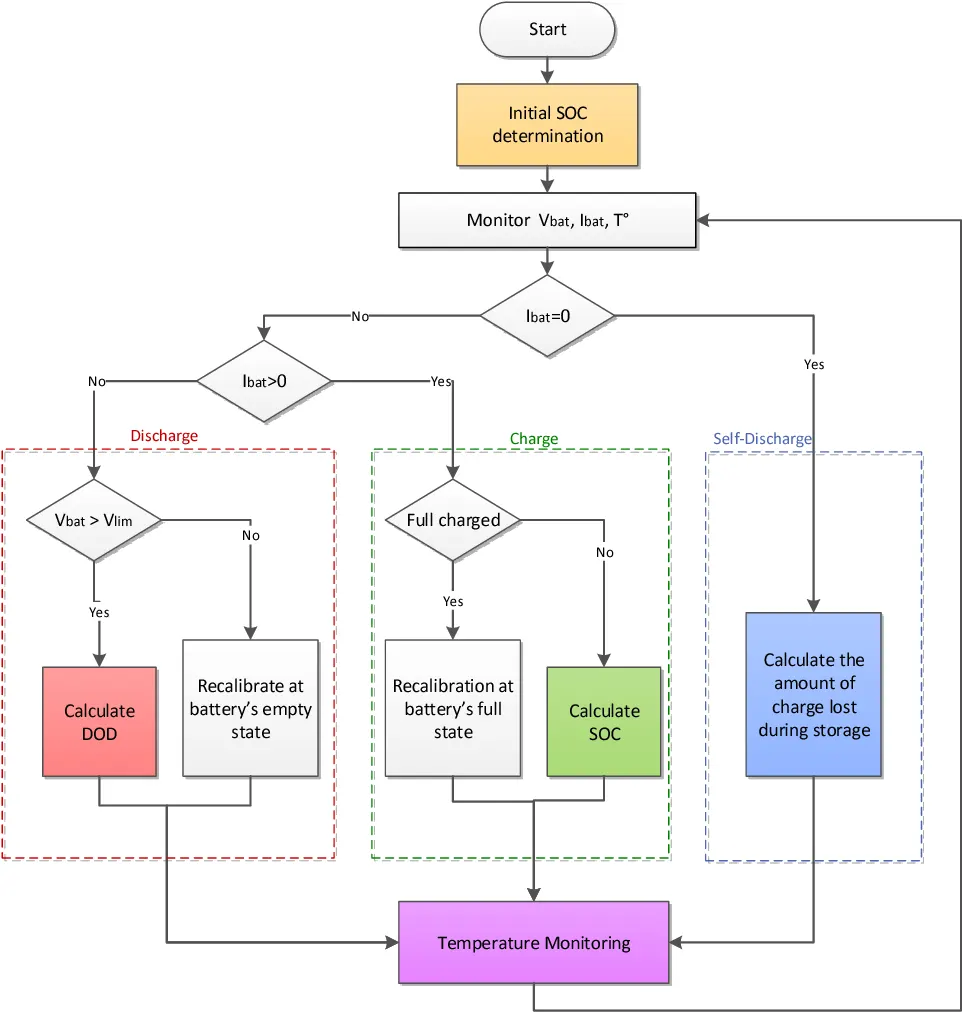
* Coulumb counting method can be implanted in BMS with a suitable algorithm. The following chart gives the general idea how SOC estimation is going to work.
* This algorithm can be implemented with state machine in SIMULINK, which can be further uploaded in flesh memory of BMS hardware.
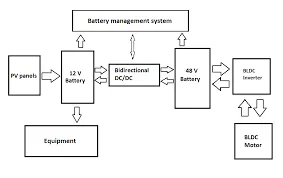
* In this given model, the SOC is estimated with different methods, namely KALMAN FILTER and COULUMB COUNTING.
* Coulumb Counting method is taking pack current values, which shows the variation of capacity with temperature, further values are integreated to estimate charge.
Conclusion:
* The Coulumb Counting has been defined using the formulae and models
* The implementation of BMS for SOC estimation has been done and elaborated.