Week 7 State of charge estimation
BMS system module
Battery management system it is work with the soc, load current, load voltage, short circuit current, over current & over voltae when charge the battery system, lower current and voltage when the discharge condition of the battery module
over current & over voltage condition BMS module
That stages of the over current and voltage level the battery cell going to high temprature, at final of the status battery module are bursted over this cause,in this case BMS module cut of the battery charging connection so the module important for manage the battery with out monitor every time by human it self
That time over charging this type of ubnormal condition happen that lifecycle will reduced
lower current & lower voltage condition BMS module
lower voltage and lower voltage condition that charger circuit will be start agin for charging condition, that indication for requirement of charging
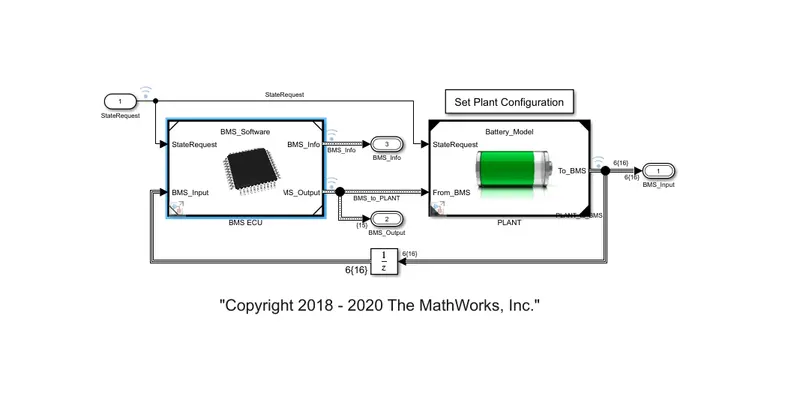
BMS with Plant module
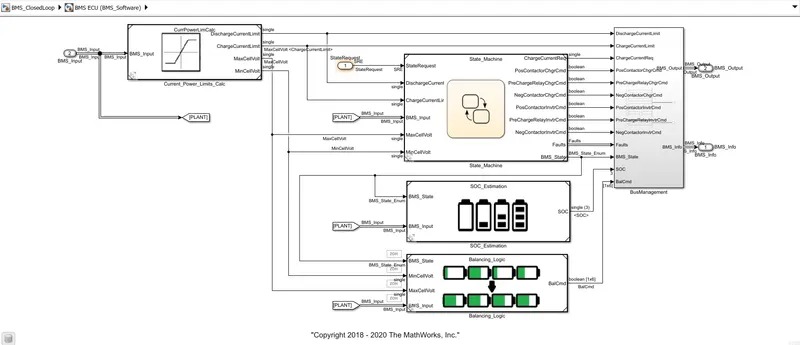
State module
battery temprature state, soc , batty current
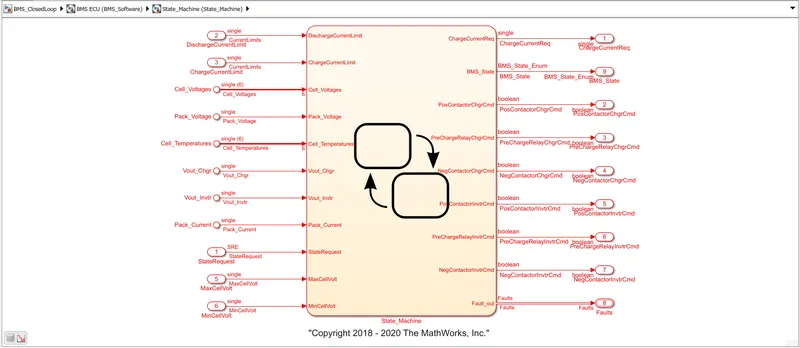
STATE MACHINE module
PLANT DESIGN
loaded motor , charger circuit stae selection for charging and dicharging of the battery pack
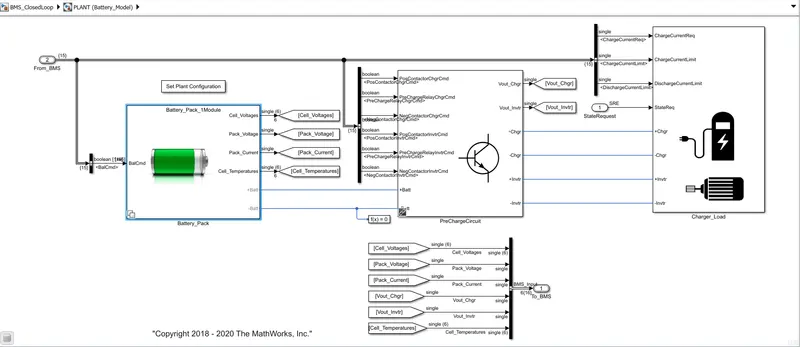
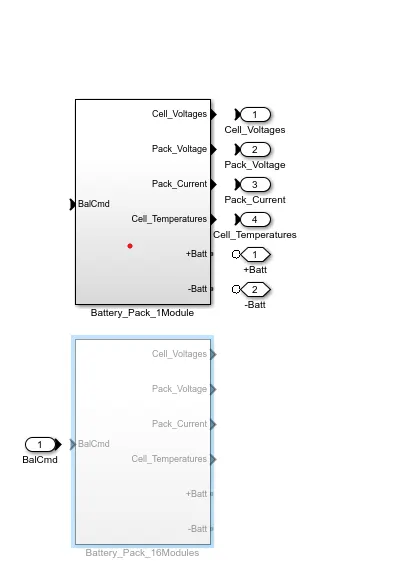
Battery back for two number of module available
16 nos and 96 nos battery pack
HARDNESS TEST STATE MODULATION
STATE 1
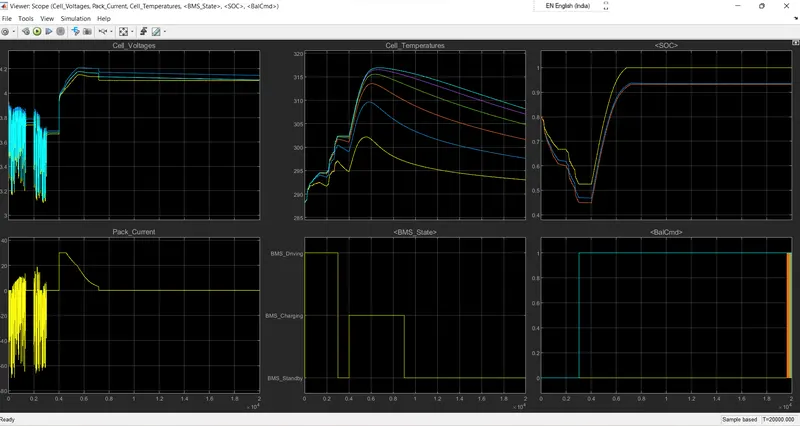
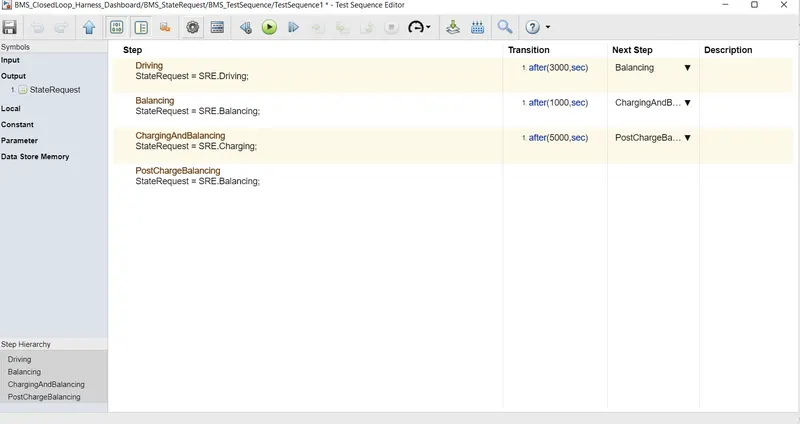
STATE 2
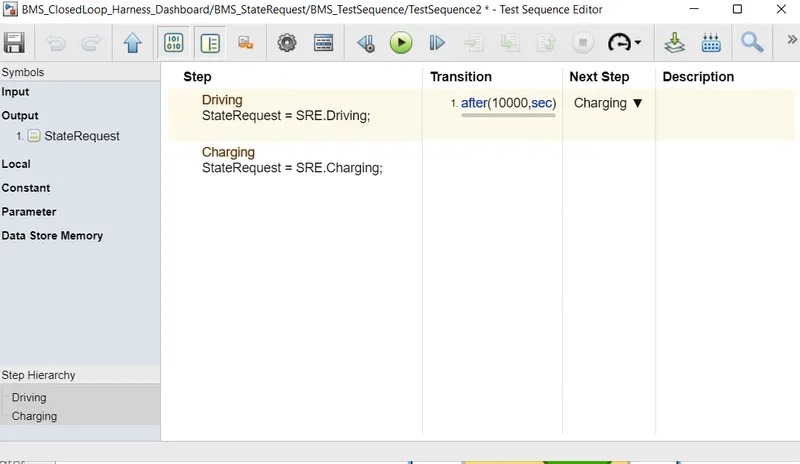
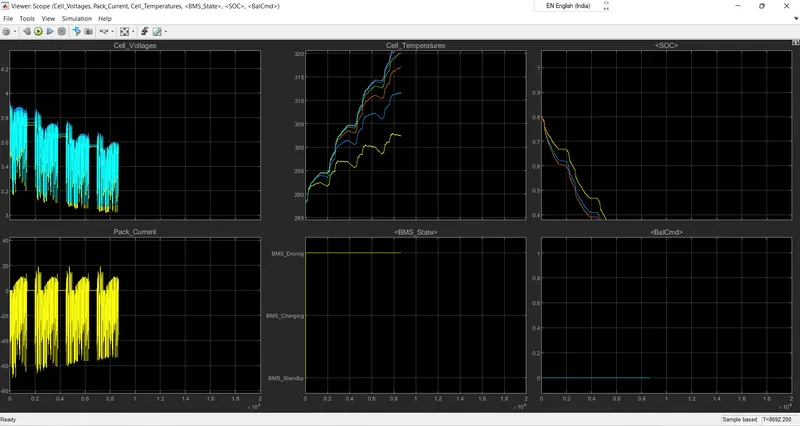
STATE 3
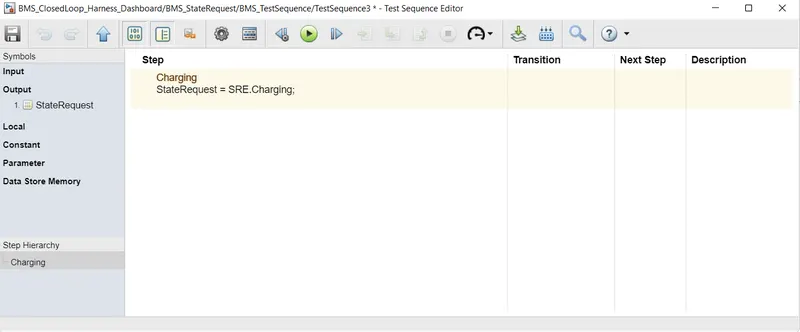
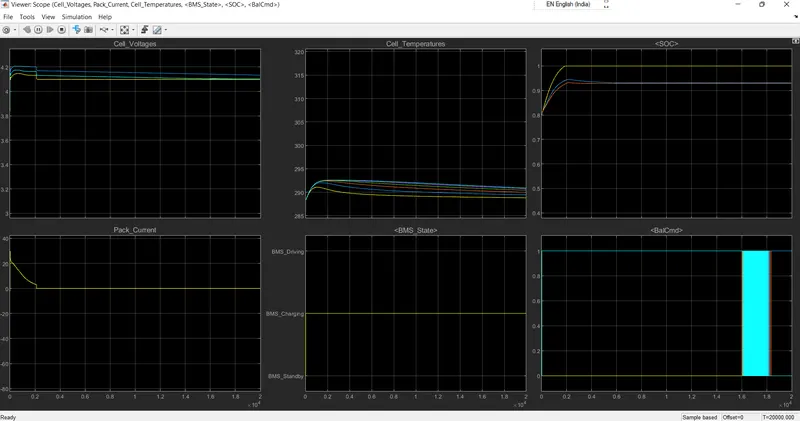
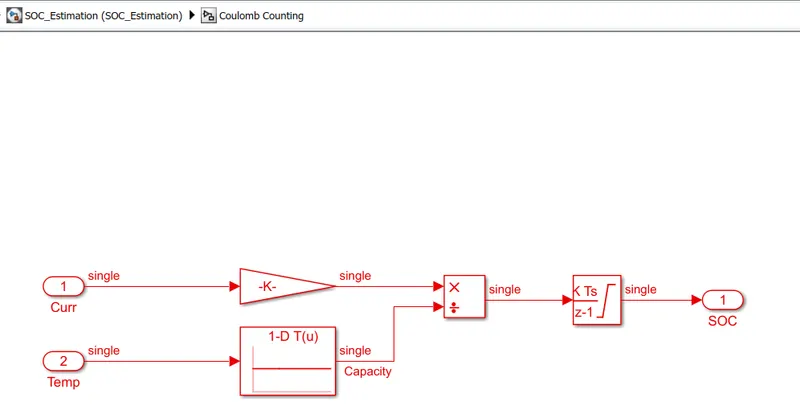
COLUMP CONTING METHOD IN ECU MODULE
State of charge (SoC) is the level of charge of an electric battery relative to its capacity. The units of SoC are percentage points (0% = empty; 100% = full). An alternative form of the same measure is the depth of discharge (DoD), the inverse of SoC (100% = empty; 0% = full). SoC is normally used when discussing the current state of a battery in use, while DoD is most often seen when discussing the lifetime of the battery after repeated use.
Voltage method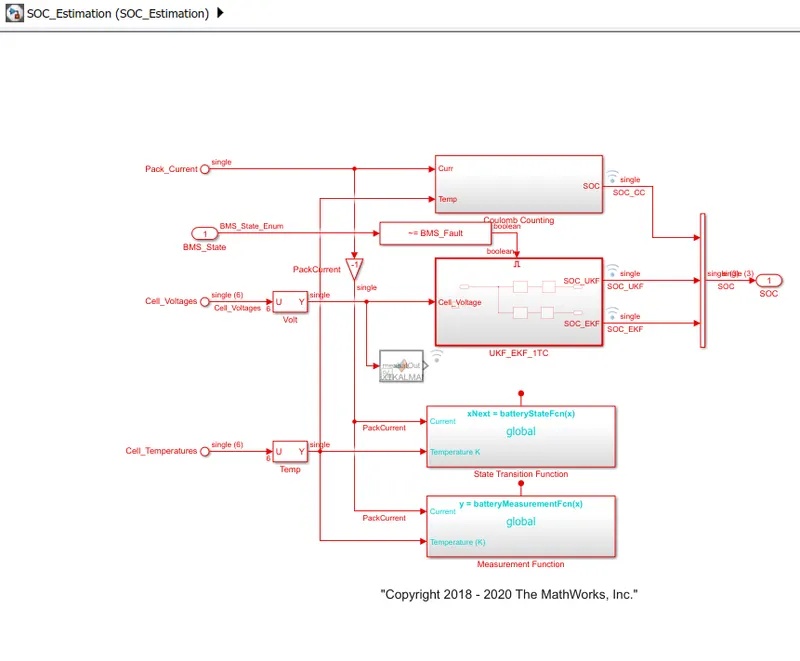
This method converts a reading of the battery voltage to SoC, using the known discharge curve (voltage vs. SoC) of the battery. However, the voltage is more significantly affected by the battery current (due to the battery's electrochemical kinetics) and temperature. This method can be made more accurate by compensating the voltage reading by a correction term proportional to the battery current, and by using a look-up table of battery's open circuit voltage vs. temperature.
In fact, it is a stated goal of battery design to provide a voltage as constant as possible no matter the SoC, which makes this method difficult to apply.
Current integration method
This method, also known as "Coulomb counting", calculates the SoC by measuring the battery current and integrating it in time. Since no measurement can be perfect, this method suffers from long-term drift and lack of a reference point: therefore, the SoC must be re-calibrated on a regular basis, such as by resetting the SoC to 100% when a charger determines that the battery is fully charged (using one of the other methods described here).
Combined approaches
Maxim Integrated touts a combined voltage and charge approach that is claimed superior to either method alone; it is implemented in their ModelGauge m3 series of chips, such as MAX17050,[5][6] which is used in the Nexus 6 and Nexus 9 Android devices.
Kalman filtering
To overcome the shortcomings of the voltage method and the current integration method, a Kalman filter can be used. The battery can be modeled with an electrical model which the Kalman filter will use to predict the over-voltage, due to the current. In combination with coulomb counting, it can make an accurate estimation of the state of charge. The strength of a Kalman filter is that it is able to adjust its trust of the battery voltage and coulomb counting in real time.