Week 7 State of charge estimation
Aim:
1. Simulate the 3 test cases from the harness dashboard and write a detailed report on the results
2. What is coulomb counting? Refer to the above model and explain how BMS implements coulomb counting for SOC estimation?
Solution:
algorithms
Part 1: Simulate the 3 test cases from the harness dashboard and write a detailed report on the results.
The Closed Loop Harness Dashboard model by Mathworks is shown below.
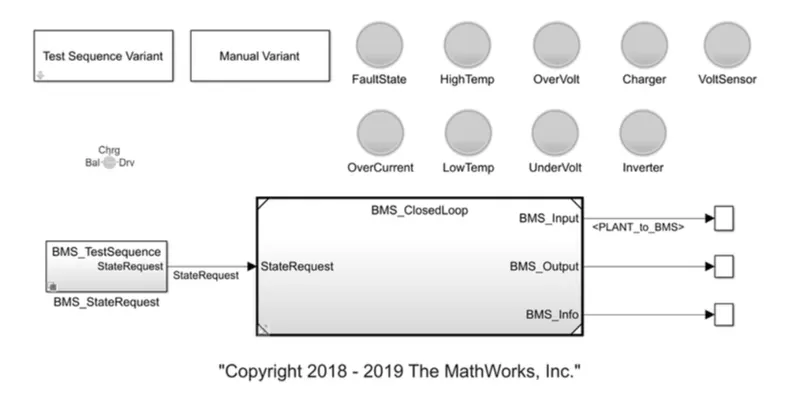
1) Click on the Test Sequence Variant Block and select test case as 1
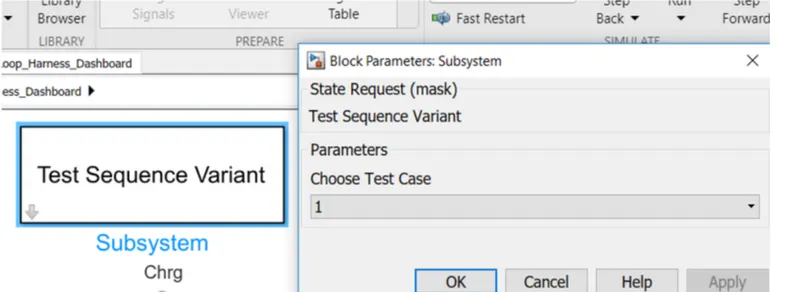
By clicking on BMS block sequence block we get a chart
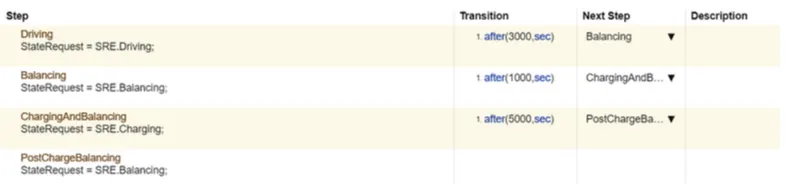
The starting of the simulation indicates the driving mode. After 3000 sec it is in a stand-alone mode. After 1000 sec it will be in charging mode.
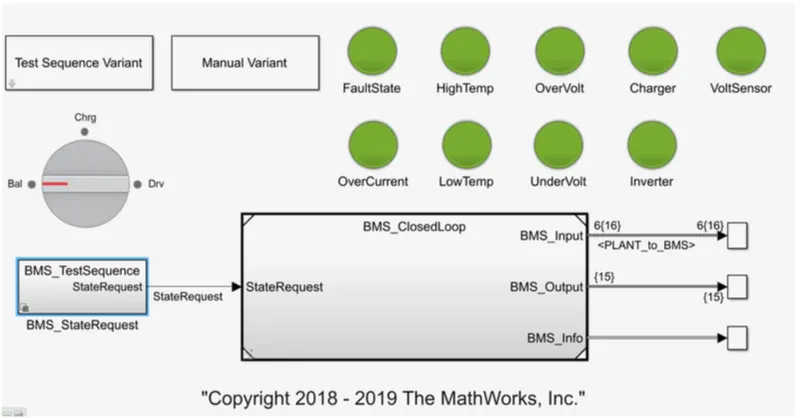
Results:-
All the indicators are green and hence the following graphs are seen
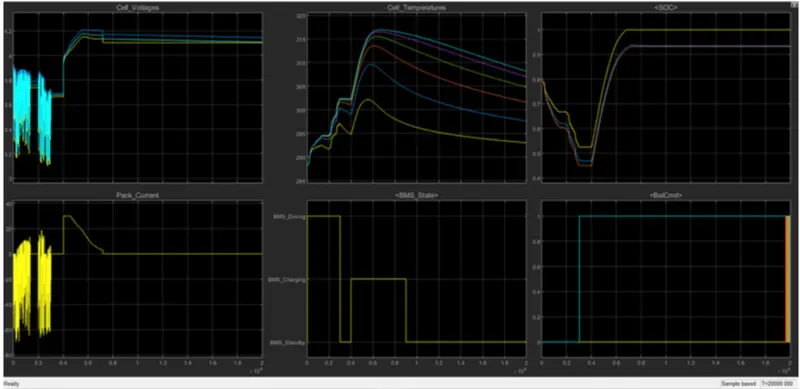
As seen in the plot, charging was completed to 90% when the car was initially in a driving state. It enters standby mode after charging. It can be observed in the BMS state plot. When driving and charging, battery temperature rises. While charging, the battery's voltage rose to 4.2V. The value of current provided to the vehicle while it is moving is displayed on the current plot. SOC reduced while driving by up to 50%, while it increased while charging.
2) Now, try simulating with test case 2
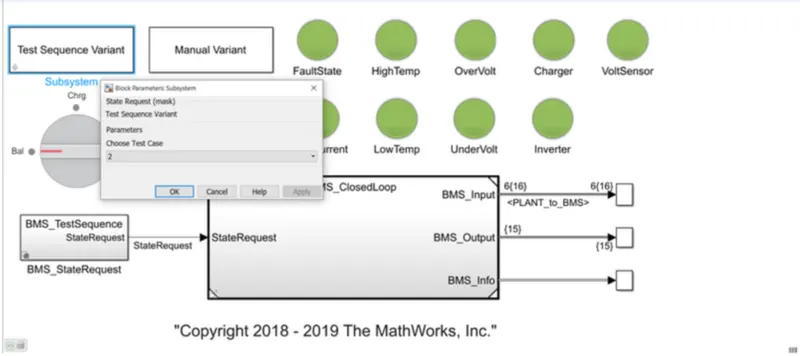
Now, click BMS state request block

The driving state is from 0 to 10000 secs. After that, it will transition to Charging.
Result:
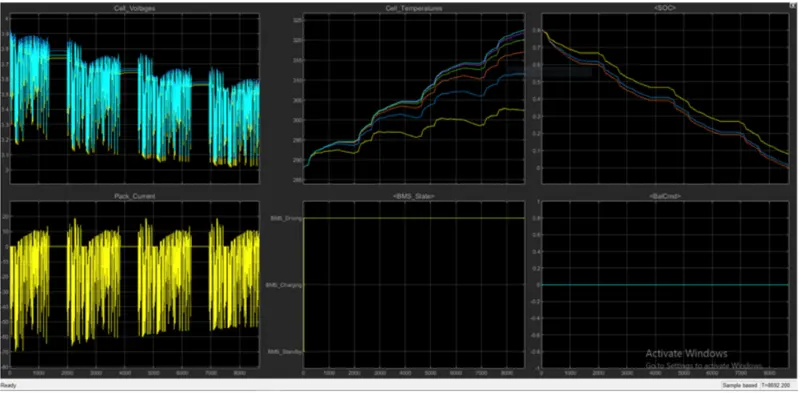
The fault condition has occurred in the second case and that is why the SOC is didn't not increase. It rather decreased.
3) Checking for test case 3
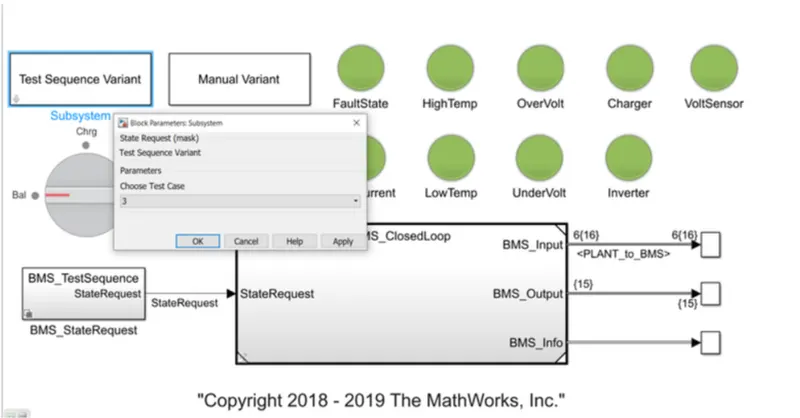

The condition is only charging.
Results:
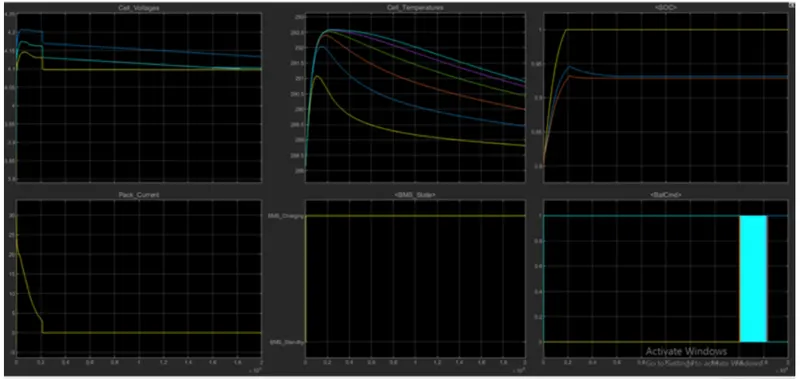
The above graph suggested that a SOC is reached 100%. It reaches a stand-alone mode after some time. The cell temperature also reduced as the system reached to stand alone mode.
------------------------------------------------------------------------------------------------------------
2) What is coulomb counting? Refer to the above model and explain how BMS implements coulomb counting for SOC estimation?
SOC: SOC refers to a battery's state of charge. SOC is a measurement of the remaining energy in a battery in relation to the total amount of energy present when the battery is fully charged. A user can assess how much energy he can extract from a battery at a given moment by using SOC to help him decide whether to charge the battery or cease charging.
There is no direct way to compute SOC for a Li-ion battery, but there are a few different methods we can use with some additional information. The battery voltage translation method is the simplest way to determine a battery's state of charge (SOC). Although not precise, this method aids in roughly and rapidly calculating SOC and can be applied to devices like power banks where SOC is displayed as a range rather than an exact percentage. For instance, a common power bank displays SOC in the range of 0–25%, 25–50%, 50–75%, and 75%–100%.
Coulomb counting method:
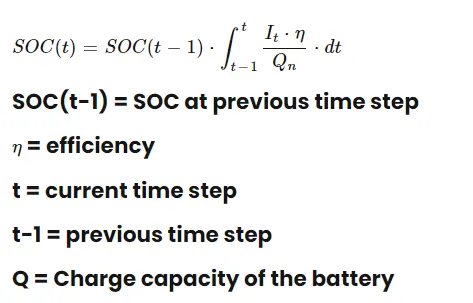
The battery current integration method is another name for the coulomb counting technique. To determine how much energy is still in the battery using this method, a discharging/charging current I(t) is measured and integrated over time. This approach uses SOC at the previous time step SOC(t-1) and subtracts or adds the energy lost or added at the current time step to the SOC of the previous time step soc(t-) to determine the amount of energy in the battery at the moment.
Using the equation below, the SOC is estimated using the coulomb counting method.
For example, refer to the system model We downloaded
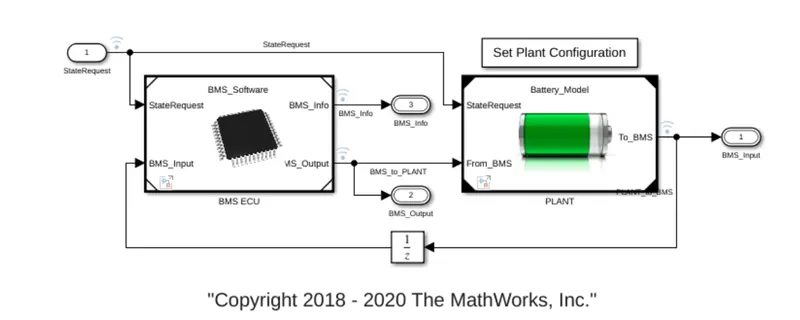
BMS algorithm models, protects, reports the measurement from the battery pack.
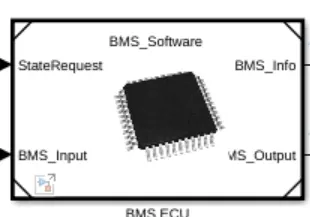
Unmasking BMS ECU we get
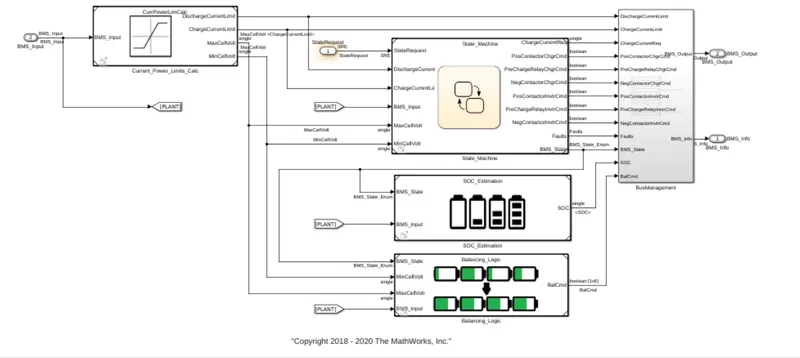
By unmasking the SOC estimator. The subsystem is like
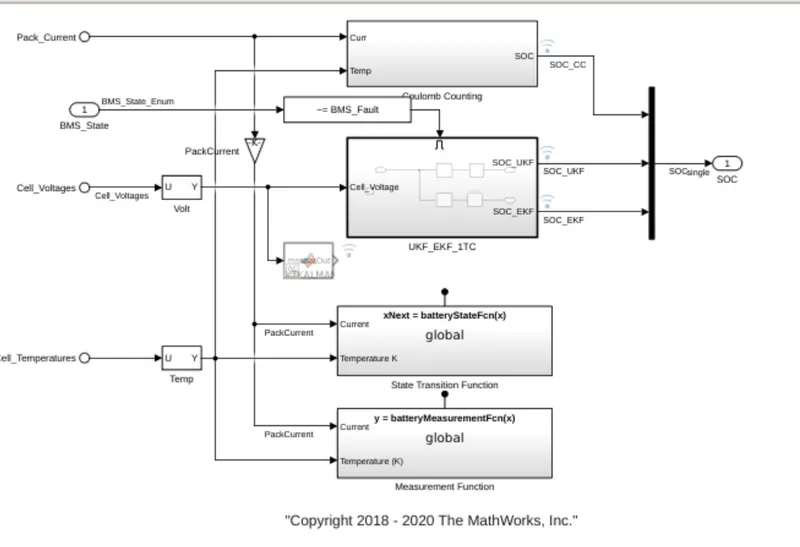
The simulation block model has a column counting block which is as follows
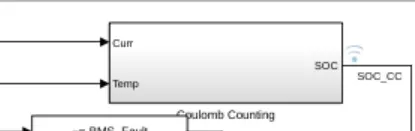
Unmasking the subsystem we have a simulation as follows
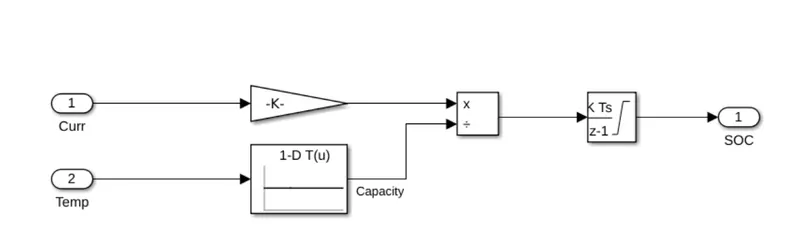
The observations from the above system are:
1. The estimation by the coulomb counting equation is performed by this system.
2. The simplicity and minimal computing cost of the coulomb counting method constitute perks.
3. The battery's current and temperature are provided as inputs.
4. Since it varies with temperature, the current signal is sent to a gain block and temperature is given to capacity.
These inputs are provided for the integration process, which involves integrating current with regard to time.
5. A different block receives this output and divides it out according to capacity.
The SOC would therefore be estimated.