Week 7 State of charge estimation
1.Simulate the 3 test cases from harness dashboard and write a detailed report on the results
1) Evaluation for Balancing mode of BMS :-
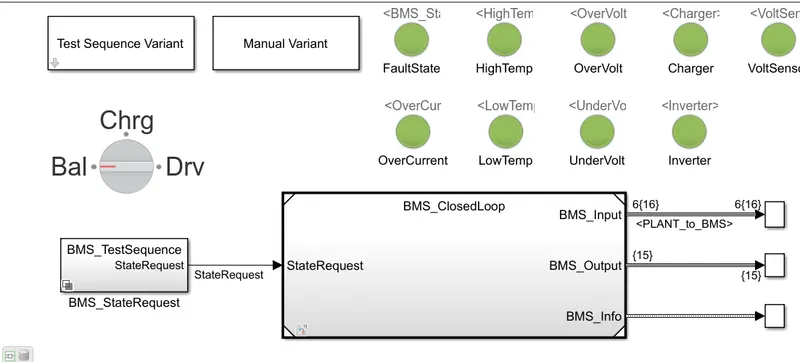
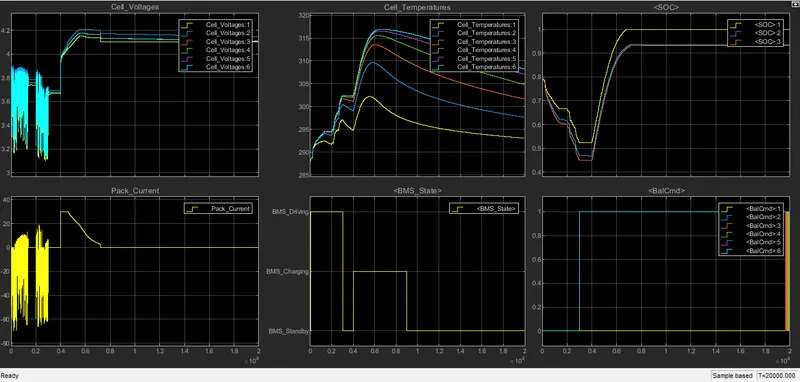
- For 3000 second BMS is run on driving mode. Due to that volage is fluctuating between 3.1V to 3.9V with high frequency.
- As voltage is drop current is also fluctuationg. And system is also charging during driving cycle which is known from negative ampere. Due to driving cell temprature increase gradually and SOC is decreasing. During this cycle BMS is not balancing the cells so balancing command is 0 because all cells are balanced.
- At 3000 to 4000 second BMS is go at standby. So, voltage, SOC and current being stable. But cell 1 has lowest voltage and crate imbalancing so balancing command being 1 for cell 1 and 0 for others.
- From 4000 to 9000 second BMS run on charging state. In this stage voltage and current shows sudden increament in value. In this also cell is getting heated due to charging and temprature is hiking. SOC is also going high. As shown pack current is getting lower afer sudden hike because of constant voltage balancing and become stable.
- After 9000 to 20000 second, BMS again go in standby mode. So, voltage current and SOC become stable because no input and output driven to battery. Due to this no working cell temprature isdecreasing slowly. At last few second of end of cycle every cell balancing command is activaed for balancing at same value to 1. And battery is becoming balanced.
2) Evaluation for Driving mode of BMS :-
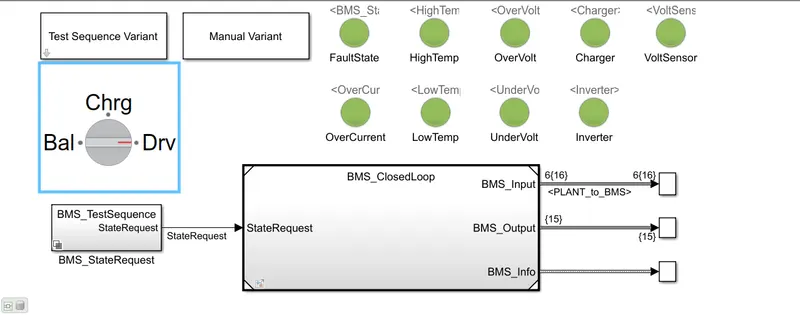
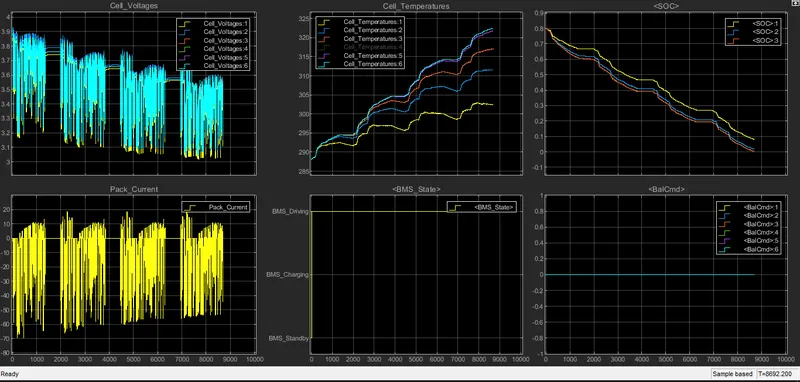
- In this test sequance, BMS is run on driving mode till 8962 second.
- During this cycle voltage i dropping and increase with very high frequency due to charging and dicharging during driving cycle.
- A shown in figure ampere i also fluctuating above and below 0 which shows charging and discharging ampere.
- Due to this kind of usage and fluctuation battery cell resistance in increase which reult in higher temprature of cell.
- SOC is decresing continuously 0.
- Inbetween this cycle BMS command is not activated for any cell which means every cells are in balanced condition.
- After 8962 second BMS ystem goes in charging state. But due to any fault it is not charging the cell. So, current and SOC becomes constant at 0 value. While volage is getting value of cutoff voltage. Due to not working system, temprature is getting loss by the time and cell temprature is decreased.
3) Evaluation for Driving mode of BMS :-
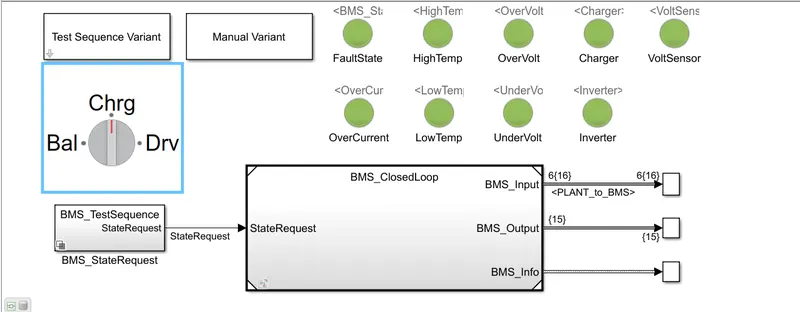
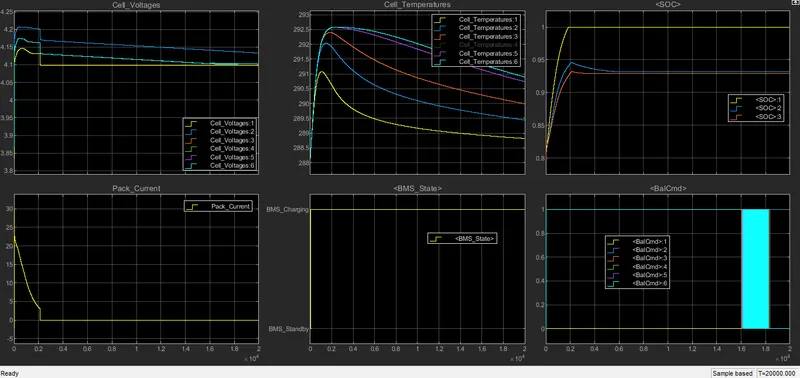
- In this mode, BMS run for 20000 econd on charging mode.
- In this cycle, voltage is increased sudden to peak value from there it is decrease gradually to nominal voltage and become stable.
- While in ampere, it increased suddenly but decreased gradually to become zero because charging is done on constant volatage.
- Due to sudden charging condition application cell temprature is increased but after getting voltage and current stability temprature is start decreasing.
- As shown in figure SOC is increasing and become full at value of 1.
- During this charging, there is need to balancing. So, balancing command is become on off for perticular cell if cell is become weaker compare to other or may show any difference.
So, like this these three case are working.
2.What is coulomb counting? Refer to the above model and explain how BMS implements coulomb counting for SOC estimation ?
SoC Estimation by Coulomb Counting is based on the measurement of the current and integration of that current over time.
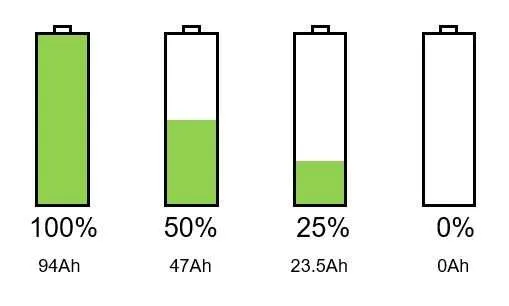
The State of charge (SoC) of a battery cell is required to maintain it’s safe operation and lifetime during charge, discharge and storage. However, SoC cannot be measured directly and is estimated from other measurements and known parameters. This leads to errors in the estimated SoC and that means it is not possible to fully exploit the full capability of the cell.
Coulomb counting gives a relative change in SoC and not an absolute SoC. If you measure the current over a given time step you have a measure of the number of Ah that have left or been received by the battery.
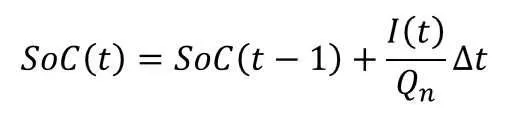
where:
- SoC(t) = estimated State of Charge at time, t
- SoC(t-1) = previous State of Charge at time t-1
- I(t) = charging or discharging current at time, t
- Qn = battery cell capacity
- Δt = time step between t-1 and t
If you know the absolute SoC you need to know the starting SoC of the cell, SoC(t-1) as given in the equation. One option is to fully charge the cell to a known voltage. Charging to maximum cell voltage and SoC can be used as a reset and known point.
There are a number of sources of error with the coulomb counting method:
- Starting SoC accuracy
- Current measurement accuracy
- Current integration error
- Uncertainty in battery capacity
- Timing error
In order to define the accuracy you need it is important that you firstly look at what the SoC is used for.
- capacity of the cell that is remaining (fuel gauge on your phone or electric vehicle)
- an input to estimate the available charge and discharge power capability of the battery
- used in the calculation of State of Health
The accuracy required for these values will determine the accuracy that is required for the inputs to the SoC algorithm. This will impact the selection of:
- components for cell voltage measurement
- voltage sense wires, connectors and connection locations
- current sensor or sensors
- voltage and current measurement channel accuracy
- timing circuit
The references below give a good overview of the errors associated with Coulomb Counting along with methods to improve them.
In this model below algorithm is used.
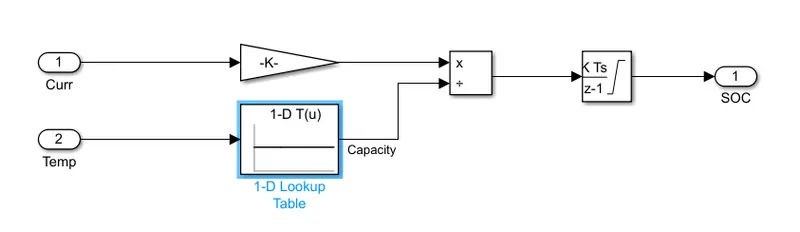
- It gets value of current and convert it into Ah by dividing 3600 in gain block.
- Also it receive value of temprature and make one dimensional look up table.
- Then both value go in divide block where current is divided by value of temprature.
- Now it is discrete intterpolation and get SOC value with respect to time.
So, like this coulomb counting is working.