Week 7 State of charge estimation
Battery managment system-
It's one of the most important factor that plays an important role in the battery as it's decide how much should my overvoltage and undervoltage and overcurrent and undercurrent and this helps and how much should be battery temperature be and there are many other factors which are taken care it helps to decide indiviual voltage and current of each indiviual cell.
if there was no battery managment system it would have been difficult to manage each cell of the battery.
So to study in brief about battery managment model-
After downloading the above extract the file and open it in the simulnk,then click on the test and bms algorithim option-
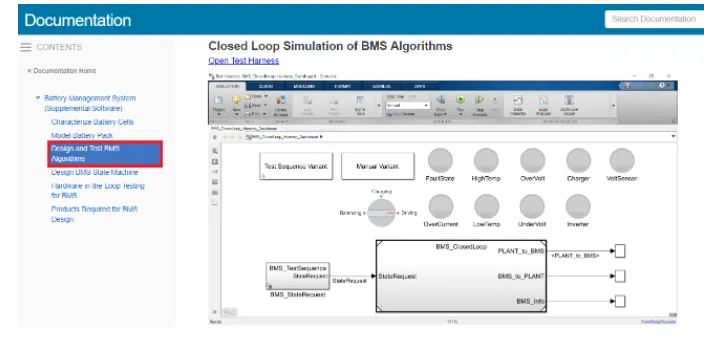
after opening click on the bms and closed harness dashboard and after this click on the matlab window and select bms system.

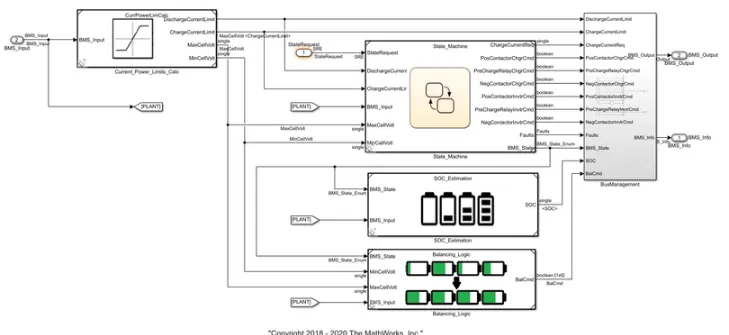
it hass two models in it one is bms ecu and the other one is plant,the control algorithims are both inside the plant and there are two types of choices one is 6s-1p and the other one is 96s-1p.
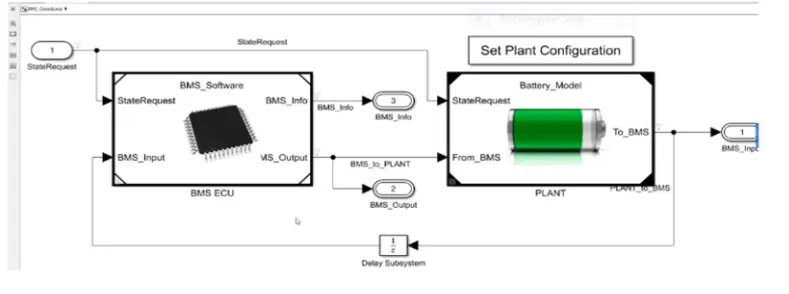
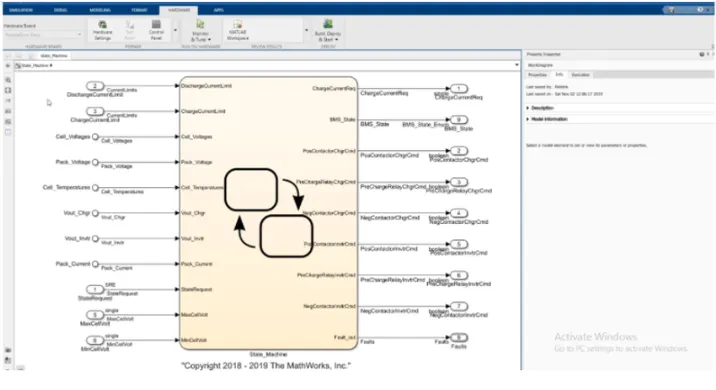
click on the bms ecu and select on state machine.state machine is the main operating state of machine and it has four state and all these states can't be active at the same time
the four states consist of -
1)the first one consist of variabe bms_state which have standby driving and charging mode, and charging cosnsist of constant current and voltage.
2)the second one switches on the fault state where there is increase in voltage current and temperature.
3)the third an fourth consist consist contractor on and off mode this is needed for the excessively large current at the beginning stage.
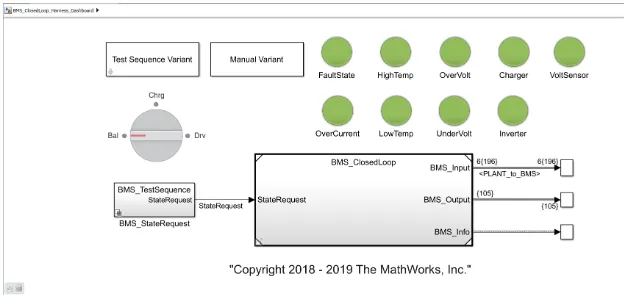
after all this click on harness state on the matlab after this harness dashboard gets open which has three different cases and with the help of this we can select the test which we want to carry on and by this well get to know the default system.
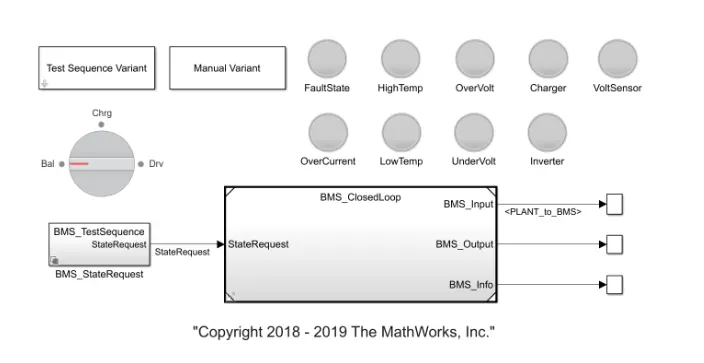
After this we are going back to documentation and are going to select the run and simulate and we are going to select the test case 1-
and before we have to select the test sequence and after selecting the test sequence and let's see what have we got the first test-
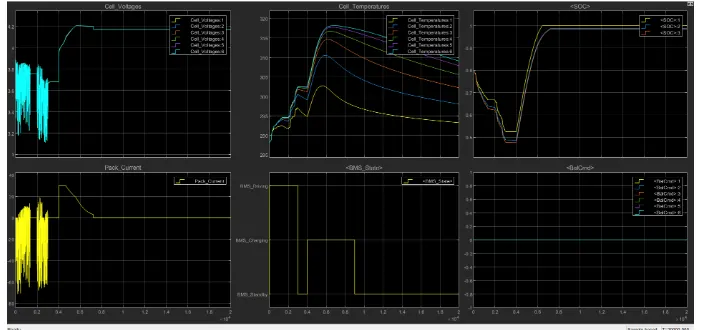
the soc will increase because it's in the driving state,right after three thousand second it's in balancing mode and the vehicle is in stand by condition after 1000 seconds it's in charging where soc of the battery has been increased to 100 perrcent and after that there is post charging mode which is called stand by mode.
according to bms state we can see that it goes driving state and then charging mode where it's soc has been increased to 90 percent and the volt has been increased to 4.2v.
the cells temperature has been increased during charging and driving mode and the in stand by mode there is decrease in temperature.
the soc of the battery has been decreased in driving to around 50 percent and then later it's increased to 100 percent during charging.
test-2
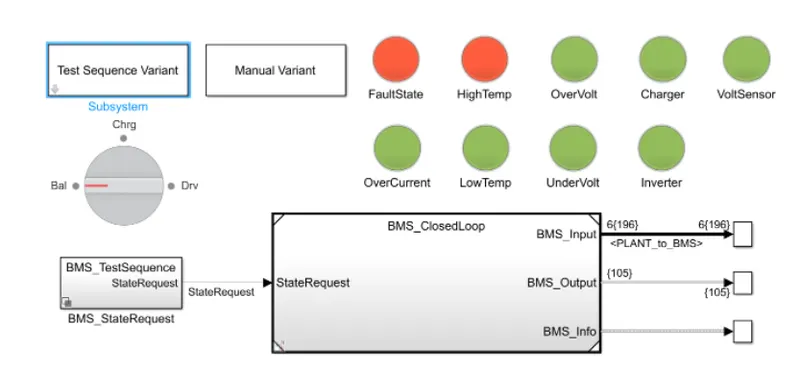
In this case we can see that there is fault in the system and it's detected by the bms and there has been increase in temperature. And it has two cases charging and driving phase.
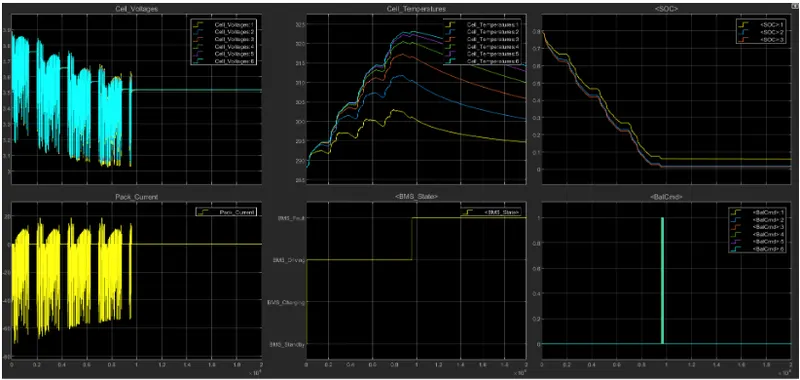
And this runs for 10000 seconds though there is charging phase but there is not increase in soc becuase fault is test case 2.
tets case 3
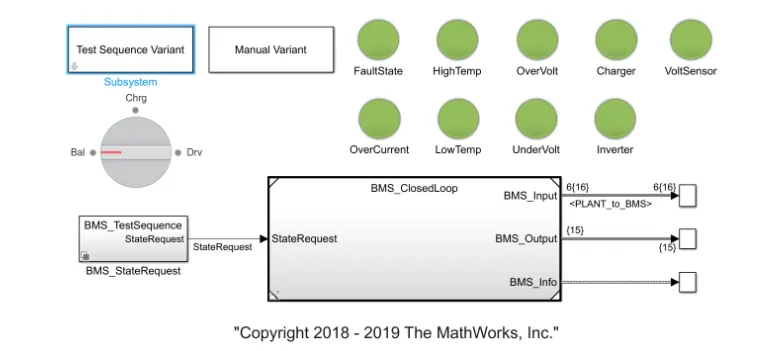
in this test case only single phase is there and that is charging and soc is increasedfrom 80 to 100 percent.
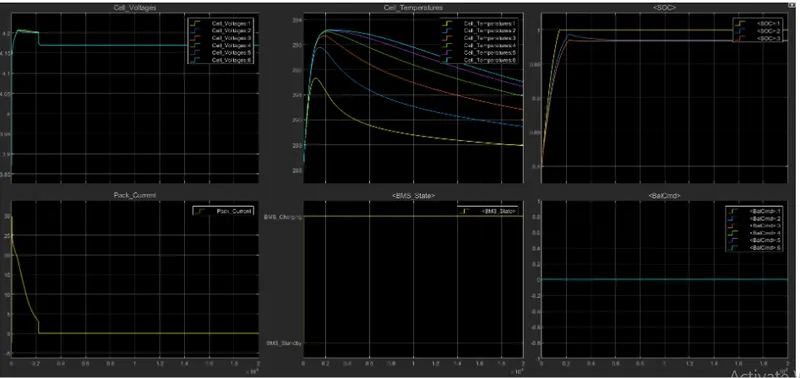
What is coulomb counting? Refer to the above model and explain how BMS implements coulomb counting for SOC estimation ?
Coulumb counting-
It is a method used for estimating the state of charge (SOC) of a battery. The coulomb counting method is expedient for state-of-charge (SOC) estimation of lithium-ion batteries with high charging and discharging efficiencies. The charging and discharging characteristics are investigated and reveal that the coulomb counting method is convenient and accurate for estimating the SOC of lithium-ion batteries. The Coulomb counting method measures the discharging current of a battery and integrates the discharging current over time in order to estimate SOC. Coulomb counting method is done to estimate the soc (t), which is estimated from the discharging current, I(t) , and previously estimated SOC values, SOC(t-1). SOC is calculated by the following equation:
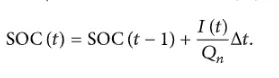
but the problem with the above equation is that it dosen't account the temperature the life cycle of the batter, the discharge current, the battery history and the cycle life to account all this new formulae has been derived which takes all this into consideration.
The modified current and soc formulae are updated as-

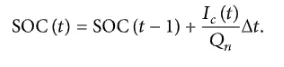
for this model click on bms ecu and select on soc estimation sub system-
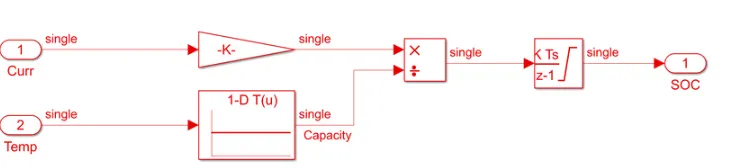
in this temp and current are given as the input and temp is current to capacity since it varies with temp and current is given to gain block,This inputs are given for integeration where current will be integerated with respected to time,this out put is given to another block and this divides by the capacity which results is soc estimation.