Week 7 State of charge estimation
SOLUTION 1.
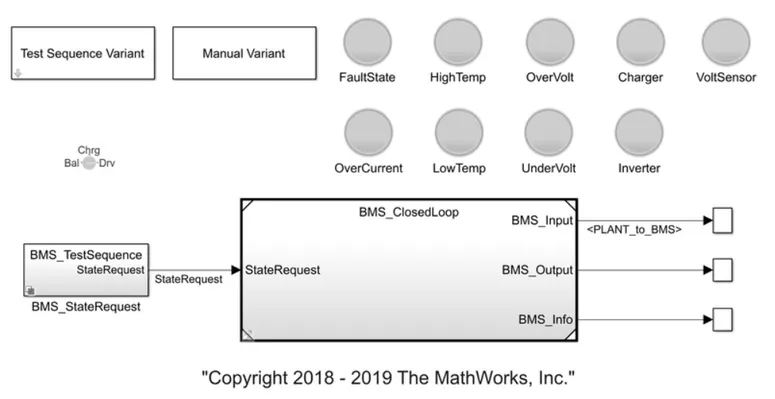
Now we have to simulate 3 test cases from the harness dashboard. We used to select the harness from the project file which we downloaded with the reference link. The battery model harness dashboard is represented below.
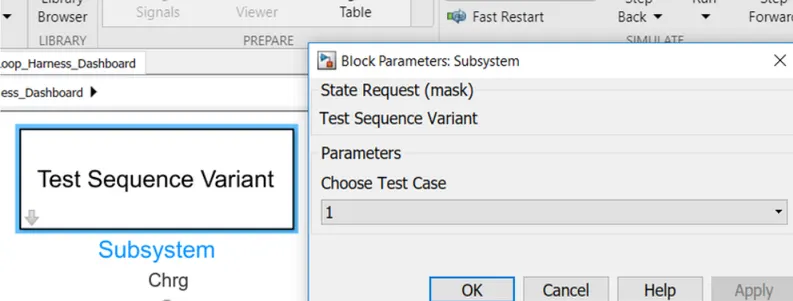
Click on the Test Sequence Variant Block and select test case as 1
Now by clicking on the BMS sequence block we get the chart
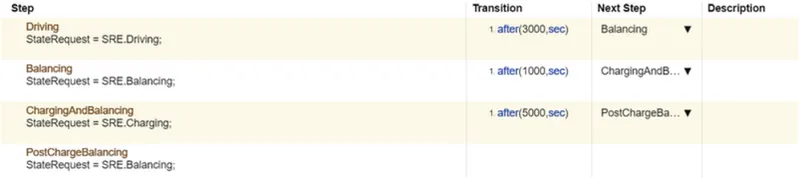
When simulation will start, the model will be in driving condition. After 3000 seconds it will be in standby mode and after 1000 seconds it will be in charging mode. Now by running the simulation
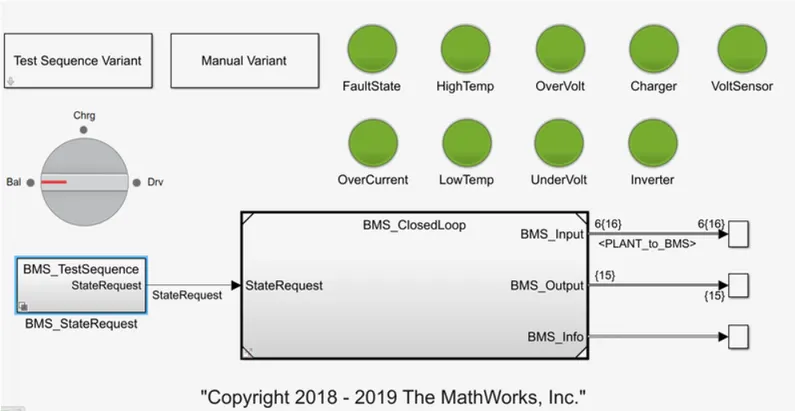
RESULT:-
Here all the indicators are green, So NO ERROR & Also we can check the plot.
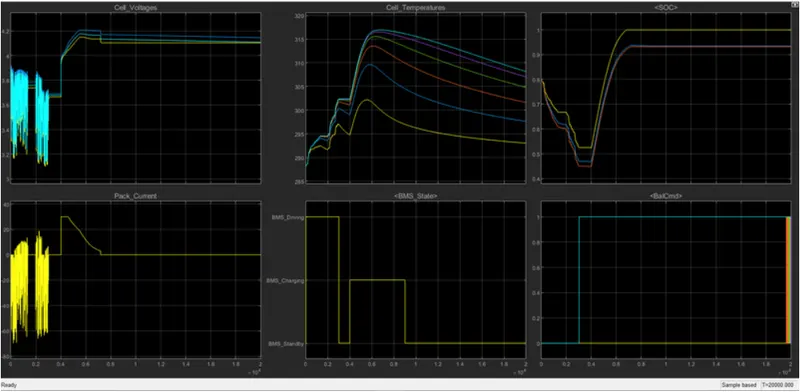
From the plot we can say the vehicle was initially in a driving state and charging was done till 90%. After charging it reaches standby mode. It can be seen in BMS state plot. The battery temperature increases in driving and charging. Battery voltage was increased to 4.2V while charging current plot shows the value of current supplied to the vehicle while driving SOC decreased up to 50% in driving condition & it was increased while charging.
2)Now change the test sequence variant in case 2nd.
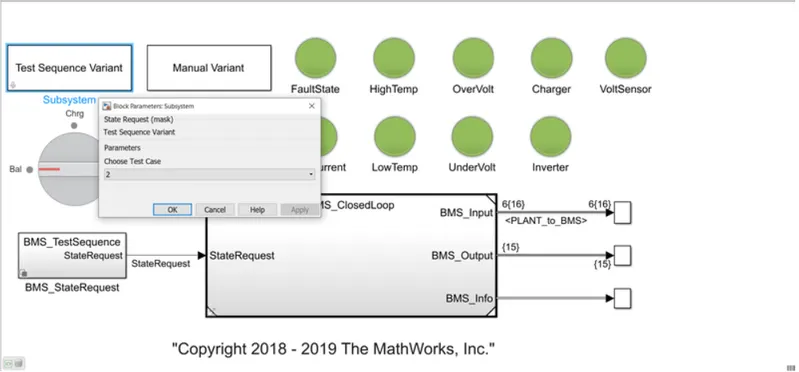
Now by clicking on the BMS state request block
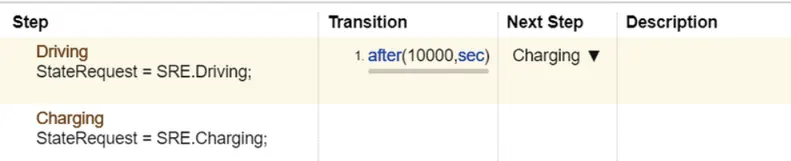
THE DRIVING STAGE IS FOR 0 TO 10000 seconds, then the charging stage occurs.
RESULT:-
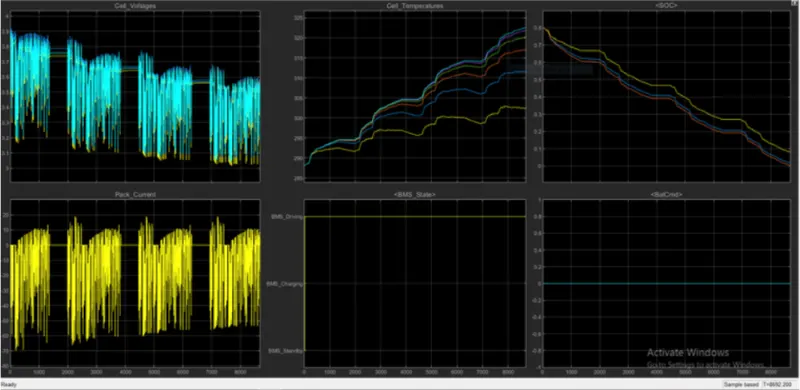
From the graph, a fault condition occurs in the second case. So Even after charging was started, the SOC didn't increase. It continues to decrease.
NOW TEST SEQUENCE VALUE TO 3
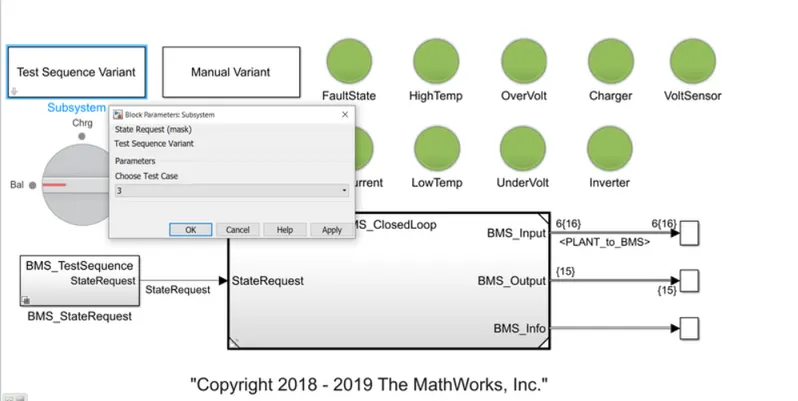
This condition has only one phase that is Charging, Thus 0 to 20000 seconds of simulation runs.
RESULT:-
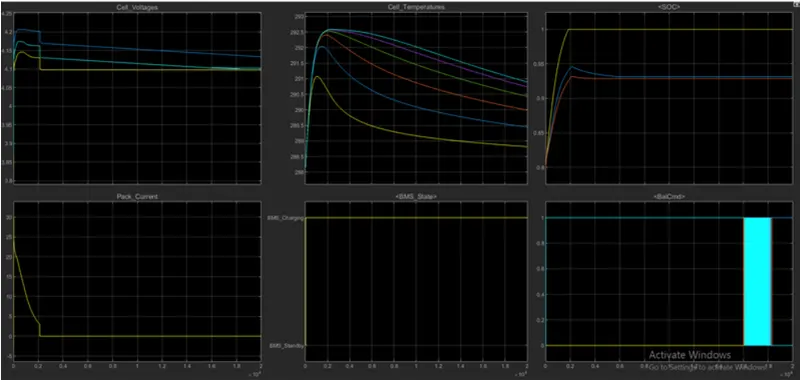
- Here we can see that the SOC reaches 100% in charging and continues to stand by mode. Cell temperature also decreased when standby mode was achieved.
From the 3 cases we observe that only charging takes place thus SOC was 80% at first, then SOC increases to 100% in 2000 seconds then SOC remains Constant at 100%.
SOLUTION 2.
COULOMB COUNTING:-
Coulomb Counting is a technique used to track the state of charge of the battery pack. It works by integrating the active flowing current (measured in amps) over time to derive the total sum of energy entering or leaving the battery pack. This produces a capacity that is typically measured in Amp-hours.
COULOMB COUNTING METHOD:-
The coulomb counting method measures the discharging current of a battery and integrates the discharging current over time in order to estimate SOC.
Coulomb counting method is done to estimate the SOC(t), which is estimated from the discharging current I(t) and previously estimated SOC values SOC (t-1).
SOC is calculated by the following equation:
SOC(t)=SOC(t-1)+(I(t)/Qn)Δt
But there are several factors that affect the accuracy of the coulomb counting method including temperature, battery history, discharge current, and cycle life.
MODIFIED COULOMB COUNTING METHOD:-
To Improve the coulomb counting method, a new technique called the modified Coulomb counting method is proposed. The Modified Coulomb Counting Method uses the corrected current to improve the accuracy of estimation.
The corrected current is the function of Discharging current. There is a Quadratic Relationship between the corrected current and the Discharging current of the battery. The corrected current can be calculated by the following form
Ic(t)=(K2.I(t)^2)+K1.I(t)+K0
Where K1, K2 &K0 are constant values obtained from the practice Experimental data.
In the Modified Coulomb Counting method, SOC is calculated by the following equation.
SOC(t)=SOC(t-1)+(Ic(t)/Qn)Δt
The accuracy of the Modified Coulomb Counting Method is superior to the Conventional Coulomb Counting Method.
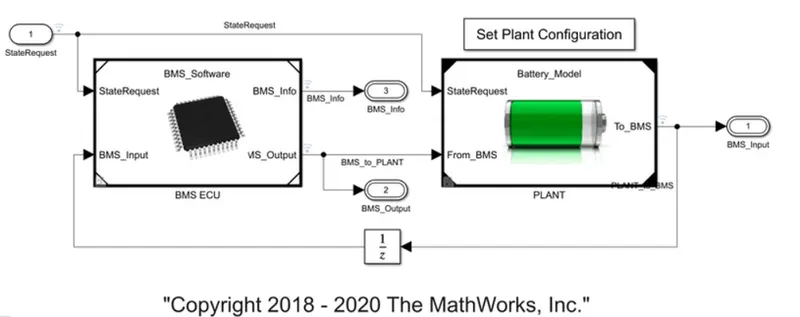
BMS algorithm models, protects, reports the measurements from battery pack.
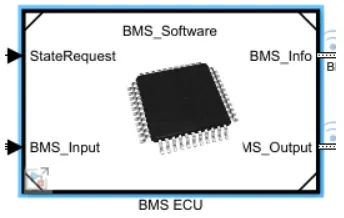
click on the BMS ECU, we get the subsystem
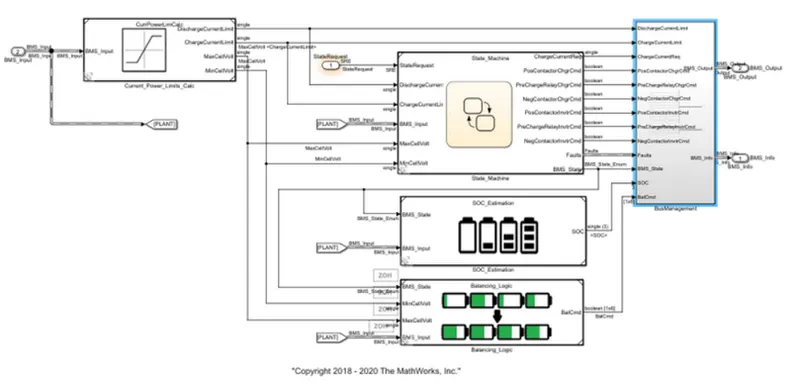
Click on SOC estimation block we get.
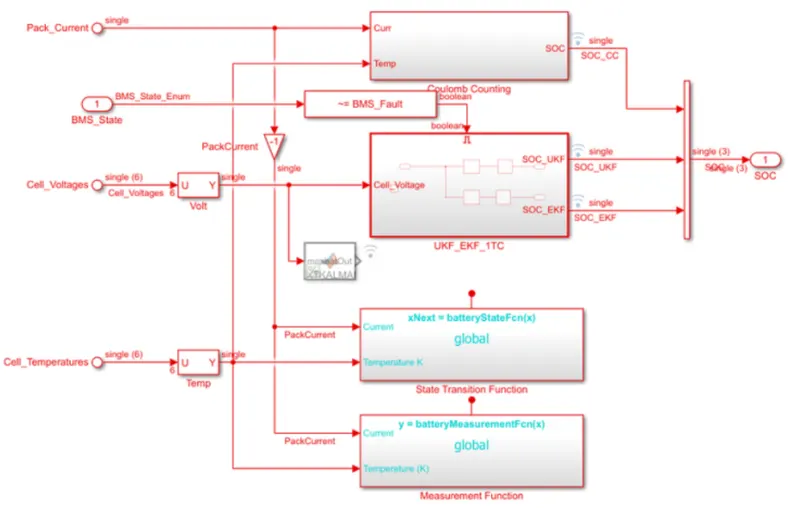
From just seeing above we can see the Coulomb Counting Block, just click on it and open that block.
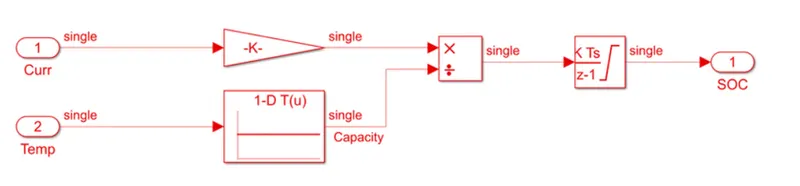
- This system does the estimation by the coulomb counting equation mentioned above.
- The advantage of the coulomb counting method is its simplicity and low computational cost.
- Temperature and current from the battery is given as inputs.
- The current signal is given to a gain block and temperature is given to capacity since it varies according to temperature.
- These inputs are given for integration where the current will be integrated with respect to time.
- This output is given to another block where it is divided by capacity.
- Hence the SOC is estimated.