Week 7 State of charge estimation
Coulomb Counting:
SOC is the measure of how much charge is available for use in the battery. For the application of rechargeable batteries in EVs the SOC is the crucial parameter & thus needs to be measured accurately. It can not be measured directly as it needs to account amount of Li content at both the electrodes. Without accurate measurement of the SOC the BMS wont be able tot ell the user when to charge the vehicle & how much capacity is left at the moment. Few Indirect methods are as follows:
Chemical method: Only applicable to the cells that gives open access to their electrolyte (Lead Acid batteries). SOC can be measured from the specific gravity or the Ph of the electrolyte.
Voltage method: Measures the present voltage of the battery to measure SOC using discharge characteristics of the Voltage Vs SOC. Not a preferred method because temperature variations are not accounted.
Current Integration Method (Coulomb Counting): It involves amount of the current entering & leaving the battery, integrated over a time. A device called a culoumb counter measures the current supplied or removed over period of time & compares to the preprogrammed capacity of the battery. Hence determines the current SOC.
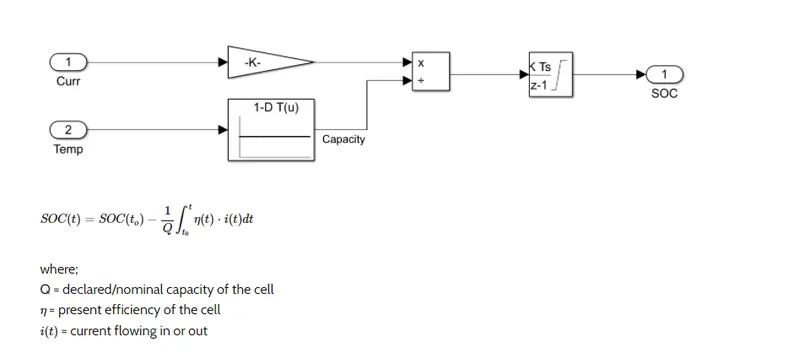
TEST CASE 1: No fault condition in the vehicle
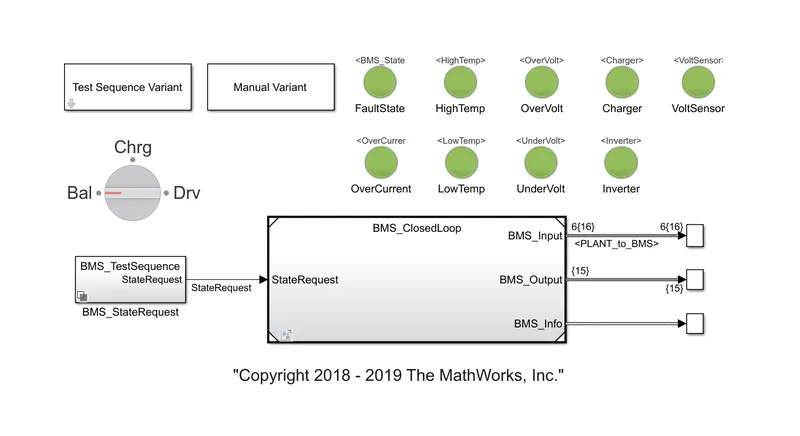
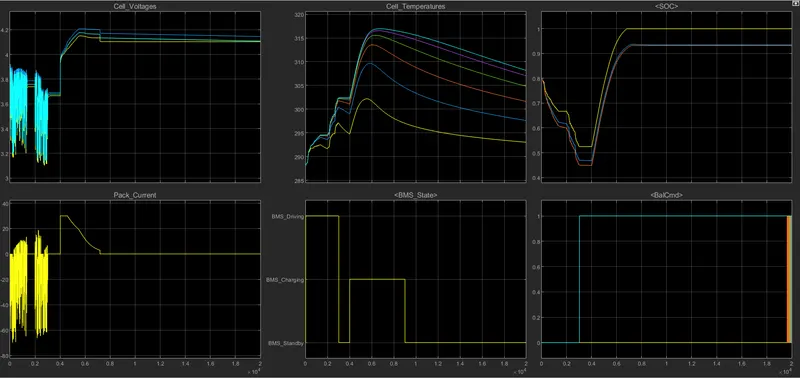
- Battery is in driving mode for the first 3000 sec.
- The next 1000 sec is taken for cell balancing as BMS come to standby mode. This generally happens when vehicle comes to stop for longer period of time.
- The next 5000 sec is for charging.
- The BMS continues to stays in standby state for the next 11000 sec.
Observations:
- The fluctuations in Cell voltage & pack current indicates that the vehicle was in driving mode for first 3000 sec.
- Cell voltage starts off differently means there was SOC unbalancing from the beginning. However they starts converging after 3000 sec & reaches to 4.1V by the end of 20000sec
- From 4000sec to 9000 sec charging happens by means of constant current(CC) & constant voltage(CV). From 4000 to 4600 sec charging happens by CC & remaining by CV.
- During CC SOC increases effectively & then slows down during CV due to the precaution mechanism to avoid charging past the voltage limit.
- There is moderate difference in temperature of the cell 1(297K) & cell6(303K) when vehicle comes to stop at the end of 3000 sec. This is because the way battery pack is assembled. Cell 1 is open to ambient temperature while cell 6 is insulted. This difference increases to 15° during period of charging & remains same at the end of the cycle wen BMS goes into the standby mode.
- SOC graph shows the SOC estimation through different methods. Yellow corresponds to Coulomb counting, Blue for Unscented Kalman Filter (UKF) & orange for Extended Kalman Filter (EKF).
TEST CASE 2: ONLY DRIVING
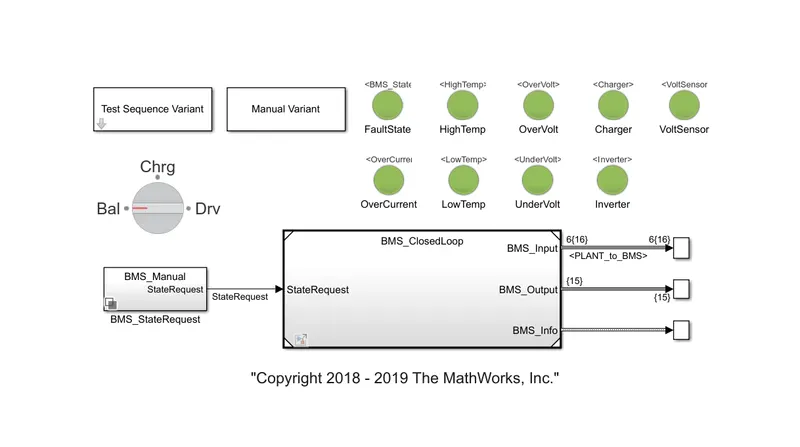
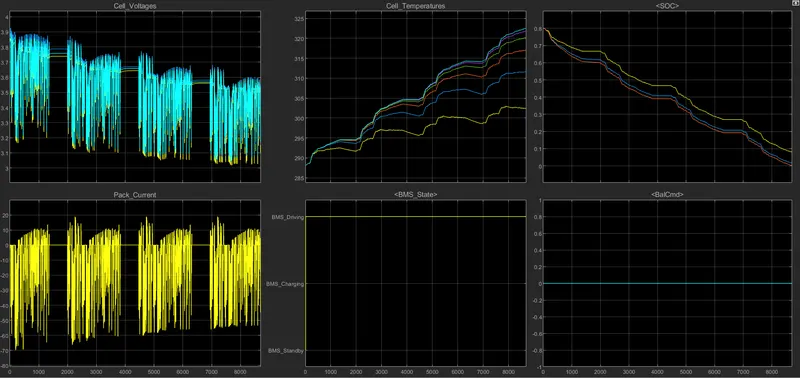
Observations:
- The cycle is continuously in driving state with cell voltage decrement from 3.9V to 3.6V.
- AT the start of the cycle all cells were at almost same temperature (288K). At the end of the cycle after 9000 sec cell 1 reaches to 303K while cell 6 reaches to 323K. This is happening because of BMS is in driving state till end & balancing doesn’t occur.
- SOC starts from 80% & reaches to 0% at the end of the cycle.
TEST CASE 3: ONLY CHARGING
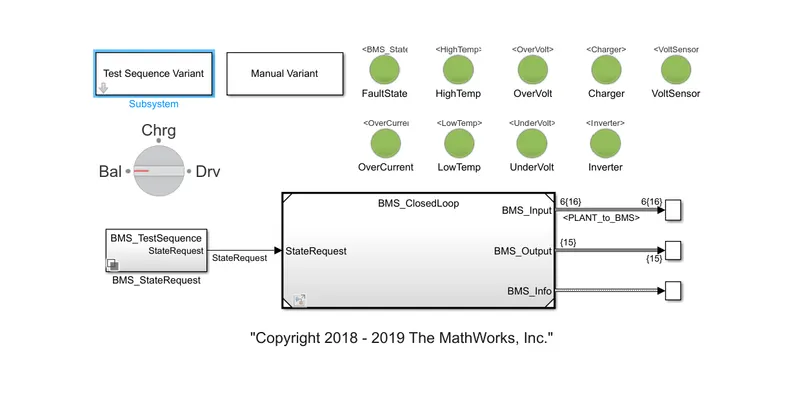
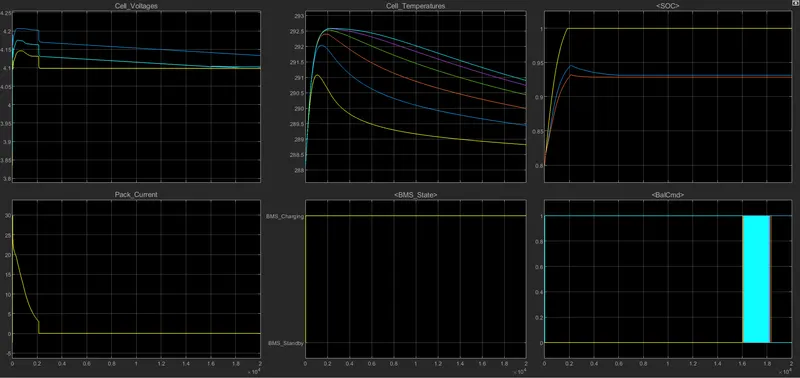
Observations:
- Since the battery is only in charging mode, the sudden influx of the current from 0 to 30A is seen within the first 5sec( if zoomed in).
- Cell balancing is in the process since beginning.
- EKF has outperformed UKF by a little bit again, while coulomb counting method for SOC estimation seems most inaccurate one. As we know the SOC to be 100% is non real condition which is been displayed by the Coulomb counting method which is happening due to it is preprogrammed to do so after CCCCV charging. EKF shows 93% while UKF shows 94% which seems more realistic & accurate.
Code Link:
https://drive.google.com/file/d/1kKGvnVhmVENrCF9Xks8YDxN1lfrmqmQO/view?usp=sharing