Week 7 State of charge estimation
AIM:
1) To Simulate the 3 test cases from the harness dashboard and write a detailed report on the results
2)coulomb counting Refer to the above model and explain how BMS implements coulomb counting for SOC
PROCEDURE:
OBJECTIVE 1)
STATE OF CHARGE ESTIMATION:
Electric vehicles (EV) and hybrid electric vehicles (HEV) and plug-in hybrid electric vehicles (PHEV) are now more and more popular. The main element of all these vehicles is the battery pack. To avoid shortening battery life or even damaging of battery, batteries should not be over-discharged or overcharged. For battery protection and optimal
utilization of battery is a battery management system (BMS) is used. One of the key components of the battery management system is accurate to state of charge (SOC) estimation because SOC reflects battery performance. Due to battery storage of chemical energy and this chemical energy is not directly accessed, is SOC estimation very difficult.
DIRECT MEASUREMENT METHODS:
Direct measurement methods use some battery physical attributes such as impedance or terminal voltage. The most common methods are the open-circuit voltage method, terminal voltage method, impedance measurement method, impedance spectroscopy method.
OPEN CIRCUIT VOLTAGE METHOD:
There is approximately a linear relationship between the SOC of the lead-acid battery and its open-circuit voltage(OCV) given by
𝑉𝑉OC (𝑡𝑡) = 𝑎𝑎1 × SOC (𝑡𝑡) + 𝑎𝑎0,
where SOC (𝑡𝑡) is the SOC of the battery at 𝑡𝑡, 𝑎𝑎0 is the battery terminal voltage when SOC = 0% and 𝑎𝑎1 is obtained from knowing the value of 𝑎𝑎0 and 𝑉𝑉OC (𝑡𝑡) at SOC = 100%. By, the estimation of the SOC is equivalent to the estimation of its OCV [8]. The OCV method based on the OCV of batteries is proportional to the SOC when they're disconnected from the loads for a period longer than two hours. However, such a long disconnection time may be too long to be implemented for the battery. Unlike the lead-acid battery, the Li-ion battery does not have a linear relationship between the OCV and SOC. The OCV relationship with SOC was determined by applying a pulse load on the Li-ion battery, then allowing the battery to reach equilibrium. The relationship between the OCVand SOC cannot be exactly the same for all batteries. Because the conventional OCV-SOC differs among batteries, there is a problem in that the relationship of the OCV-SOC should be measured to estimate accurately the SOC.
TERMINAL VOLTAGE METHOD:
The terminal voltage method is based on the terminal voltage drops because of the internal impedances when the battery is discharging, so the electromotive force (EMF) of the battery is proportional to the terminal voltage. Since the emf of the battery is approximately ISRN Applied Mathematics 3 linear proportional to the SOC, the terminal voltage of the battery is also approximately linearly proportional to the SOC. The terminal voltage method has been employed at different discharge currents and temperatures. But at the end of battery discharge, the estimated error of the terminal voltage method is large, because the terminal voltage of the battery suddenly drops at the end of discharge.
IMPEDANCE METHOD:
The method uses battery voltage and current to measure the internal resistance of the battery. Voltage is measured with the variation of current change during a small duration ( < 10 ms). The ratio of voltage and current variation results in DC resistance, which represents the capacity of the battery in DC. A small interval of less than 10ms is needed not only to capture the ohmic effect but also to reduce the effect of transfer reaction and acid diffusion[8]. However, the value of estimated resistance contains an error if the time is longer. In addition, the method has good adaptability as well as the high accuracy of SOC estimation only during the end period of discharging. Furthermore, due to its low value (in the milliohm range), the accuracy to get internal resistance is very hard to obtain. The internal resistance changes slightly with a wide range of SOC which is difficult to observe, Due to this
a shortcoming, the DC internal resistance is hardly used to estimate SOC.
IMPEDANCE SPECTROSCOPY METHOD:
The impedance spectroscopy method measures battery impedances over a wide range of ac frequencies at different charge and discharge currents. The values of the model impedances are found by least-squares fitting to measured impedance values. SOC may be indirectly inferred by measuring present battery impedances and correlating them with known impedances at various SOC levels.
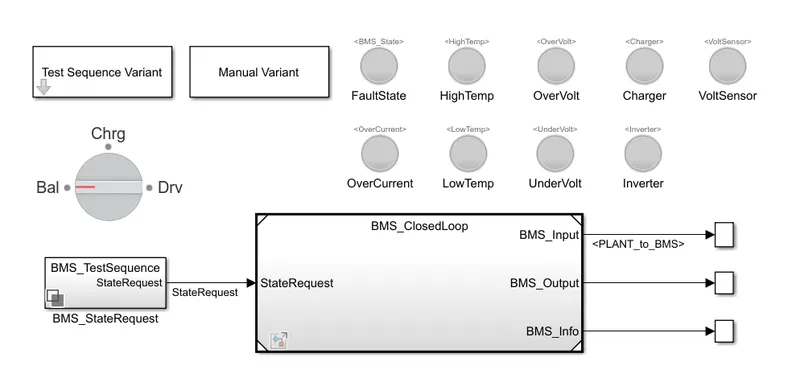
SIMULINK MODEL OF BATTERY MANAGEMENT SYSTEM:
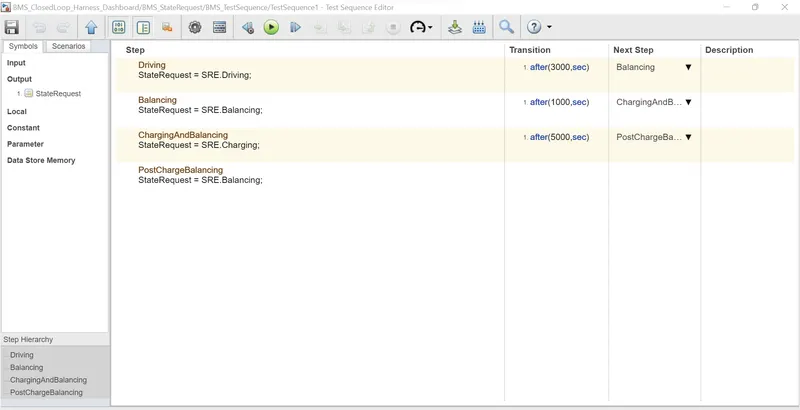
BMS TEST SEQUENCE:
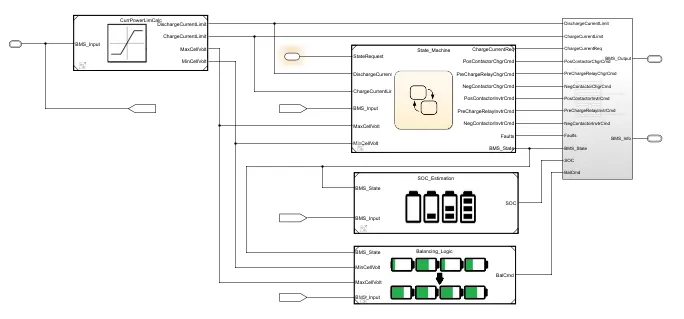
This is the entire system-level design inside the BMS ECU. it has the following block: State_machine; SOC_estimation; balancing_logic block.
The State_machine is responsible for implementing 3 logic namely :
DRIVING CHARACTERISTICS: The response to the different driving conditions
CHARGING: Response to the EV while Charging
BALANCING: Response to the fault options
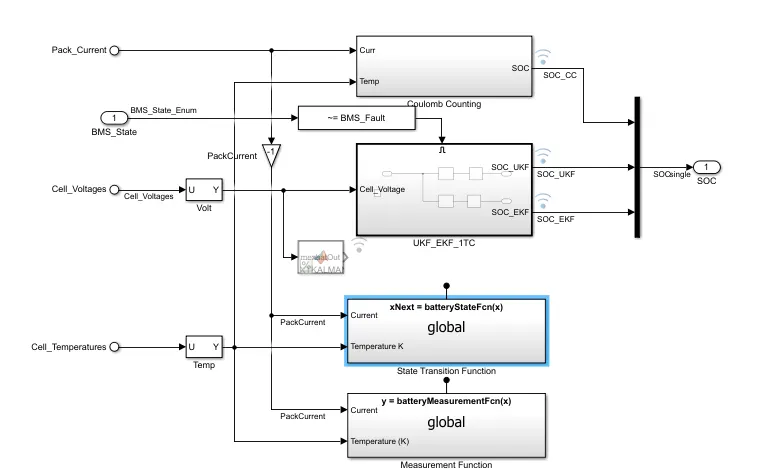
The SOC-Estimation is also a key important block in the BMS_ECU, which helps to tell the estimate of the battery charging condition; whether cells are charging properly or not etc.
The Balancing_Logic is responsible for the management of the battery pack while charging so that there is the occurrence of weak cells into the system. introducing
weak cell in the pack compromises with the SOC and SOH.
The Test Sequence Variant has in build 3 models.
It has 3 stages of driving condition, namely
1)DRIVING.
2)CHARGING AND BALANCING.
3)STANDBY.
COULOMB COUNTING:
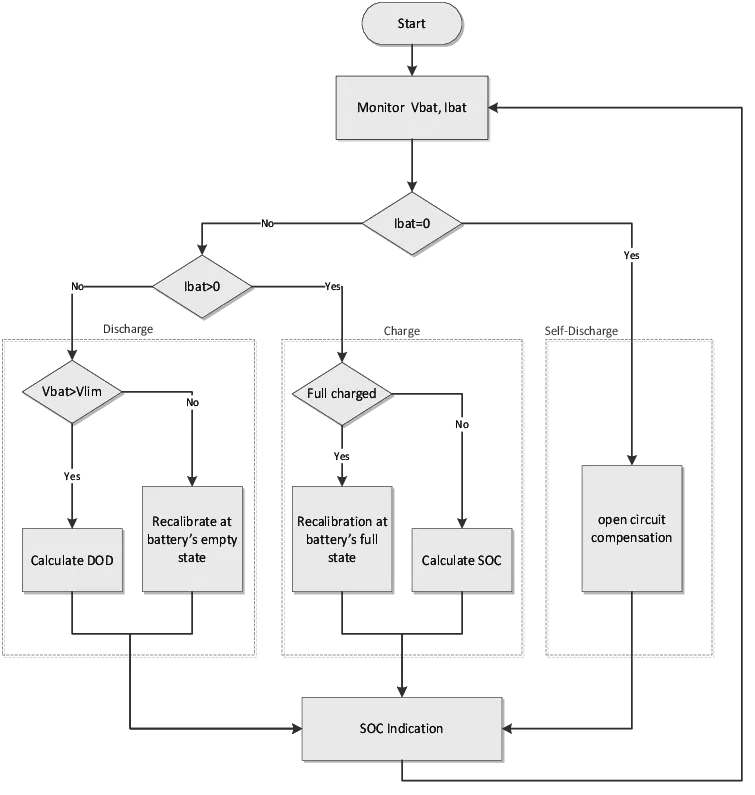
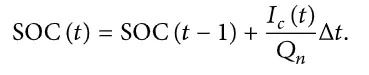
SOC stands for the state of charge of a battery. SOC represents the amount of energy left inside the battery with respect to the total amount of energy in the battery at the Fully charged condition. SOC can help a user to determine when to charge the battery or stop charging and how much energy he can extract from a battery at that time. There is no direct method to calculate SOC for a Li-ion battery but there are several ways in which we can calculate SOC with the help of some additional parameters. The easiest method to calculate the SOC of a battery is by using a battery voltage translation method. This method is not accurate but helps to approximately and quickly calculate SOC and can be used in devices like power banks where SOC is shown in range and not the exact percentage. For example, a typical power bank shows SOC in the range from 0-25%, 25-50%, 50-75%, 75-100%. There are several limitations to this method and hence more accurate methods are needed like the Coulomb counting method, the Fuzzy logic method, the Kalman filter, the RBF Neural network, the Fuzzy neural network, the Hybrid methods, etc. Each method has its limitations, accuracy, and complexity and hence proper decision should be made while selecting methods for SOC estimation. Coulomb Counting Method: The coulomb counting method is also known as the battery current integration method. In this method, a discharging/charging current I(t) is measured and integrated over time to calculate the amount of energy remaining inside the battery. In this method, SOC is taken at the previous time step SOC(t-1) and the amount of energy removed/added at the current time step is subtracted/added from the SOC of the previous time step SOC(t-1) to obtain the amount ofthe energy present in the battery at the present instant.
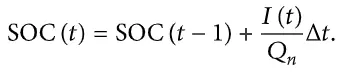
The SOC estimation in the coulomb counting method is done using the below equation,
SOC(t-1) = SOC at previous time step
= efficiency
t = current time step
t-1 = previous time step
Q = Charge capacity of the battery
This method is more accurate and more reliable than the voltage translational method but does not take into account the discharge rate, temperature, hysteresis, age of the
battery,
FLOWCHART FOR COULOMB COUNTING METHOD:
FORMULA:
MODIFIED COULOMB METHOD:
To improve the Coulomb counting method, a new technique called the modified Coulomb counting method is proposed. The modified Coulomb counting method uses the corrected current to improve the accuracy of estimation.
The corrected current is the function of discharging current. There is a quadratic relationship between the corrected current and discharging current of battery. By practice of experimental data, the corrected current is calculated by the following form:

where, K2, K1, and K0 are constant values obtained from the practice experimental data.
In the modified Coulomb counting method, SOC is calculated by the following equation:
The experimental results show that the accuracy of the modified Coulomb counting method is superior to the conventional Coulomb counting method.
SIMULINK MODEL:
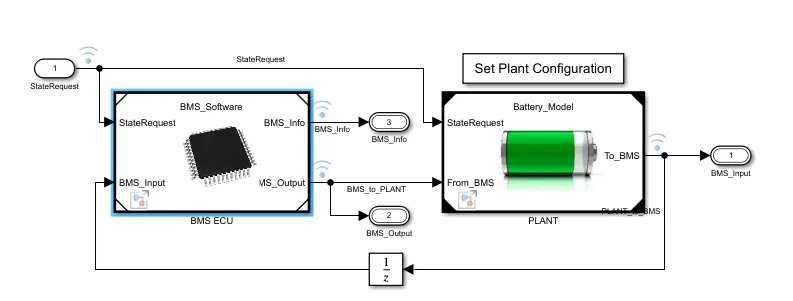
BOTH THE BMS ECU AND SET PLANT CONFIGURATION WHUCH ARAE CONNECTED THE TERMINALS,
INNER BLOCK:
SOC MODEL:
ERROR:
I'VE FACED MANY ERRORS WHILE IN SIMULATION THE MODEL WHICH DOESN'T SUPPORTS TO MY VERSION SO THAT THE GRAPH DOESN'T OCCURS.
RESULT:
HENCE THE TEST CASES FROM THE HARNESS DASHBOARD ARE BRIEFLY EXPLAINED.