Week 1 Understanding Different Battery Chemistry
AIM
The below content shows the materials and chemical reactions occurring at the anode and cathode of LCO, LMO, NCA, NMC, LFP, AND LTO type of lithium-ion cells
PROCEDURE
LITHIUM-ION BATTERIES: FIG(1) REPRESENTS THE LITHIUM-ION BATTERY OR LI-ION BATTERY which was introduced in the date of 1960s is a rechargeable battery in which Li-ion moves from negative electrode through electrolyte during discharge. LI-ION batteries have a higher density and lower self-discharge rate. The material lithium compound as positive electrode and Graphite as a Negative electrode.
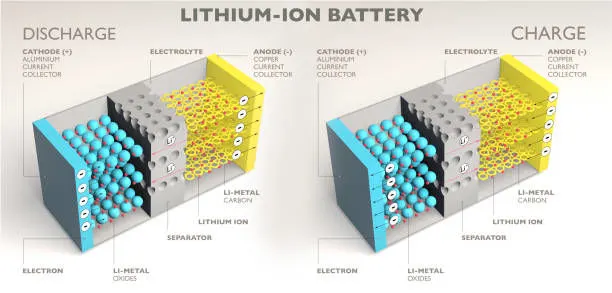
FIG (1).LITHIUM-ION BATTERY
TYPES:
1) LITHIUM COBALT OXIDE(LICoO2) (LCO): FIG(2) REPRESENTS THE LCO, It's a common cathode material in lithium-ion batteries, whose cathode is composed of lithium cobalt oxide it is highly used in mobile phones, laptops, etc.., It features high stable capacities along with higher specific energy.
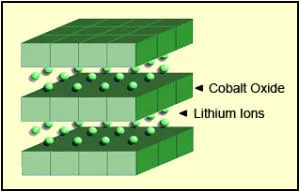
FIG (2) LCO
2) LITHIUM MANGANESE OXIDE(LiMn2O4) (LMO): FIG(3) REPRESENTS THE LMO. It was introduced in the year 1983, it is sometimes known as li-ion manganese batteries or manganese spinal batteries. High-temperature stability distinguishes li-ion batteries from others, They can be frequently found in the application of medical types of equipment and also in power tools, electric vehicles, etc..,
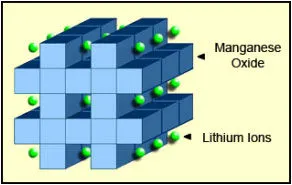
FIG (3) LMO
3) LITHIUM NICKEL COBALT ALUMINIUM OXIDE (LiNiCoAlO2)(NCA): FIG (4) REPRESENTS THE NCA. The Lithium Nickel Cobalt Aluminium Oxide battery, or NCA, is a li-ion battery type that is rarely seen in consumer applications but is being investigated for the automotive industry. Its main advantage is that it has a good life span and high energy and power density figures.
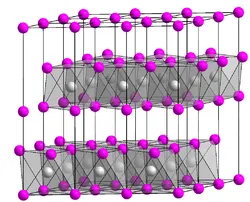
FIG(4) NCA
4) LITHIUM NICKEL COBALT MANGANESE OXIDE (LiNiMnCoO2) (NMC): FIG (5) REPRESENTS THE NMC. It is having a higher specific energy density or a higher specific power. This battery is most commonly seen in power tools and automobile powertrains. It consists of 60% nickel,20% manganese, and 20% cobalt are commonly the cathode combination ratios. This means that the cost of the raw material is lower than for other lithium-ion battery solutions, as cobalt may be fairly costly. Because some battery manufacturers plan to convert their battery chemistry to a larger percentage of nickel to utilize less cobalt, the price of these batteries may drop even more in the future. Because of its low self-heating rate, this battery type is highly used in electric vehicles.
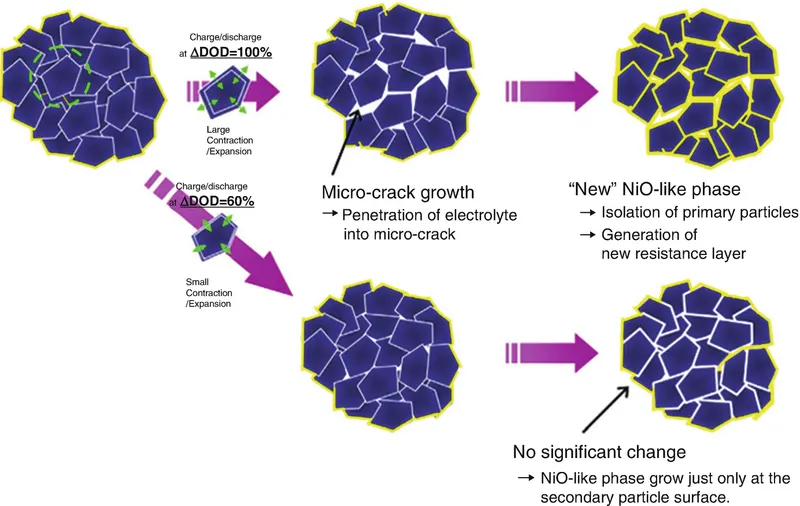
FIG (5) NMC
5) LITHIUM IRON PHOSPHATE (LiFePO4) (LFP): FIG (6)REPRESENTS THE LFP. Phosphate is used as a cathode in lithium iron phosphate batteries, often known as li-phosphate batteries. They have low resistance qualities, which improve their thermal stability and safety. The fully charged batteries can be kept with no effect on the battery’s overall charge life. When the lengthy battery life of Li-phosphate batteries is considered, they are frequently the most cost-effective option. The lower voltage of the lithium-phosphate battery, on the other hand, means that it has less energy than other lithium batteries. As a result, these batteries are frequently used in electric bikes and other applications requiring a long life cycle and a high level of safety. These batteries are also commonly used in electric vehicles.
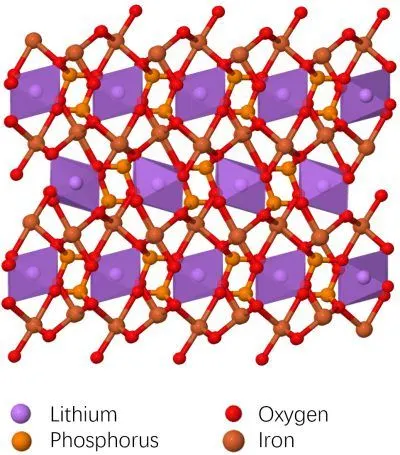
FIG (6) LFP
6) LITHIUM TITANATE OXIDE (Li2TiO3) (LTO): FIG (7) REPRESENTS THE LTO. It's a type of rechargeable battery that has the advantage of being faster to charge than other lithium-ion batteries, but the disadvantage of having a much lower energy density. Lithium titanate is used as a cathode in layer one of a double layer cathode for molten carbonate fuel cells. These fuel cells have two material layers, layer 1 and layer 2, which allow for the production of high-power molten carbonate fuel cells that work more efficiently. As Lithium Titanate batteries are entirely free of carbon, they avoid thermal runaway or overheating which is the main cause of fires in traditional energy storage systems. Without the risk of fires or explosions, Lithium Titanate technology allows for safe, user-friendly, and low-risk energy storage in any application.
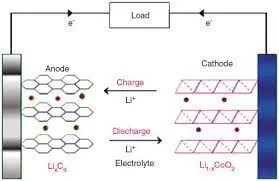
FIG (7) LTO
TABLE OF CONTENTS
THE BELOW TABLE SHOWS THE MATERIALS AND CHEMICAL REACTIONS OCCURRING AT THE ANODE AND CATHODE OF LI-ION CELLS AND THEIR TYPES.