Week 7 State of charge estimation
Objective :
1.Simulate the 3 test cases from harness dashboard and write a detailed report on the results
2.What is coulomb counting? Refer to the above model and explain how BMS implements coulomb counting for SOC estimation ?
Solutions :
1). Simulate the 3 test cases from harness dashboard and write a detailed report on the results
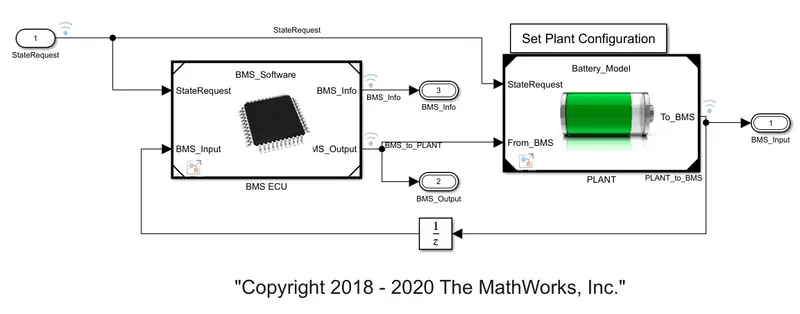
This above model can be used to mimic diverse usage cycles and environmental conditions to evaluate a systems response to a potentially unsafe condition.
For instance, voltage, current, or temperature outside the recommended limits. Lets say this BMS is a part of an EV powertrain and the initial SOC is 75 % with the ambient temperature being 15 degrees C.
The vehicle is run for a while and then stops to charge. Once the vehicle and battery are at rest and charging, the cell balancing cycle kicks in.
How do we know that during the charging stage the battery pack will remain within recommended electrical and thermal limits? What if the temperature of the pack is 40 degrees instead of close to 15 ? Will an aggressive drive cycle cause an under-voltage situation when the SOC is running low? A model such as this one allows the vehicle designer to test these types of situations.
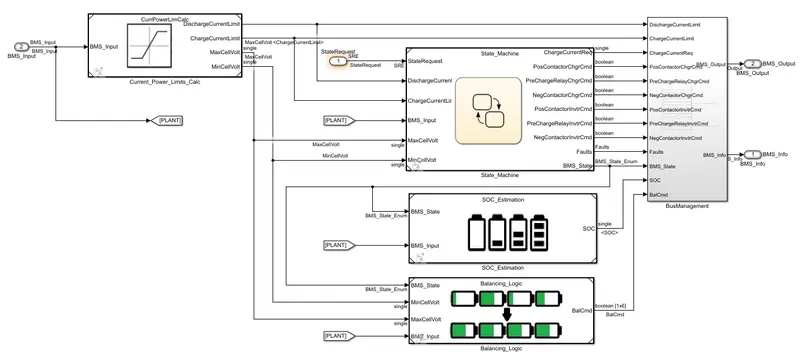
BMS ECU:
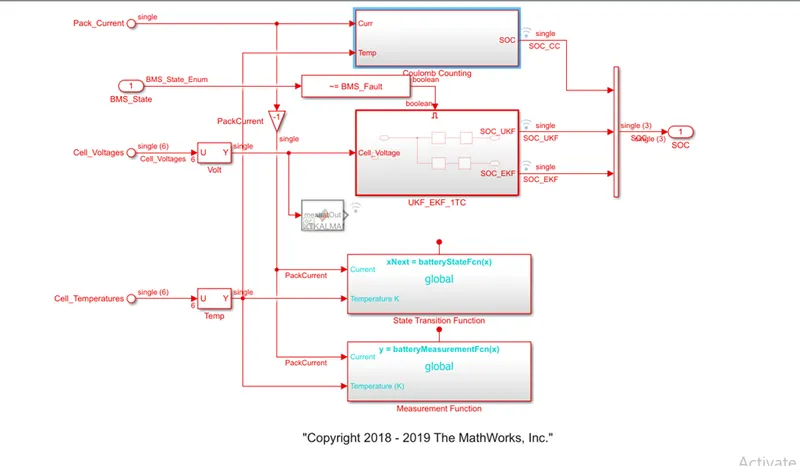
BMS ECU represents the software and controls part of the model, showing how cell balancing is done, SOC is estimated, and response to different states (using stateflow)
as represented below in the following screenshot :
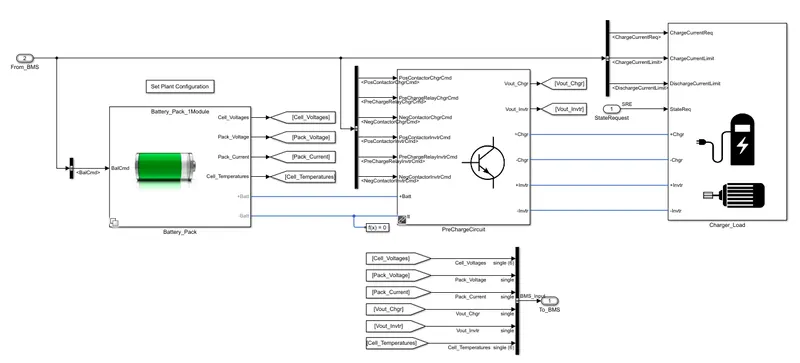
Plant : The Plant represents the part or subsystem of the model with the battery pack, precharge circuit and the charger .
this is as shown below in the screenshot :
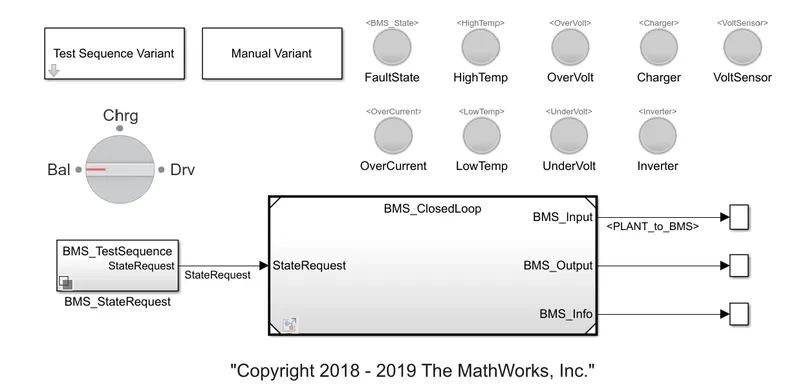
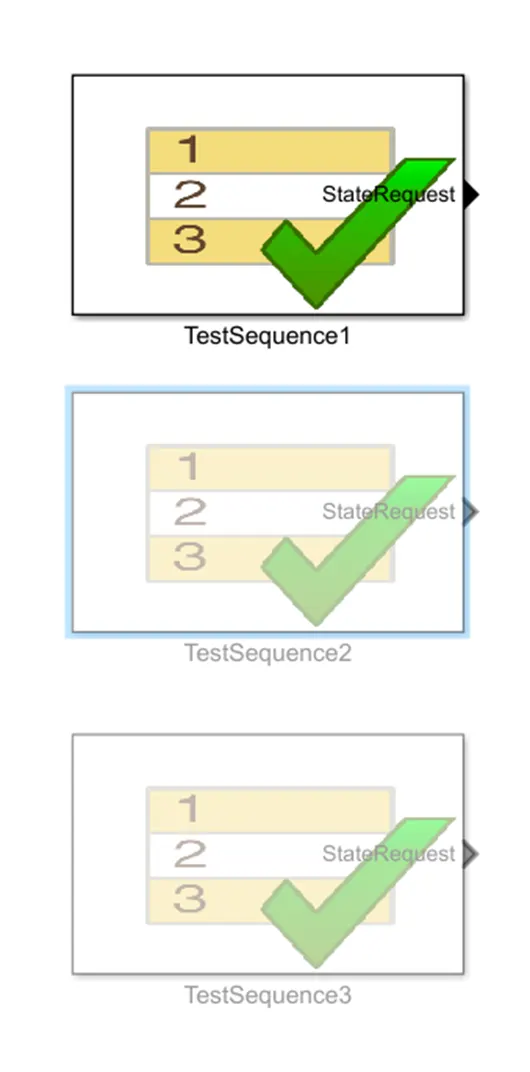
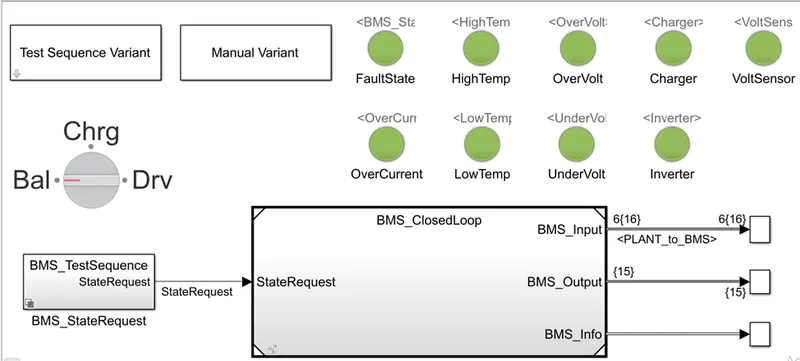
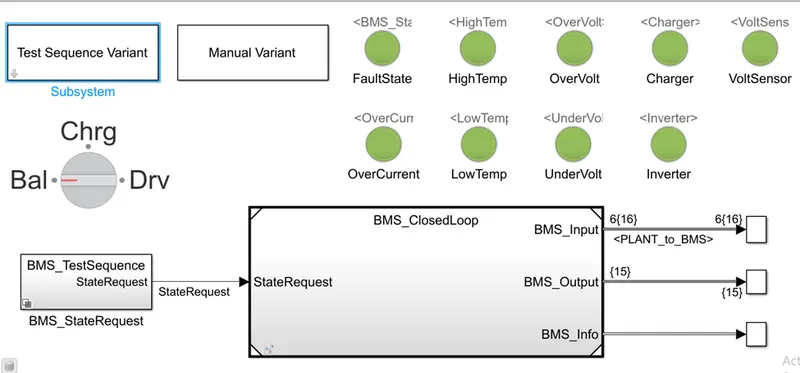
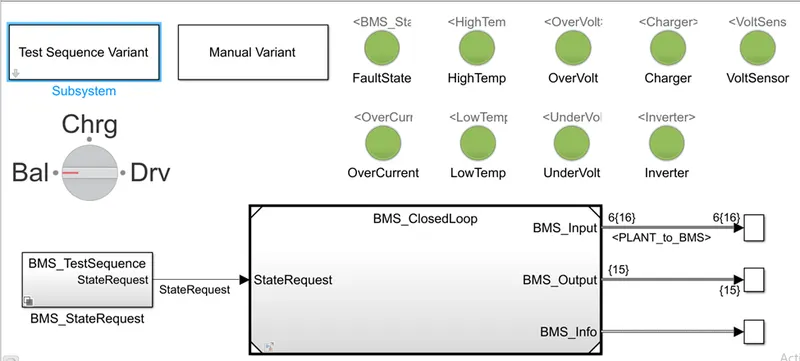
The below model shows the Closed loop harness model. It holds three test cases and has been executed in the below report.
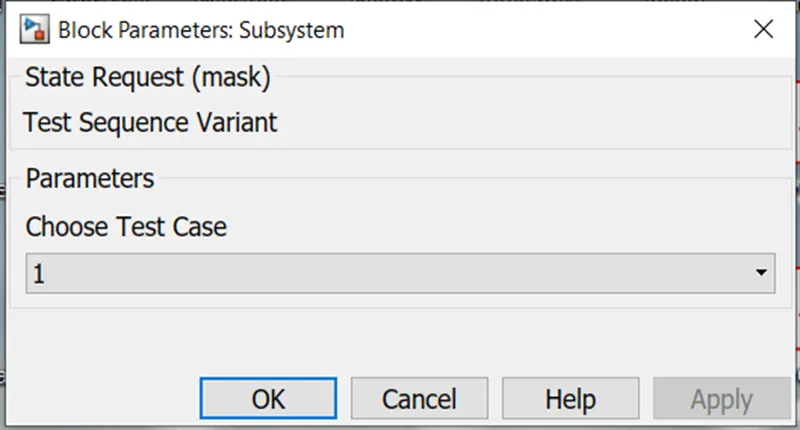
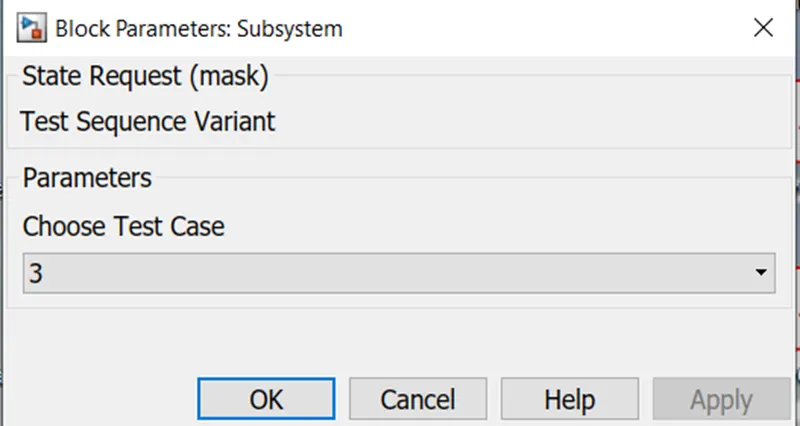
The model holds the Test sequence variant to change the test cases and Lamps are connected to report the execution
Test Case 1:
Here, the test case 1 is been verified. The model has been ran for 20000 seconds and results are plotted
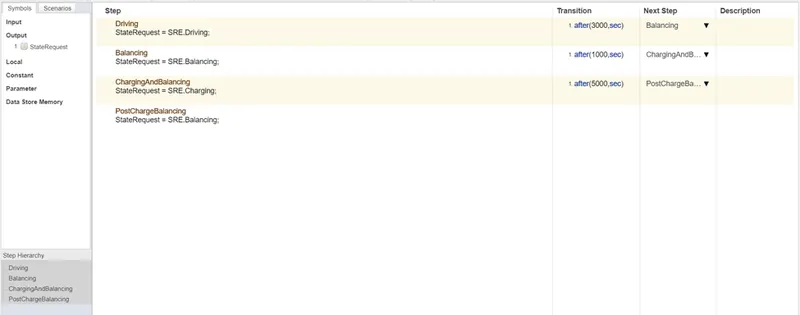
The Test case is to execute the below criteria:-
- Driving for 3000 seconds
- Balancing for 1000 seconds
- Charging and balancing for 5000 seconds
- Post charge balancing for later.
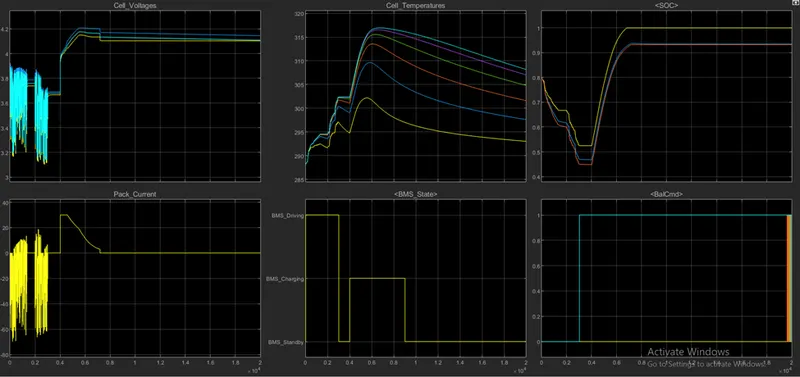
The Plot shows that the vehicle is initially in driving state.
The results are plotted for Cell voltages, cell temperature, SOC, Pack Current, BMS state.
Then it was charging as Constant Current constant voltage mode. Then it was in standby mode. While driving , the battery reached the SOC of 45% and then while charging, it reached to 98%.
Test Case 2: Second case is Driving for 10000 seconds.
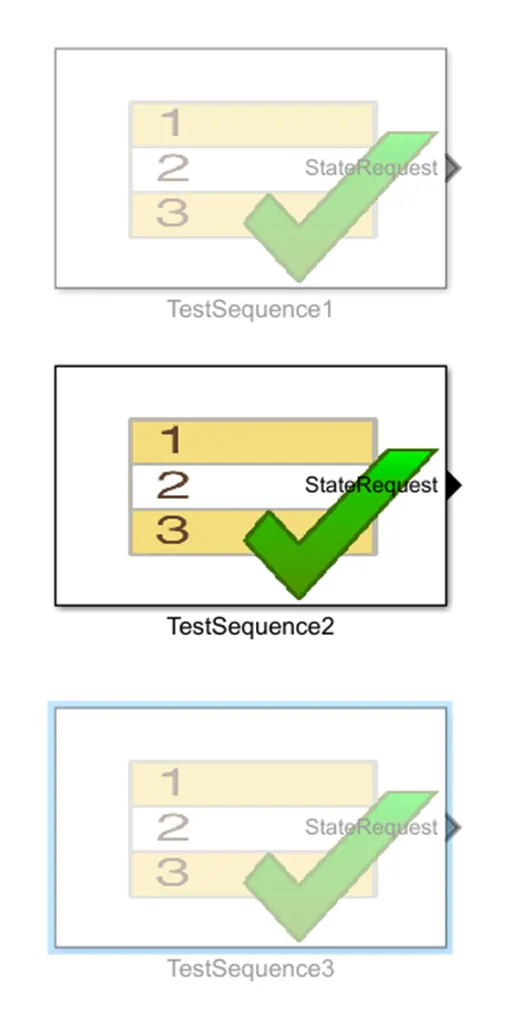
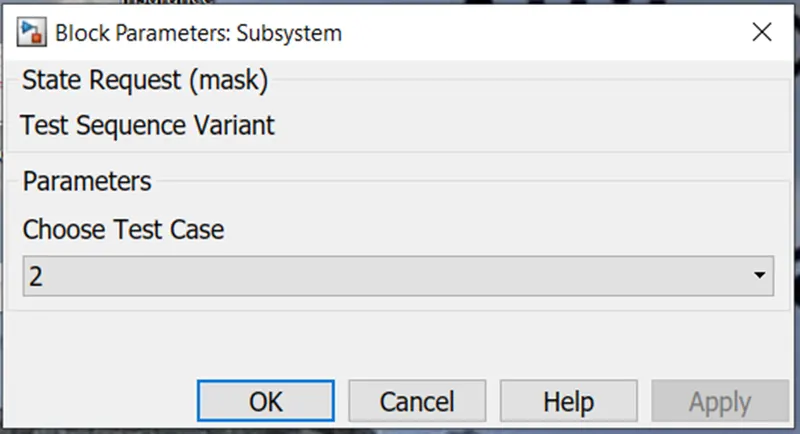
Here second case is to drive for 10000 seconds and later charged
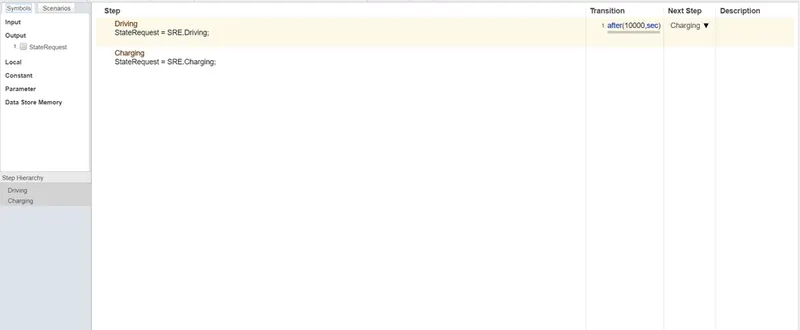
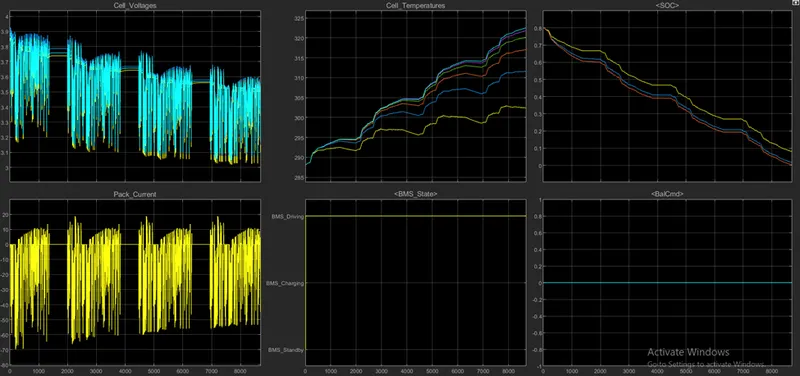
From the graph, shows that for 10000 seconds the system is in driving state and SOC of the system is continuously decreasing and temperature is increasing continuously.
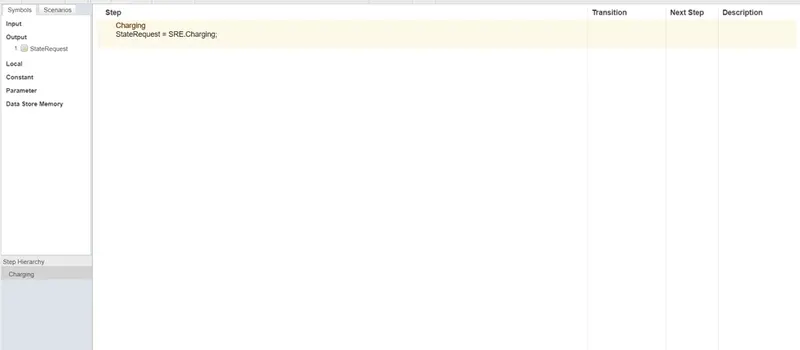
Test Case 3: Condition is continuously charging
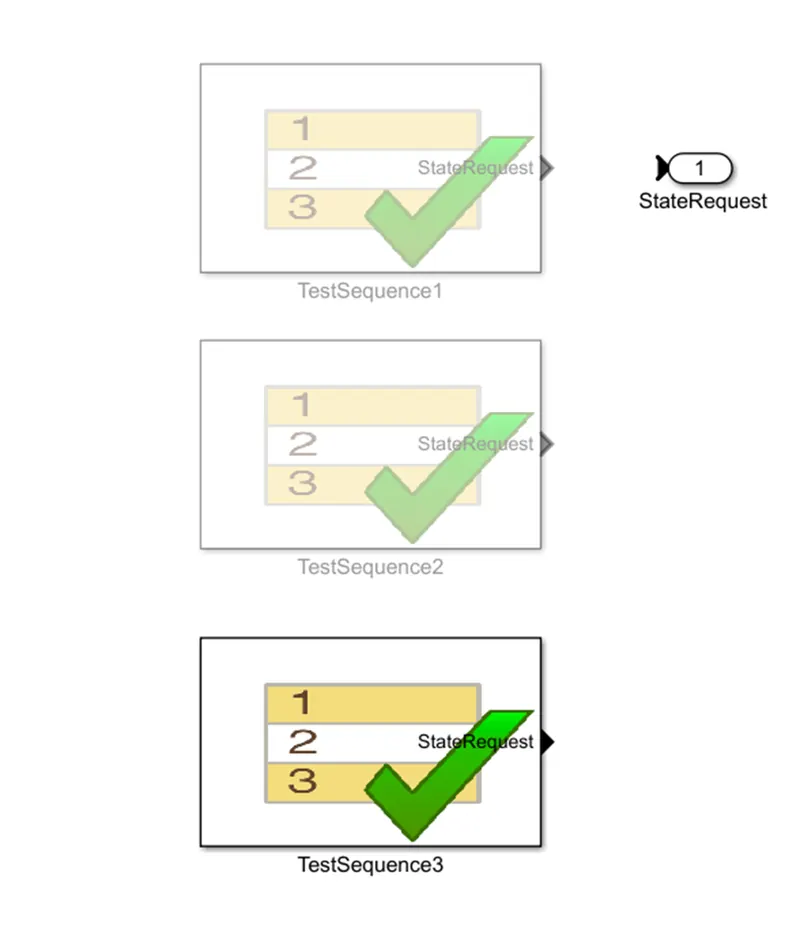
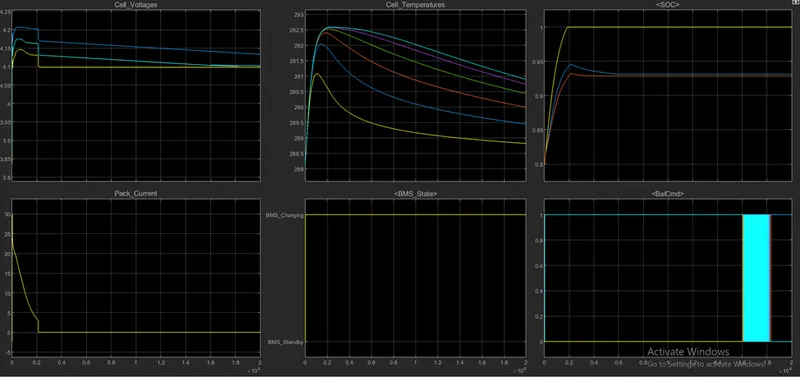
The above plot shows that system is continuously in charging mode, reaching 100% and stand down. Temperature increases while charging and reaching the stand point and deacreasing gradually.
2.What is coulomb counting? Refer to the above model and explain how BMS implements coulomb counting for SOC estimation ?
Algorithms used for SOC and SOH Estimation are:
- Coulomb counting, OCV
- Kalman filter
Coulomb Counting:
The Coulomb counting method is associated with monitoring the input and the output current continuously.
Since capacity is the integral of current with respect to time, by measuring the input and the output current, change in capacity or capacity degradation of a battery can be measured easily .
During the estimation of SoC, at some random OCV and temperature ,modeling of cell characteristics was done by ANFIS.
The assessment was done on the cell level instead of the pack level for better precision. The coulomb counting method, also known as ampere hour counting and current integration, is the most common technique for calculating the SOC.
This method employs battery current readings mathematically integrated over the usage period to calculate SOC values given by
where SOC(t0) is the initial SOC, Crated is the rated capacity, Ib is the battery current, and Iloss is the current consumed by the loss reactions.
The coulomb counting method then calculates the remaining capacity simply by accumulating the charge transferred in or out of the battery.
The accuracy of this method resorts primarily to a precise measurement of the battery current and accurate estimation of the initial SOC.
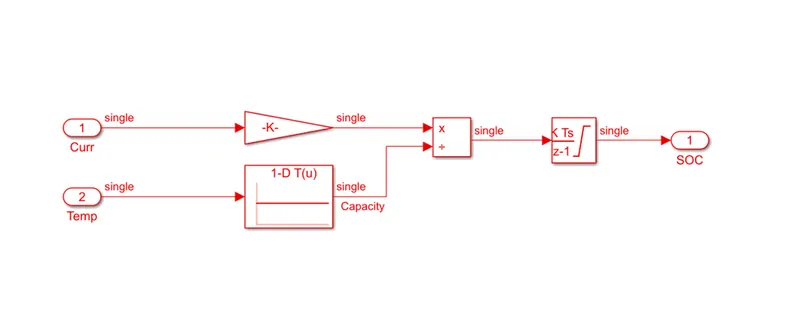
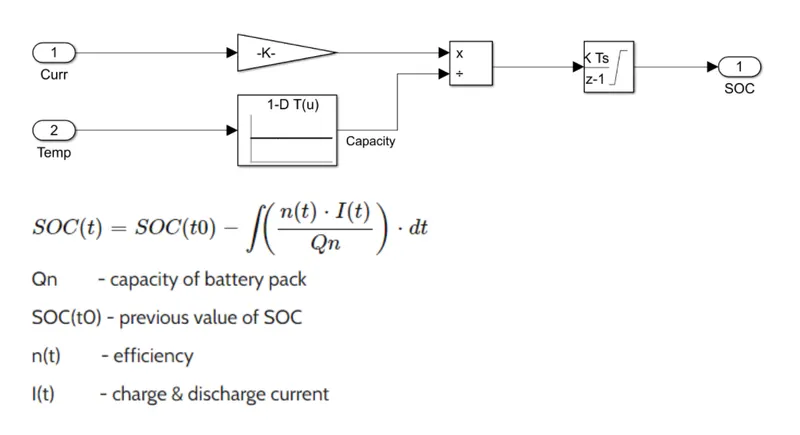
The above model shows the charge estimation for the SOC.
The Current and Temperature is taken as an input to the model. The Current multiplied with gain and the Temperature has wide range of capacity , so given to the capacity block. The temperature and the Current are given to the integrator block and integrated with respect to time.
and thus the SOC is analysed from the block diagram.
Although this is one of the most common ways of measuring SOC, it still suffers from a lack of reference point.
The SOC needs to be recalibrated regularly back to 100 %everytime a battery is fully charged, and this is dependent on how accurately the sensor determines a fully charged cell.
This method also does not consider the changing efficiency of the cell, which is dependent on how much is the charging and discharging current.
With greater charge discharge current, the temperature of the cell increases, which affects efficiency.
In addition, over time, the pre-declared capacity (Q) and efficiency of a cell reduces, so reduction in cycle life also affects the SOC measurement.
Steps for coulomb counting in BMS implementation.
1. Develop the algorithm for the coulomb counting method
2. Transfer the algorithm to the BMS (microprocessor)
The BMS is the hardware in PCB consisting of a processor, many sensors, connectors, indication lights, etc. Actually, BMS has many responsibilities like battery balancing, SOC, SOH, DOD estimation, under & over-voltage protection, thermal protection, providing battery pack cooling, calculating duty cycle, etc.
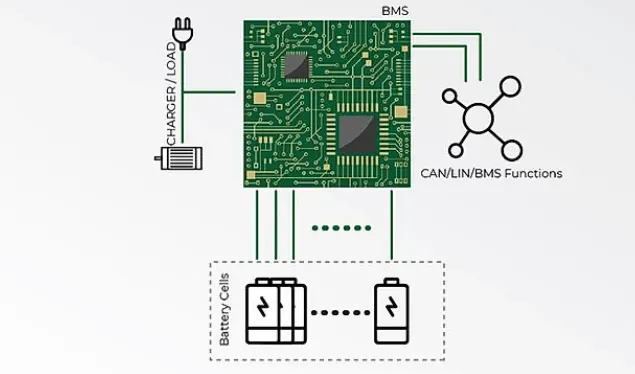
Here our main aim is to implement the coulomb counting method in BMS to develop the algorithm according to the battery voltage capacity
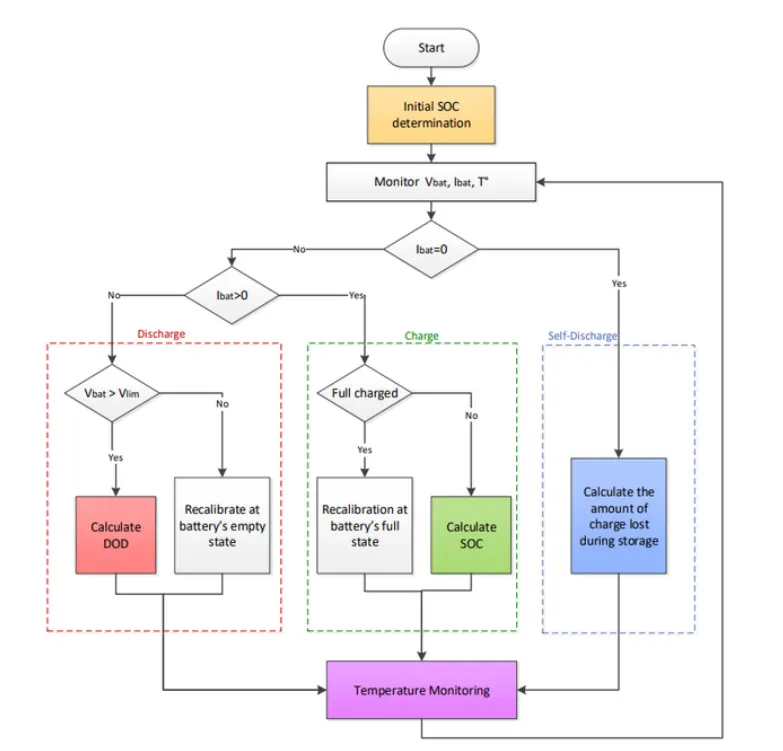
The initial value of SOC is mainly by the OCV method. Then based on the voltage level and charging mode the algorithm will execute.
So in our case of soc estimation, there will be a separate unit in the BMS for the estimation.
Implement the algorithm in the hardware(processor), make the necessary connection to batteries and sensors, and analyze the result for charging and discharging.
CONCLUSION:
While completing this challenge we learnt about SOC test for BMC and run it with three stages of simulation from harness dashboard.
We learnt about coulumb counting, and how BMS implements coulomb counting for SOC estimation.
Conclusions :
reference link :https://in.mathworks.com/matlabcentral/fileexchange/72865-design-and-test-lithium-ion-battery-management-algorithms
1. Mathworks documentation
2. https://www.sciencedirect.com/topics/engineering/state-of-charge
Gdrive link:https://drive.google.com/drive/folders/1iishD3vdN7Ugg1skqbxd9_RPFGxm6Cxv