Week 7 State of charge estimation
- Simulate the 3 test cases from harness dashboard and write a detailed report on the results
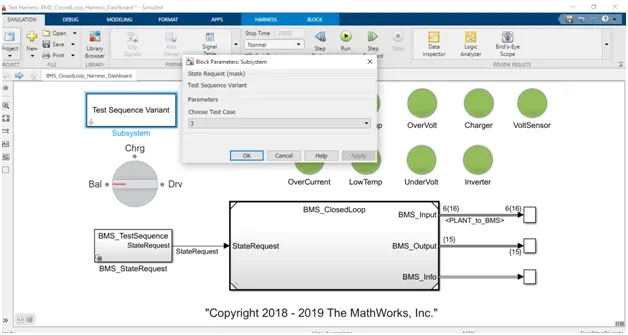
The closed loop harness is given below.
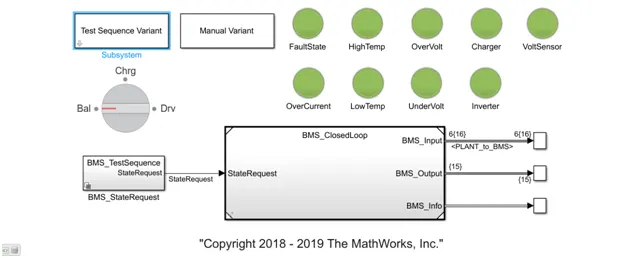
To select one of the 3 test conditions, it can be selected by double clicking the Test Sequence Variant block which allows to select which test needs to be simulated. The first variant is selected.
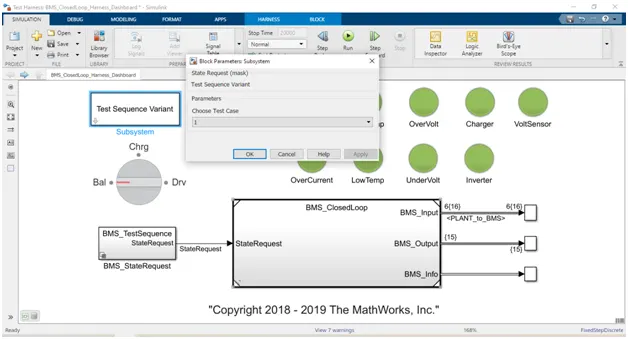
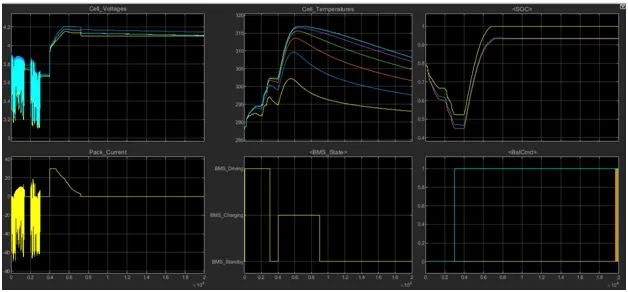
- It can be observed from the plot that the vehicle is initially in the driving state and the charging was done till 90%. After the charging mode, it reaches to the standby mode which can be seen from the BMS state plot.
- From the cell temperature plot, it is observed that the battery temperature rises in driving and charging.
- The battery voltage was increased to 4.2V while charging.
- The current plot shows the current value supplied to the vehicle while driving. The SOC was observed to be decreased around 50% in driving conditions, which increased while charging.
SECOND VARIANT:
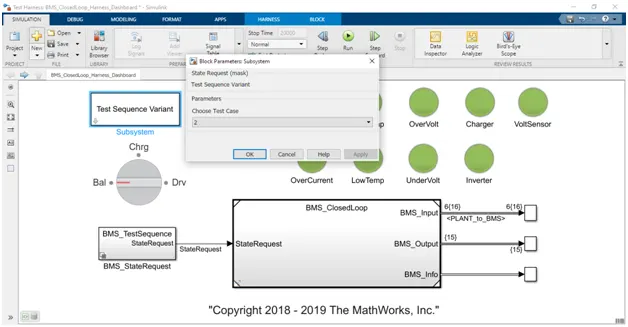
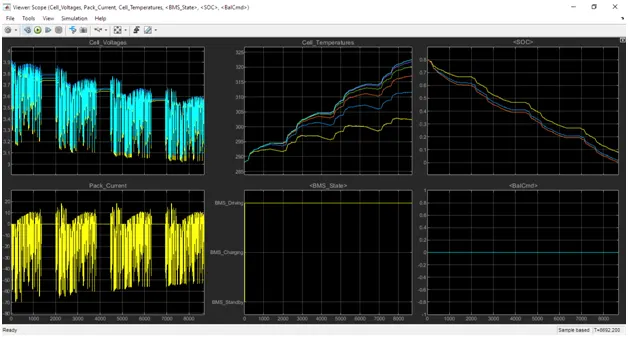
- It was observed from the plot that the battery discharges completely in 8692 seconds and the vehicle does not go forward and the charging state was not achieved at 10000 seconds. Hence the vehicle comes to standby condition and the simulation stops midway.
- The cells are initially at 80% of SOC and then they are falling at different time periods.
- The temperature of the entire cell starts from 288 degree Celsius and they get scattered.
THIRD VARIANT:
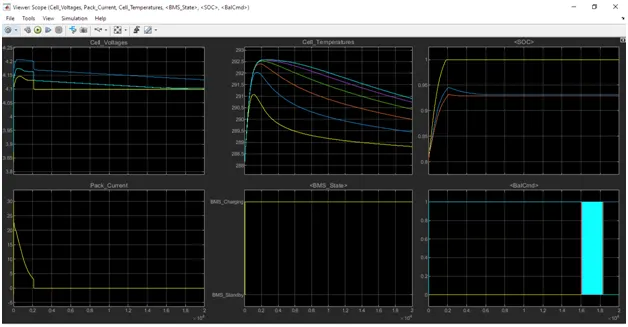
- The battery starts charging and the SOC starts increasing from beginning to around 2000 seconds and stays stable at 100% continuously from 2000seconds to 20000 seconds.
- The peak current drops from 0 to 2000 seconds and stay constant as the charge is not used anywhere as the driving is not present.
From the above simulated 3 variants of the simulation, it is observed that,
- In the first simulation all three conditions were simulated such as driving charging and the stable state hence the charging and the discharging were observed and in the end the constant 100% SOC was observed because of the standby state of the vehicle.
- In the second simulation it was just the discharging as the SOC dropped to 0% in the driving state within 8600 seconds and the charging state was not achieved at 10000 seconds.
- In the third simulation, only charging was observed for the first 2000 seconds and the SOC remained at 100% constant for the next 18000 Seconds.
- What is coulomb counting? Refer to the above model and explain how BMS implements coulomb counting for SOC estimation ?
The Coulomb counting method measures the discharging current of a battery and integrates the discharging current over time in order to estimate SOC . Coulomb counting method is done to estimate the SOC(t), which is estimated from the discharging current, I(t), and previously estimated SOC values, SOC(t-1) . SOC is calculated by the following equation:
`SOC(t)= SOC(t-1)+ (I(t))/Q_n delta.t`
But there are several factors that affect the accuracy of Coulomb counting method including temperature, battery history, discharge current, and cycle life.
MODIFIED COULOMB COUNTING METHOD:
To improve the Coulomb counting method, a new technique called modified Coulomb counting method is proposed. The modified Coulomb counting method uses the corrected current to improve the accuracy of estimation.
The corrected current is the function of discharging current. There is a quadratic relationship between the corrected current and discharging current of battery. By practice of experimental data, corrected current is calculated by the following form:
`I_(c ) (t)= K_2 〖I(t)〗^2+ K_1 I(t)+K_0`
Where k2, k1 and k0 are constant values.
In modified Coulomb counting method, SOC is calculated by the following equation:
`SOC(t)= SOC(t-1)+ (Ic(t))/Q_n delta.t`
From the given model by Mathworks as shown below of BMS closed Loop model,
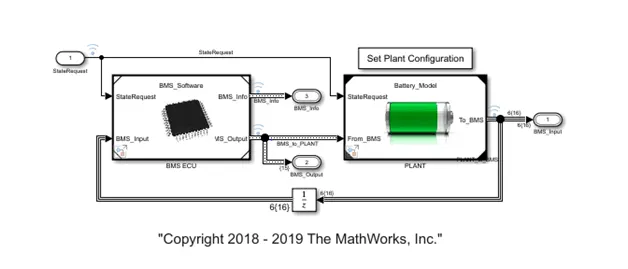
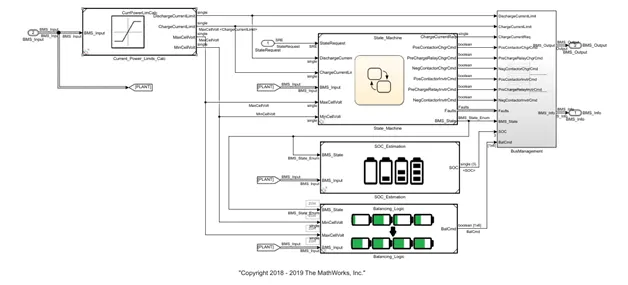
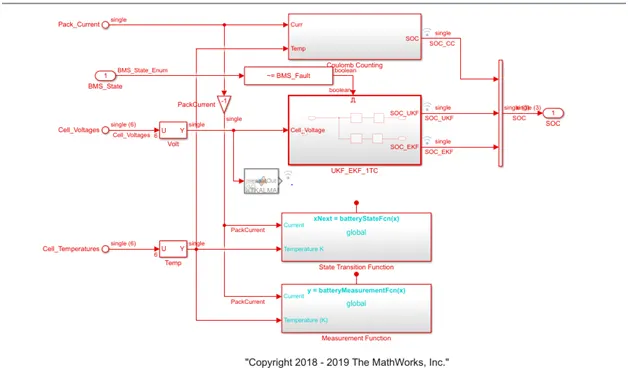
The coulomb counting block can be observed on the top of the model, where the coulomb counting was carried out. The model for the same can be seen below.
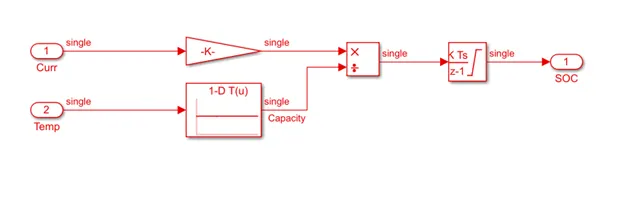
- This system carries out the estimation by coulomb counting equation mentioned earlier. The main advantage of coulomb counting is that of its simplicity and low computational cost.
- Temperature and current are taken as input from the battery. Current signal is given to the gain block and the temperature is given to the capacity as it varies according to the temperature.
- These inputs are given to the integration where current will be integrated wrt time. The output is given to another block where it is divided by capacity and henceforth the SOC is estimated.