Week 7: Shock tube simulation project
Aim:
Setup a transient shock tube simulation
Plot the pressure and temperature history in the entire domain
Plot the cell count as a function of time
Shock tube:
The shock tube is an instrument used to replicate and direct blast waves at a sensor or a model in order to simulate actual explosions and their effects, usually on a smaller scale. Shock tubes (and related impulse facilities such as shock tunnels, expansion tubes, and expansion tunnels) can also be used to study aerodynamic flow under a wide range of temperatures and pressures that are difficult to obtain in other types of testing facilities. Shock tubes are also used to investigate compressible flow phenomena and gas phase combustion reactions.
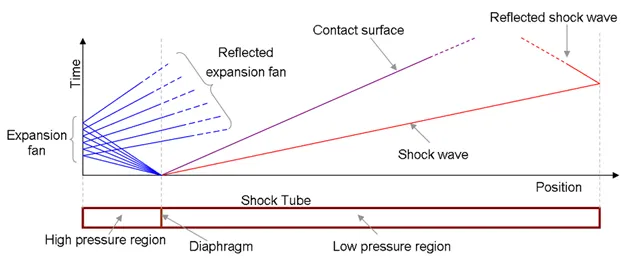
Case-setup
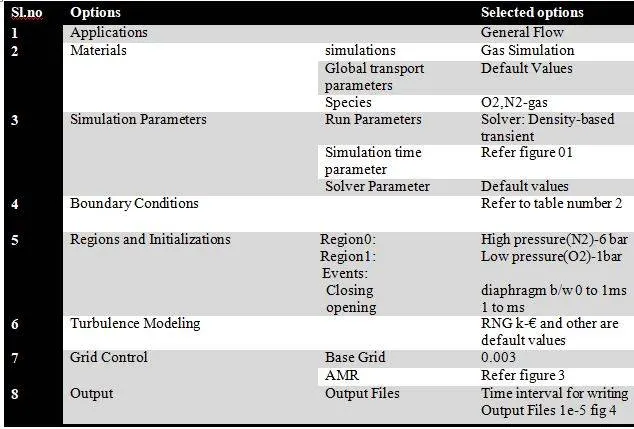
simulation time parameter
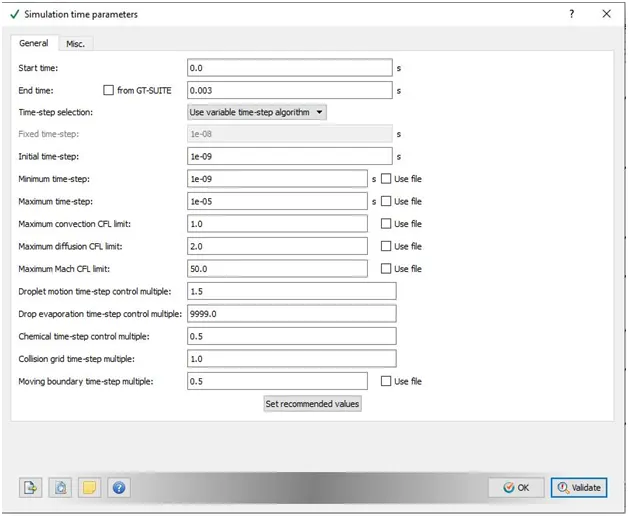
Boundary Conditions
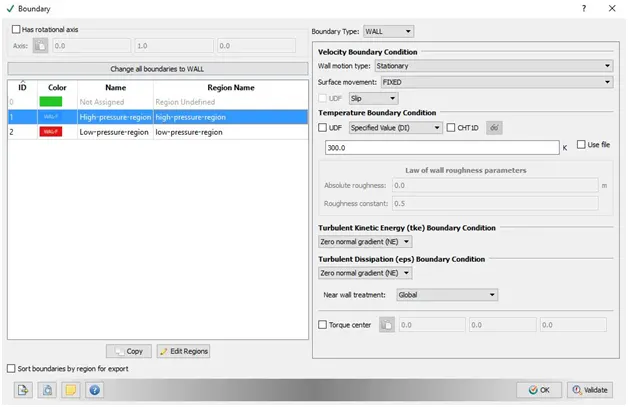
High pressure and low pressure region both have same wall conditions
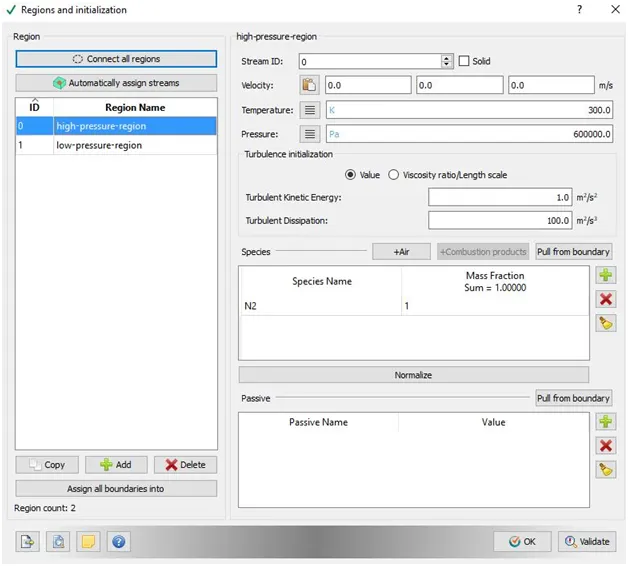
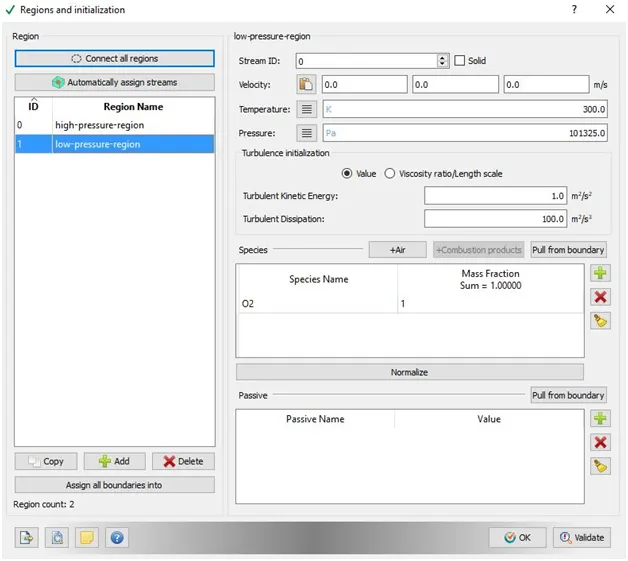
Region and Intialization
Events
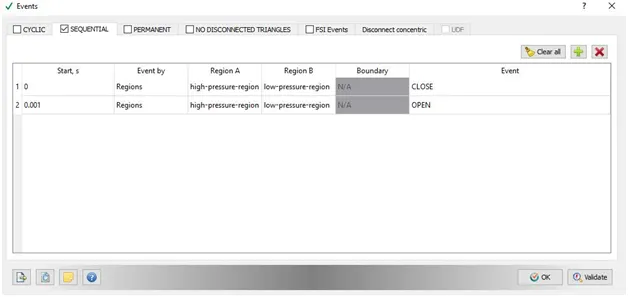
Converge uses events to activate or deactivate triangles, which controls when and where flow between the regions is allowed. An open event deactivates the disconnect the triangle thus allowing to flow from high pressure region to low pressure region In closed event connects the triangle between the two region acting as an diaphragm The event can be cyclic ,sequential or permanent
In this problem it acts separator/diaphragm between high pressure and low pressure region from to 0 to 1ms active no triangles are created only events must be define i.e closed
1ms to 3ms in this event it is opened so that reaction of high pressure to low pressure region can be observed
Meshing
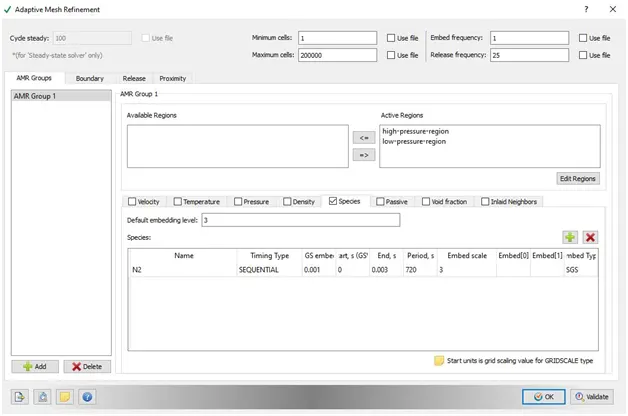
Adaptive mesh refinement
Adaptive mesh refinement (AMR) is a method of adapting the accuracy of a solution within certain sensitive or turbulent regions of simulation, dynamically and during the time the solution is being calculated. Usually the mesh is more refined than the base grid to capture more significant data in this region
In our case we need more refinement of mesh at shock location to capture temperature,pressure ,density variations
The formula used by AMR to refine the mesh
Refined Mesh grid Size =(Base grid mesh size)/(2^embedded level)=(0.003)/(2^3)=0.000375
Output
Meshing

Pressure
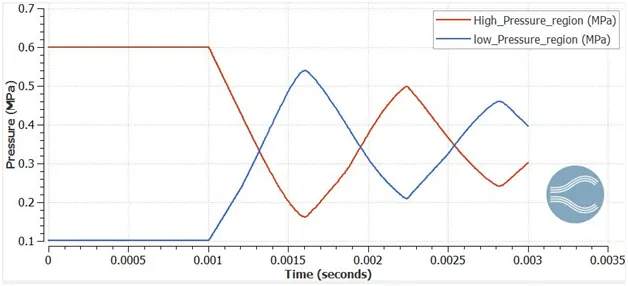
There is pressure difference of 5bar due to which the gas molecules of nitrogen N2 at high pressure tries to expand and oxygen molecules gets compressed due to incoming molecules of N2 breaks the diaphragm exerting pressure on the oxygen molecules therefore creating shock due rapid movement of N2 molecules towards the O2 molecules
Temperature
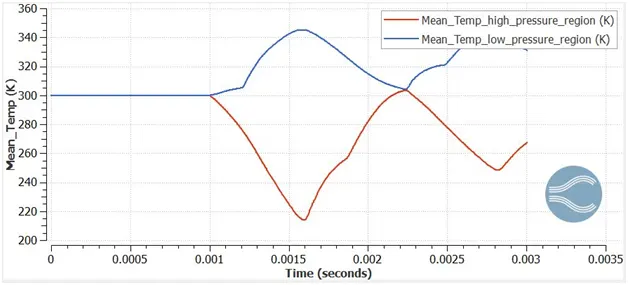
The temperature in the low pressure region increases(300k to 345K) due the increase in the molecular collision in the Low pressure region (due to expansion of N2 and compression of O2) which obeys (Charles law and due to shock variation in the temperature) at the same instance the temperature decreases in high pressure region(300k to 215k) .As the shock waves hits the wall of low pressure region walls wave again propagates towards high pressure increases its temperature(215k to 300k) in that domain and eventually decreasing the temperature(345k to 300k) in low pressure region. The cycle repeats maximum temperature decreases as the time step proceeds
Mass fraction N2 and O2
Nitrogen
Oxygen
Total cell count
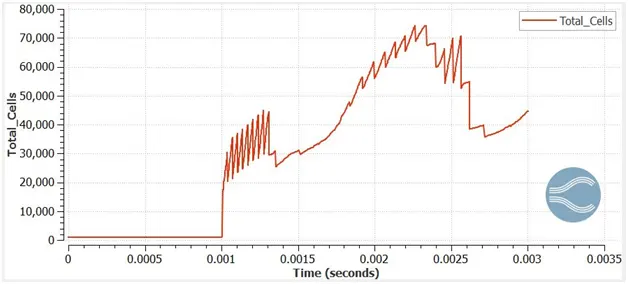
From the graph after 1ms diaphragm raptures there is an unsteady of cell counts since we have used AMR technique no of cells increases in some region(where the shock waves produced in the domain to capture temperature, velocity ,etc)
Conculusion
High and low pressure region are created , how the fixing of sprecies takes place in a tube
change in temperature,pressure and total_cell_count are observed in the tube