Week 7 - Mid-term Project - Natural Convection
Aim: low voltage control panel thermal analysis.
Low voltage control panel: it is a component of an electrical distribution system that divides an electric power to feed into branch circuits, while providing a circuit breaker.
Components of voltage panel:
Enclosure: an enclosure is a cabinet for electrical or electronic equipment.
Bus bars: a busbar is a metallic bar or strip that conducts electricity within an electronic equipment.
Circuit breaker: an electric fuse given to control the current flow through the system.
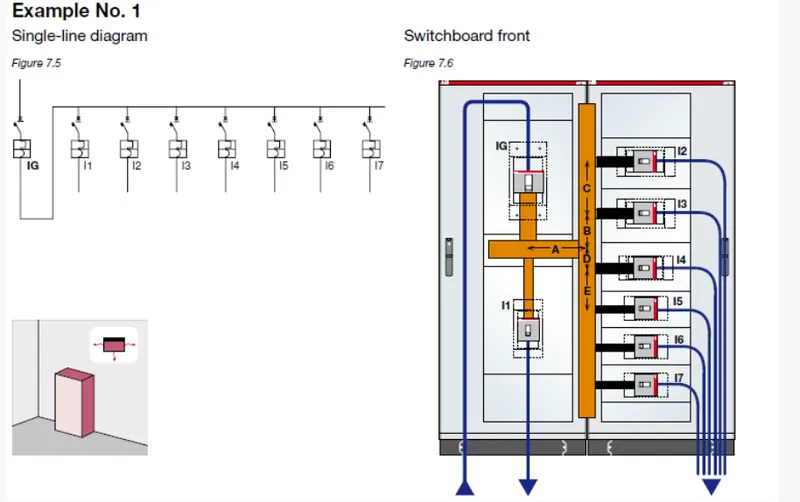
Model:
Cabinet: it creates a fluid region around the model for which the governing equations are solved.
IG block:
Block type: solid
Surface material: Paint non metallic
Solid material: Fe
Total power: 168.92 W
I1 block:
Block type: solid
Surface material: Paint non metallic
Solid material: Fe
Total power: 56.16 W
Rest of the blocks follow the same procedure.
Bus bar A:
Shape: prismatic
Surface material: Cu polished surface
Solid material: Cu pure
Total power: Joule heating
Joule heating power:
Type: constant
Current: 800amp
Resistivity: 1.72e-8 ohm
C = 0.0039
Tref: 25 degree c
Rest of the busbars follow the same procedure.
IG cable:
The cable is used to distribute the current from the busbars. The total power is distributed and is dependent on the length of the cable
Block type: solid
Surface material: Cu polished surface
Solid material: Cu pure
Total power: Joule heating
Enclosure:
Block type: solid
Surface material: paint white acrylic
Solid material: steel carbon 1020
Thermal specification: thin is set wall boundaries type and the thickness is 3mm. the radiation of all walls are activated.
Grille: grille is used for natural convection of air to keep the low voltage cool down.
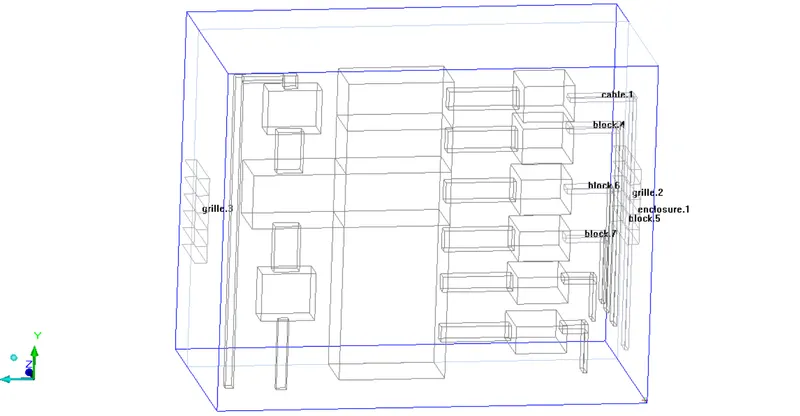
Mesh:
Assemble1:
Slack settings for assembly meshing
Min x = 2mm
Max x =2mm
Min y= 0
Max y= 0
Min z = 2mm
Max z = 2mm
Mesh type
Maximum element size in x =100mm
Maximum element size in y = 80mm
Maximum element size in z = 52.5mm
Min gap x =1mm
Min gap y = 1mm
Min gap z = 1mm
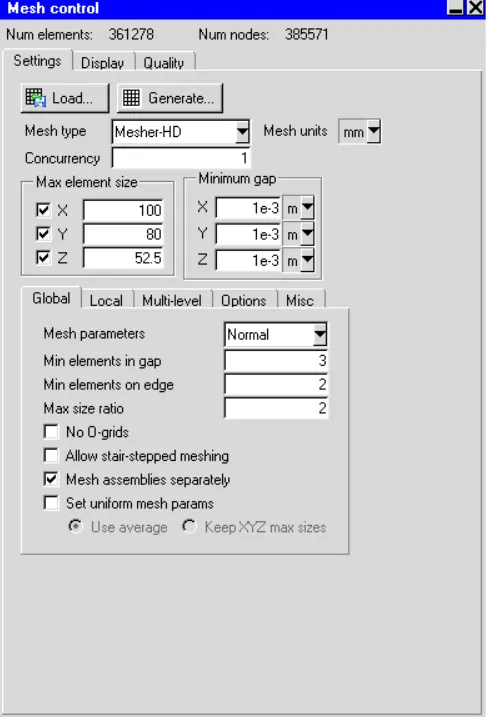
To check for validation of mesh
Macros>> productivity>> validation>> automatic case check tool
It checks the assembly interface between the various objects and assembly.
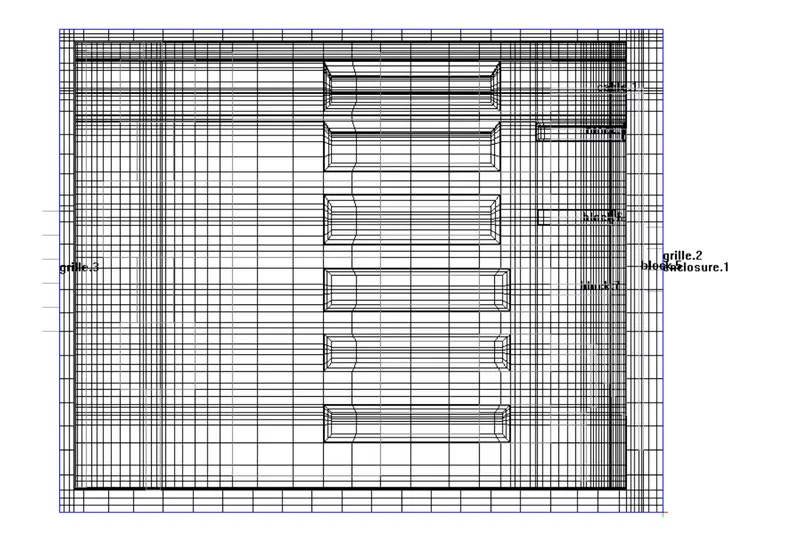
Mesh display in x direction
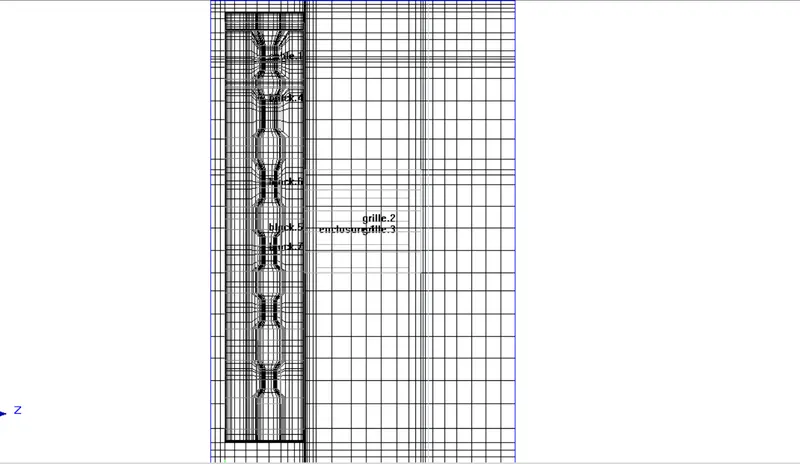
Mesh display in y direction
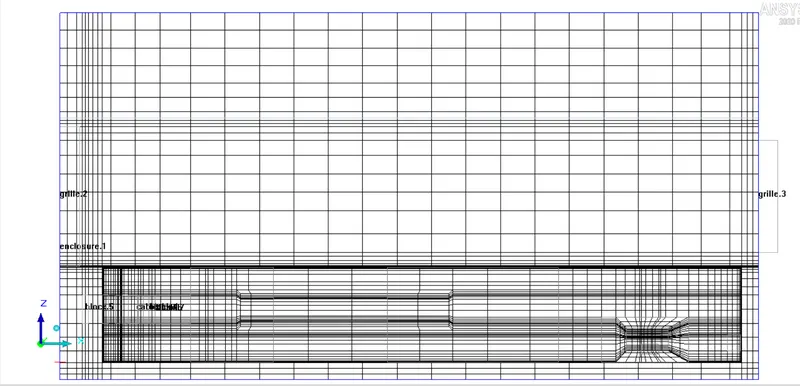
Mesh display in z direction
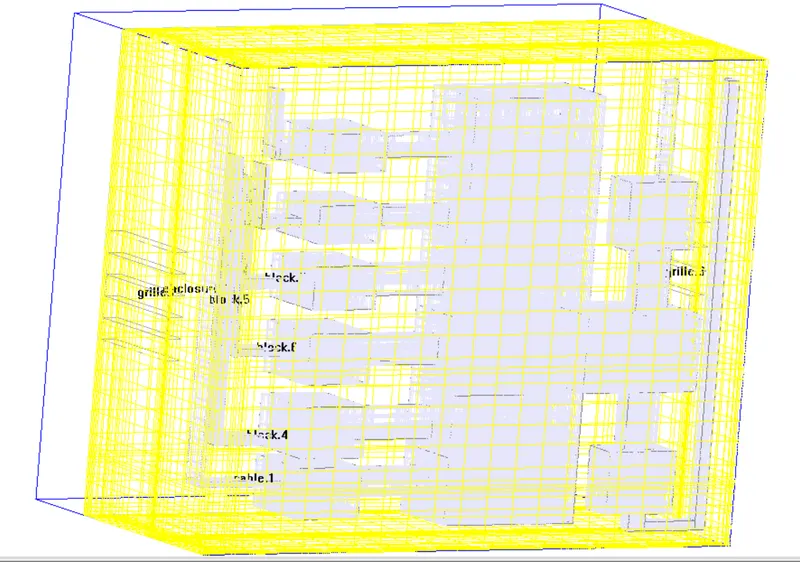
Solid and wire mesh
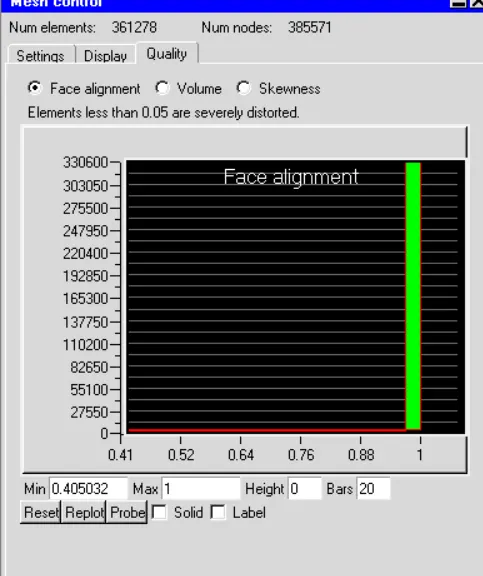
Face alignment:
Measures the mesh quality by face alignment index.
The value of face alignment ranges from 0 to 1. Value greater than 0.1 is preferred and greater than 0.15 is better.
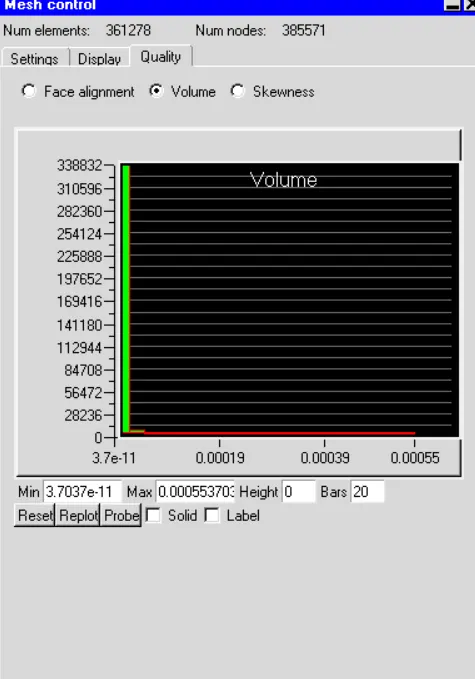
Volume:
Preferable volume mesh should be 1e-12 for single precision and 1e-15 for double precision.
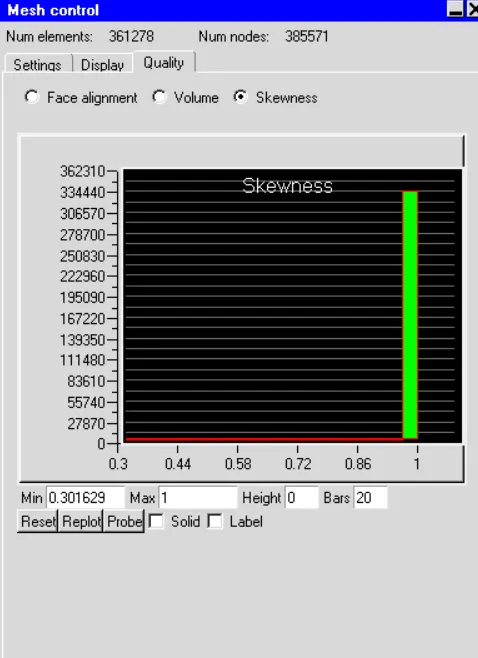
Skewness:
It determines the deviation of the mesh from its ideal shape.
Physics setup:
Solver: 3D navier stokes solver is used to study the computational domain.
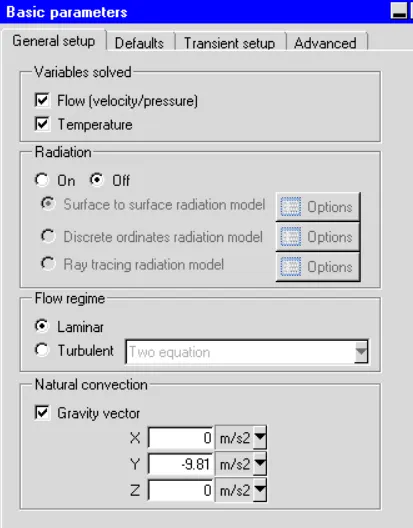
General set up:
Boundary conditions
Flow conditions
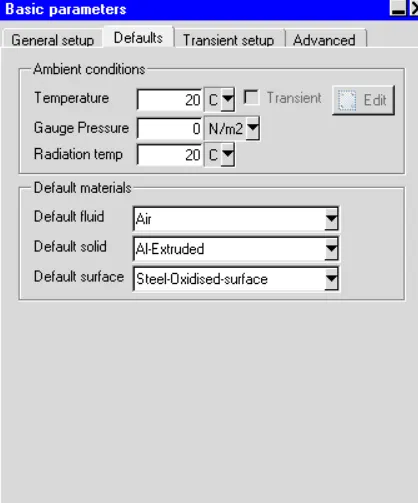
Temp 20 degree
Pressure 0Pa
Radiation temp 20degree
Default fluid air
Default solid extruded Al
Radiation: off
Transient setup: steady
Solution initialization:
X velocity- 0m/s
Y velocity- 0.005m/s
Z velocity- 0m/s
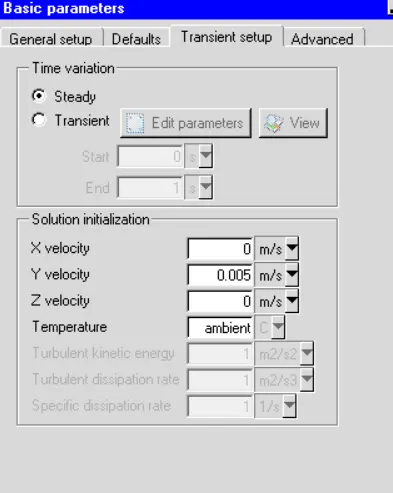
Natural convection bc
Gravity vector for y axis -9.81 m/s2
No of iterations: 200
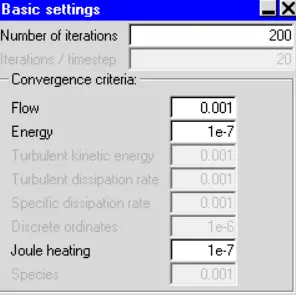
Flow convergence: 0.001
Energy convergence: 1e-10
Joule heating: 1e-7
Parallel setting:
No of processors- 4
Post processing plots
Convergence plot
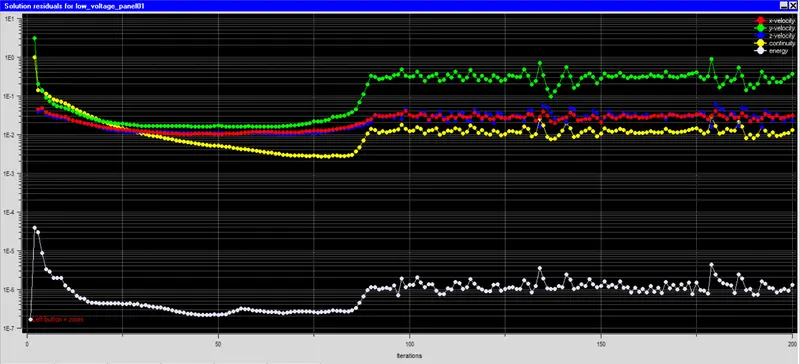
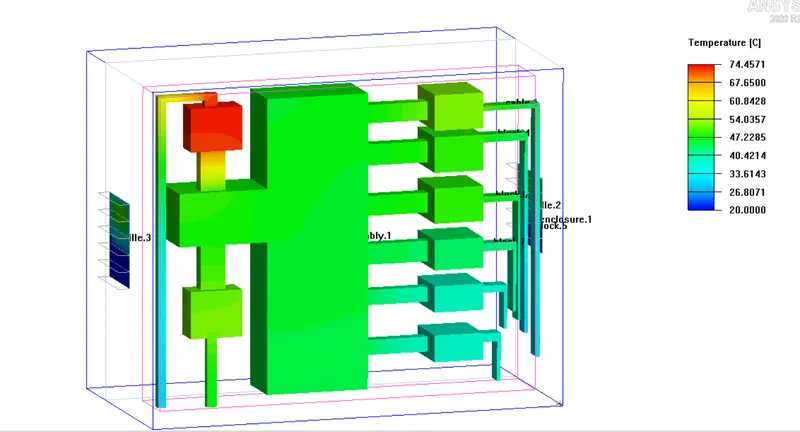
Temperature object contour
The maximum temperature at rthe block is 74.65 degree C and minimum at the cable 20 degree C.
Temperature in X axis
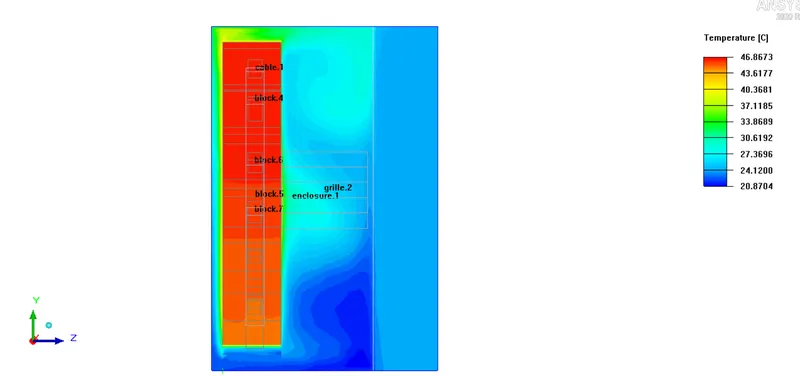
the temperature of the block is at max 46 degree. The air at the vicinity of the block is at 37 degree. Due to natural convection the air is hotter at the nearby zone and cooler at the outer zone which is at 24.12 degree.
Temperature in Y axis
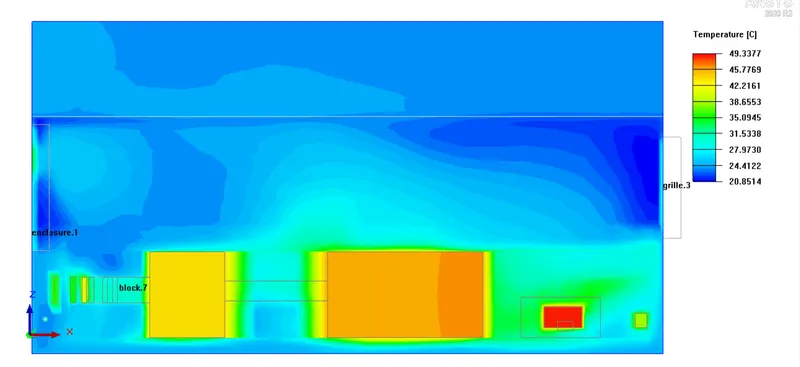
The maximum temperature is found at the block A which is 49.37 degree and the heat is transferred to the outer cables by natural convection to a temperature of 35 degree. The air flow temperature is seen to vary from 24 to 7 degree C.
Temperature in Z axis
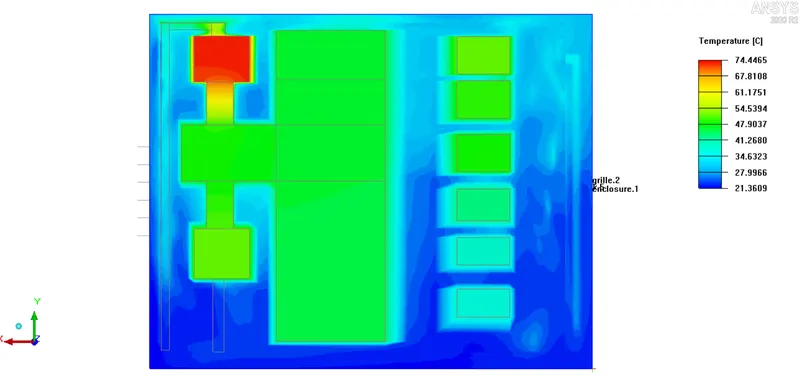
The maximum temp of 74.4 degree C is at block A and min temperature at the cable of 21.36 degree C.
Velocity vector plot
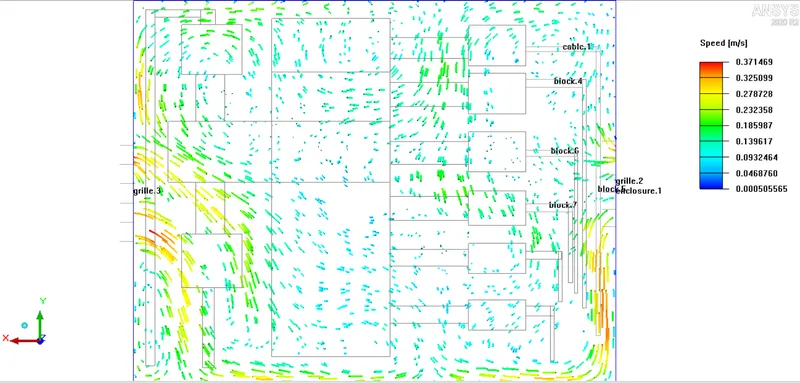
Velocity in X axis
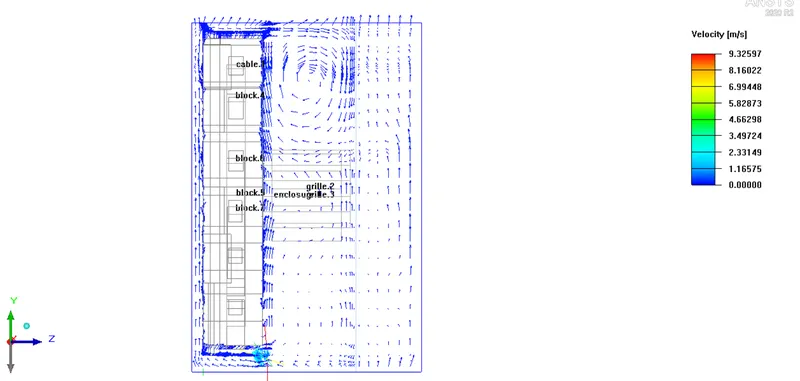
The maximum velocity of 9.32 m/s at the block A is found, where maximum joule heating is generated, while at the other place the velocity is around 1.16 m/s.
Velocity in Y axis
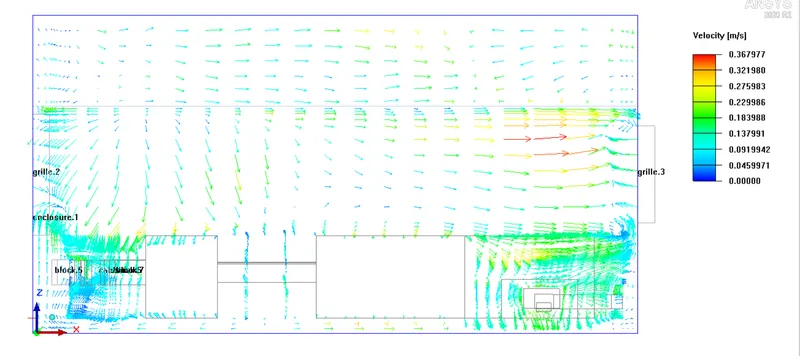
The velocity magnitude is very low with maximum velocity of 0.36 m/s and minimum of 0.04m/s. the air recirculates from inlet grille which carries away the heat from all the blocks and moves towards outlet grille.
Velocity in Z axis
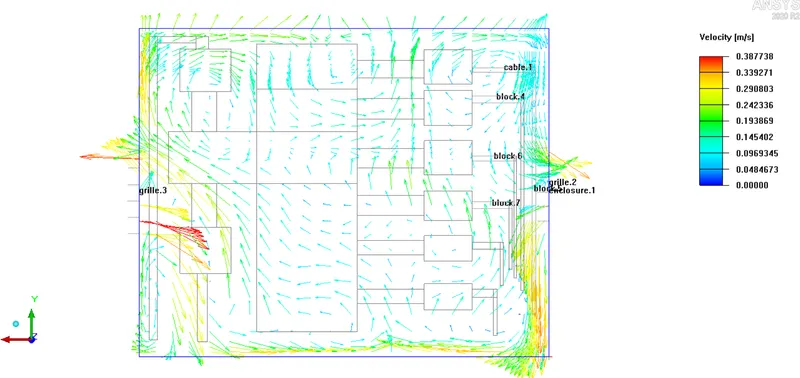
The air enters from inlet grille with max velocity of 0.38 m/s and recirculates from the top by removing heat from the heated block to the cable surface and finally moving out from outlet grille at an avg velocity of 0.3 m/s. the velocity on other areas remain at 0.19-0.048 m/s.
Conclusion:
Due to natural convection, the circulation of air takes place from the inlet grille to outlet grille. The temperature of air at the top region of enclosure is 41.23 degree C and at the bottom phase it is 21.35 degree C.
The bottom portion of the voltage panel is relatively cooler and has minimum velocity, while at the upper block heat source the velocity is relatively higher to dissipate the heat from the surface.