Week 7-Long Piston With Cam
Objective
To perform a transient analysis on a piston and cam mechanism model to find out the directional deformation, strains and stresses by varying the frictional coefficient for three cases and to compare the results.
Introduction
A transient analysis on the long piston and cam problem is simulated. The geometry is imported and checked for any irregularities in the spaceclaim. If not, the spaceclaim is closed and the model scheme is updated with the geometry.
Transient analysis is a type of analysis where the model is put under a time-dependent loads. It means the loads vary with time and it increments as time increases. here, the rotation of the barrel cam is given in time increments.
Procedure
The materials employed for the components are general structural steel. Since the barrel is going to be rigid without any motion, its stiffness behaviour is changed to rigid. As it is changed to rigid, the meshing of that component does not happen as it is unnecessary elements/nodes.
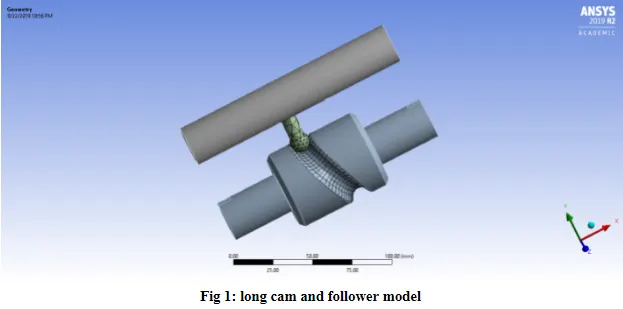
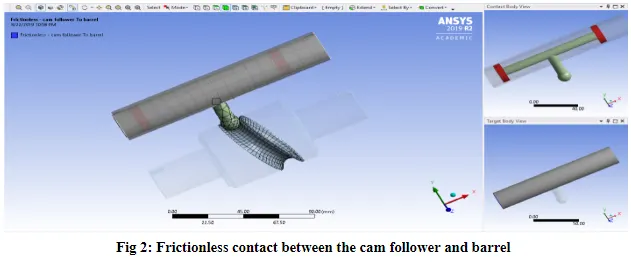
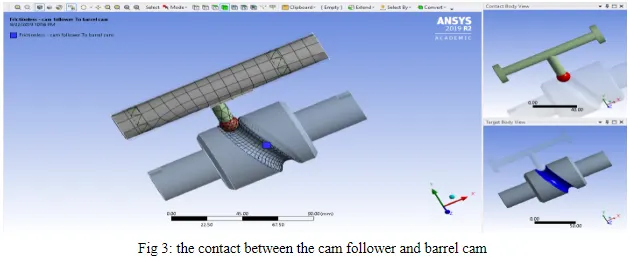
The contacts are established. A frictionless contact is established between the cam follower and the barrel by taking the cam follower as the contact body and the barrel as the target body. The next contact is between the cam follower and the barrel cam. Its frictional coefficient is what changed and that results are compared.
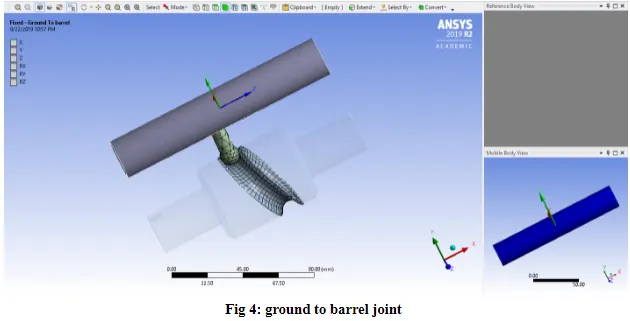
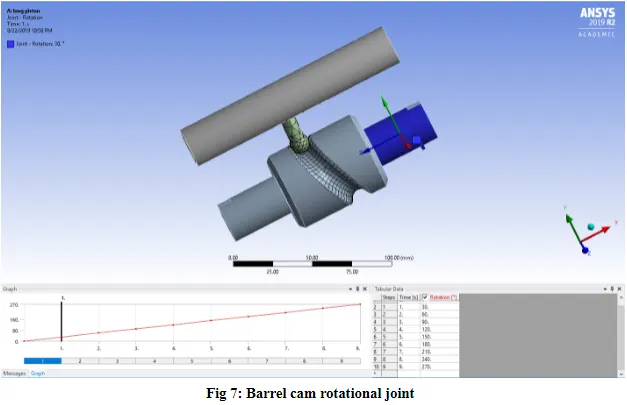
The joints are established. Since the barrel is rigid, a fixed body-ground joint is established for the barrel. The rotation of barrel cam is given by using the revolute body-ground joint. Its rotation is given in steps. As the cam follower is going to slide inside the barrel, a translation body-body joint is established with barrel as reference and cam follower as the mobile.
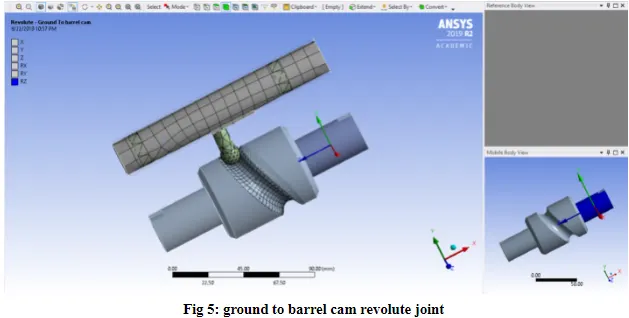
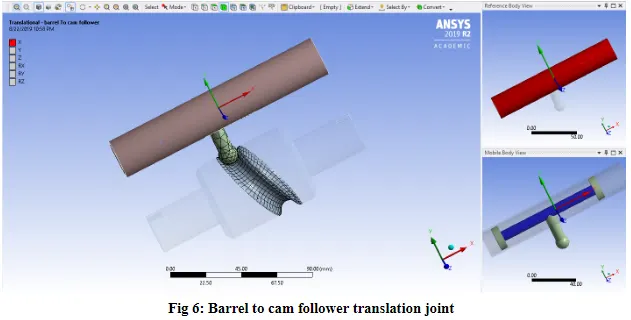
Meshing is done on the cam follower and a face sizing is done on the cam tip and the cam path. Meshing the other parts is going to increase the elements unnecessarily. The analysis settings are given in 9 steps with increments of 30 degrees.
Step Controls
Number Of Steps 9.
Current Step Number 1.
Step End Time 1. S
Auto Time Stepping On
Define By Time
Initial Time Step 0.1 s
Minimum Time Step 5.e-002 s
Maximum Time Step 0.3 s
Time Integration On
Solver Controls
Solver Type Program Controlled
Weak Springs Program Controlled
Large Deflection On
Nonlinear Controls
Newton-Raphson Option Program Controlled
Force Convergence Program Controlled
Moment Convergence Program Controlled
DisplacementConvergence Program Controlled
Rotation Convergence Program Controlled
Line Search Program Controlled
Stabilization Constant
--Method Energy
--Energy Dissipation Ratio 0.1
--Activation For First
Substep Yes
--Stabilization Force Limit 0.2
Solution
The long cam and follower simulation is carried for 3 different frictional cases and the results are obtained.
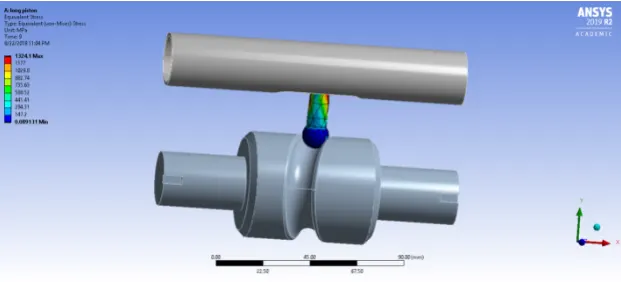
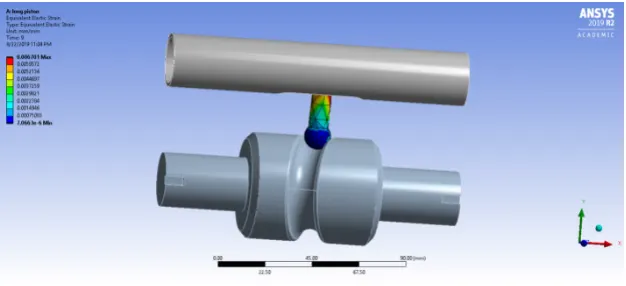
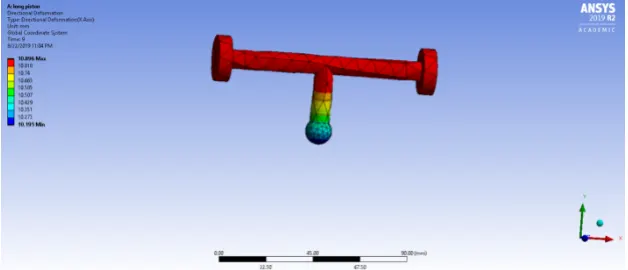
Case 1: Frictionless
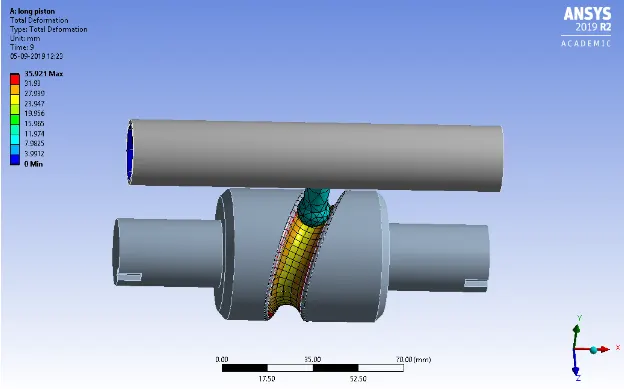
Total deformation: 35.921 MPa Max
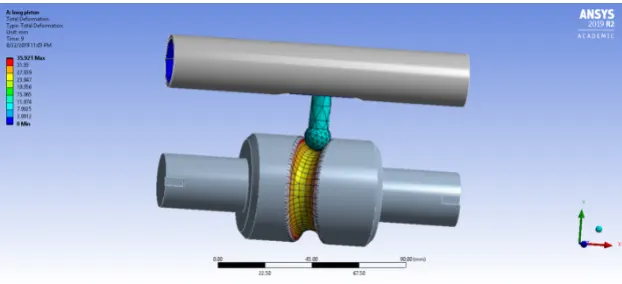
Equivalent stress: 1324.1 MPa Max
Equivalent strain: 0.006701 Max
Directional deformation: 10.89
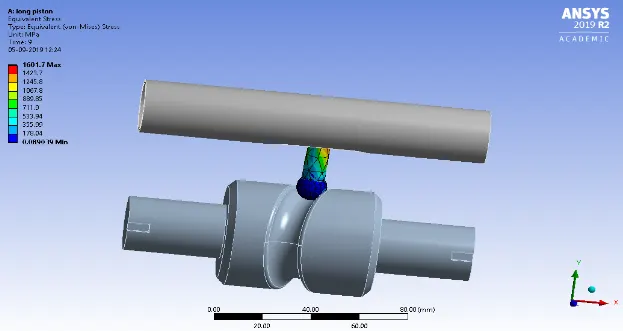
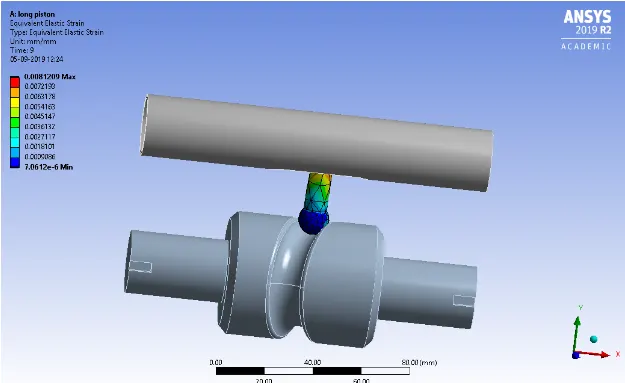
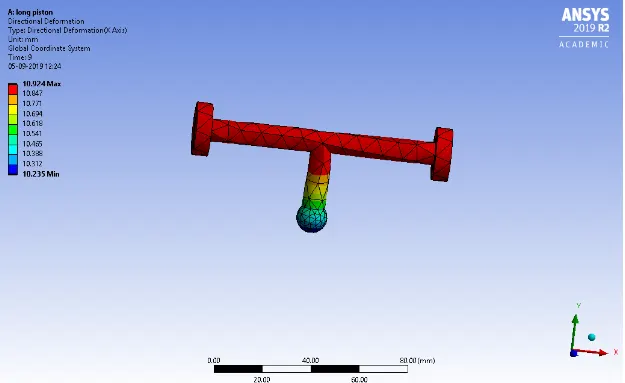
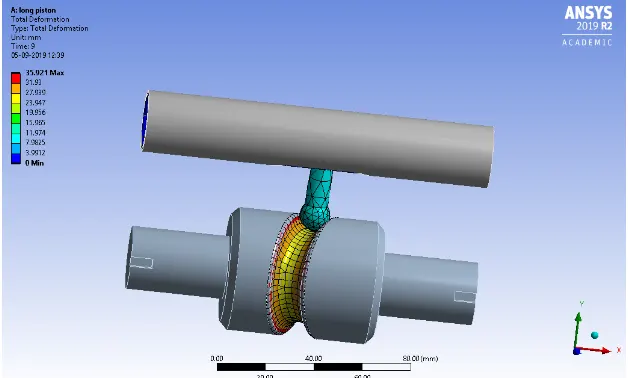
Case 2: for frictional coefficient of 0.1
Total deformation: 35.921 MPa Max
Equivalent Stress: 1601.7 MPa Max
Equivalent Strain: 0.00812 Max
Directional Deformation: 10.924 mm Max
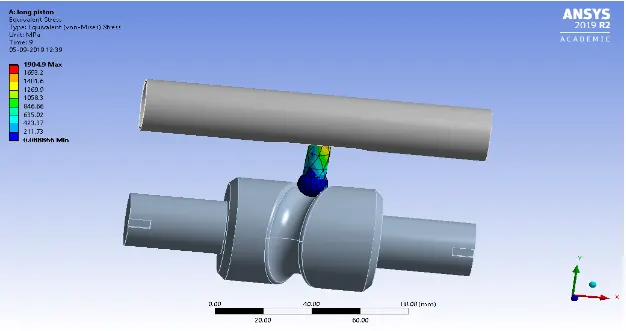
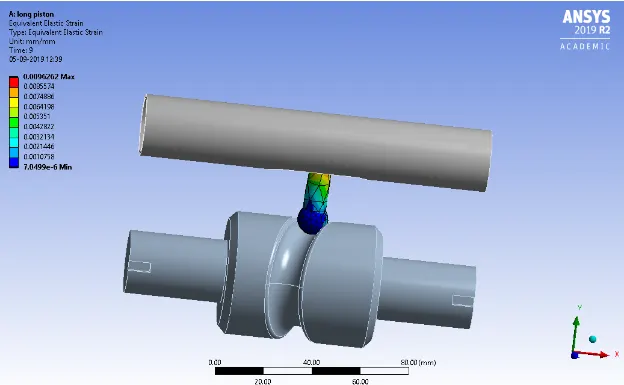
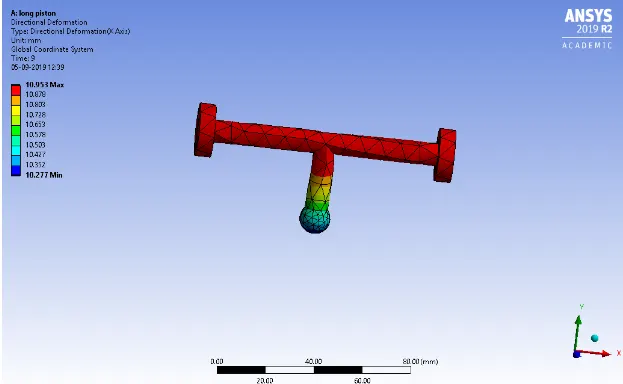
Case 3: For Frictional Coefficient of 0.2
Total deformation: 35.921 mm Max
Equivalent stress: 1904.9 MPa Max
Equivalent Strain: 0.00962 Max
Directional Deformation: 10.953 mm Max
Conclusion
The long piston with cam follower simulation is carried out and the results are tabulated below
|
Solution |
Frictionless |
0.1 |
0.2 |
|
Total deformation |
35.921 |
35.921 |
35.921 |
|
Equivalent stress |
1324.1 |
1601.7 |
1904.9 |
|
Equivalent Strain |
0.0067 |
0.00812 |
0.0098 |
|
Directional deformation |
10.89 |
10.924 |
10.953 |
From the results above, we can conclude that as the frictional coefficient increases the corresponding stress values increase. This is due to the fact that as the coefficient of friction increases, it imparts some resistance while motion. As the frictional force is the product of load and frictional coefficient, as the frictional coefficient increases when it is multiplied with the load a much higher frictional force is produced. This is in turn leads to increase in stress and strain.
Hence, a high amount of stress is produced when the coefficient value is 0.2 and it is less when it is frictionless.