Week 7: Literature review : RANS derivation and analysis
RANS Derivation & Analysis:
Aim:
- To apply Reynold’s decomposition to the Navier Stokes equations and come up with the expression for Reynold’s Stress.
- To explain the understanding of term Reynold’s Stress.
- To explain Turbulent viscosity and differentiate it from molecular viscosity.
We should first understand the phenomenon of turbulence and why RANS modelling approach is required.
Turbulence:
Turbulence is a state of fluid in which the flow is unstable, irregular and chaotic. This is the opposite of laminar flow. The turbulence phenomenon takes place in various heat exchanger application and the effects of which are needed to be studied according to the applications.
Turbulence is characterized by Reynold’s number (Re) which is the ratio of inertia forces to the viscous forces. Based on the Reynold’s number a flow can be characterized as laminar of turbulent flow. Higher the ‘Re’, more unstable the turbulent flow is. For the flow to be turbulent Re must be greater than the critical value.
For eg.:
If the Re of the flow in a round pipe:
- is less than 2300, then it is a laminar flow
- is more than 4000, then it is a turbulent flow
- is between 2300 to 4000, then the flow is in transient state.
What is a Turbulent Model ?:
In an IC engine or Gas turbine due to high velocities, the flow is almost always turbulent.
In non-premixed engines, combustion depends on the rate of fuel-air mixing. Turbulence increases the rate of mixing and if we have to capture this in a simulation, then the number of computational cells are in the order of 1e-6 m.
In premixed engines, turbulence stretches the flame surface area, enhancing the burning rate, so we will need the number of computational cells in the range of 1e-5 m to accurately capture this process.
Since to check turbulence frequency in a very small time step and at a very small distance, the number of cells will be high, this becomes impractical for simulation. Hence, a turbulent model with Reynold’s decomposition is applied, so that average can be worked out to capture the effects of turbulence with the help of coarser grid and larger time steps.
There are two typs of turbulence modelling approaches:
- Reynolds Averaged Navier Stokes model (RANS)
- Large Eddy Simulation model (LES)
Reynold’s Averaged Navier Stokes Modelling:
This approach solves the equations for an ensemble-averaged OR time averaged velocity field and the magnitude of the turbulent fluctuations.
In this type of modelling, the first thing carried out is Reynold’s decomposition. Here, the instantaneous velocity is divided into a mean and fluctuating component. We try to solve for the ‘mean velocity’ and the ‘fluctuating velocity’ component is modelled or approximated.
The equation is written as below:
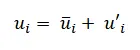
Where,
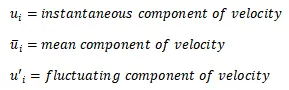
This Reynold’s Decomposition equation is used in the Navier Stokes equation and time averaging the results produces RANS equation.
Reynold’s Stress: After solving / time averaging the RANS equation, we obtain an additional important term called as Reynold’s Stress (Ꞇij). The diffusion of momentum due to turbulence is called as Raynold’s Stress.
The turbulence modelling is focused on calculation of Reynold’s stress accurately.
The Reynold’s stress is expressed as below:
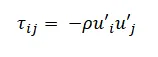
Turbulent Viscosity: The Reynold’s Stress has two important factors which are Turbulence Viscosity (μ) and velocity gradients. The turbulent transfer of momentum by eddies giving rise to an internal fluid friction, in a manner analogous to the action of molecular viscosity in laminar flow, but taking place on a much larger scale. Eddy viscosity is a function of the flow, not of the fluid. It is greater for flows with more turbulence.
There are various models to solve for turbulent viscosity. In Converge we are mainly using:
- RNG k-ε (k-epsilone)
- K-ω SST (k-omega SST)
Molecular Viscosity: At a molecular level, viscosity is a result the interaction between the different molecules in a fluid. This can be also understood as friction between the molecules in the fluid. Just like in the case of friction between moving solids, viscosity will determine the energy required to make a fluid flow.
Molecular viscosity is at a microscopic level occurs due to friction between the two molecules whereas the Turbulent viscosity is a property of flow which occurs due to fluctuation inside the flow.
Application of Reynold’s Decomposition to Navier Stokes Equation:
In Renold’s Decomposition, the velocity component is split into its mean and fluctuating components as below:
u (x,y,z,t) = um (x,y,z) + uf (x,y,z,t)
v (x,y,z,t) = vm (x,y,z) + vf (x,y,z,t)
w (x,y,z,t) = wm (x,y,z) + wf (x,y,z,t)
Where, ‘m’ stands for mean component and ‘f’ stands for fluctuating component.
The mean component is expressed as time average of instantaneous velocity over the turbulent time step.

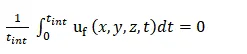
If the fluctuating component of velocity is integrated then its value becomes zero, expressed as below:
Navier stokes equations are basically Continuity equation and Momentum equation.
Continuity Equation:
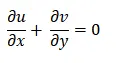
Now, applying Reynold’s decomposition to Continuity equation -
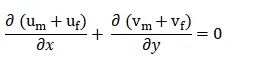
Integrating this equation with time interval -
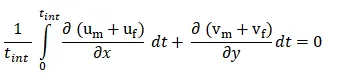
Splitting the equation –

Now, the time integral of fluctuating components becomes zero. Hence,
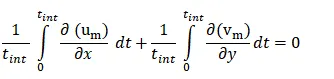
Now, applying the limits of integration,
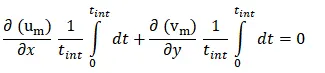
So, the continuity equation is simplified as below:
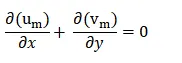
Hence, time averaged mean component of velocity satisfy the Continuity Equation.
Momentum Equation:

Now, density is taken to the other side of the equation,

Where, μ/ρ is expressed as kinematic viscosity (ν),
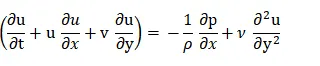
Now, introducing continuity equation and multiplying it with x component of velocity. This is done to convert the equation into suitable form.

Solving further,

Here, we introduce,
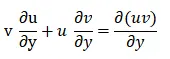
Therefore, the equation becomes,

Now solving further,

Now, applying time integration and Reynold’s decomposition,
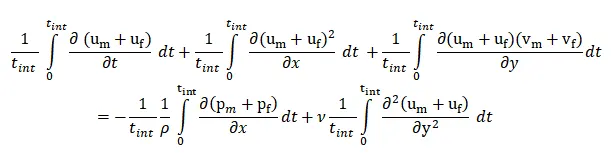
The value of integral of fluctuating terms will be zero, so the equation will be:

Now, assuming that inside a boundary layer x component of velocity has negligible value, so we consider it is as zero. So the equation remains as:

The above equation consists of Inertial Terms, Pressure term and Momentum Diffusion term.
The Momemtum Diffusion term consists of following:
- Molecular Viscosity,
 , which is called as viscous stress.
- Diffusion of momentum due to turbulence,
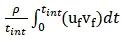 , which is called as Reynold’s stress.
Conclusion: The Reynold’s decomposition is applied to Navier Stokes equation and as a result Reynold’s Stress is obtained.