Week-7 Head Impact
Head Impact analysis of the Pedestrian Hitting the car bonnet
Introduction:
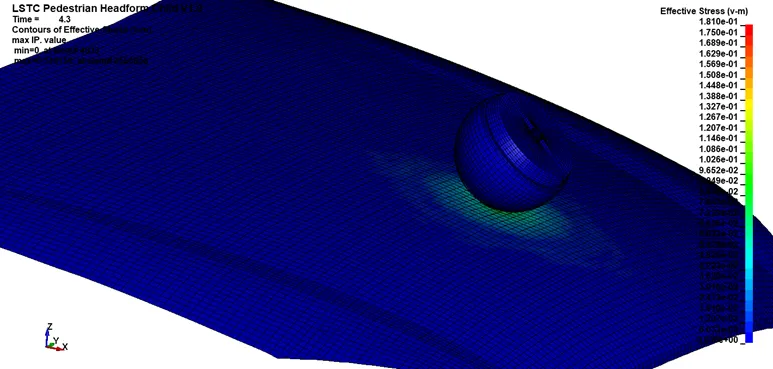
Head impact is the most vital simulation done throughout the automotive industry. It is very important because even small effect on the head can cause severe damage in brain and ultimately cost the quality of the life. Previously, these were not a concerned and front part of the car used to make strong and hard. But nowadays, taking pedestrian accident and study, it is suggested that many lives can be saved by making design of the car bonnet from the perspective of pedestrian lives. In this simulation we have taken the head model distributed by the LSTC group for more realistic simulation.
Modeling and Boundary conditions:
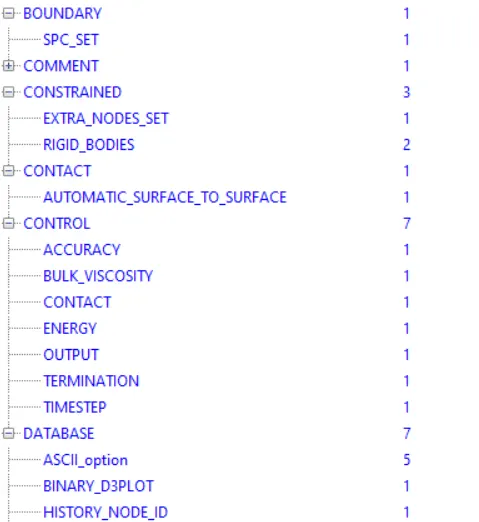
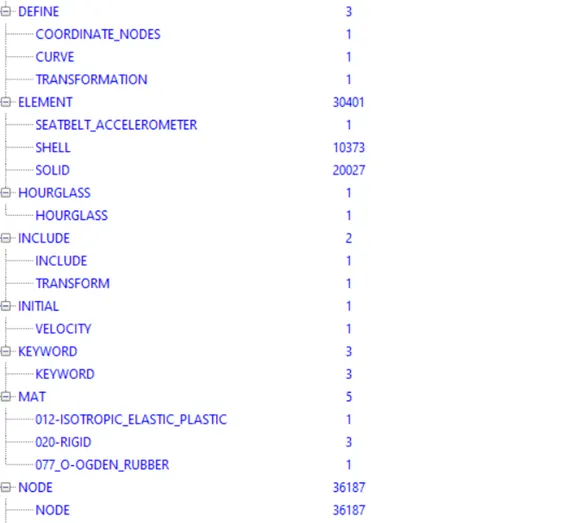
These are keywords used for modeling this model. The boundary conditions called "SPC_SET" is used for fixing the outer edge node set in all directions. The "CONSTRAINED" keyword is used in head model to create "Extra node set" and " Rigid body". The "CONTACT" keyword is created for the "AUTOMATIC _SURFACE_TO_SURFACE" contact between the head and the hood. The "CONTROL" keyword is used for handling the simulation in an efficient manner. The "ACCURACY" keyword help us to control the stress and node numbering. The "BULK VISCOSITY" is left default. The "CONTACT" help us control the initial penetration and sliding measurement control. Other, control keyword called "ENERGY" is used to calculate and include the different types of energy like hourglass energy, sliding energy, damping energy and whether to include that in energy balance or not. The "OUTPUT" control keyword is use for controlling how the output of the energy is printed like interval of printing the every calculated data, interval of showing the error in d3hsp file and so on. Finally, the termination keyword is use for ending the simulation and time-step is use for dividing the numerical problem in to small interval.
The "isotropic_elastic_plastic" material is use for the aluminum metal for hood. The "rigid" mat is use for the "Skull", "Acceleration plate", and "Back plate". The "O-OGDEN_RUBBER" is used for the skin of the head model. The head skin is made for the 3D elements.
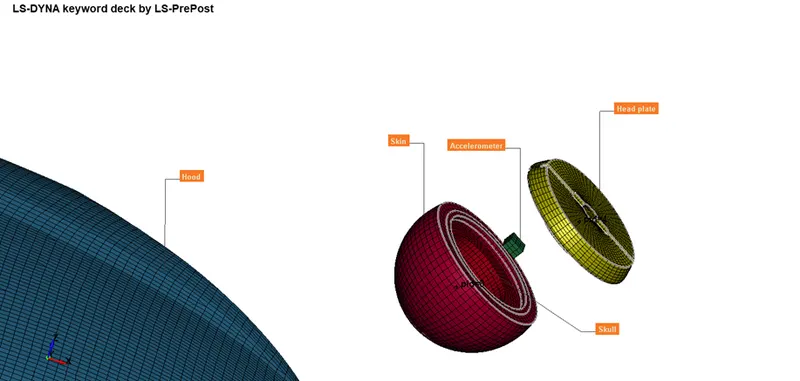
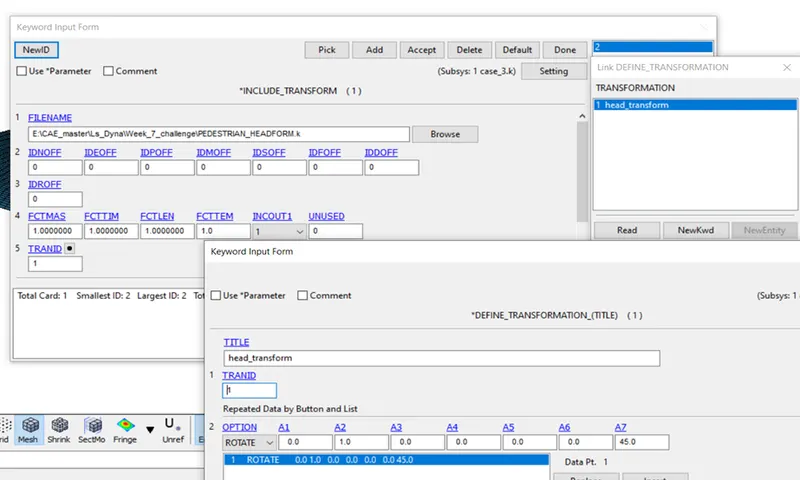
The keyword "INCLUDE" is use for including the head in the hood model with transformation of 45 degree angle to the horizontal.
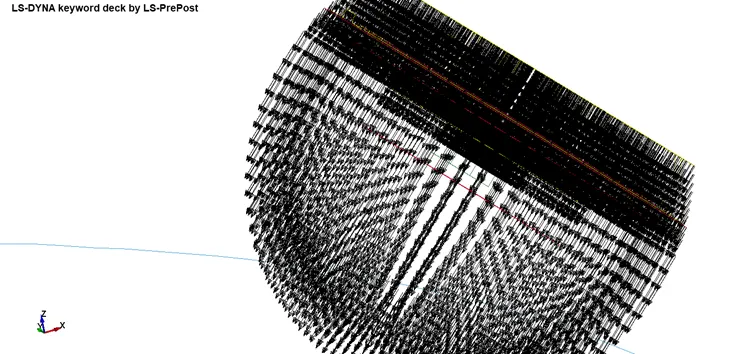
The initial velocity is assigned to all parts of the head so that no energy will be lost in propelling the other part of the head. Otherwise, one will see some stress occurring on the part of head which is not assigned to the velocity.
Analysis and Discussion:
CASE 1: Simple head impact with the rigid wall
Simple ball shape head is used for the validation and simplification of the problem at the start. Below we see some of the result on what happen if the simple head impact with rigid wall.
Energy balance:
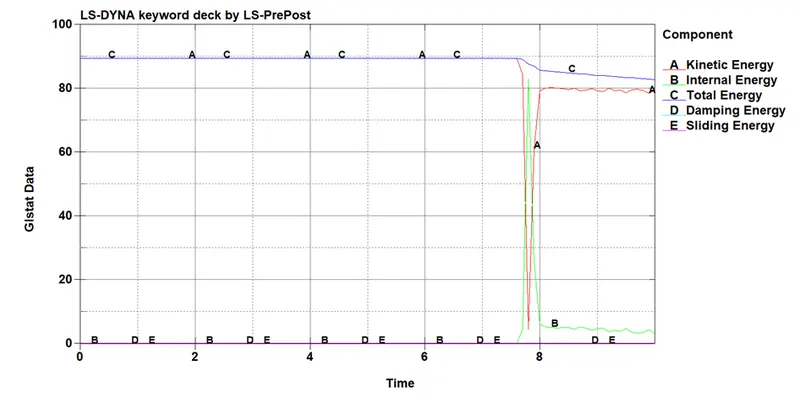
From above plot, it is obvious that the total energy of the system is conserved until the 7th second then after the total energy has decreased due to increasing damping energy of the system. Now, we can proceed ahead to see the HIC 36 value of the head impact over the rigid wall.
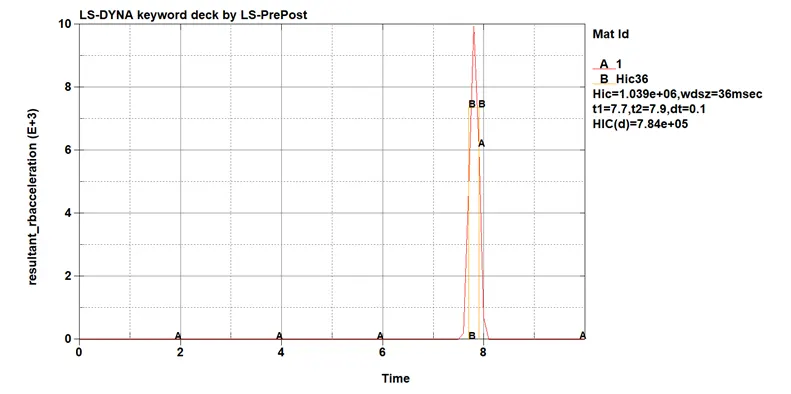
It is said that the HIC value below 1000 is safe for the head and cause very less injury. Due to pendulum like system of the head, the acceleration of the head due to braking cannot be impeded thus it can achieve higher velocity within a very short period of time. In this case, the HIC value is considerably high, 7.84E5 for 0.2ms only.
CASE 2: Head form impact to the rigid wall
Energy:
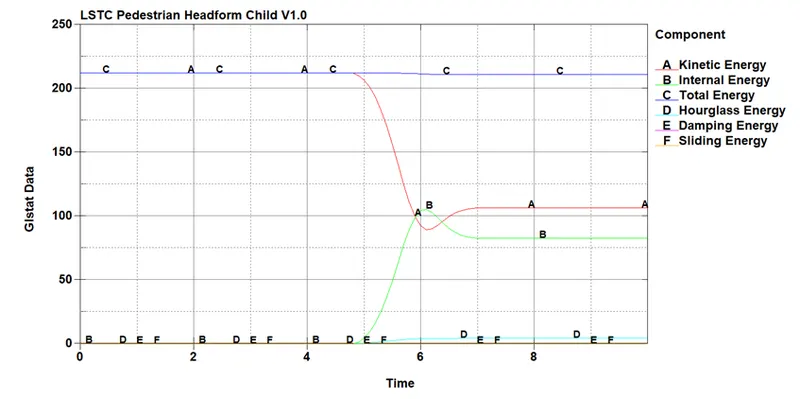
The total energy of the system is conserved until head hits to the rigid wall. However, total energy of the system is not altered significantly. The increase and decrease in the kinetic and internal energy are correspondingly opposite to each other which is good from the perspective of validation. Now, we should check the HIC value for the head while hitting the rigid wall.
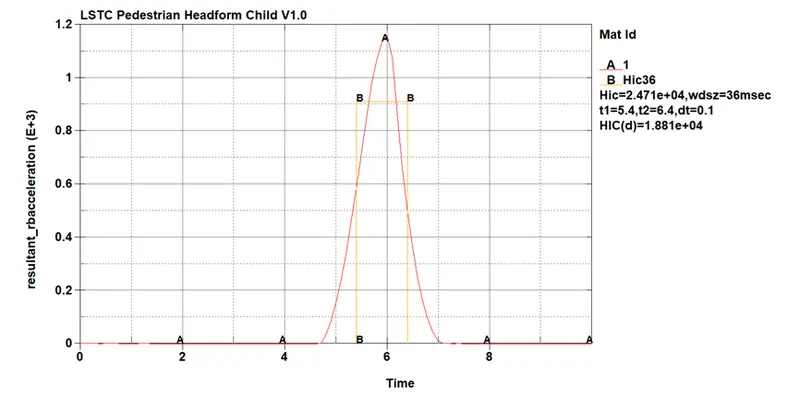
The HIC value in this case is less than the previous case. The time duration in this case is higher for impact which is almost 1ms. It is due to the skin which increases the damping and hence the time for contact.
CASE 3: Head form impact with the car bonnet
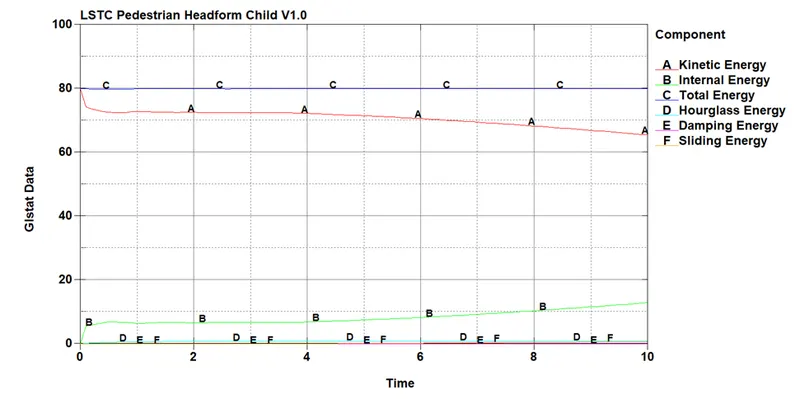
The total energy of the system is constant over the time. As we can see from the above plot, internal energy of the system is increasing gradually at the expense of kinetic energy of the system. Other energy like hourglass energy, damping and sliding energy are very less and can be neglected. This case is more relevant to the real world situations so we expect less HIC during impact of the head with the bonnet.
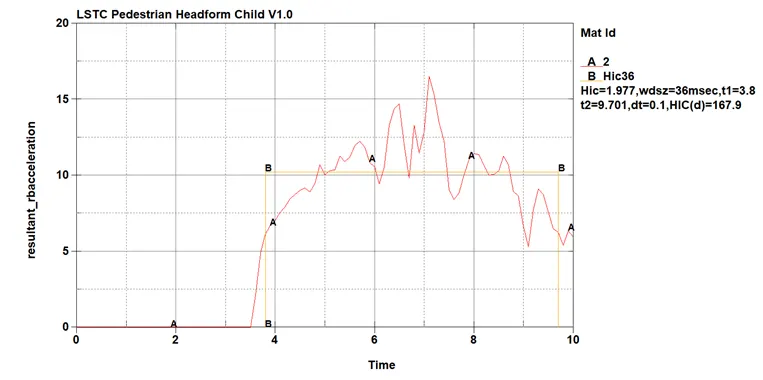
The HIC value in this case is only 167.9 which is far below as compared to the previous two of the cases. The time of impact is also long of about 5.9ms. If we compare this HIC value with set standard by FMVSS then we will find this HIC value compatible and bonnet will pass the pedestrian safety standard.
Comparison of the stress occurring on the head in case 2 and 3:
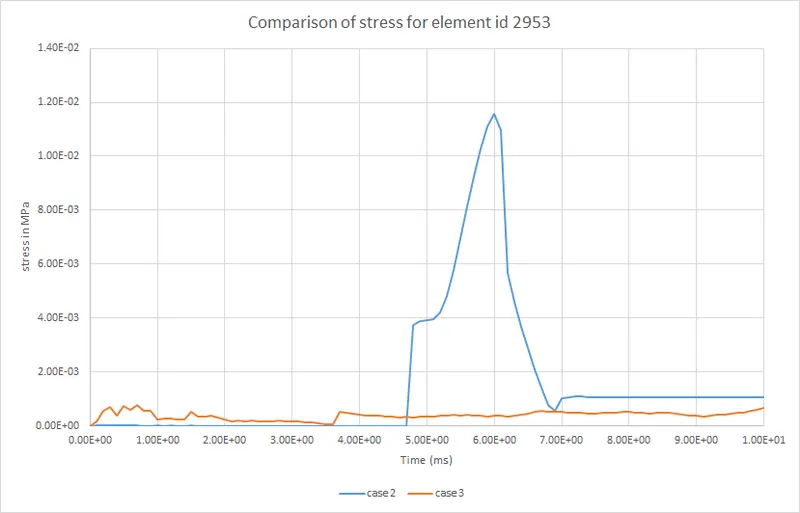
From above plot, we can easily distinguish the variation in both the cases. Here, it is obvious that the stress value is high in case 2 while impacting the rigid wall which is not the case in case 3. In case 3, the value of the stress is very low and increases the chance of head safety while creating maximum damage to the bonnet. Similarly, if you check the value of HIC in both cases you will find the similar pattern. Thus, from here it is clear that we can save life of occupant by creating an optimum design from the perspective of occupant safety.
Learning Outcomes:
- How to calculate the HIC value and interpret the result
- The importance of designing the car front part from the perspective of occupant safety and protection
- Differences of hitting the hard and soft object and their injury criteria
Conclusions:
The injury to the occupant head can be reduced by reducing the impact strength of the bonnet and making the bonnet crushable at the optimum level.