Week-7 Head Impact
Aim:
In this project, a children's head form model is provided. We are supposed to replicate a scenario where this head form will impact on a car bonnet. The bonnet should be considered as a rigid wall for the 1st case and while using the meshed hood model a elasto-plastic material card has to be used. From the simulation, the head impact coefficient must be calculated manually and with the help of LS-PrePost. We need to perform the Head Impact Simulation and calculate the HIC value in the LS-PrePost.
- We need to organize a multi-include file model using the keywords *INCLUDE, *INCLUDE_TRANSFORM, *DEFINE_TRASFORMATION.
- The Impact angle of the Pedestrain Head is between 35-75 degrees.
- Create a simple elastic material model for the simple head (meshed) that is provided.
The report should contain the following,
- The impact simulation of a simple head impact with the Rigid wall.
- The impact simulation of the Headform provided with the Rigid wall with the Stress / Strain plots and acceleration plot.
- The impact simulation of the head form with the Hood with the Stress / Strain plots and acceleration plot. For the hood, you can use Aluminium.
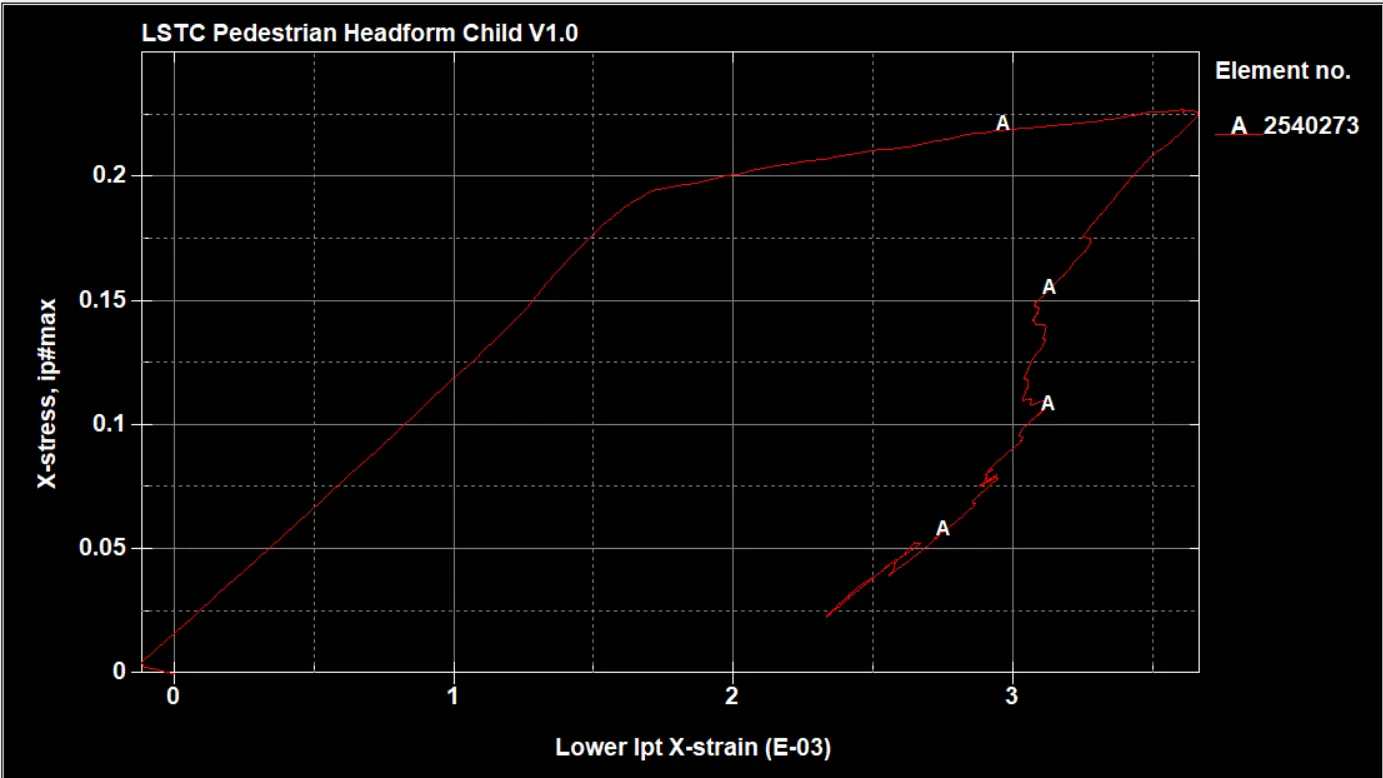
- The Stress / Strain plot from the Rigidwall simulation should be compared with the Stress / Strain plot from the Hood Simulation and there should be a detailed explanation if there is any difference in the plots.
Theory:
Pedestrain Head Impact
Pedestrian protection CAE is a part of vehicle safety engineering from a crash perspective. In pedestrian protection, we look for imparting minimum injury to head, upper leg (thigh), and lower leg (including knee) in case of an accident with a human subject. These tests are usually done at a lower velocity from 20-40 kmph as accidents tend to result in more severe circumstances above these velocities and braking in case of an accident often results in collision at low velocities.
Head Injury Criterion (HIC)
It is a measure of the likelihood of head injury arising from an impact. The HIC can be used to assess safety related to vehicles, personal protective gear, and sport equipment. Normally the variable is derived from the measurements of an accelerometer mounted at the center of mass of a crash test dummy’s head, when the dummy is exposed to crash forces.

where t1 and t2 are the initial and final times (in seconds) chosen to maximize HIC, and acceleration a is measured in as (standard gravity acceleration). The time duration, t2 – t1, is limited to a maximum value of 36 ms, usually 15 ms.
This means that the HIC includes the effects of head acceleration and the duration of the acceleration. Large accelerations may be tolerated for very short times.
At a HIC of 1000, there is an 18% probability of a severe head injury, a 55% probability of a serious injury and a 90% probability of a moderate head injury to the average adult.
PROCEDURE:
Case (i) : Simple head model impacting against rigid wall
* MAT PIECEWISE LINEAR PLASTICITY card is used to give the material property where aluminium material is used for the head.
* SECTION shell is used to specify the section of head with ELFORM 2 and thickness 1.5mm.
* Section and material is assigned to the part.
* RIGIDWALL planner is used to create a rigid body to strike the head with making the distance with around 10mm from head.
* CONTACT – AUTOMATIC SINGLE SURFACE used to give the contact of head and rigid wall. Where head nodes selected as slave set.
* INITIAL VELOCITY given as -11.11 mm/ms along z direction.
* CONTROL Termination ENDTIM is given as 3ms.
* DATABASE binary d3plot to get the outputs in time interval, ASCII option is used to get the required outputs, EXTENT binary is used to get the strain data, HISTORY node is used to get the output for particular node.
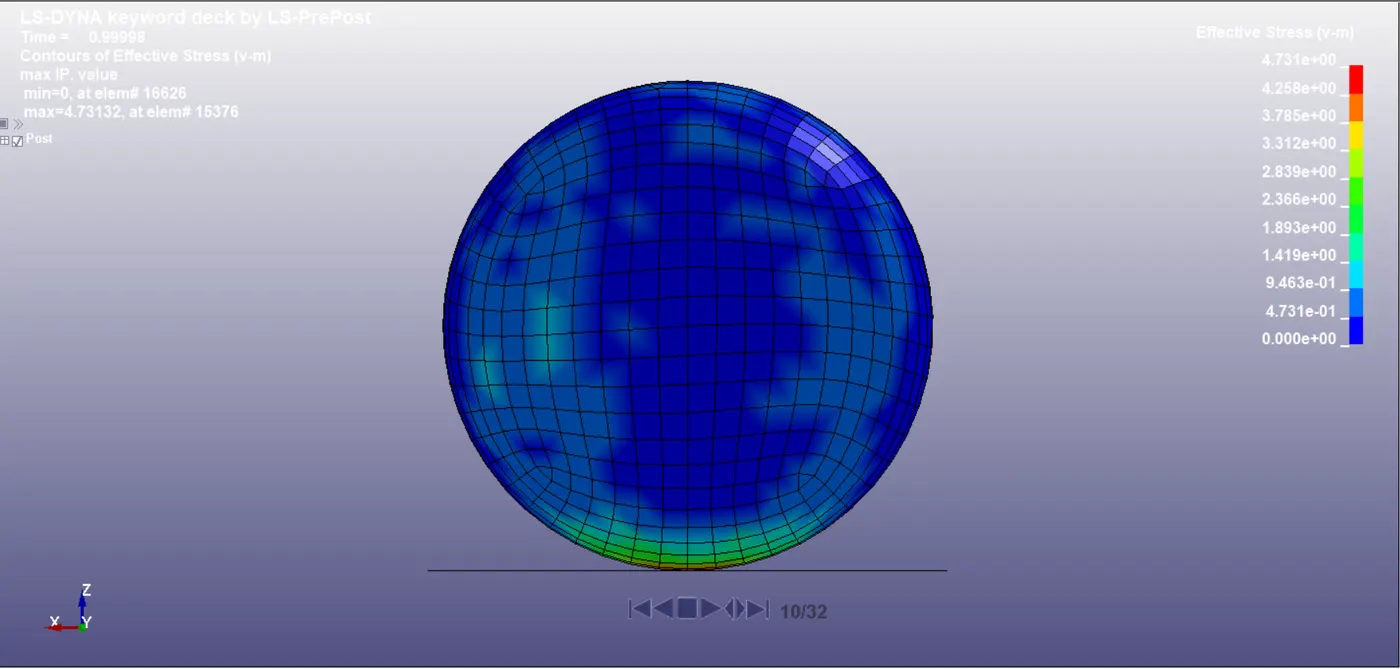
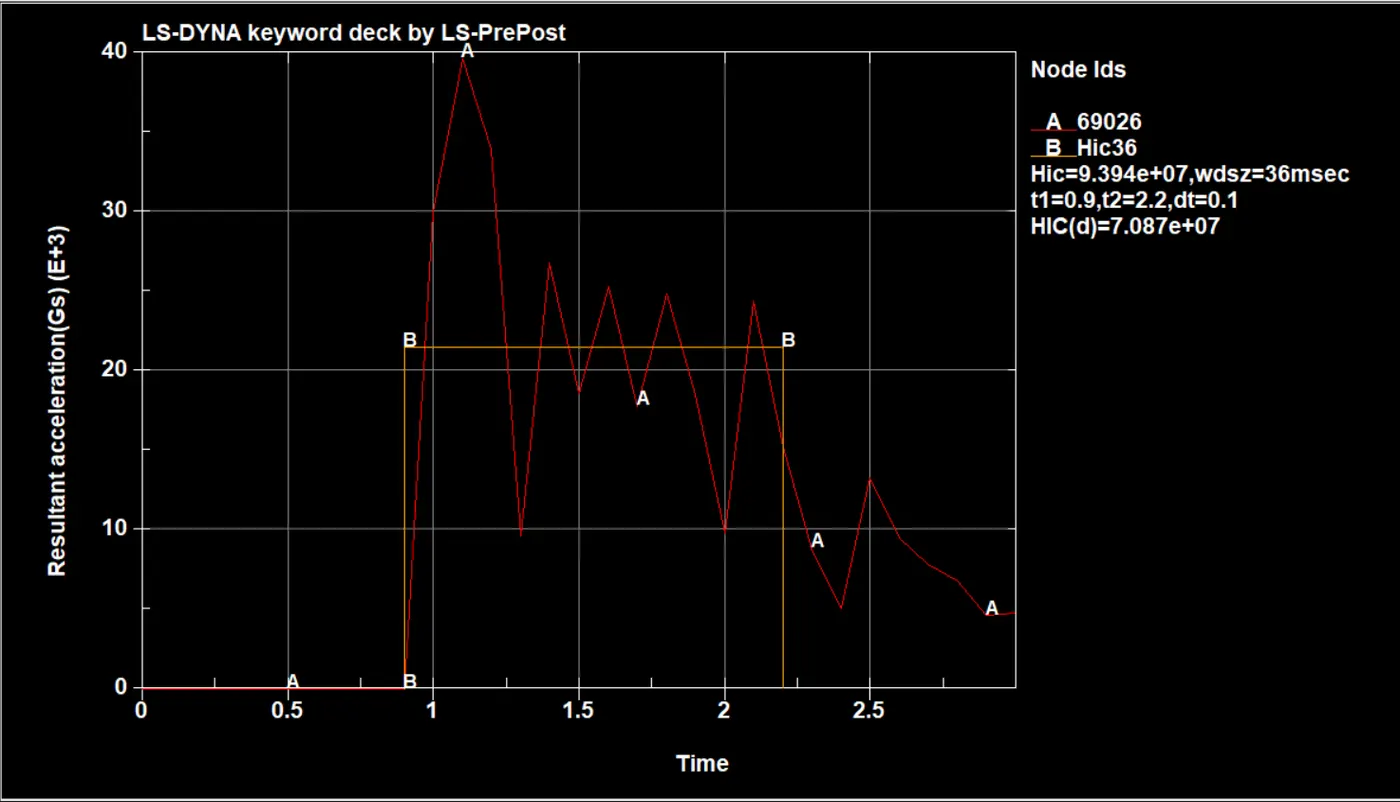
From the above graph we can see that HIC value is too much high from the normal that's because of the wall that head hitting is rigid so there's no chance for head to slow deaccelration.
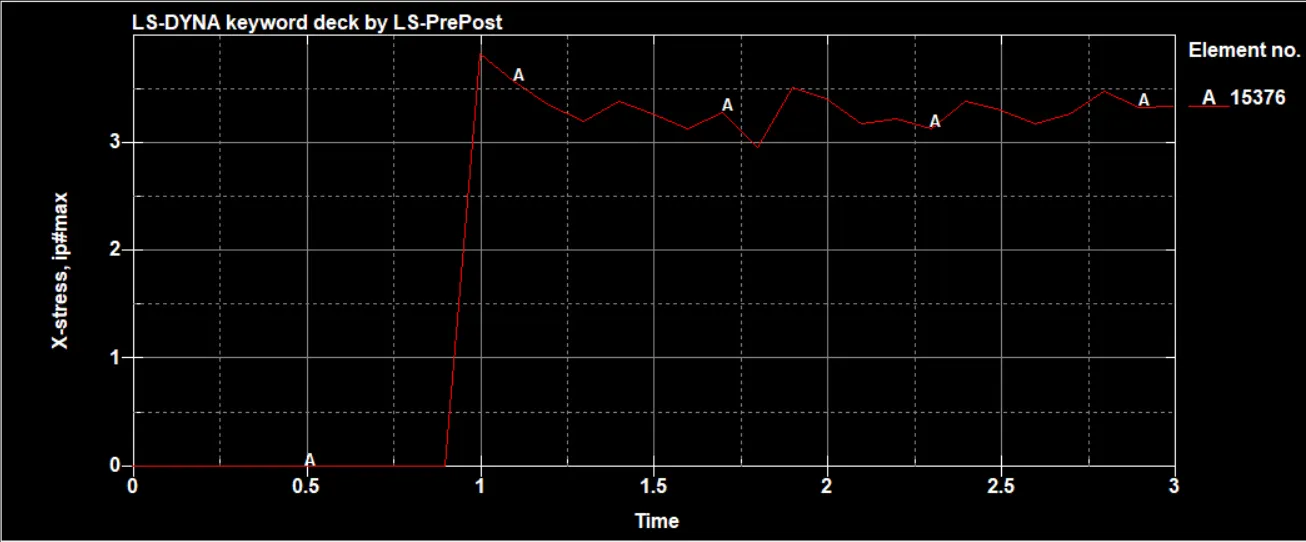
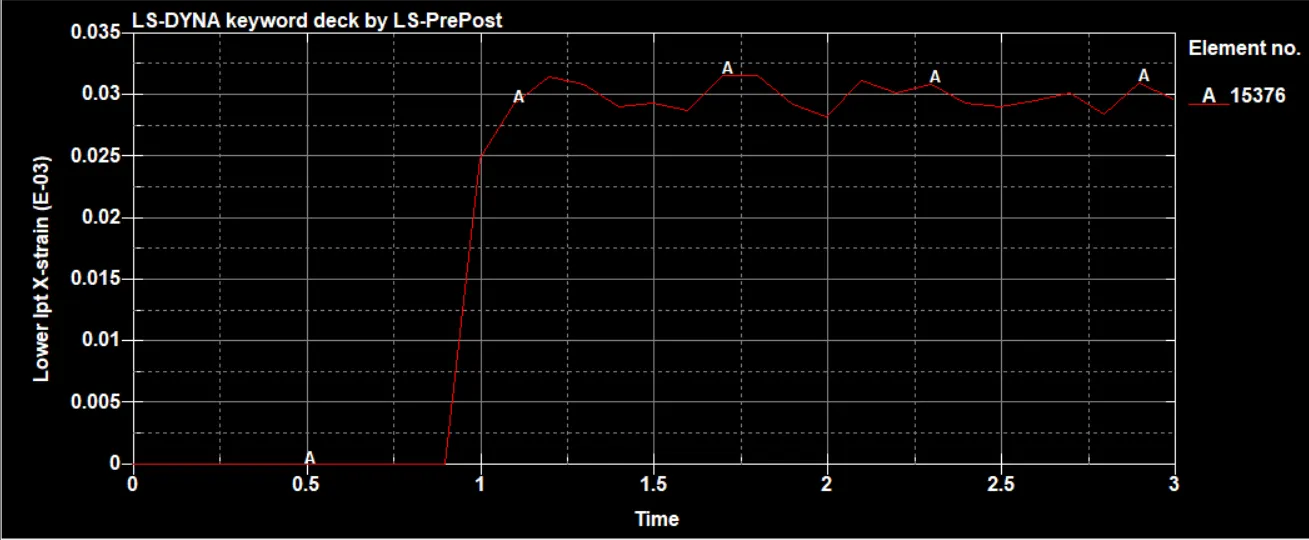
From the above graph we can see that stress is increasing at the time of impacting and becomes constant.
Case (ii) : Pedestrian head form model impacting against rigid wall
* Unlike the previous case the head form model is impacted against the rigid wall normally at any angle due to the round form of head so it doesn’t change anything but in this case the head is turned around 35 to 70 degree according to the requirement.
* So to rotate the head we need to include the keyword include transform and define transformation in a separate file.
* First, we need to open the LS-PREPOST then we need to DEFINE TRANSFORMATION using rotate option the head is turned for 45 degrees in Y direction. And using INCLUDE TRANSFORM the transformation id is selected and filename which is just a normal head form is selected and save this with a new name then we need to close this file and we need to open again where we can see the head rotated with 45 degree with all the details of head.
* As the details of head contains everything, we just need to give the rigid wall, velocity and contact.
* For RIGIDWALL PLANNER we just need to create the rigid wall below the head with around 10mm distance.
* For INITIAL VELOCITY we just need to give the value of velocity of -15.11 mm/ms on z axis.
* For CONTROL TERMINATION end time is given as 20ms.
* Database ascii option, binary d3plot, extent binary options are used to get the required outputs.
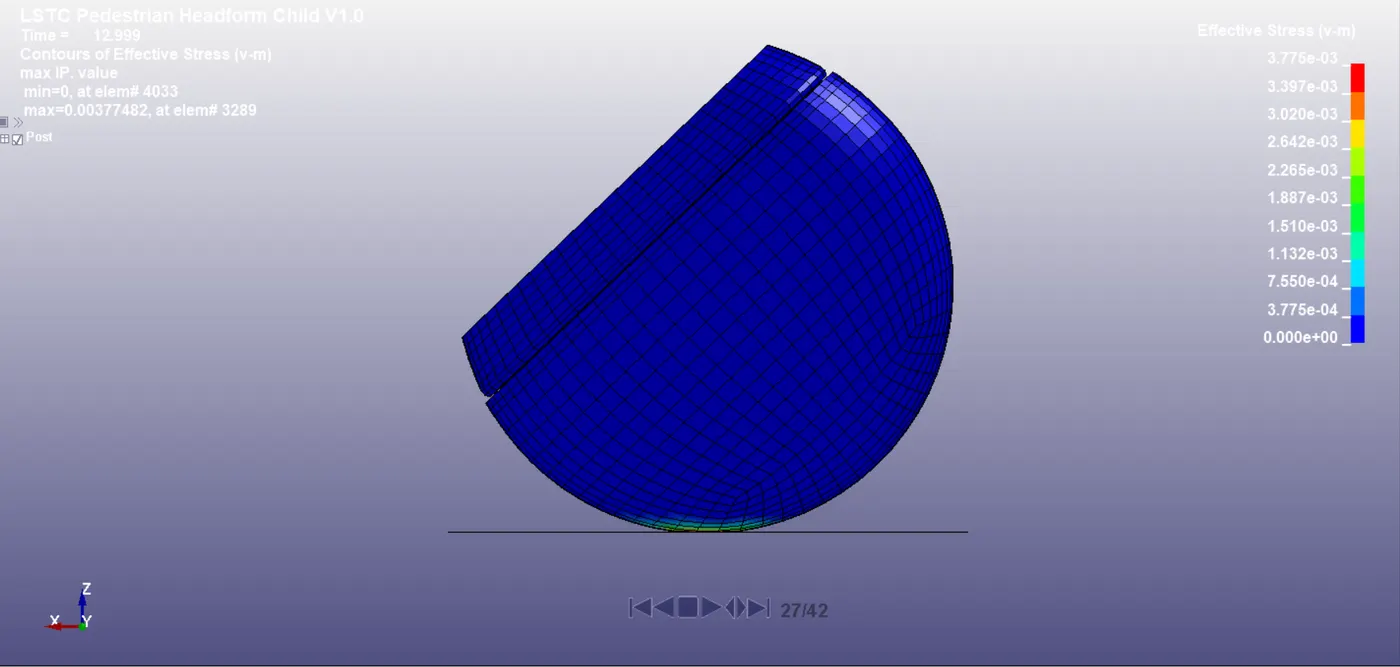
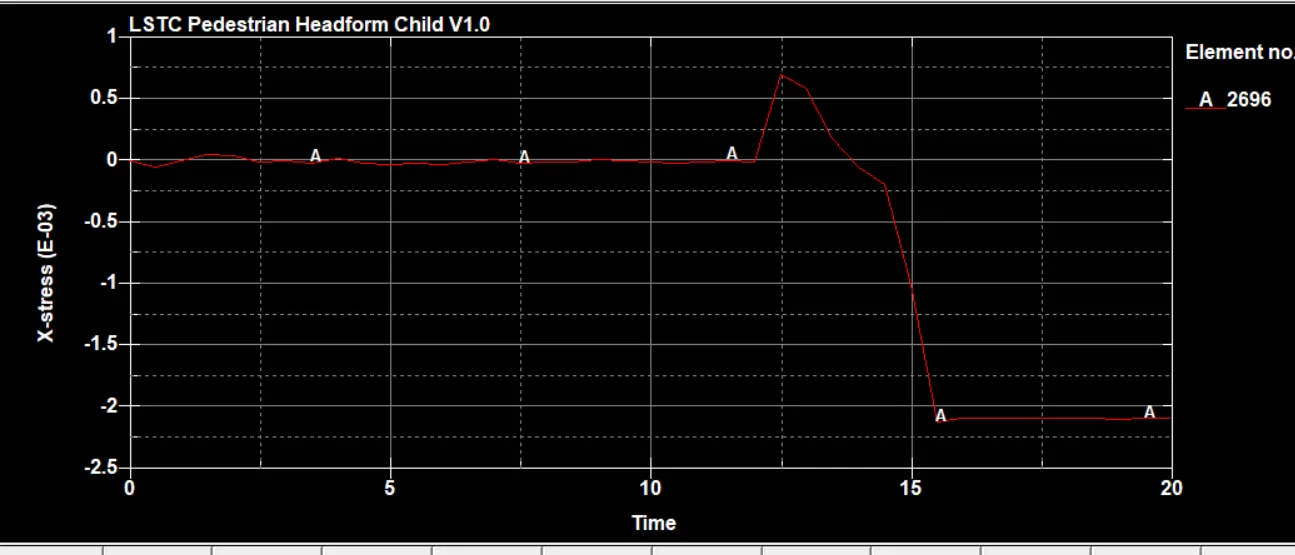
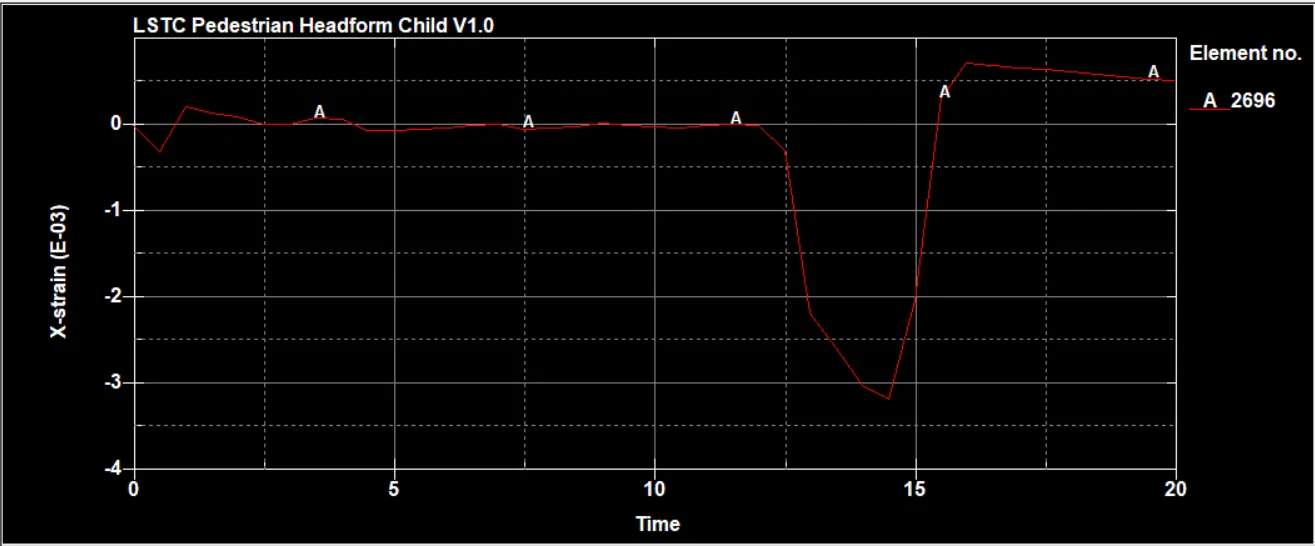
From the above graphs we can see the x-stress and x-strain
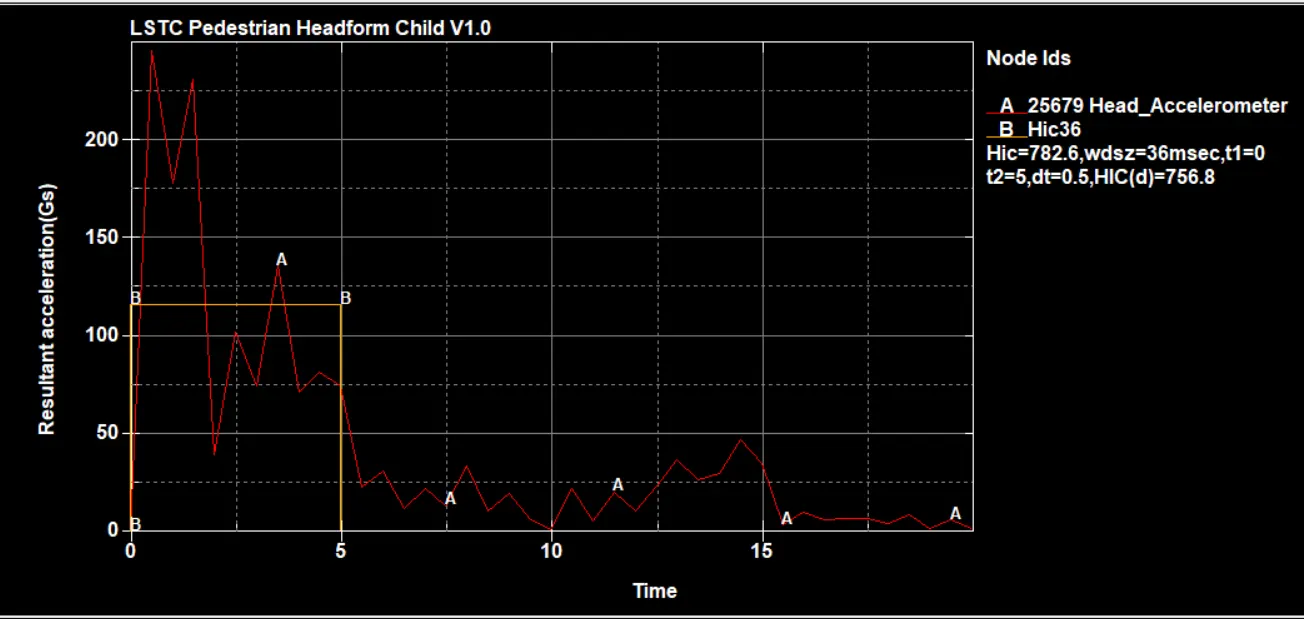
From the above graph we can see that HIC value is 782 which is slightly better of normal value 650 and also the deacceleration of the head is slow compared to case (i)
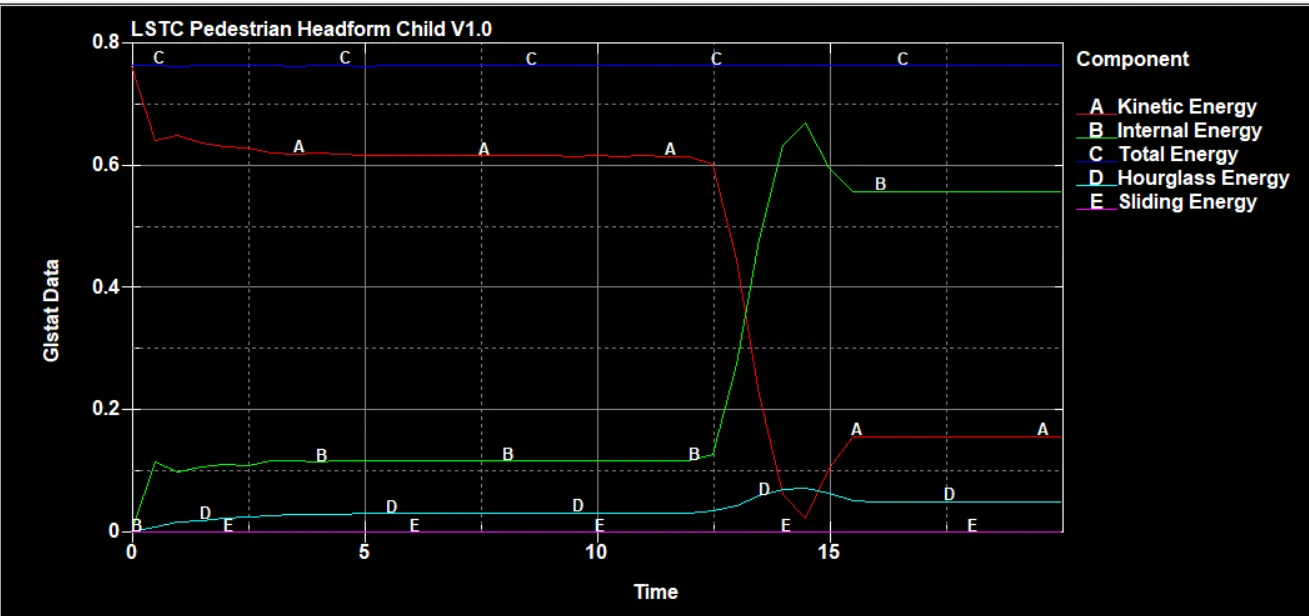
Above graph shows the Energy plots
Case (iii) : pedestrian head form model impacting against Hood
* Same as second case where we need to include the file within the file but in this case, we don’t need to create the new file where we just need to edit with the meshed hood file where just the include transform and define transformation keywords are included.
* As the details of head contains everything, we just need to give the boundary, velocity, control and contact.
* For contact automatic surface to surface hood is given as slave set and head is given as master set.
* For INITIAL VELOCITY we just need to give the value of velocity of -20 mm/ms on z axis.
* For CONTROL TERMINATION end time is given as 40ms.
* Database ascii option, binary d3plot, extent binary options are used to get the required outputs.
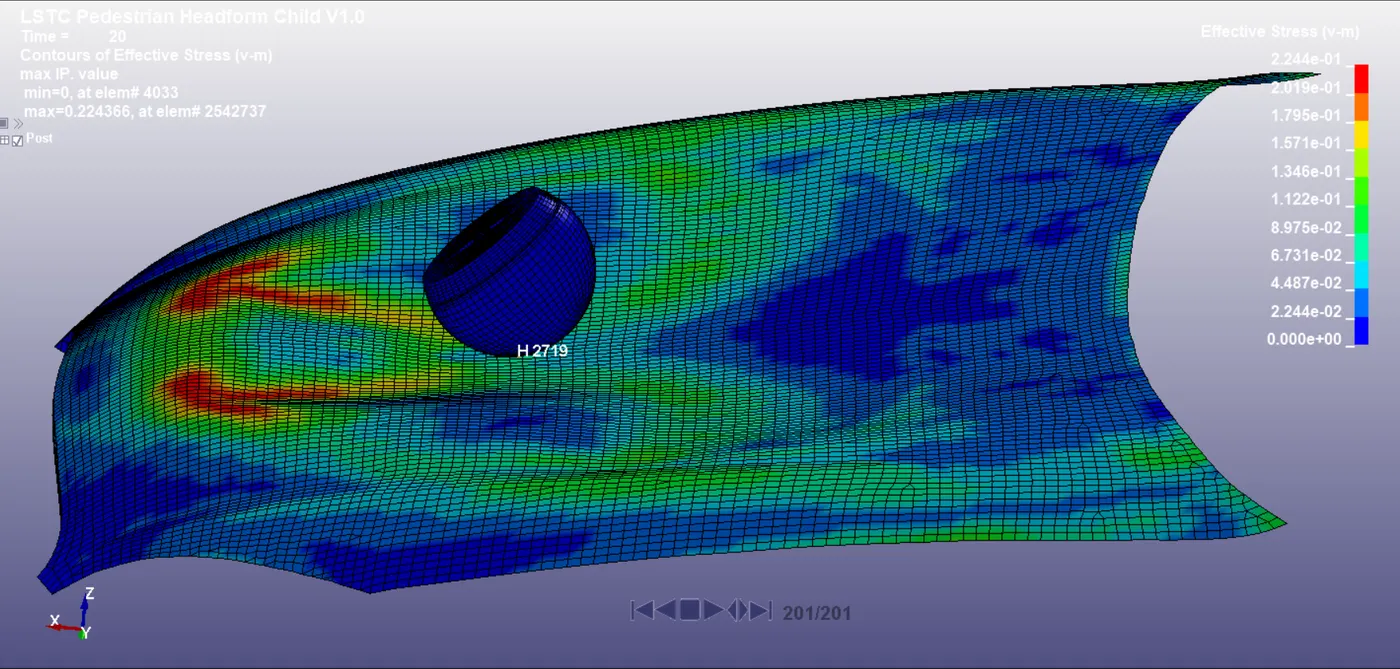
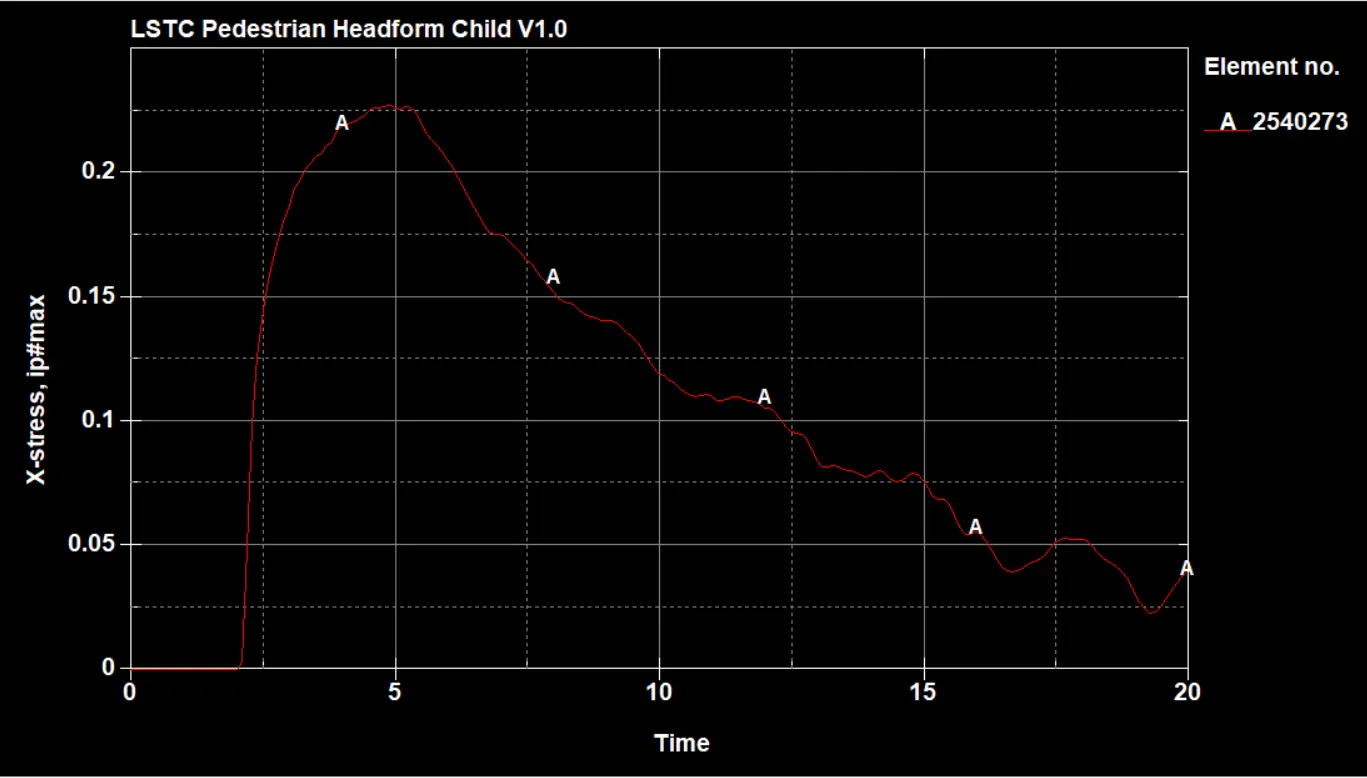
From the above graph we can see the stress on hood where at the time of impact it suddenly rises and it gradually decreses due to the sliding of the head after impact
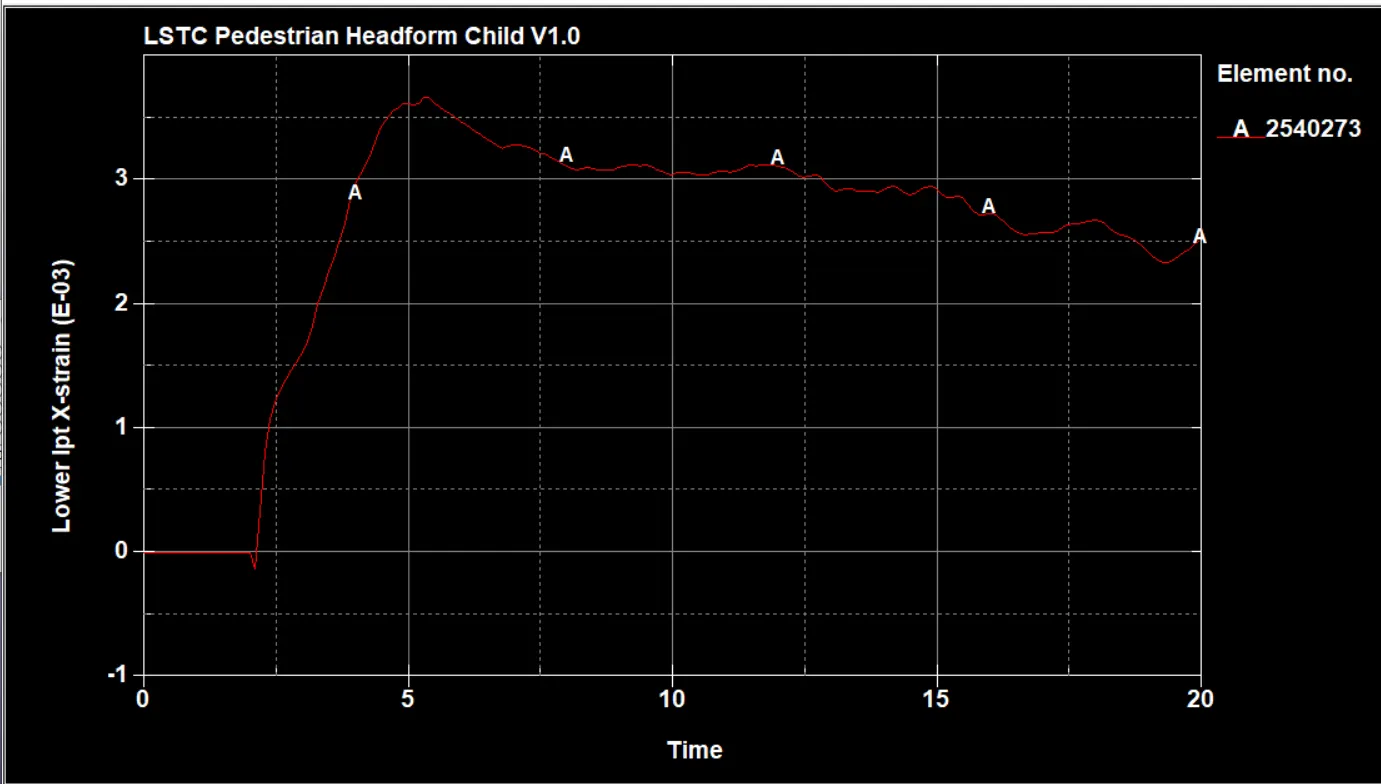
From the above graph we can see that strain is increasing at the time of impact and it gradually decreses due to the sliding of the head after impact
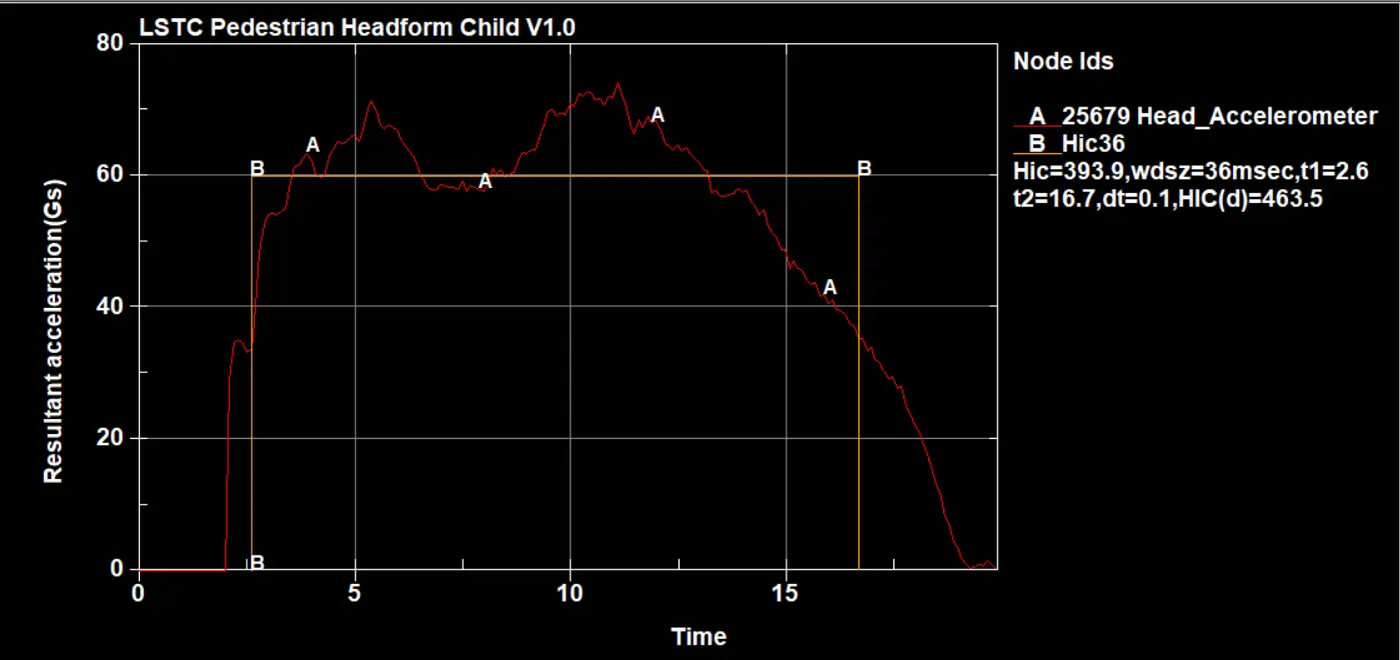
From the above graph we can see the HIC value where it is very low then normal which is actually good and why the value is low because the hood material where it is elastic material so the deacceleration is very slow.
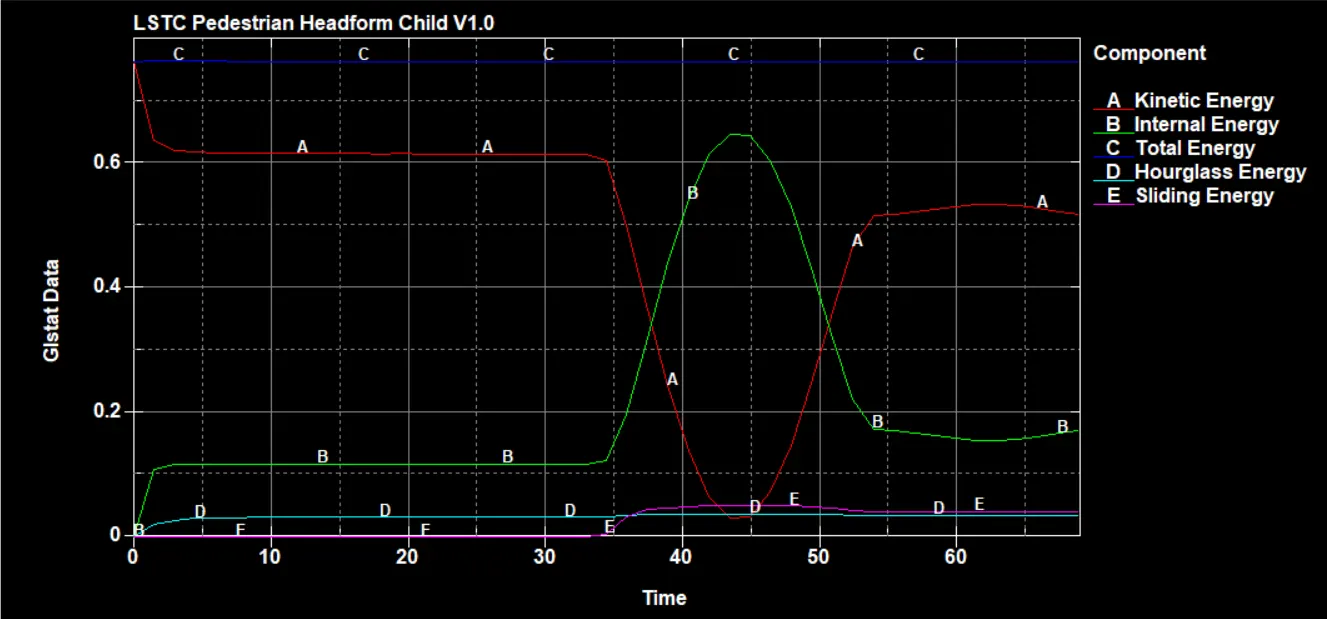
From the above graph we can see the energy graphs.
Conclusion :
Case (i) : Simple head model impacting against rigid wall.
In this case the HIC value is too much high that's because there is no deformation of the wall and so head which is made up of the normal elastic material impacted on the rigid wall will bounce back so that creates the fast deacceleration.
Case (ii) : Pedestrian head form model impacting against rigid wall.
In this case the standard model of Head Form is used so we can see the HIC value which is very low compared to case (i) that's because of the material used for the head.
Case (iii) : Pedestrian head form model impacting against Hood.
In this case the normal scenario which is happening in the day to day life where the pedestrian is hitted by the car so normally the head and legs are most vulnerable for damage where head is most important part of the human body so we need to protect the head of the pedestrian so head is hitting on the hood part of the car so we need to build the hood which is more elastic and it shoudn't harm much for the head so in this we can see the HIC value where it very low compare to all the above cases thats because of the slow deacceleration of the head.